6,638 m · the unclimbed peak Kora 53 km · 3 days Mansarovar bath · 4,600 m Saga Dawa · 18 Jun 2027 Permits only · guided travel
The wind never quite stops at Darchen. Prayer flags crack overhead, yak bells clink somewhere behind you, and to the north a dome of dark rock and clean snow stands apart from every ridge around it, so symmetrical it looks placed rather than formed. Beside you on the dusty path walk Hindus, Buddhists, Jains and Bonpos, some prostrating full length in the grit. No human being has ever stood on that summit. The world walks around it instead.
The one great peak humanity has agreed not to summit. No verified ascent exists, China has formally prohibited climbing since 2001, and the mountaineer Reinhold Messner, offered the chance, refused it, saying that to conquer this mountain would be to conquer something in people's souls.
Four living traditions hold the mountain holy at once: Hindus as the abode of Lord Shiva and Of Maa Parvati, Buddhists as Kang Rinpoche, mandala of the deity Demchok, Jains as Ashtapada, where Bhagwan Rishabhanatha attained moksha, and Bonpos as Yungdrung Gutseg, the nine story swastika mountain.
Four of Asia's great rivers rise within sixty kilometres of its slopes: the Indus, the Sutlej, the Brahmaputra and the Karnali, which reaches the Ganga as the Ghaghara. The waters of half a continent begin at this one axis.
The mountain the world walks around
In the Hindu telling, Kailash is the visible form of Meru, the axis on which the worlds turn. On its summit Lord Shiva sits in meditation without end, and With Him Abides Maa Parvati. On the high path below the Dolma La lies an emerald pool called Gauri Kund, and tradition holds that Maa Parvati Bathed there, Shaped a boy from the lather of Her Own Body, and Breathed life into him: the child who would receive an elephant's head and be worshipped as Ganesha.
Buddhists tell of the yogi Milarepa, who came here and was challenged by the Bon priest Naro Bonchung for mastery of the mountain. They agreed to race to the summit. Naro Bonchung rose slowly on his magic drum; Milarepa sat still in meditation until, at the last moment, he rode a ray of the rising sun to the top. He gave the Bonpos a neighbouring mountain out of compassion, and pilgrims still point to his footprint in the rock. For Bonpos the mountain remains Yungdrung Gutseg, seat of their founder Tonpa Shenrab's descent, and they walk its circle counterclockwise to this day.
For Jains this is Ashtapada, where Bhagwan Rishabhanatha, the first Tirthankara, attained moksha. And below all of it lies Mansarovar, the lake the scriptures say Brahma first made in his own mind, beside its dark twin Rakshastal. Buddhists add that Queen Maya bathed in Mansarovar before the Buddha's conception. One mountain, one lake, four doors into the same silence.
What you'll actually see
1
The north face from Dirapuk
The first day's walk up the Lha Chu valley ends at Dirapuk monastery, directly under the north face: a sheer wall of dark rock banded with horizontal ledges of snow, so close it fills the sky. Pilgrims sit on the moraine at dusk simply looking at it. This is the view that ends every argument about why the kora exists.
2
The Dolma La and Gauri Kund
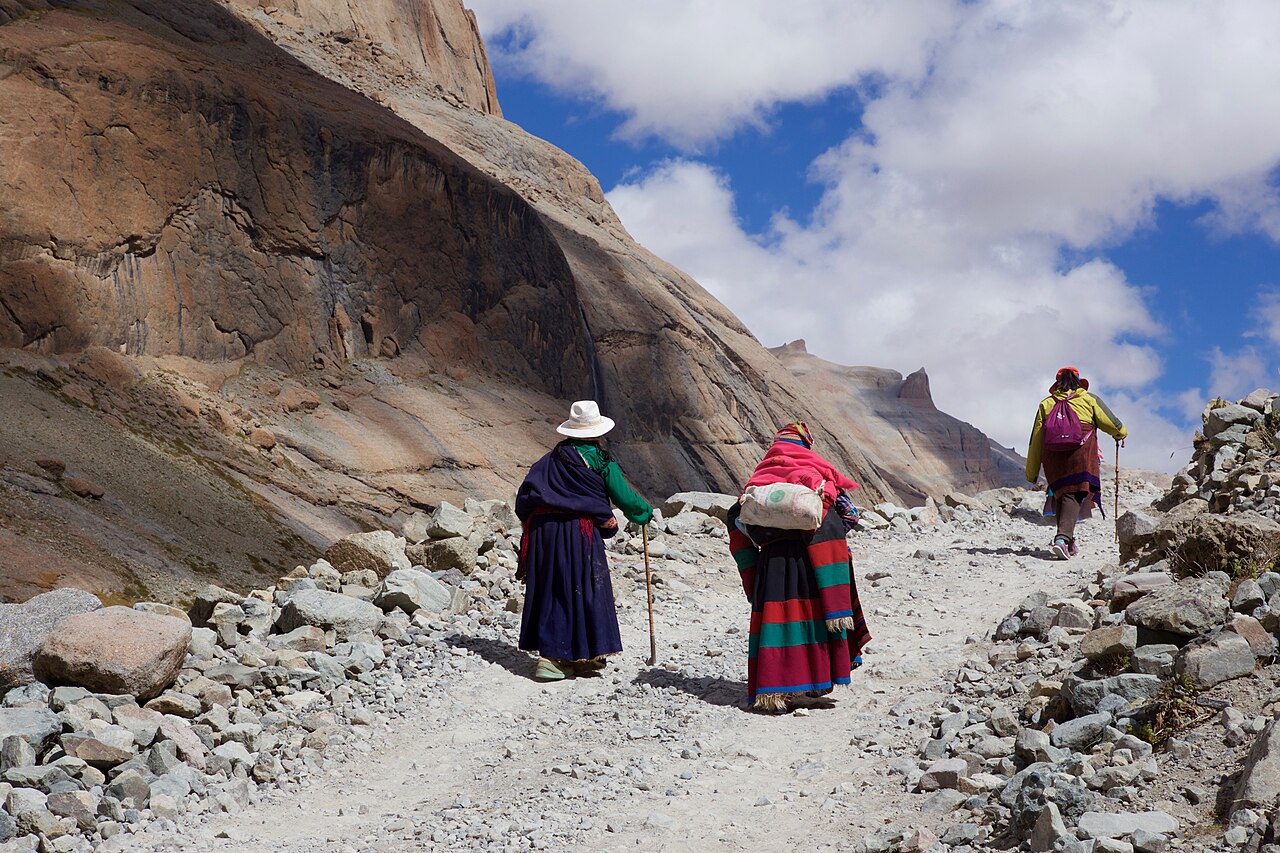
The second day climbs to the Dolma La at 5,650 m, the highest point of the kora, buried under decades of prayer flags where pilgrims leave a strand of hair, a tooth, or an old garment as a symbolic death. Just below the pass on the descent glints Gauri Kund at about 5,608 m, the green pool Where tradition says Maa Parvati Bathed.
3
Two lakes, one lesson
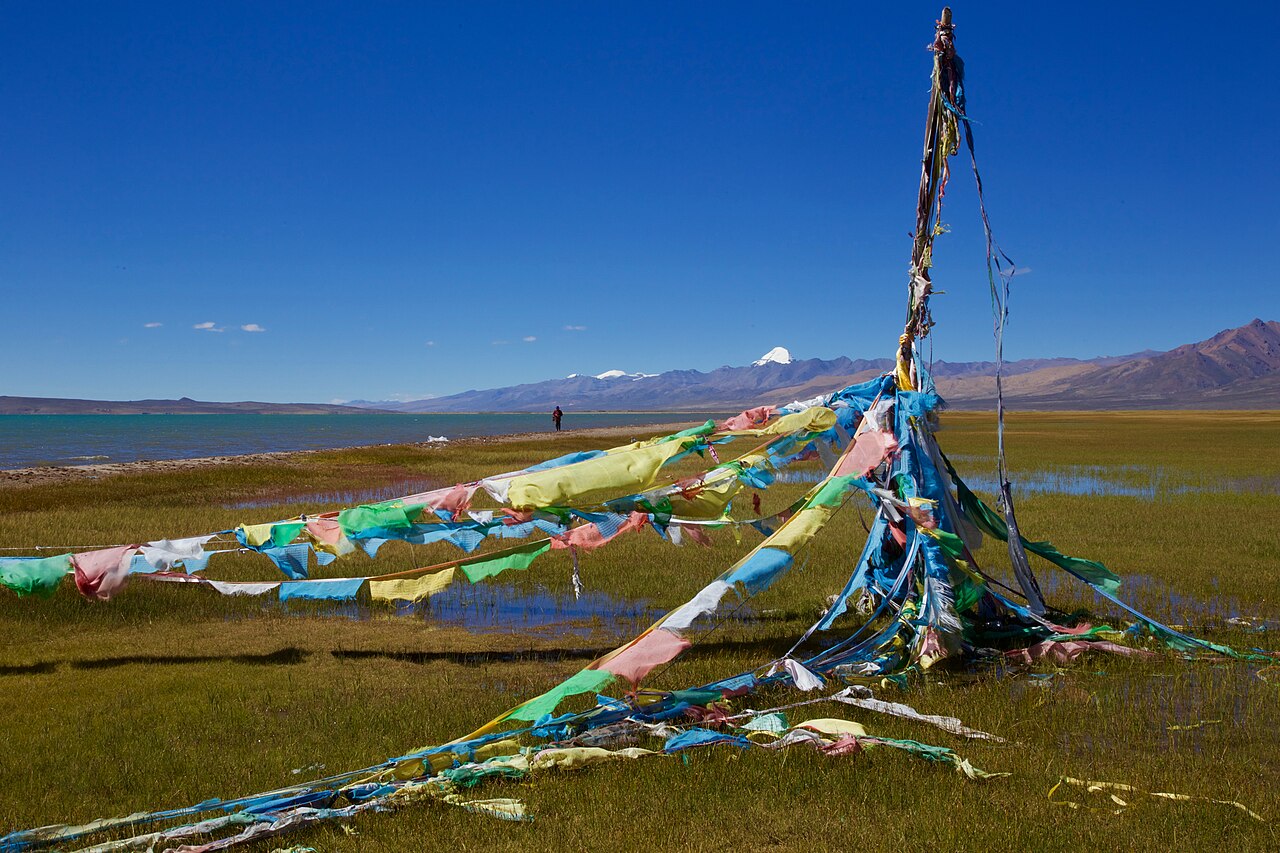
South of the mountain the freshwater of Mansarovar spreads 320 square kilometres at 4,600 m, ringed by an 88 km shoreline with the white walls of Chiu Gompa on a crag above it. Beside it lies salt water Rakshastal, linked by the natural Ganga Chhu channel, lake of light and lake of shadow side by side. Pilgrims bathe in one and only look at the other.
Prayer flags on the shore of Lake Mansarovar with the snow dome of Mount Kailash on the horizonTibetan pilgrims walking the high kora path around Mount Kailash
The mountain and the lake · photos Jean-Marie Hullot · CC BY-SA 4.0 · Wikimedia Commons
The festival found nowhere else
Saga Dawa: raising the great flagpole at Tarboche
On the full moon of the fourth Tibetan month, the month that holds the Buddha's birth, enlightenment and parinirvana, thousands gather on the Tarboche plain at the mouth of the kora valley. The towering flagpole is lowered, dressed in thousands of fresh prayer flags carried in by pilgrims, and hauled upright again while lamas chant and the crowd circles it. Tradition reads the pole as an omen: it must stand perfectly vertical for the year to be auspicious. The next Saga Dawa falls on 18 June 2027.
The kora is at its most crowded and most alive around Saga Dawa; permits, guides and lodging fill months ahead, so commit early.
Plan your visit
Getting there
Darchen (4,670 m), the kora gateway, is reached only overland: private pilgrims drive several days in from Kathmandu across the Nepal border, or from Lhasa across western Tibet. There is no independent travel; every foreign visitor comes with a licensed operator.
Permits
China requires a Tibet Travel Permit and supporting regional permits, arranged only through a registered tour operator. Factor weeks of lead time.
The official Indian yatra
India's Ministry of External Affairs runs the Kailash Mansarovar Yatra (kmy.gov.in) for Indian passport holders, selected by computerised draw. The 2026 season runs June to August in 20 batches of 50, via Lipulekh (about 22 days) and Nathu La (about 21 days); 2026 applications closed 19 May 2026.
Cost, honestly
Substantial. Indicative official 2026 estimates are about ₹2.09 lakh per pilgrim via Lipulekh and ₹3.31 lakh via Nathu La, plus a ₹5,000 confirmation fee; the MEA gives no subsidy. Private operator tours via Nepal are priced in the same serious range.
The kora
53 km around the mountain from Darchen, walked clockwise over 3 days: about 14 km to Dirapuk, about 19 km over the Dolma La to Zutulphuk, then back. Ponies and yaks can be hired; prostrating pilgrims take around three weeks.
At Mansarovar
The lake lies at 4,600 m with an 88 km shoreline circuit. Pilgrims take the holy bath and sip its water, which tradition holds absolves sin; yatra batches also circle the lake, a circuit of roughly 90 km.
Season
June to September is the pilgrimage window; snow closes the Dolma La for most of the rest of the year. Official Indian batches travel June to August.
Altitude and fitness
The entire pilgrimage lies above 4,500 m and the pass is 5,650 m. KMY pilgrims must clear mandatory medical tests in Delhi before departure; private pilgrims should train, acclimatize over several days, and carry altitude medication with medical advice.
Kang Rinpoche, the Tibetan name, means precious jewel of snow; Mansarovar joins Sanskrit manasa (mind) and sarovara (lake), the lake first formed in the mind of Brahma.
Hindus, Buddhists and Jains walk the kora clockwise while Bonpos walk it counterclockwise, so half the faces you meet on the path are coming toward you.
Tradition holds that the inner kora, the 34 km circuit past the Nandi ridge toward Ashtapada, is earned only after thirteen outer circuits.
Even in high summer the weather turns fast: snow can fall on the Dolma La in July and nights drop to freezing, so full winter layers travel with you.
Questions pilgrims ask
Can I climb Mount Kailash?
No. There is no verified ascent in history, and after a Spanish expedition sought permission in 2001 the Chinese authorities declared all climbing on the mountain strictly prohibited. All four traditions agree the summit is not for human feet; the pilgrimage is the circle, never the climb.
How hard is the kora, honestly?
It is 53 km at extreme altitude: the path never drops below Darchen's 4,670 m and crosses the Dolma La at 5,650 m. A fit, acclimatized walker does it in three days, ponies and yaks can be hired, and yatra batches build in rest days, but altitude sickness is a real risk and turning back is honourable.
How do I join the official Indian yatra?
Apply online at kmy.gov.in when the window opens; selection is by computerised draw, open only to Indian citizens holding Indian passports, with mandatory medical tests in Delhi. Applications for 2026 closed on 19 May 2026, so watch the portal for the next season.
Can non-Indians or private pilgrims go?
Yes. Pilgrims of any nationality travel through licensed tour operators, most commonly overland from Kathmandu, on Chinese permits arranged by the operator. Independent travel in this part of Tibet is not permitted.
What happens at Lake Mansarovar?
Pilgrims bathe at the shore and take the water, which tradition holds cleanses the sins of lifetimes; many also circle the lake, visit Chiu Gompa on its northwest crag, and keep a bottle of the water for shrines at home. Its salt water twin Rakshastal is honoured with distance, not a dip.
Dharamshalas and guest houses near this Sthan, shared by devotees. Adisthan takes no bookings and no money; contact each stay directly.
No stays are listed here yet. Know one that serves pilgrims well?
No single custodian holds Kailash; if you serve pilgrims here, keep a monastery on the kora, or organize the yatra, claim this page and keep its facts true for the devotees who follow.