
Dongbaoxing Road Gurdwara
Gurdwara Shanghai · Shanghai Gurdwara · North Sichuan Road Gurdwara · Yindu Miao (印度庙)
About
Standing on what was once Tung Pao-hsing Road in Shanghai's Hongkou District, the Dongbaoxing Road Gurdwara represents one of the most remarkable chapters in the global story of the Sikh diaspora. Erected on land granted by the Shanghai Municipal Council, the two-storey, south-facing structure was raised from red brick into a rectangular form spanning roughly 1,500 square metres. Nineteen broad steps, each two metres wide, led visitors up to an arched wooden doorway, beyond which two further arched entrances opened onto a spacious interior hall. A sacred rostrum occupied the rear centre of that hall, where the Guru Granth Sahib, the living scripture of Sikhism, was installed and honoured.
Local Chinese residents knew the gurdwara by the affectionate name Yindu Miao, literally 'Indian Temple', a recognition of how visibly the Sikh congregation had woven itself into the fabric of the neighbourhood. The building served not merely as a place of congregational worship but as a community anchor: granthis (Sikh scripture-readers and priests) were brought from India to lead sacraments, mediate disputes, and maintain the rhythms of daily devotion. Festivals such as Vaisakhi and Guru Nanak Gurpurab were observed with processions and celebration, drawing hundreds of Sikh policemen, watchmen, and ordinary members of the congregation.
Today the building endures as a protected immovable cultural relic under the stewardship of the Hongkou District Government, even as it serves as housing for several Chinese families and accommodates a community health clinic. Surrounded now by high-rise towers and the elevated Line 3 of the Shanghai Metro, the structure has aged considerably, yet it remains a rare and tangible trace of a Sikh presence in East Asia that stretched across more than half a century.
History
The Sikh community of Shanghai laid the foundation stone on 11 August 1907, on land granted by the Shanghai Municipal Council, and opened the completed gurdwara in July 1908 with a procession that carried the Guru Granth Sahib from Louza police station behind a town band. For decades it served Sikh policemen, watchmen, and traders under British colonial administration, with granthis brought from India to lead worship and mediate the community's disputes, and it survived bombing during the Second Sino-Japanese War when neighbouring buildings did not. After the Second World War the Sikh community of Shanghai dwindled rapidly, and by the early 1970s its last two remaining members, both dairy traders, had left the city, ending the building's active life as a gurdwara. The Hongkou District Government designated it an immovable cultural relic on 16 December 2003, though the building today houses several Chinese families and a community health clinic rather than any congregation.
Significance
The gurdwara is a rare material witness to the Sikh diaspora's reach into East Asia in the early twentieth century, and in August 1909 it was the site of the first recorded Chinese-Sikh interfaith marriage, when a Pudong-born woman baptised as Gursharan Kaur married Jagjit Singh in an Anand Karaj ceremony before the Guru Granth Sahib. It is not an active place of worship today, and the site is not open for pilgrimage or public devotion, its protected status resting on historical and architectural memory rather than a living congregation.
Architecture
Colonial-era red brick construction with a stepped gable roofline, designed by public works architect R. C. Turner; a two-storey rectangular hall originally fronted by nineteen steps
Visiting
Hours
Hours not listed.
Contact
No contact details listed yet.
Engage with Dongbaoxing Road Gurdwara
Through the four pathways
Seva सेवा — Service
Offer your time and skills here. The following opportunities are open at Dongbaoxing Road Gurdwara:
No Seva offerings listed yet.
Sādhana साधना — Practice
Learn the worship and practice associated with Dongbaoxing Road Gurdwara:
No Sādhana offerings listed yet.
Sandhāna सन्धान — Wisdom
Unite with the wisdom of this tradition:
No Sandhāna offerings listed yet.
Sādhya साध्य — Giving
Support this sacred place according to your means:
No Sādhya offerings listed yet.
All giving flows directly to Dongbaoxing Road Gurdwara. Adisthan does not take a commission.
Gallery
Related sacred places
 Sikhism
Central Sikh Temple
Singapore · Singapore · gurdwara
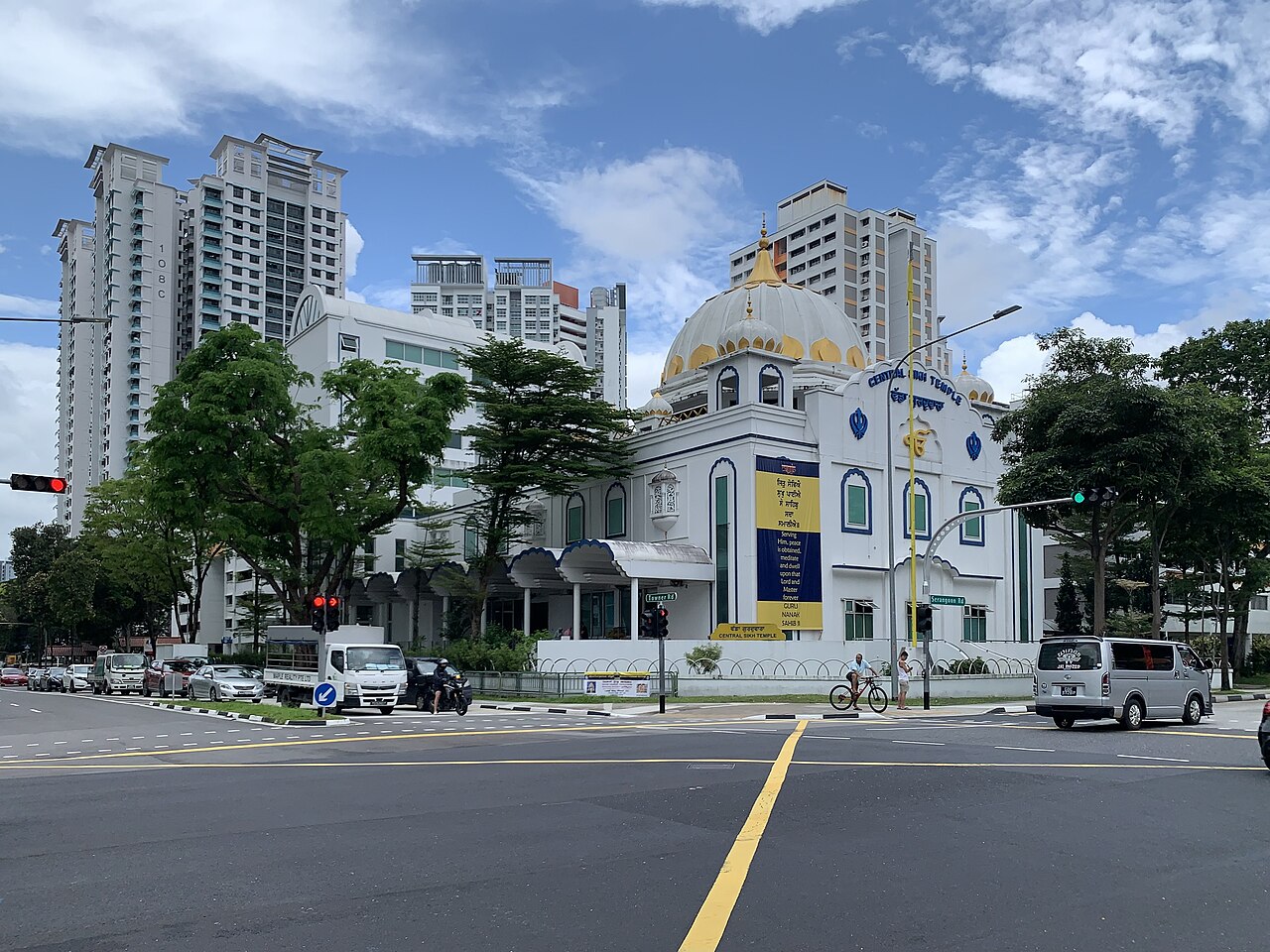
At the junction of Towner Road and Serangoon Road in Kallang, the Central Sikh Temple is Singapore's principal gurdwara, its gold-crowned dome rising over a congregation whose roots in the city reach back to 1912. A seven-storey community building stands beside it, carrying the gurdwara's life beyond the prayer hall into daily service and learning.
 Sikhism
Gurdwara Baba Atal
Amritsar · India · gurdwara
A nine-storey gurdwara rising beside the Kaulsar sarovar in Amritsar, a short walk south of Sri Harmandir Sahib, built in memory of Baba Atal Rai Ji, the young son of Guru Hargobind Sahib.
._Painting_at_Gurdwara_Bal_Leela_Sahib%2C_Sri_Patna_Sahib.jpg%2F1280px-Painting_of_Guru_Gobind_Singh_in_their_Bal_Saroop_(child_form)._Painting_at_Gurdwara_Bal_Leela_Sahib%2C_Sri_Patna_Sahib.jpg&w=3840&q=75) Sikhism
SikhismGurdwara Bal Lila Maini Sangat
Patna · India · gurdwara
A small gurdwara in a quiet lane of Patna Sahib, marking the household of Raja Fateh Chand Maini, where the child Guru Gobind Singh Ji often sat in the queen's lap and shared her simple offering of boiled, salted gram.
 Sikhism
Gurdwara Beri Sahib
Sialkot · Pakistan · gurdwara
A gurdwara in Sialkot, Pakistan, built beside the berry tree under which Guru Nanak Dev Ji is said to have rested and met the Sufi saint Hamza Ghaus.
 Sikhism
Gurdwara Dukh Nivaran Sahib
Patiala · India · gurdwara
A gurdwara in Patiala whose sarovar is held to carry healing grace, raised where Guru Tegh Bahadur Ji rested beneath a banyan tree in 1672 and eased the suffering of the village of Lehal.
 Sikhism
Gurdwara Fatehgarh Sahib
Fatehgarh Sahib · India · gurdwara
The gurdwara at Fatehgarh Sahib marks where the two youngest sons of Guru Gobind Singh Ji were martyred in December 1705, and the ground that Diwan Todar Mal bought with gold coins so that they could be cremated with dignity.