
Gurdwara Dukh Nivaran Sahib
Gurdwara Dukhniwaran Sahib · Gurdwara Sri Dukh Nivaran Sahib
About
Gurdwara Dukh Nivaran Sahib rises from what was once the village of Lehal, now absorbed into the expanding city of Patiala. Its very name, Dukh Nivaran, meaning 'eradicator of suffering', encodes the story at its heart: when the ninth Sikh Guru, Guru Tegh Bahadur, paused here beneath a banyan tree beside a quiet pond, the mysterious illness that had long afflicted the village's people began to lift. That moment of grace on the fifth day of Magh's bright fortnight in Bikram Samvat 1728 gave the site its enduring name and its enduring purpose.
The complex unfolds across several acres, revealing itself in layers as one enters. A two-storey gateway, its floor laid in black-and-white marble, opens onto a pathway where a small marble shrine to the left quietly marks the exact spot of the Guru's rest under the ancient banyan. Beyond it, the principal hall stands on a raised plinth, its corners anchored by octagonal domed chambers and its roofline crowned by a pinnacled lotus dome ringed by curved sun-windows. Decorative pavilions and carved lotus blossoms adorn the parapet above. Inside, white and grey marble paving covers the floor; the same stone, in white, panels the walls and pillars. Stucco floral work graces the ceiling, and the Guru Granth Sahib rests under a square canopy at the hall's far end.
The rectangular sarovar, considerably enlarged over the decades, lies to the right of the entrance, while Guru ka Langar occupies the opposite side. The Shiromani Gurdwara Parbandhak Committee administers the complex today. Gatherings swell here on the fifth day of every lunar month's bright half, and Basant Panchami draws the largest annual assembly, marking the anniversary of Guru Tegh Bahadur's compassionate visit.
History
A jhivar of Lehal named Bhag Ram sought out Guru Tegh Bahadur Ji at Saifabad and asked him to visit the village, whose people had long suffered a mysterious illness. The Guru came to Lehal on Magh Sudi 5, Bikram Samvat 1728, corresponding to 24 January 1672, and rested under a banyan tree beside a pond. The sickness lifted, and the spot became known as Dukh Nivaran, the reliever of suffering. Raja Amar Singh of Patiala later laid out a memorial garden here under the care of Nihang Sikhs, and in 1920 the banyan tree was spared when workers refused to fell it for a proposed railway line, leading Maharaja Bhupinder Singh to cancel the project outright. The present gurdwara was built between 1930 and 1942 under Maharaja Yadavindra Singh, and passed in time to the care of the Shiromani Gurdwara Parbandhak Committee.
Significance
Devotees hold that the waters of the sarovar carry the same healing grace Guru Tegh Bahadur Ji brought to Lehal, and many come to bathe in and drink from them, especially on the fifth day of each lunar month's bright fortnight. Basant Panchami is kept here with particular devotion each year, marking the anniversary of the Guru's visit, and for pilgrims who arrive carrying illness or grief, the gurdwara's name still stands as a living assurance that suffering can be met within the shelter of the Guru's presence.
Architecture
SGPC-era Punjabi gurdwara architecture completed in 1942: a domed pavilion on a raised plinth with an octagonal domed chamber at each corner, white and grey marble facing throughout, and a pinnacled gold lotus dome
Visiting
Hours
Hours not listed.
Contact
No contact details listed yet.
Engage with Gurdwara Dukh Nivaran Sahib
Through the four pathways
Seva सेवा — Service
Offer your time and skills here. The following opportunities are open at Gurdwara Dukh Nivaran Sahib:
No Seva offerings listed yet.
Sādhana साधना — Practice
Learn the worship and practice associated with Gurdwara Dukh Nivaran Sahib:
No Sādhana offerings listed yet.
Sandhāna सन्धान — Wisdom
Unite with the wisdom of this tradition:
No Sandhāna offerings listed yet.
Sādhya साध्य — Giving
Support this sacred place according to your means:
No Sādhya offerings listed yet.
All giving flows directly to Gurdwara Dukh Nivaran Sahib. Adisthan does not take a commission.
Festivals & Events
- Feb
Basant Panchami
11 February 2027 · annual
Marked at Dukh Nivaran Sahib with particular devotion each year, Basant Panchami falls on the anniversary of Guru Tegh Bahadur Ji's 1672 visit to Lehal, the day tradition holds the village's long affliction lifted.
Gallery
Related sacred places
 Sikhism
Central Sikh Temple
Singapore · Singapore · gurdwara
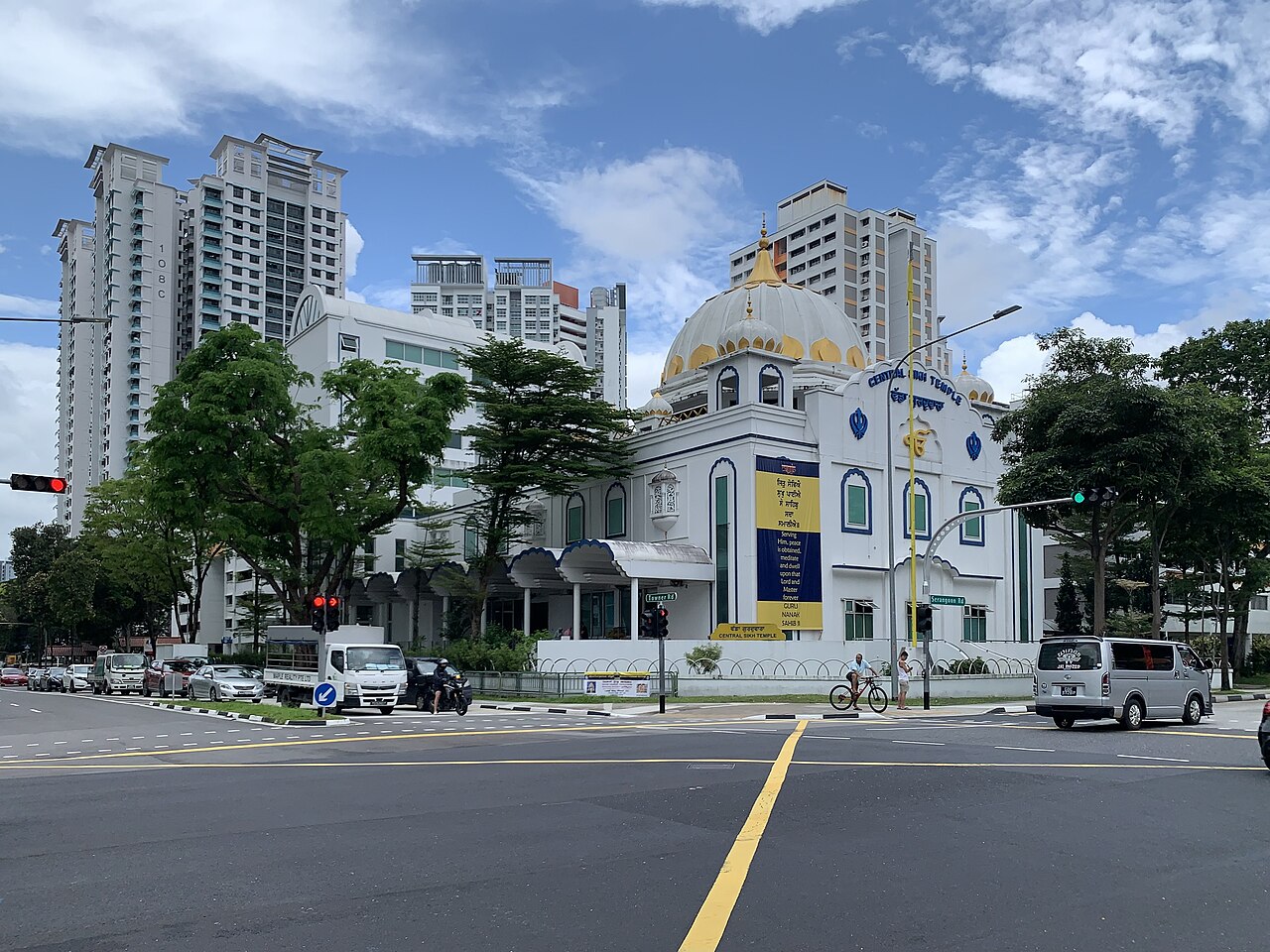
At the junction of Towner Road and Serangoon Road in Kallang, the Central Sikh Temple is Singapore's principal gurdwara, its gold-crowned dome rising over a congregation whose roots in the city reach back to 1912. A seven-storey community building stands beside it, carrying the gurdwara's life beyond the prayer hall into daily service and learning.
 Sikhism
Dongbaoxing Road Gurdwara
Shanghai · People's Republic of China · gurdwara
A red brick building in Shanghai's Hongkou District that served as a Sikh gurdwara from 1908 into the early 1970s, now protected as a cultural relic though it has stood deconsecrated, closed to worship, and repurposed as housing and a community clinic for more than fifty years.
 Sikhism
Gurdwara Baba Atal
Amritsar · India · gurdwara
A nine-storey gurdwara rising beside the Kaulsar sarovar in Amritsar, a short walk south of Sri Harmandir Sahib, built in memory of Baba Atal Rai Ji, the young son of Guru Hargobind Sahib.
._Painting_at_Gurdwara_Bal_Leela_Sahib%2C_Sri_Patna_Sahib.jpg%2F1280px-Painting_of_Guru_Gobind_Singh_in_their_Bal_Saroop_(child_form)._Painting_at_Gurdwara_Bal_Leela_Sahib%2C_Sri_Patna_Sahib.jpg&w=3840&q=75) Sikhism
SikhismGurdwara Bal Lila Maini Sangat
Patna · India · gurdwara
A small gurdwara in a quiet lane of Patna Sahib, marking the household of Raja Fateh Chand Maini, where the child Guru Gobind Singh Ji often sat in the queen's lap and shared her simple offering of boiled, salted gram.
 Sikhism
Gurdwara Beri Sahib
Sialkot · Pakistan · gurdwara
A gurdwara in Sialkot, Pakistan, built beside the berry tree under which Guru Nanak Dev Ji is said to have rested and met the Sufi saint Hamza Ghaus.
 Sikhism
Gurdwara Fatehgarh Sahib
Fatehgarh Sahib · India · gurdwara
The gurdwara at Fatehgarh Sahib marks where the two youngest sons of Guru Gobind Singh Ji were martyred in December 1705, and the ground that Diwan Todar Mal bought with gold coins so that they could be cremated with dignity.