Tepeyac Hill · Villa de Guadalupe, Mexico City, Mexico
Am I not here, I who am your mother?
Be the first to check in
Coming up: Feast of St. Juan Diego Cuauhtlatoatzin · 9 DecEntry tended 11 Jul 2026
Open daily 6 am to 9 pm Entry free Feast of Guadalupe · 12 December Las Mañanitas at midnight, 11 to 12 Dec Circular basilica · dedicated 1976
Drums reach you first, out on the vast stone plaza: matachines dancers in feathered headdresses, turning to a rhythm older than the city around them. Pilgrims cross the Atrio de las Américas on their knees, roses cradled in their arms. Ahead a green copper roof sweeps up like a great tent, and inside, a slow moving walkway carries you beneath a small framed cloth. This image was not painted in Europe and shipped across the sea. Tradition holds it appeared on the cloak of an Indigenous man, and it has never left.
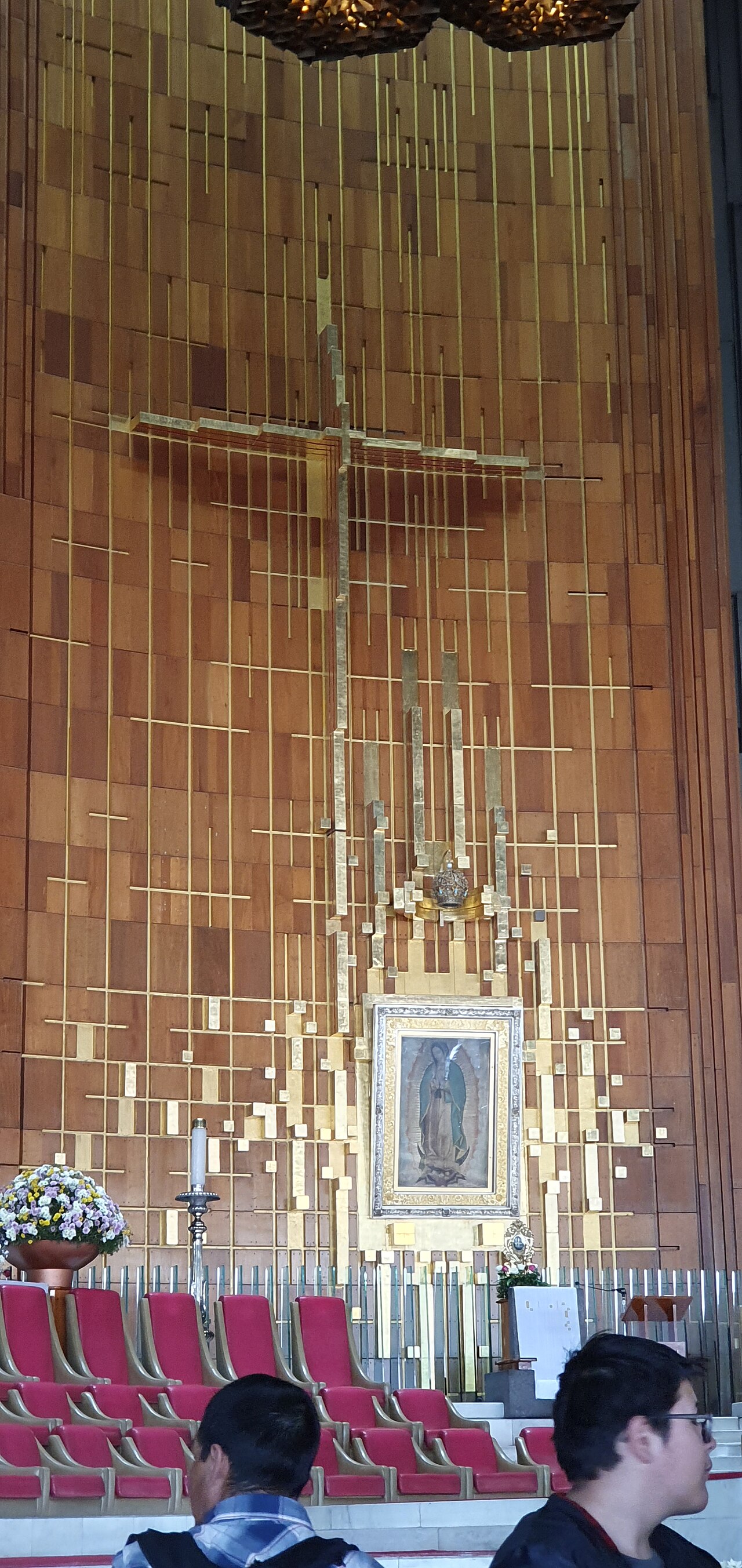
Above the main altar hangs the tilma of St. Juan Diego, a cloak of woven agave fiber bearing the image of Our Lady, imprinted, tradition holds, before the Bishop of Mexico on 12 December 1531. Cloth like this frays within decades; this piece is approaching five hundred years.
This is the most visited Marian shrine in the world. Some twenty million pilgrims come each year, and for the feast of 12 December alone the city prepares for ten million or more in a single week.
On Tepeyac hill Our Lady spoke to Juan Diego in Nahuatl, his own tongue, and left an image threaded with Indigenous signs. Mexico calls her La Morenita, the dark-skinned mother of the Mexican people, and Juan Diego became the first Indigenous saint of the Americas.
The roses of Tepeyac
In December 1531, ten years after the fall of the Aztec capital, an Indigenous convert named Juan Diego Cuauhtlatoatzin was walking to Mass before dawn. As he passed the hill of Tepeyac he heard birdsong pouring from the summit, and on the height stood a lady who spoke to him in Nahuatl. I am the perfect ever Virgin Holy Mary, Mother of the true God, she said, and asked that a Temple be built for her there. Bishop Juan de Zumárraga listened kindly to the peasant in his rough cloak, and asked for a sign.
On Tuesday 12 December, hurrying to fetch a priest for his dying uncle, Juan Diego skirted the hill. The Lady came down to meet him. Am I not here, I who am your mother, she asked, and told him his uncle was already healed. She sent him to the summit, where roses were blooming out of frozen December ground. He gathered them into his tilma, and when he opened it before the bishop the flowers fell away and the image of Our Lady stood on the cloth. The Nahuatl account of these days is the Nican Mopohua, and his uncle told how the Lady wished to be called the ever Virgin Holy Mary of Guadalupe.
Chapel rose upon chapel at the foot of the hill. The great basilica of 1709 slowly sank and tilted into the soft bed of the old lake, so the architect Pedro Ramírez Vázquez raised the present circular basilica beside it, and the tilma was carried across on 12 October 1976. Beneath it, on 31 July 2002, Pope John Paul II canonized Juan Diego, the first Indigenous saint of the Americas.
What you'll actually see
1
The Atrio de las Américas and the leaning old basilica
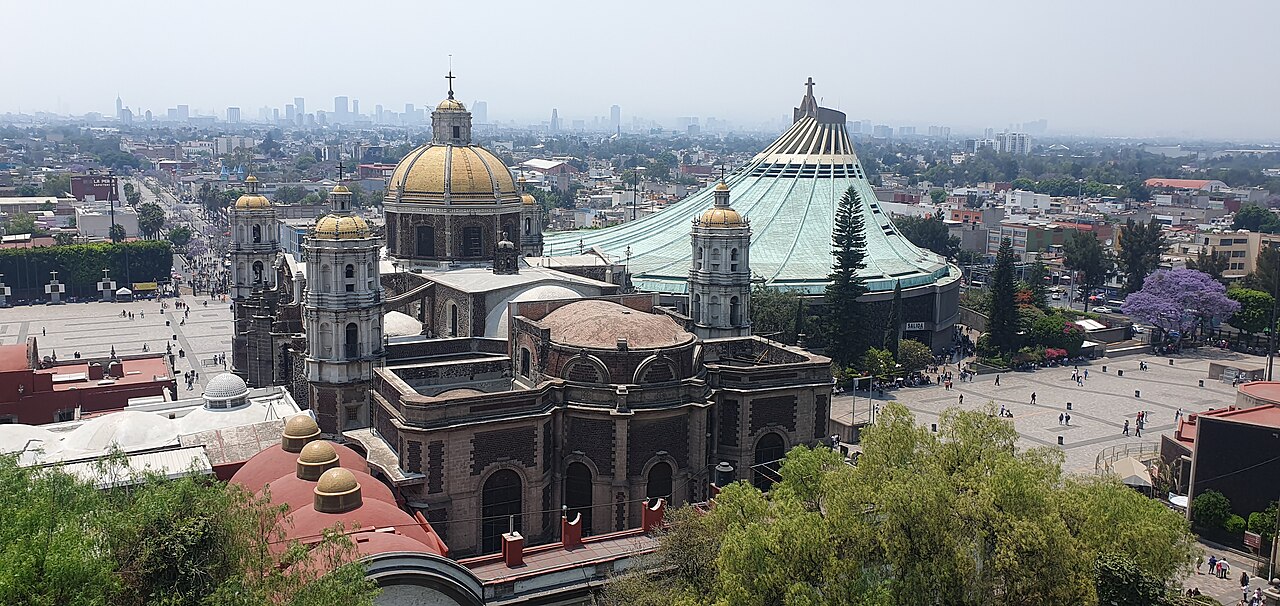
The immense paved atrium gathers the whole sanctuary: chapels, gardens, and the domed Baroque basilica of 1709, which leans visibly where its foundations settled into the lakebed. It closed for a generation, was rescued with control piles, and reopened in 2000 as the Templo Expiatorio a Cristo Rey, with Mass offered once more.
2
The tilma above the golden wall
Inside the new basilica a vast wall of wood and gold rises behind the altar, a crucifix streaming down it like light. Beneath the cross, in a frame, hangs the tilma itself. Moving walkways glide below the sanctuary floor so that every pilgrim passes directly under the image without a crowd ever standing still.
3
The Capilla del Cerrito and the gardens of Tepeyac
A stepped path climbs the hill of the apparitions through terraced gardens to the Capilla del Cerrito, the little chapel marking where Our Lady met Juan Diego and where the roses were gathered. From the top, the domes of the old basilica and the green tent-roof of the new one spread out against the whole valley of Mexico.
The tilma of St. Juan Diego framed beneath the cross on the gilded altar wall of the new basilicaThe old and new basilicas of Guadalupe and the plaza seen from the top of Tepeyac hill
The Sacred Image above the main altar, and the sanctuary seen from Tepeyac hill · photos CC BY-SA 4.0 José Luiz, Wikimedia Commons
THE NIGHT FOUND NOWHERE ELSE
Las Mañanitas to La Morenita · 11 to 12 December 2026
For days before the feast the roads into Mexico City fill with walkers, cyclists and torch runners carrying images of the Virgin home to her house. By the night of 11 December millions are camped across the atrium, and at midnight the basilica sings Las Mañanitas, the Mexican birthday serenade, to Our Lady with mariachis, while matachines dance troupes drum and turn in the plaza until dawn. Masses follow through the whole of 12 December. For the 2025 feast the city authorities prepared for between ten and twelve million pilgrims.
Streets around the Villa close and the crowds are immense; arrive days early to walk with the pilgrims, or keep to another week if you seek quiet.
Plan your visit
By air
Mexico City International Airport (MEX), roughly 10 km away by road; taxi time swings widely with city traffic.
By metro
La Villa-Basílica station on Line 6, then under ten minutes on foot up Calzada de Guadalupe to the atrium.
Timings
Basilica open daily 6 am to 9 pm; Capilla del Cerrito on the hill 7 am to 6 pm.
Entry
Free: the basilica, the walkways beneath the tilma, the old basilica and the hill chapels ask no ticket.
Best time
Early on a weekday morning the walkways are almost empty; Sunday noon, the Cardinal's Mass, is the fullest hour of the week.
Seeing the tilma
The moving walkways run whenever the basilica is open. There is no queue to pay and no time limit; step around and pass beneath the image as many times as you wish.
Dress
Ordinary modest church dress; hats off indoors, and keep voices low during the hourly Masses.
Masses are offered roughly every hour in the basilica from 6 am, with Lauds and the chapter's sung Mass mid-morning and a novena Mass at 6 pm.
The name Guadalupe, the apparition account says, was asked for by Our Lady herself, speaking to Juan Diego's healed uncle Juan Bernardino.
Early chroniclers, among them the Franciscan Bernardino de Sahagún, record that Tepeyac had long been a pilgrimage shrine of Tonantzin, our revered mother, in the Nahua world; pilgrims climbed this hill long before 1531.
In 1921 a bomb hidden in a flower arrangement exploded beneath the image; the altar was damaged, the tilma was not. The year 2026 marks fifty years since the new basilica's dedication on 12 October 1976.
Questions pilgrims ask
Is the image in the basilica the original tilma from 1531?
Yes. The framed cloth above the main altar is the tilma of St. Juan Diego itself, the agave-fiber cloak on which tradition holds the image appeared in 1531. The moving walkways beneath the sanctuary carry you directly under it, free of charge.
Do I need a ticket or a booking?
No. The basilica is open free every day from 6 am to 9 pm, Masses are offered roughly every hour, and the walkways beneath the tilma cost nothing. Even on 12 December entry is free; the only price is the crowd.
Which of the churches on the plaza is the basilica?
The sanctuary is a whole precinct. The great circular building with the green roof is the new basilica of 1976, where the tilma hangs. The domed Baroque church beside it is the old basilica of 1709, now the Templo Expiatorio a Cristo Rey, and the Capilla del Cerrito crowns the hill where the apparitions took place.
Can visitors who are not Catholic come?
Yes, everyone is welcome. It is a living shrine rather than a museum, so walk quietly, dress modestly, and expect Mass to be under way somewhere in the precinct at almost any hour.
Is it worth climbing the hill?
The climb to the Capilla del Cerrito is short, through terraced gardens, and it is the ground of the story itself: the chapel marks where Our Lady met Juan Diego and where the December roses were gathered. The view takes in the whole sanctuary and the valley of Mexico.
The Sthan in photographs
Darshan from afar
From the temple's own channels. Nothing loads until you press play.
Dharamshalas and guest houses near this Sthan, shared by devotees. Adisthan takes no bookings and no money; contact each stay directly.
No stays are listed here yet. Know one that serves pilgrims well?
Are you of the rectory or chapter of the Insigne y Nacional Basílica de Santa María de Guadalupe? Claim this page to keep Mass times, feast notices and the live transmission true for the pilgrims of La Morenita everywhere.