Open from 5:00 summer · 4:00 winter Free entry Holy Fire · 1 May 2027 Crusader church · dedicated 1149 Six communities · one Status Quo The Via Dolorosa ends here
The souk's noise funnels you into a small stone courtyard, and there it stops. One low Crusader doorway stands open; its twin was walled shut centuries ago. Inside, daylight gives way to candle-glow. Pilgrims kneel at a rose-red slab just past the threshold, pressing scarves and crosses to the stone. Lamps hang in constellations from every ceiling, and somewhere above, choirs keep their appointed hours in Greek, Latin, Armenian, Coptic, Syriac and Ge'ez. Under this single roof stand both Calvary and the empty tomb.
The two poles of the Christian faith stand about forty paces apart under one roof: the rock of Golgotha, where tradition holds Jesus was crucified, and the rock-cut tomb from which Christians believe He rose. When conservators lifted the Aedicule's marble in the 2016 to 2017 restoration, the original limestone walls of the burial cave were still standing within.
Six ancient communities share the church: Greek Orthodox, Latin (Franciscan), Armenian Apostolic, Coptic, Syriac and Ethiopian. Their balance is the Status Quo, fixed by Ottoman firmans of 1757 and 1852, under which nothing in the church may change without the consent of all. A cedar ladder resting on a facade cornice since the eighteenth century, the Immovable Ladder, is its quiet emblem.
Every dawn a Muslim custodian unlocks the church. The Joudeh family keeps the key and the Nuseibeh family opens the doors, a trust that tradition traces to Saladin's time in 1187, and one that all the Christian communities honor as part of the church's living order.
The tomb that outlived its destroyers
The Christians of Jerusalem remembered this spot so stubbornly that an emperor tried to bury it. Around 135 CE Hadrian filled in the old quarry and its rock-cut tombs and raised a Temple of Venus on the platform. Two centuries later that Temple became a map. When Constantine ordered it demolished in 326, tradition holds that his mother Helena came to Jerusalem and, beneath the rubble, found the wood of the True Cross itself. The builders cut the first-century tomb free of the hillside, raised a rotunda over it, and consecrated the great basilica on 13 September 335.
The church survived the Persian invasion of 614, but in 1009 the Fatimid caliph al-Hakim ordered it razed to the rock. Christendom shook, and slowly rebuilt: the Byzantine emperor Constantine IX Monomachos restored the rotunda by 1048, and the Crusaders who took the city in 1099 spent fifty years binding tomb, Calvary and chapels into one Romanesque church. They dedicated it on 15 July 1149, fifty years to the day after their conquest. It is essentially their building a pilgrim enters now.
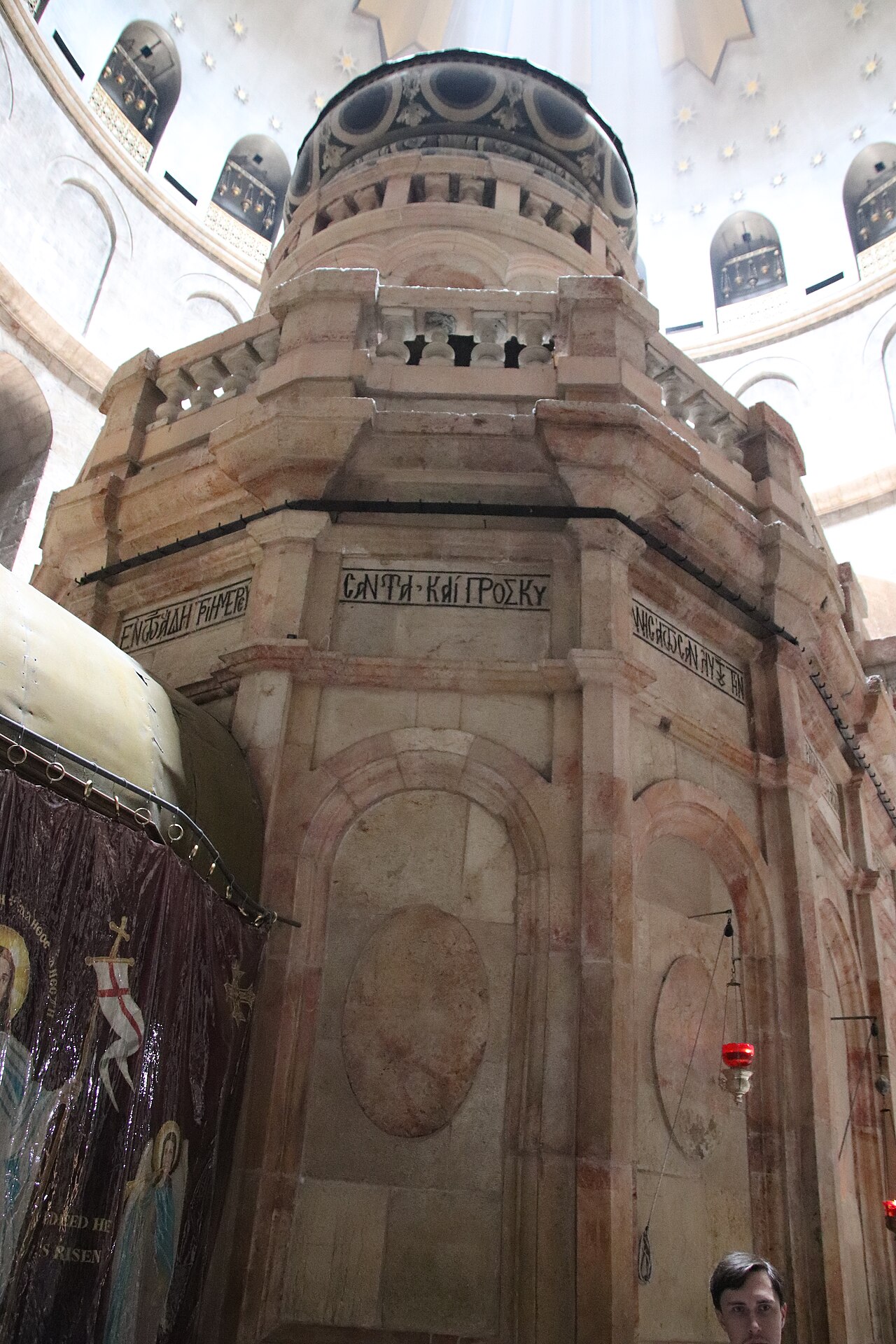
Fire gutted the rotunda in 1808, and the present Aedicule, the marble shrine over the tomb, was raised in 1810 to the design of Nikolaos Komnenos. Two centuries of candle smoke and iron bracing later, a team from the National Technical University of Athens restored it between May 2016 and March 2017, lifting the marble to reveal the tomb's original stone. The communities prayed at an ecumenical service when the scaffolding came down, and the church went on, as it always has.
What you'll actually see
1
The Stone of Anointing
The first thing every pilgrim meets, a few steps inside the door: a polished rose-hued slab commemorating the anointing of the body of Jesus before burial, with a row of lamps hanging above it from the communities that keep the church. Pilgrims kneel the whole day long to kiss it and to press cloths, candles and icons against the stone to carry its blessing home.
2
Calvary, up the worn stairs
Immediately right of the entrance a steep stone stair climbs to Golgotha, raised chapels built over the rock of the crucifixion. The Latin altar marks where tradition holds Jesus was nailed to the Cross, and beneath the Greek altar a silver disc rings the socket where the Cross stood; pilgrims kneel and reach through to touch the rock, which shows through glass on either side. Stations XI and XII of the Via Dolorosa are here.
3
The Rotunda and the Aedicule
At the heart of the church the Anastasis rotunda opens upward, its dome crowned with a sunburst of rays above the oculus. Beneath it stands the Aedicule, the two-chambered marble shrine over the tomb: first the Chapel of the Angel, then a doorway so low you bow to enter, and the burial bench itself, sheathed in marble, lit by lamps. A few pilgrims enter at a time while the queue circles the rotunda.
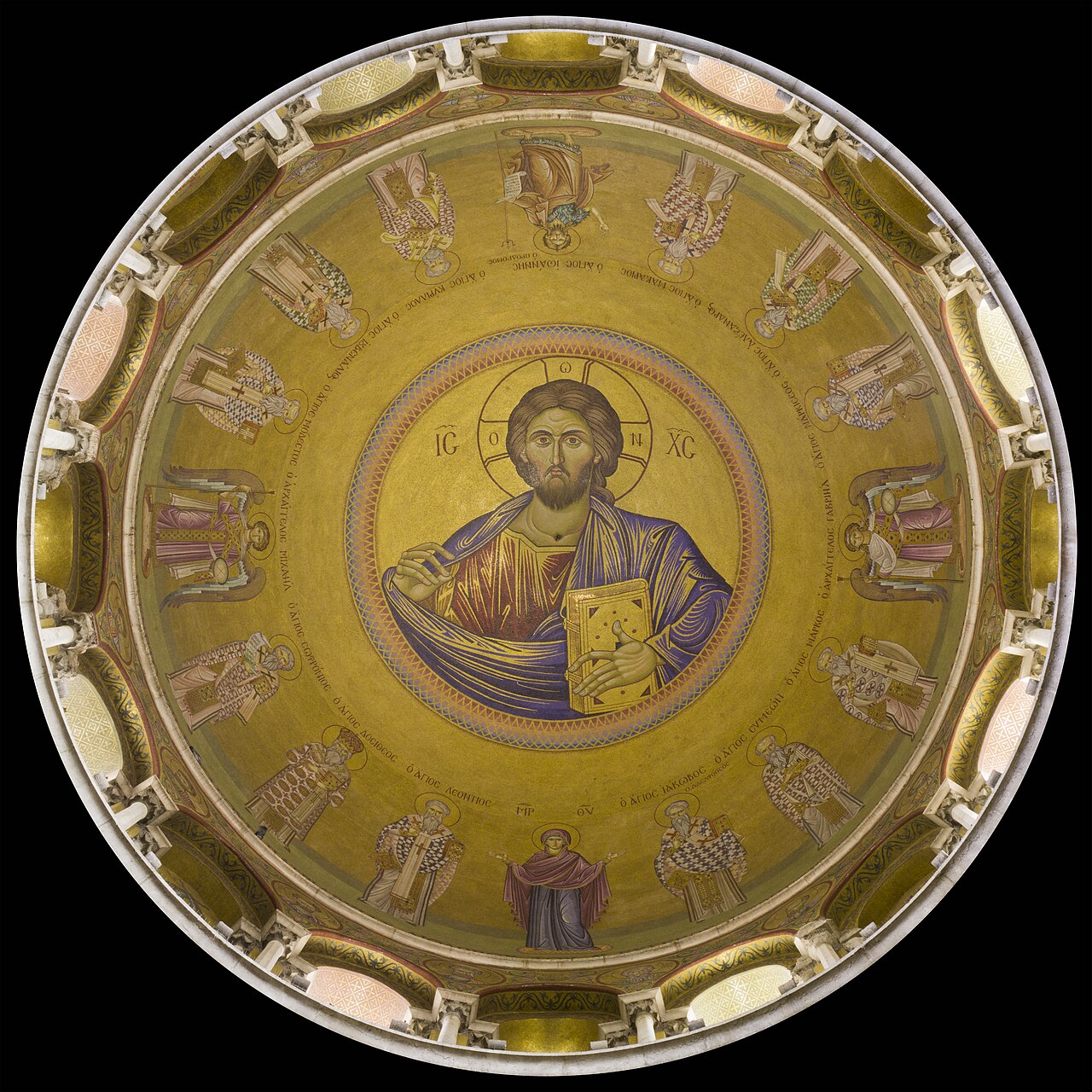
The restored Aedicule, the marble shrine over the tomb of Christ, beneath the rotunda of the Holy SepulchreChrist Pantocrator in the mosaic dome of the Catholicon, seen from directly below
The restored Aedicule, and Christ Pantocrator in the Catholicon dome · photos CC0 (Gary Todd) and CC BY-SA 4.0 (Godot13), Wikimedia Commons
THE FIRE THAT COMES OUT OF THE TOMB
The Holy Fire · Orthodox Holy Saturday, 1 May 2027
Once a year, on the Saturday before Orthodox Pascha, the church fills beyond its walls hours before midday. The Aedicule is inspected and sealed; the Greek Orthodox Patriarch of Jerusalem enters the tomb and kneels in prayer; and when he emerges holding two lit candles, fire passes hand to hand until thousands of candles blaze through the rotunda within minutes. Orthodox faithful receive it as a miracle, and pilgrims have described the rite for over eleven centuries: the monk Bernard the Wise recorded it in 867. The same day the flame is flown to Greece and other Orthodox lands to light the Paschal services. Orthodox Pascha follows at the church on 2 May 2027.
On Holy Fire day entry is tightly controlled and the church fills hours ahead; come that week only if you come for the rite itself, and follow the communities' published arrangements.
Plan your visit
By air
Ben Gurion Airport lies about 45 km northwest of Jerusalem; direct trains run to Jerusalem Yitzhak Navon station, then light rail or taxi toward the Old City walls.
Getting in
Enter the Old City at Jaffa Gate and follow David Street into the souk, then the signs to the Christian Quarter; the church stands between Christian Quarter Road and Suq Khan e-Zeit. The single door off the parvis courtyard is the only public entrance.
Timings
Summer (April to September) 5:00 to 20:45; winter 4:00 to 19:00; October closes at 20:00 and March at 19:30. On Christmas Day and 2 February the church opens at 8:00, and Holy Week runs on its own timetable.
Entry fee
Free. There is no ticket, and visitors of every faith are welcome.
Best time
The first hours after opening, when the communities' morning liturgies overlap, incense hangs in the rotunda, and the line for the tomb is shortest.
The queue
There is no timed ticketing. At busy hours the wait for the Aedicule can reach an hour or more, and far longer around Easter; only a few pilgrims enter the tomb at a time.
Dress
Modest dress for all: shoulders and knees covered. Keep voices low near the tomb and during the liturgies.
Eastern Christians do not call it the Sepulchre at all: to them this is the Anastasis, the Church of the Resurrection, named for the rising rather than the burial.
The cedar ladder beneath the right-hand facade window has stood there since the eighteenth century, first recorded in place by 1728; under the Status Quo nothing may be moved without the agreement of all six communities, so the Immovable Ladder stays.
The Via Dolorosa ends here: Station X is beside the entrance, Stations XI and XII are up on Calvary, XIII is at the Stone of Anointing area, and XIV is the tomb itself.
The daily opening and closing of the doors is a ritual of its own, performed by the Muslim custodian families with a ladder passed through a hatch; arrive at opening time to watch it.
Questions pilgrims ask
Is this really the place of the crucifixion and the tomb?
The church stands inside today's walls, but in the first century this ground lay just outside the city wall, in a disused quarry that held rock-cut tombs. Jerusalem's Christians venerated the spot so persistently that Hadrian buried it under a Temple around 135 CE, and it was that Temple Constantine's builders removed in 326 to find the tomb. The 2016 to 2017 restoration confirmed the original limestone cave walls still standing inside the Aedicule. Some Protestant pilgrims also venerate the Garden Tomb north of the walls; the oldest continuous tradition of the church rests here.
Who is in charge of the church?
No single community. Under the Status Quo, an arrangement fixed by Ottoman firmans of 1757 and 1852, the Greek Orthodox, the Latins (represented by the Franciscan Custody of the Holy Land) and the Armenian Apostolic Church hold the principal custody, while the Coptic, Syriac and Ethiopian churches hold chapels and rights of use. Every space, lamp and hour of worship is allotted, and nothing changes without the consent of all.
Why do Muslim families open the doors?
By a trust that tradition traces to Saladin's time in 1187. The Joudeh family keeps the key, and the Nuseibeh family unlocks and opens the doors each morning and closes them each night. The arrangement gives the shared church a neutral doorkeeper, and the Christian communities honor it as part of the sanctuary's living order.
Can visitors of other faiths enter?
Yes. Entry is free and open to all, every day of the year. Dress modestly, keep voices low, and step aside when the communities' processions and liturgies pass; the church remains a working place of worship around the clock.
What is the Holy Fire?
The rite of Orthodox Holy Saturday, when the Greek Orthodox Patriarch enters the sealed Aedicule and emerges with lit candles, and the flame spreads across the whole church within minutes. Orthodox faithful receive it as a yearly miracle from the tomb; written accounts of the rite go back to the ninth century. In 2027 it falls on 1 May.
Darshan from afar
From the temple's own channels. Nothing loads until you press play.
Dharamshalas and guest houses near this Sthan, shared by devotees. Adisthan takes no bookings and no money; contact each stay directly.
No stays are listed here yet. Know one that serves pilgrims well?
Do you serve one of the communities of the Holy Sepulchre, the Custody of the Holy Land, or the Patriarchates that keep this church? Claim this page to keep its hours and feasts exact for every pilgrim who seeks the empty tomb.