Beneath the dome no one knew how to build, Florence laid its flower at the feet of Our Lady.
Be the first to check in
Coming up: Feast of the Annunciation and Dedication of the Cathedral · 25 MarEntry tended 25 May 2026
Visits Mon to Sat 10:15 am to 3:45 pm Cathedral free · Passes 15€ to 30€ Mass daily · Sundays given to worship Scoppio del Carro · Easter morning Gothic · consecrated 1436 Largest masonry dome in the world
You come at it down a narrow street, and it does not arrive gradually: the marble wall is suddenly there, white from Carrara, green from Prato, red from Siena, patterned like the side of an enormous reliquary. Above the rooftops swells the terracotta mountain of the dome, eight white ribs converging on a marble lantern. Inside, the nave is vast, cool and strangely bare, until you look up into the octagon and the painted heavens open. Florence built this church for Our Lady of the Flower, and the flower is the city itself.
Brunelleschi's dome, raised between 1420 and 1436 without wooden centering, is still the largest masonry dome in the world: two shells of stone and herringbone brick, 45.5 metres across on the inside, crowned by a lantern whose own weight locks the structure in place.
The cathedral is dedicated to Our Lady as Santa Maria del Fiore, St. Mary of the Flower: the flower is the lily of Florence. It was consecrated by Pope Eugenius IV on the feast of the Annunciation, 25 March 1436, the day the old Florentine calendar began its year.
It stands in a single sacred ensemble with the octagonal Baptistery of St. John, older than the cathedral itself and hung with Ghiberti's gilded Gates of Paradise, and with Giotto's marble bell tower. The whole square lies within the Historic Centre of Florence, a UNESCO World Heritage Site since 1982.
The church that waited a century for its dome
In 1296 Florence resolved to replace its small early Christian cathedral of Santa Reparata with a church worthy of the city's ambition. The first stone was laid on 8 September 1296 and the work entrusted to Arnolfo di Cambio; from the mid 1300s Francesco Talenti enlarged the plan to its present size, and the new walls rose around the old basilica like a nesting box until Santa Reparata was finally demolished in 1379. One thing the plans demanded that no one alive could deliver: an octagonal crossing wider than any dome vaulted since antiquity, left open to the sky.
In 1418 the Opera announced a competition, and the goldsmith Filippo Brunelleschi made the claim that won it: the dome could be built without wooden centering, one self-supporting ring at a time, in herringbone brick between two shells. Between 1420 and 1436 he raised it, inventing hoisting machines and running what the Opera calls the first construction site of the modern era. On 25 March 1436 Pope Eugenius IV consecrated the finished cathedral. Brunelleschi died in 1446 and lies under a plain stone in the crypt of Santa Reparata, beneath the church he crowned; Verrocchio's gilded ball was set on the lantern in 1471.
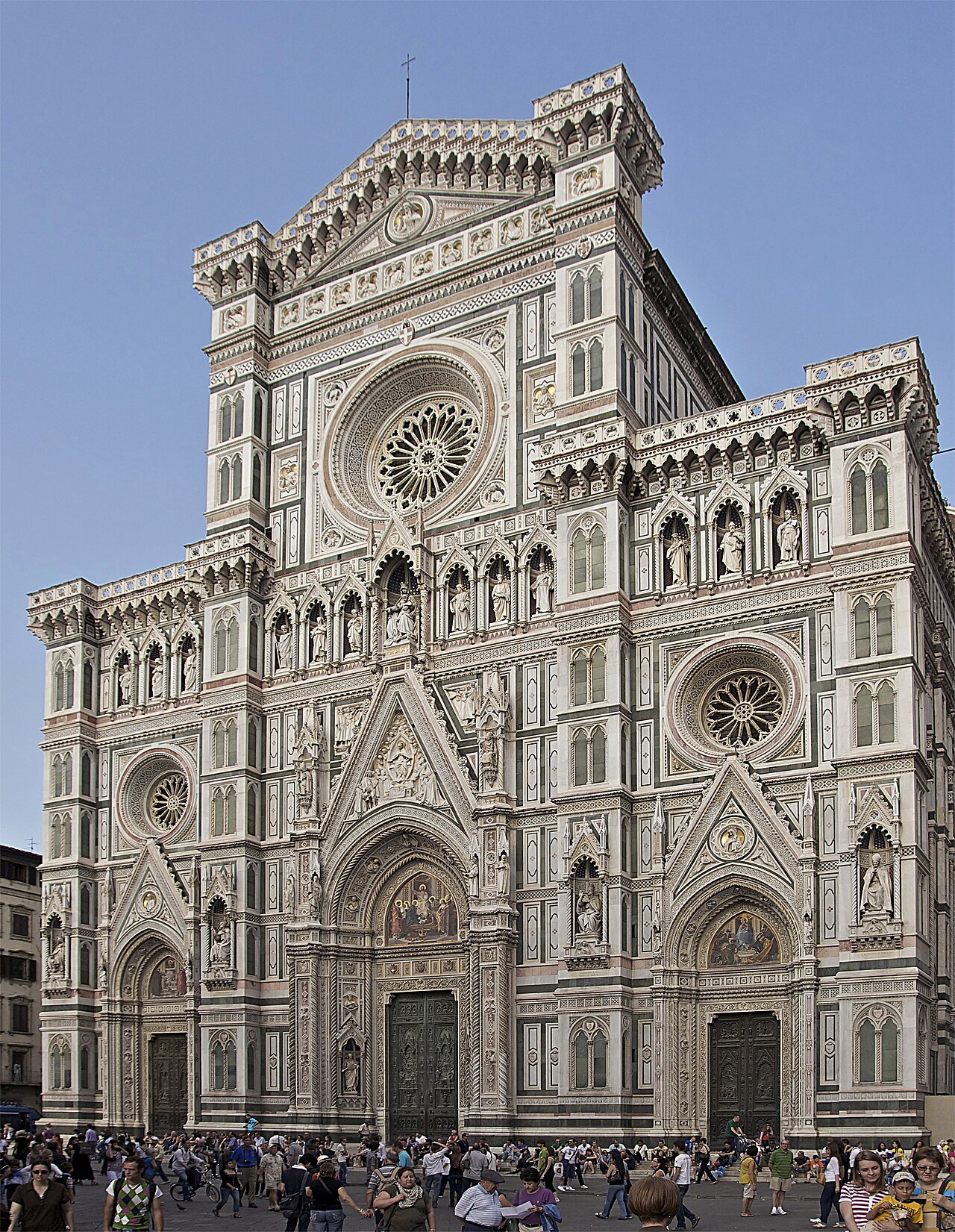
The front of the church waited even longer. Arnolfo's unfinished medieval facade was torn down and the west end stood bare or makeshift for centuries, until Emilio De Fabris won the competition of 1871; his neo-Gothic marble facade was begun in 1876 and completed in 1887, the face the cathedral wears today.
What you'll actually see
1
The marble front of 1887
De Fabris clothed the west end in the same white, green and red marble as Giotto's bell tower beside it, so that the whole ensemble reads as one work. Mosaics glow in the tympana above the three portals, and the sides of the cathedral carry four tall mullioned windows, eight round ones and four sculpted portals, including the Porta della Mandorla on the north, through which the dome climb begins.
2
The nave and the painted dome
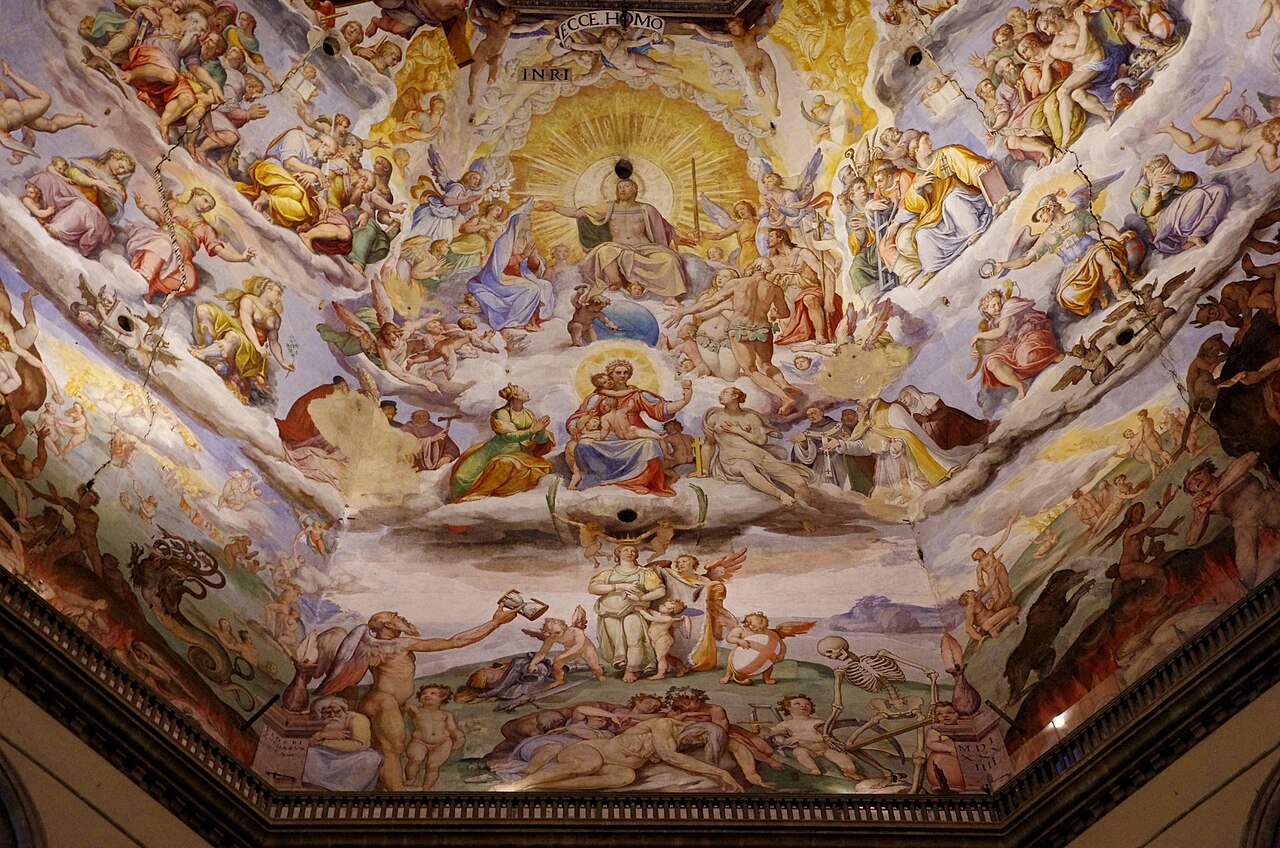
The nave runs 153 metres under bare Gothic arches: Paolo Uccello's monumental one-handed clock over the door, the giant equestrian portraits of John Hawkwood and Niccolò da Tolentino on the left wall, Domenico di Michelino's Dante holding his poem before the city, and 44 stained glass windows designed by Donatello, Ghiberti, Uccello and Andrea del Castagno. Overhead, the Last Judgment painted by Giorgio Vasari and Federico Zuccari in 1572 to 1579 covers about 3,600 square metres of the inner dome; Luca della Robbia's glazed terracotta reliefs crown the two sacristy doors below.
3
The Baptistery and the crypt
Across the parvis stands the octagonal Baptistery of St. John, one of the oldest buildings in Florence, its vault lined with thirteenth-century gold mosaics (under restoration and not currently visible). The doors Michelangelo reportedly said could stand at the gates of Paradise are replicas; Ghiberti's gilded originals wait in the Opera del Duomo Museum. Inside the cathedral, a stair in the right aisle descends to Santa Reparata, the fifth-century basilica beneath the floor, where Brunelleschi's tomb is marked by a simple stone.
The Last Judgment by Vasari and Zuccari painted inside Brunelleschi's dome, Florence CathedralThe neo-Gothic marble facade of Florence Cathedral, completed in 1887 by Emilio De Fabris
The Last Judgment inside the dome, and the facade of 1887 · photos Paolo Villa CC BY-SA 4.0 and Jebulon CC0, Wikimedia Commons
THE RITE FOUND NOWHERE ELSE
Scoppio del Carro · Easter morning, 28 March 2027
On Easter morning a towering antique cart, drawn by white oxen wreathed in the first flowers of spring, rolls from Porta al Prato to the cathedral door. The new fire is struck from three flints of the Holy Sepulchre, carried home from the First Crusade by the Florentine Pazzino de' Pazzi and kept at the church of Santi Apostoli. At the singing of the Gloria in the Easter Mass, a dove-shaped rocket, the colombina, flies down a wire from the high altar, ignites the cart into a storm of fireworks, and returns; a clean, straight flight has promised Florence a good year for centuries. In 2027 Easter falls on 28 March.
The piazza fills hours ahead, so come early; the monuments are closed to visitors on Easter Sunday, but the rite and the Mass are open worship.
Plan your visit
By air
Florence Amerigo Vespucci (FLR). The T2 tram runs from beside the terminal to Santa Maria Novella station in about 20 minutes; the cathedral is a 10 minute walk from there.
By rail
Firenze Santa Maria Novella, about 1 km away: walk out toward Piazza dell'Unità and straight down Via de' Cerretani, 10 to 12 minutes to the piazza.
Timings
Cathedral: Monday to Saturday 10:15 am to 3:45 pm; closed to visitors on Sundays and religious feasts. Dome climb: Monday to Friday 8:15 am to 6:45 pm (last slot), Saturday to 4:30 pm, Sunday 12:45 to 4:30 pm.
Entry
The cathedral itself is free, no ticket or booking. The other monuments need a pass: Brunelleschi Pass 30€ (dome climb, bell tower, Baptistery, museum, Santa Reparata, valid 3 days), Giotto Pass 20€ (all but the dome), Ghiberti Pass 15€ (Baptistery, museum, Santa Reparata). Ages 7 to 14 reduced, under 7 free.
For worship
Weekday Masses 8:30 (capitular), 10:00 and 6:00 pm, with Lauds at 8:00. Saturday 5:00 pm Mass in English, 6:00 pm vigil Mass. Sundays 9:00, 10:30 Chapter Mass in Latin and Gregorian chant, 12:00 and 6:00 pm, with Vespers in Gregorian chant at 5:15 pm.
Best time
Book the first dome slot at 8:15 am on a weekday for cool stairs and an empty lantern; for the cathedral itself, the queue is shortest right at the 10:15 opening.
Dress
Shoulders and knees covered, no flip-flops; the rule is enforced at the cathedral and Baptistery doors as places of worship.
The climb
463 steps to the top of the dome between the two shells, no lift; a reserved date and time slot plus a photo ID are required. Suitcases, backpacks and medium or large bags must be left at the luggage storage at Piazza del Duomo 38/r first.
The name Santa Maria del Fiore, St. Mary of the Flower, weaves together the lily of Florence and the city's own name, Florentia, the one destined to bloom.
The dome climb is not recommended for those with heart trouble, vertigo or claustrophobia, or for expectant mothers; the same 463 steps go up and come down, and minors must climb with an adult.
The whole complex closes on 25 December, 1 January and Easter Sunday; the museum closes every first Tuesday of the month, and in 2026 the bell tower closes 9 to 13 November and the dome 16 to 20 November for maintenance.
The originals migrate across the square: Ghiberti's Gates of Paradise, the bell tower sculptures and Michelangelo's late Pietà all stand in the Opera del Duomo Museum, so keep an hour for it on your pass.
Questions pilgrims ask
Do I need a ticket to enter the cathedral?
No. The cathedral is free, without ticket or booking, Monday to Saturday 10:15 am to 3:45 pm. On Sundays and religious feasts it is closed to visitors and given wholly to worship. The passes are only for the dome climb, bell tower, Baptistery, museum and Santa Reparata.
How do I climb Brunelleschi's dome?
Only with the Brunelleschi Pass (30€), which requires a reserved date and time slot chosen at purchase, and since March 2025 a photo ID at the door. Entry is through the Porta della Mandorla on the north side: 463 steps, no lift, about 45 minutes, passing the Last Judgment frescoes at close range on the way up.
Can I attend Mass at the Duomo?
Yes, daily and free. Weekdays: 8:30, 10:00 and 6:00 pm. Saturday adds a 5:00 pm Mass in English. Sundays: 9:00, the 10:30 Chapter Mass sung in Latin and Gregorian chant, 12:00 and 6:00 pm, with sung Vespers at 5:15 pm. The schedule is kept by the Florentine Metropolitan Chapter.
Is Michelangelo's Pietà in the cathedral?
Not any more. The Bandini Pietà, which Michelangelo carved for his own tomb between 1547 and 1555 and once broke in frustration, stands in the Opera del Duomo Museum across the piazza; the hooded Nicodemus is believed to be his self-portrait. The museum is included in all three passes.
What is under the cathedral?
Santa Reparata, Florence's first cathedral, founded early in the fifth century and demolished in 1379 once the new church enclosed it. A stair in the right aisle leads down to its excavated mosaics and tombs, among them the plain stone slab of Filippo Brunelleschi himself.
Darshan from afar
From the temple's own channels. Nothing loads until you press play.
Dharamshalas and guest houses near this Sthan, shared by devotees. Adisthan takes no bookings and no money; contact each stay directly.
No stays are listed here yet. Know one that serves pilgrims well?
Are you of the Opera di Santa Maria del Fiore or the Florentine Metropolitan Chapter? Claim this page to keep visiting hours, Mass times and feast-day notices true for the pilgrims who come to Our Lady of the Flower.