Before there was a faith called Sikhi, there was this ground, and a child who opened his eyes upon it.
Be the first to check in
Coming up: Guru Nanak Gurpurab · 24 NovEntry tended 24 May 2026
Nankana Sahib, Punjab, Pakistan Visitors by day, roughly 8 am to 4 pm Rebuilt under Maharaja Ranjit Singh, 1819 to 20 Guru Nanak Gurpurab · 24 Nov 2026 Marble sarovar for pilgrim bathing Entry free, always
Cross the marble forecourt at Nankana Sahib and the bazaar noise of the town falls away into kirtan, carried without pause from a hall wide enough to hold the whole white colonnade in the sarovar's still reflection. Inside, past a small railing and a curtained canopy, sangat gather around a spot marked by neither a relic nor a grave. This ground did not become sacred over time; a child was born on it, and everything else followed.
This is the ground where Guru Nanak Dev Ji, the first Guru and founder of Sikhi, was born in 1469 to Mehta Kalu and Mata Tripta, in a village then known as Rai Bhoi di Talwandi.
The Muslim Rajput family that held this land, remembered by name as Rai Bular Bhatti, is honoured in Sikh tradition as among the first, alongside Guru Nanak's own sister Bebe Nanki, to sense the child was no ordinary boy. It was this same family's line that renamed the village Nankana Sahib, and in 2022 the SGPC installed Rai Bular's portrait in the Central Sikh Museum at Sri Harmandir Sahib.
This is also Saka Nankana Sahib. On 20 February 1921, an armed attack ordered by the shrine's own hereditary custodian killed scores of Sikh reformers who had come to return its management to the community, a tragedy that became the founding grief of the modern Gurdwara Reform Movement.
The village that took a newborn's name
Tradition holds that Guru Nanak Dev Ji was born here in 1469, the son of Mehta Kalu and Mata Tripta, in a village then called Rai Bhoi di Talwandi. The Janamsakhis, the traditional life-accounts compiled by his early followers, remember a boyhood already turned inward, watched closely by his sister Bebe Nanki and, tradition says, by the Muslim Rajput lord who held the land. Rai Bular Bhatti's family had founded and given its own name to the village; in time, this same line renamed it for the child born within it, and Talwandi passed into memory as Nankana Sahib.
A gurdwara is held to have first marked the birthplace around 1600, within a generation or two of the Guru's passing, and the building was substantially raised again in 1819 and 1820 under the patronage of Maharaja Ranjit Singh, the Sikh ruler of Punjab, whose court funded the marble and gilding that still mark the great gurdwaras of the faith. Today the shrine and its sarovar stand at the centre of Nankana Sahib town, administered by the Pakistan Sikh Gurdwara Prabandhak Committee under the federal government.
The town's history carries grief as well as reverence. On 20 February 1921, Mahant Narayan Das, the shrine's hereditary custodian, ordered hired men to attack Sikh reformers who had arrived to bring Janam Asthan under the community's own elected management. The official toll was 86 pilgrims killed, though other accounts place it far higher. The massacre, remembered as Saka Nankana Sahib, turned public opinion behind the Gurdwara Reform Movement, and within years Punjab's historic gurdwaras passed to the Shiromani Gurdwara Parbandhak Committee, the elected body that still governs Sikh shrines in India today.
What you'll actually see
1
The canopy over the birth spot
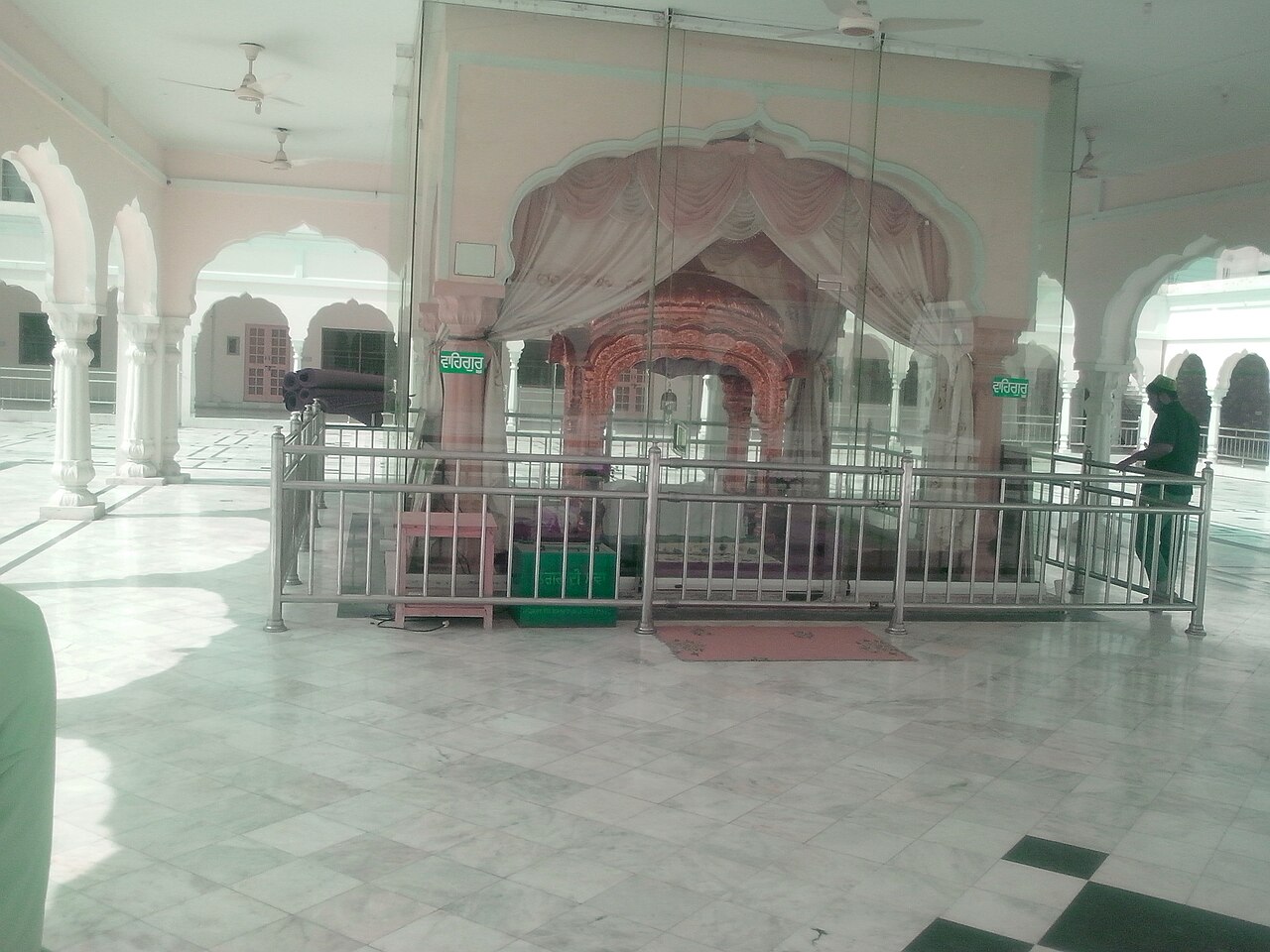
Past the outer halls, a small marble platform stands behind a plain steel railing, curtained above in pink and gold and marked simply, in Gurmukhi, Waheguru. There is no image here and no relic to view, only the railing, the canopy, and the spot itself, the innermost point of the whole complex.
2
The sarovar and its colonnade
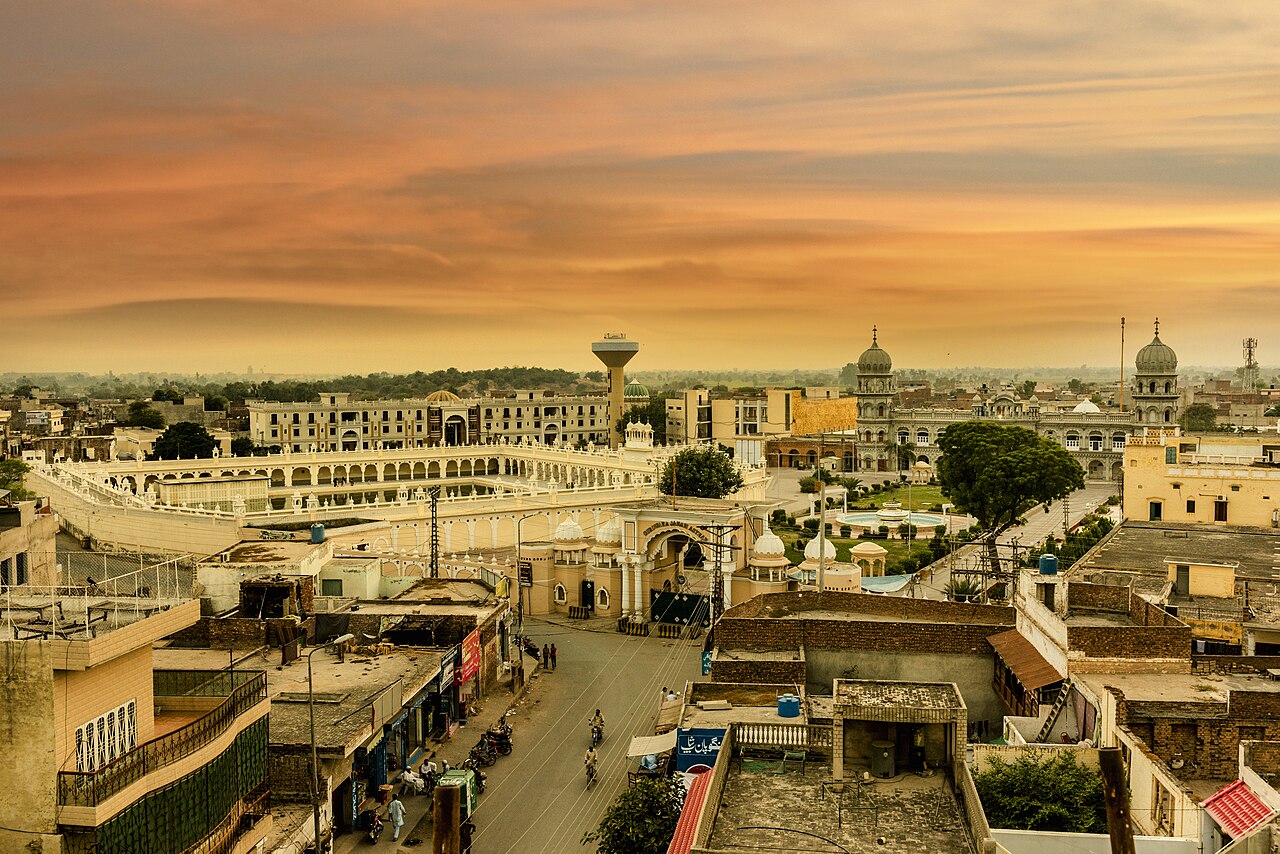
A wide rectangular pool sits behind a covered walkway of pointed white arches, the same marble parikrama pattern found at gurdwaras across Punjab. Pilgrims move along it slowly; by evening the golden-domed skyline behind it lies doubled in the still water.
3
A town built around nine gurdwaras
Janam Asthan is the first and largest of nine historic shrines scattered through Nankana Sahib, each keeping a separate episode of Guru Nanak Dev Ji's boyhood, among them Gurdwara Bal Lila, at his childhood playground, and Gurdwara Patti Sahib, at the school where he is remembered to have confounded his teacher. A short walk or rickshaw ride links them into a single day's circuit.
The railed and curtained canopy inside Gurdwara Janam Asthan marking the spot held to be Guru Nanak Dev Ji's birthplaceGurdwara Janam Asthan's domes and marble colonnade rising above the rooftops and streets of Nankana Sahib at dusk
Once a year, on Kartik Purnima, Nankana Sahib turns fully toward the birth it is named for. Akhand Path readings run through the preceding days, a nagar kirtan procession moves through streets hung with banners, and langar is served without pause to a town whose population multiplies for the week. Under the 1974 India-Pakistan Protocol on Visits to Religious Shrines, Pakistan issues several thousand visas to Sikh pilgrims travelling from India as an SGPC-organised jatha, joined by sangat from across the Sikh diaspora and by Pakistan's own small Sikh community. In 2026 the Gurpurab falls on 24 November.
This is not the Kartarpur Corridor, which is visa-free but serves only Gurdwara Darbar Sahib at Kartarpur, a different shrine near the border. Visiting Nankana Sahib from India means applying, well in advance, through a recognised Sikh body for a place on the protocol jatha.
Plan your visit
By air
Allama Iqbal International Airport, Lahore, is the nearest, roughly 75 km away and about 1.5 to 2 hours by road.
By rail
Nankana Sahib railway station sits on Pakistan Railways' Lahore to Faisalabad line, a short rickshaw ride from the gurdwara.
For pilgrims from India
There is no visa-free route here. The Kartarpur Corridor serves only Kartarpur, not Nankana Sahib; Indian Sikhs travel as part of an SGPC-organised jatha under the 1974 Protocol on Visits to Religious Shrines, applied for months ahead of Guru Nanak Gurpurab, Baisakhi, or the other protocol occasions.
Timings
Generally open to visitors by day, roughly 8 am to 4 pm, with ID such as a CNIC or passport checked at the gate; jatha pilgrims follow the schedule set by their group.
Best time
Guru Nanak Gurpurab in November brings the largest gathering and the fullest town; quieter months suit a calmer visit for Pakistan's own Sikh community and the few travellers able to arrange a visa outside the protocol quota.
Dress
Cover your head at all times inside; dress modestly. Shoes come off at the free cloakroom before the inner halls.
The approach
Phones and cameras are commonly asked to be left at the gate before the inner sanctum; there is a single entry line, not a paid queue.
Asthan means place or seat in Punjabi; Janam Asthan is simply the birthplace, and the town that grew up around it now carries the Guru's own name.
The village's Muslim landholding family is remembered by name in Sikh tradition: the SGPC installed a portrait of Rai Bular Bhatti in the Central Sikh Museum at Sri Harmandir Sahib in October 2022.
Janam Asthan is the first stop of nine historic gurdwaras clustered through Nankana Sahib town, each marking a separate episode of Guru Nanak Dev Ji's boyhood.
As at any gurdwara, tobacco, alcohol, and intoxicants are never brought inside, and the langar is vegetarian, cooked and shared without distinction of faith or status.
Questions pilgrims ask
Can I visit Nankana Sahib through the Kartarpur Corridor?
No. The Kartarpur Corridor is a separate, visa-free crossing that serves only Gurdwara Darbar Sahib at Kartarpur, the shrine where Guru Nanak Dev Ji spent his final years, near the India-Pakistan border in Narowal district. Nankana Sahib, his birthplace, lies much further inside Pakistan, near Lahore, and reaching it from India requires a visa through the 1974 Protocol on Visits to Religious Shrines, generally as part of an SGPC-organised jatha.
Is the exact birth spot marked inside the gurdwara?
A small canopied platform in the inner hall marks the spot Sikh tradition holds to be the place of Guru Nanak Dev Ji's birth in 1469. As with most such markers, this rests on continuous tradition and the accounts of the Janamsakhis rather than archaeological proof, and it is held with the same reverence either way.
Was the Muslim landlord Rai Bular really the first to recognise Guru Nanak?
Sikh tradition remembers him as among the earliest, alongside Guru Nanak's sister Bebe Nanki, though the precise sequence comes down through devotional Janamsakhi accounts rather than contemporary record. What is well attested is that his family held the land, that it was his line which renamed the village for the child born on it, and that the SGPC honoured his memory with a portrait at the Golden Temple in 2022, a token of the regard Sikh tradition still holds for him.
What happened at Nankana Sahib in 1921?
On 20 February 1921, the shrine's hereditary custodian ordered an armed attack on Sikh reformers who had come to bring the gurdwara under the community's own elected management. The official toll was 86 dead, though other accounts give higher figures. The tragedy, remembered as Saka Nankana Sahib, became a turning point that led Punjab's historic gurdwaras to pass to the Shiromani Gurdwara Parbandhak Committee.
Is there an idol or image inside the gurdwara?
No. Sikhi does not worship images. The Guru Granth Sahib Ji, the scripture Sikhs revere as their living Guru, is seated under a canopy in the main hall, exactly as at any other gurdwara.
Dharamshalas and guest houses near this Sthan, shared by devotees. Adisthan takes no bookings and no money; contact each stay directly.
No stays are listed here yet. Know one that serves pilgrims well?
Are you a sevadar or officer of the Pakistan Sikh Gurdwara Prabandhak Committee serving Gurdwara Janam Asthan? Claim this page to keep timings, Gurpurab dates, and jatha information true for the sangat worldwide.