Gurdwara Mata Sundri
Gurdwara Mata Sundri Ji · Mata Sundri Gurdwara
About
Among Delhi's Sikh places of worship, Gurdwara Mata Sundri holds a unique place: it rises from the very ground where the revered Mata Sundri chose to live out the final chapter of her life, and the neighbourhood around it still carries her name. The shrine is widely regarded as a principal historical gurdwara within the tradition, both for the sanctity of its site and for the immense role its namesake played in holding the Sikh community together through decades of uncertainty.
Mata Sundri's connection to this location began after Guru Gobind Singh set out for the Deccan from Talwandi Sabo. She made her way to Delhi and took up residence at the haveli of Bhai Jawahar Singh, and when the Guru died at Nanded in October 1708, she neither departed nor withdrew. From 1727, a newly built structure at the site, then called Mata Sundri's Haveli, became her permanent home. The hukumnamas she dispatched under her own seal between 1717 and 1730 show the reach of her authority: the Khalsa looked to her for direction, respected her counsel, and followed her instructions through one of the most turbulent periods in the tradition's early history. When she left this world in 1747, her last rites were observed at Gurdwara Bala Sahib; the present shrine was raised on the spot she had inhabited for half her life, first by the devoted sangat and later formally developed by the Delhi Gurdwara Committee.
The building's architecture speaks the language of classical gurdwara design: square-domed sanctums rise above arched copings, and the traditional entrance announces the sacred interior with quiet authority. Within the main hall, a marble-paved gallery runs along the far end, where a carved wooden beam bears an inscription in bold Gurmukhi letters. A marble slab at the gallery's centre, ringed by the engraved sacred emblem of the Sikhs, draws the devotee's gaze inward toward remembrance and prayer.
History
Mata Sundari was born to Bhai Ram Saran in Bijvara, in present-day Hoshiarpur district, and was married to Guru Gobind Singh Ji at Anandpur on 4 April 1684. After the Guru left for the Deccan, she came to Delhi and stayed at the haveli of Bhai Jawahar Singh; from 1727 she lived in a newly built house on this site, which the sangat later came to call Mata Sundri's Gurdwara. Following the Guru's death at Nanded in 1708, she guided the Khalsa for nearly forty years, issuing hukamnamas under her own seal between 1717 and 1730 that Sikhs across Punjab followed. She passed away at this place in 1747, and in her memory the sangat raised the shrine that stands here today, now cared for by the Delhi Sikh Gurdwara Management Committee.
Significance
Mata Sundari holds a singular place in Sikh history: not simply as the Guru's wife, but as a leader whose written directives held the Khalsa together through four decades without a living Guru. Gurdwara Mata Sundri marks the place where that guidance was given, and where the sangat continues to honour a woman whose authority the Panth accepted as its own.
Architecture
Sikh gurdwara architecture in brick and lime mortar, with a square-domed sanctum, arched copings, and a marble-paved gallery
Visiting
Hours
Hours not listed.
Contact
No contact details listed yet.
Engage with Gurdwara Mata Sundri
Through the four pathways
Seva सेवा — Service
Offer your time and skills here. The following opportunities are open at Gurdwara Mata Sundri:
No Seva offerings listed yet.
Sādhana साधना — Practice
Learn the worship and practice associated with Gurdwara Mata Sundri:
No Sādhana offerings listed yet.
Sandhāna सन्धान — Wisdom
Unite with the wisdom of this tradition:
No Sandhāna offerings listed yet.
Sādhya साध्य — Giving
Support this sacred place according to your means:
No Sādhya offerings listed yet.
All giving flows directly to Gurdwara Mata Sundri. Adisthan does not take a commission.
Related sacred places
 Sikhism
Central Sikh Temple
Singapore · Singapore · gurdwara
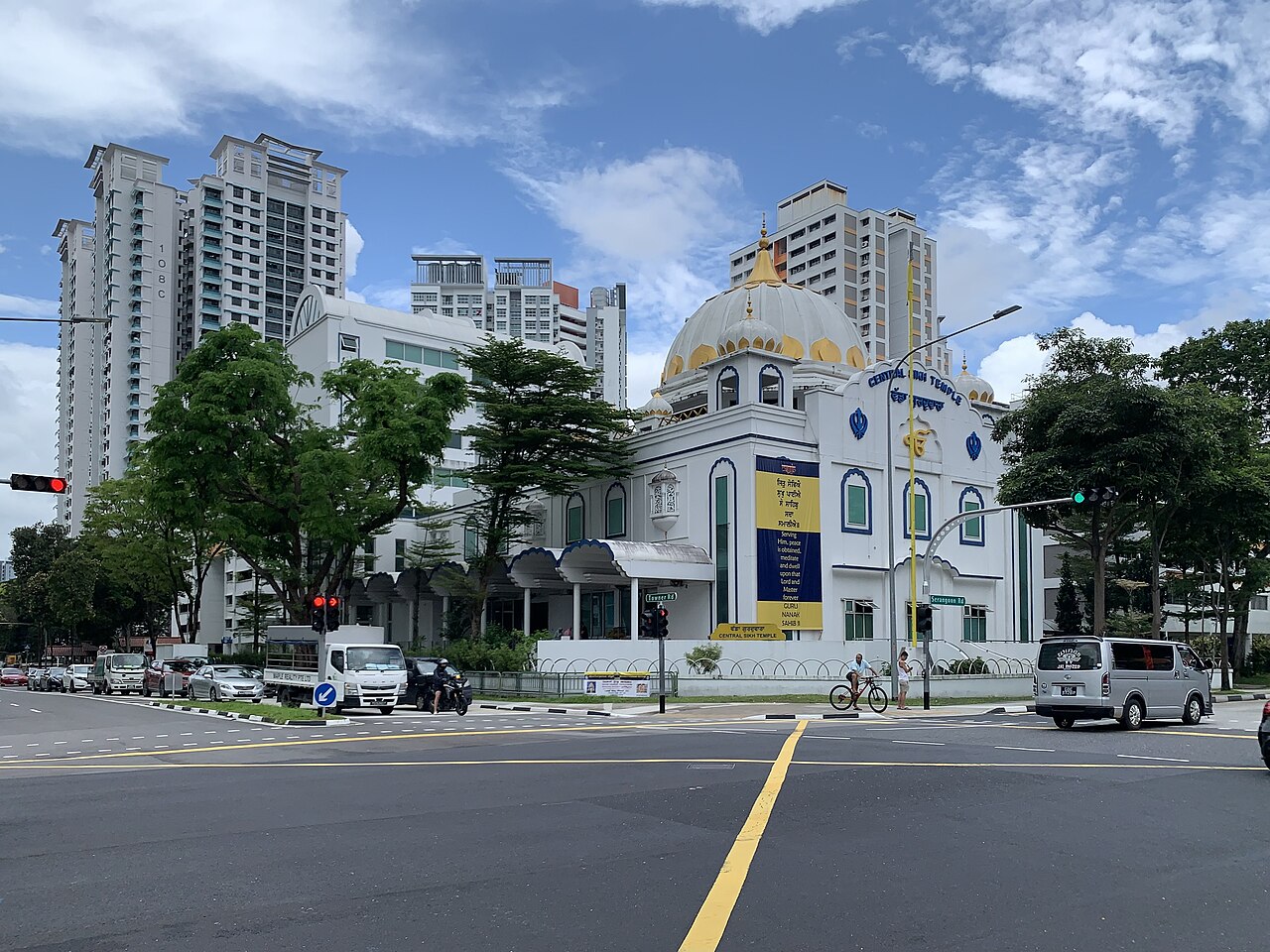
At the junction of Towner Road and Serangoon Road in Kallang, the Central Sikh Temple is Singapore's principal gurdwara, its gold-crowned dome rising over a congregation whose roots in the city reach back to 1912. A seven-storey community building stands beside it, carrying the gurdwara's life beyond the prayer hall into daily service and learning.
 Sikhism
Dongbaoxing Road Gurdwara
Shanghai · People's Republic of China · gurdwara
A red brick building in Shanghai's Hongkou District that served as a Sikh gurdwara from 1908 into the early 1970s, now protected as a cultural relic though it has stood deconsecrated, closed to worship, and repurposed as housing and a community clinic for more than fifty years.
 Sikhism
Gurdwara Baba Atal
Amritsar · India · gurdwara
A nine-storey gurdwara rising beside the Kaulsar sarovar in Amritsar, a short walk south of Sri Harmandir Sahib, built in memory of Baba Atal Rai Ji, the young son of Guru Hargobind Sahib.
._Painting_at_Gurdwara_Bal_Leela_Sahib%2C_Sri_Patna_Sahib.jpg%2F1280px-Painting_of_Guru_Gobind_Singh_in_their_Bal_Saroop_(child_form)._Painting_at_Gurdwara_Bal_Leela_Sahib%2C_Sri_Patna_Sahib.jpg&w=3840&q=75) Sikhism
SikhismGurdwara Bal Lila Maini Sangat
Patna · India · gurdwara
A small gurdwara in a quiet lane of Patna Sahib, marking the household of Raja Fateh Chand Maini, where the child Guru Gobind Singh Ji often sat in the queen's lap and shared her simple offering of boiled, salted gram.
 Sikhism
Gurdwara Beri Sahib
Sialkot · Pakistan · gurdwara
A gurdwara in Sialkot, Pakistan, built beside the berry tree under which Guru Nanak Dev Ji is said to have rested and met the Sufi saint Hamza Ghaus.
 Sikhism
Gurdwara Dukh Nivaran Sahib
Patiala · India · gurdwara
A gurdwara in Patiala whose sarovar is held to carry healing grace, raised where Guru Tegh Bahadur Ji rested beneath a banyan tree in 1672 and eased the suffering of the village of Lehal.