Where the Guru's head was given, so that another people's faith could remain their own.
Be the first to check in
Coming up: Guru Nanak Gurpurab · 24 NovEntry tended 28 Jun 2026
Chandni Chowk, Old Delhi Sangat welcomed day and night Martyrdom site, 11 Nov 1675 Shaheedi Divas · 14 Dec 2026 Present building completed 1930 Entry free, always
The gold domes catch you first, rising above the traffic and awnings of Chandni Chowk, Old Delhi's oldest market street. You climb a short flight of steps, leave your shoes at the counter, cover your head, and the roar of the street falls away into kirtan. Ahead, under a canopy, the Guru Granth Sahib Ji is seated in a hall built over the exact ground where, in 1675, a Guru knelt and did not save his own life. He gave it, deliberately, for people who did not share his faith.
This is the site of the execution of Guru Tegh Bahadur, the ninth Sikh Guru, publicly beheaded here on the order of the Mughal emperor Aurangzeb after he refused to convert and refused to let others be forced to convert.
The Guru's stand was made in defence of the Kashmiri Pandits, a Hindu community not his own, who had come to him pleading for their freedom to worship. Sikh tradition holds his martyrdom as the reason he is remembered as Hind di Chadar, the Shield of India, protector of another people's conscience.
Two disciples, in two directions, kept faith with him after death. Bhai Lakhi Shah Vanjara burned down his own house to give the Guru's body a cremation Mughal authority would not permit, and Bhai Jaita carried the severed head over 400 kilometres to Anandpur Sahib so it could be honoured, not displayed.
The Guru who stood for a faith not his own
Tradition holds that in 1675 a group of Kashmiri Pandits travelled to Anandpur Sahib in despair. Kashmir's Mughal governor was forcing conversions to Islam, and the Pandits had nowhere left to turn. Guru Tegh Bahadur, the ninth Sikh Guru, heard them, and sent word to Delhi: if Tegh Bahadur himself could be made to convert, the Pandits would follow without further resistance. It was, in effect, an offer of his own life in place of theirs.
Arrested on Aurangzeb's order, the Guru was brought to Delhi and pressed to perform a miracle or embrace Islam. He refused both. Three companions arrested with him were tortured to death before his eyes: Bhai Mati Das was sawn in two, Bhai Dayala was boiled alive, Bhai Sati Das was wrapped in cotton and burned. Still the Guru would not yield, and on 11 November 1675 he was beheaded in the open square of Chandni Chowk. Sis means head, in Punjabi and Hindi alike, and it is that word that names this Gurdwara.
What followed was devotion under threat of death. Bhai Lakhi Shah Vanjara carried the Guru's body to his own house that night and burned the house down, cremating the Guru rather than let Mughal hands touch him; Gurdwara Rakab Ganj Sahib now marks that site. Separately, Bhai Jaita lifted the severed head and carried it nearly 400 kilometres to Anandpur Sahib, evading Mughal search parties. When he laid it before the young Gobind Rai, soon to become Guru Gobind Singh, the Guru embraced him and named him Rangretta Guru ka Beta, the Guru's own son.
What you'll actually see
1
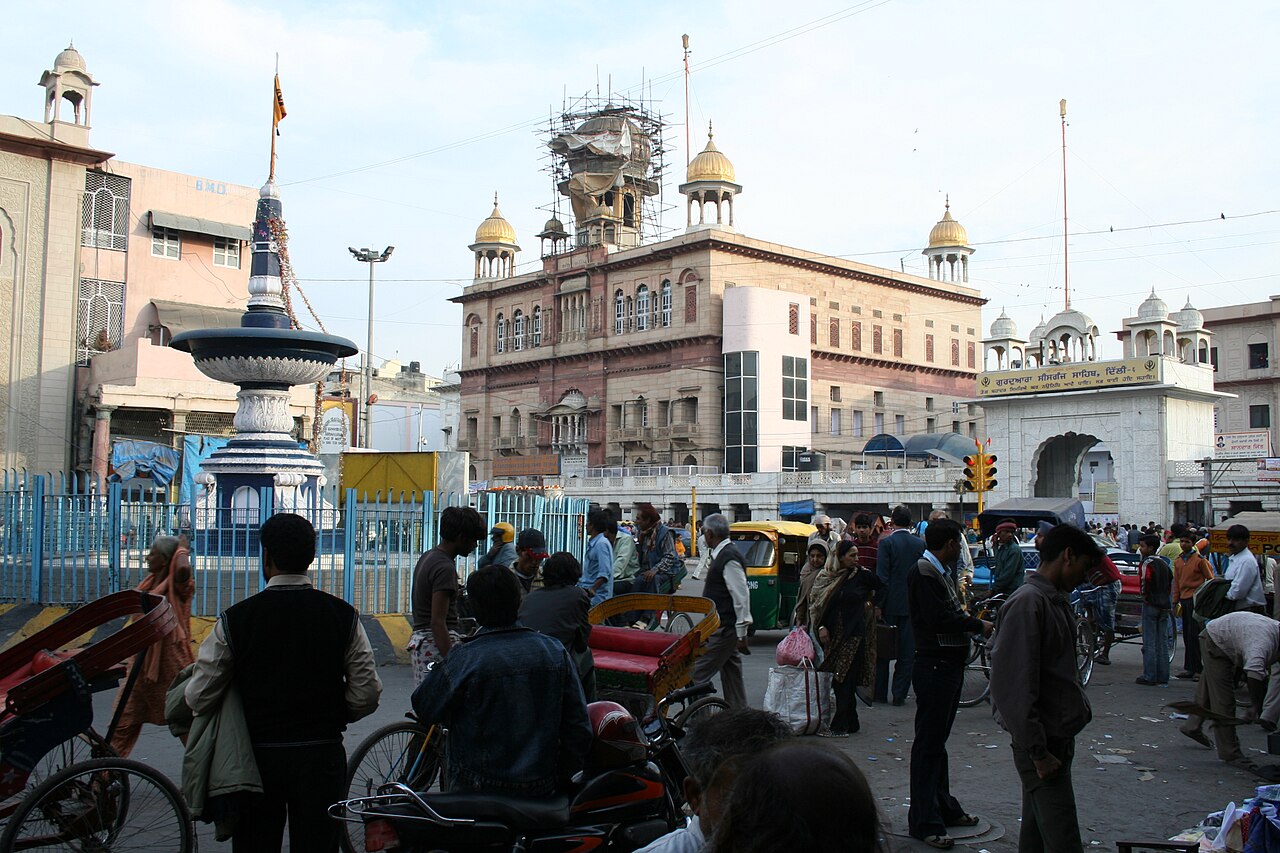
The domes above the market street
Three gilded domes and a cluster of white chhatris rise above a sandstone and marble facade, built where the wooden chauki once stood. The present structure was completed in 1930 after decades of dispute over the site, with the gold gilding added in the years after; sandstone lower storeys and Mughal-era arch forms sit beneath the unmistakably Sikh domes.
2
The preserved tree and the well
Inside the shrine, devotees can see the trunk of the tree under which the Guru is held to have been seated at the moment of his execution, and the well he is said to have used for bathing during his imprisonment. Both are kept, quietly, without ornament, as the shrine's oldest and most direct relics.
3
The old Kotwali next door
Before any shrine stood here, this ground held the Mughal Kotwali, a police post and jail where the Guru's companions were held and tortured. Part of that structure survives adjoining the Gurdwara, a stark counterpart to the gold above it. Just across the road stands the Sunehri Masjid, its own gilded domes visible from the Gurdwara's steps.
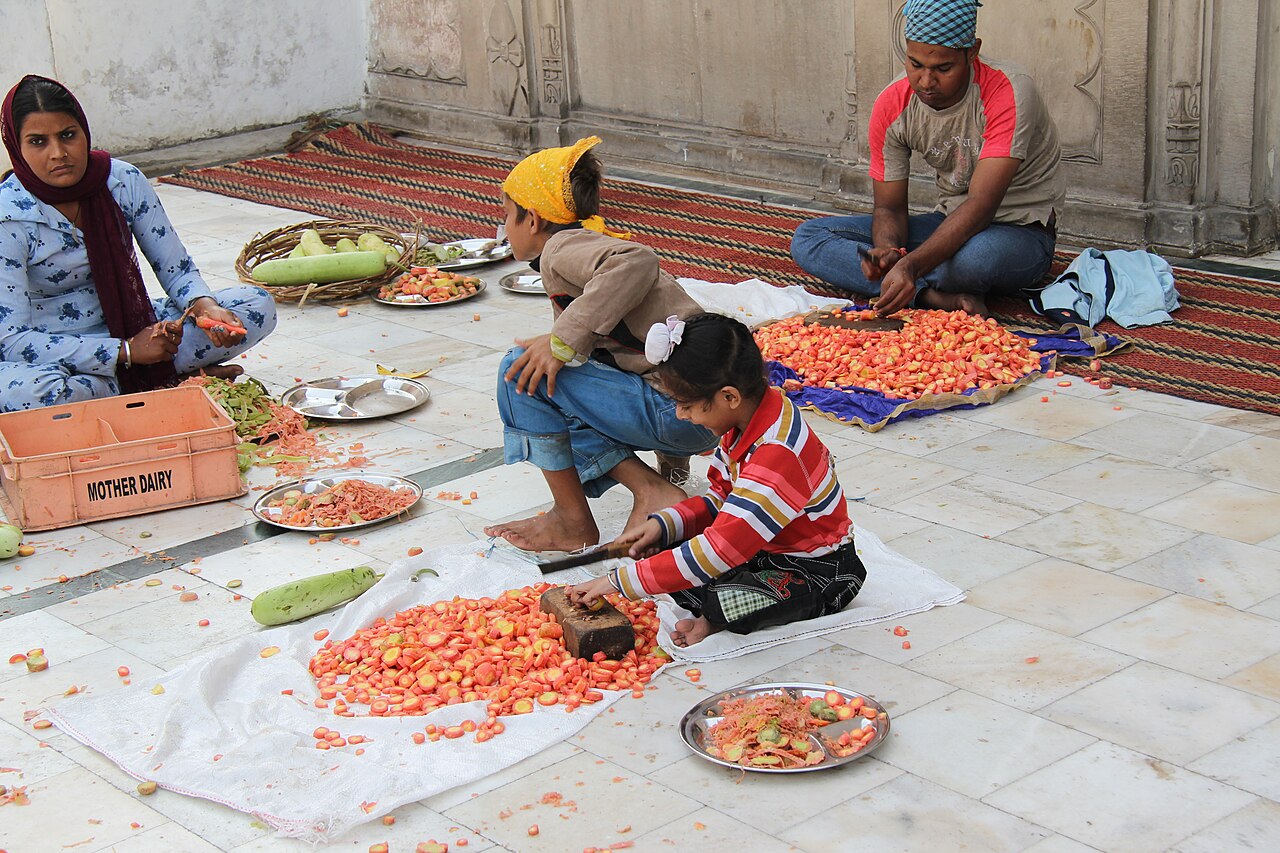
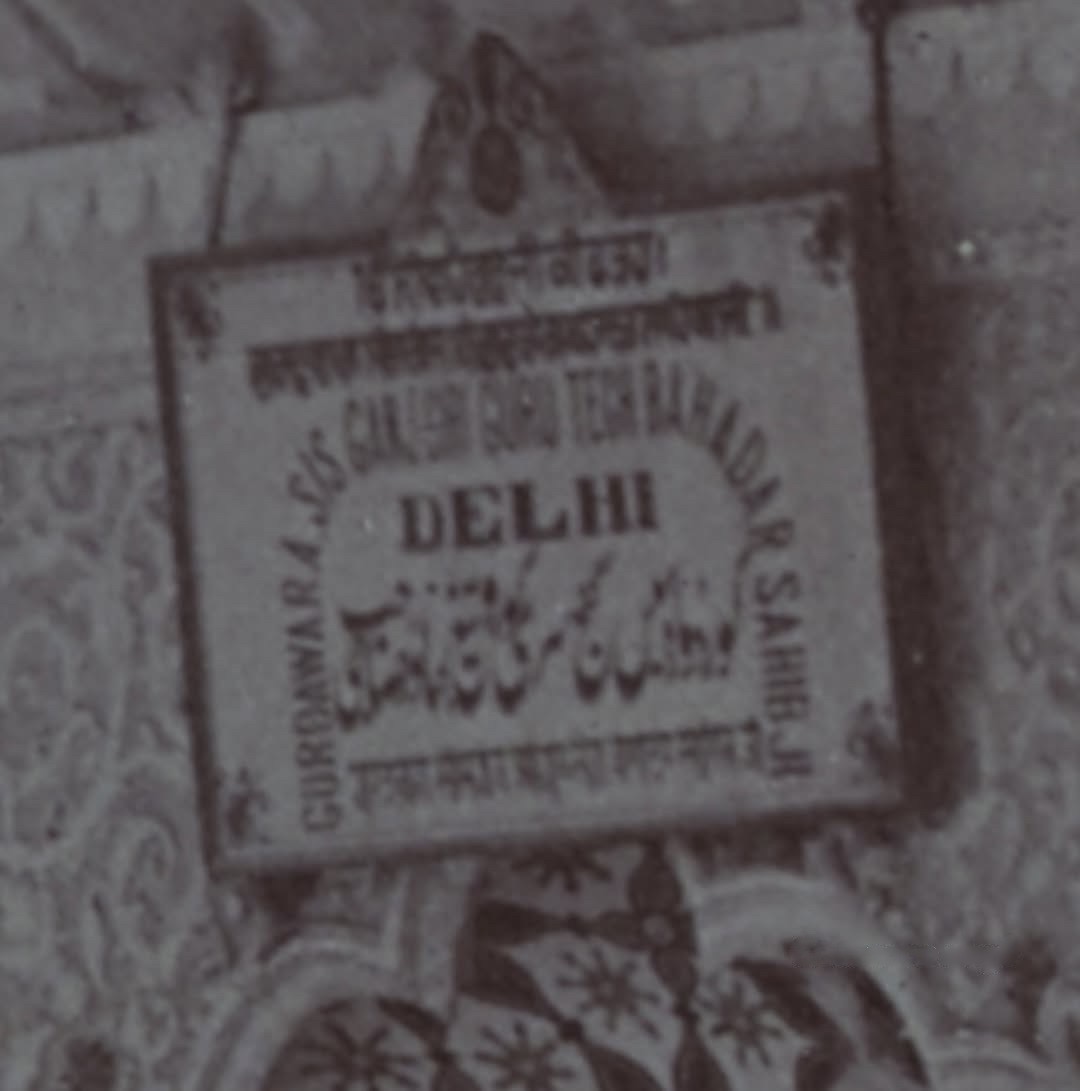
Sangat at Gurdwara Sis Ganj Sahib preparing vegetables together for the langar kitchenAn early twentieth-century signboard reading Gurdwara Sis Ganj, Guru Teg Bahadar Sahib, Delhi
Photos: Hari Singh, Ilford, Essex, UK (CC BY 2.0); unknown photographer, c. 1913-16 (public domain), via Wikimedia Commons
THE DAY THE SANGAT REMEMBERS EVERY YEAR
Shaheedi Divas of Guru Tegh Bahadur
Once a year, the Gurdwara turns fully toward the memory of 1675. Akhand Path, the unbroken reading of the Guru Granth Sahib Ji, is held over the preceding days, kirtan darbars recount the Guru's stand for the Kashmiri Pandits' freedom to worship, and langar is served without pause to the crowds that fill Chandni Chowk around the shrine. The Sikh Regiment of the Indian Army, which since 1979 has saluted this Gurdwara before it salutes the President of India on Republic Day, sends its own representatives. The Nanakshahi calendar's lunar reckoning for gurpurabs means the Gregorian date shifts year to year; in 2026 the observance falls on 14 December, distinct from the fixed historical date of the execution itself, 11 November 1675.
Come a day early if you want to sit through the Akhand Path in relative quiet; on the day itself, the street outside is as full as the hall within, and langar service moves the crowd along steadily rather than all at once.
Plan your visit
By air
Indira Gandhi International Airport is roughly 20 km from Chandni Chowk, 45 minutes to over an hour by road depending on traffic.
By rail / metro
Chandni Chowk metro station (Yellow Line) is about 1 km away, a short walk or cycle-rickshaw ride through the market lanes; New Delhi railway station is roughly 3 km away.
Timings
The Gurdwara welcomes sangat and serves langar through most of the day and into the night, in the manner of Delhi's other historic gurdwaras; published visiting hours vary by source, so travellers planning a late-night or pre-dawn visit should confirm current timings with the Delhi Sikh Gurdwara Management Committee (dsgmc.in).
Best time
Weekday mornings are quietest. Chandni Chowk itself is a working market street, so arriving before the bazaar fills gives an easier walk to the entrance; October to March is the kindest season on Delhi's streets.
Dress
Cover your head at all times inside; scarves are available near the entrance for those without one. Dress modestly. Shoes go into the free cloakroom, and hands and feet are washed before entering the hall.
The approach
There is no separate queue system; sangat moves through together. The lanes of Chandni Chowk around the entrance are dense with traffic and hawkers, so allow extra time simply to reach the steps.
Entry
Free, always, for everyone, as is the langar meal served inside.
Sis means head, in both Punjabi and Hindi; Sis Ganj Sahib is, plainly, the place of the head, and it is named for what was given here.
This is one of nine historic gurdwaras in Delhi tied to the Sikh Gurus, and its counterpart, Gurdwara Rakab Ganj Sahib, marks where the Guru's body, not his head, was cremated the same night.
The current building was completed in 1930 after decades in which the site passed between Sikh and Muslim claimants and the matter was finally settled by the Privy Council in favour of the Sikh community; the first shrine here was raised far earlier, in 1783, by the Sikh commander Baghel Singh.
As at any gurdwara, tobacco, alcohol, and intoxicants are never brought inside, and langar is vegetarian, cooked and served to be shared without distinction of caste, faith, or status.
Questions pilgrims ask
Was Guru Tegh Bahadur executed for his own faith, or someone else's?
Both are true, and the second is why this site is remembered the way it is. He refused to convert to Islam himself, but the immediate cause of his stand was his defence of the Kashmiri Pandits, a Hindu community, and their right to practise their own faith without forced conversion. Sikh tradition honours him as Hind di Chadar, the Shield of India, for defending a freedom of conscience that was not his own to lose.
Is the actual execution spot marked inside the Gurdwara?
The sanctum stands on the ground where tradition holds the execution took place, and the shrine preserves what are said to be the trunk of the tree beneath which the Guru sat and the well he used during his imprisonment. The precise spot was identified in 1783 from the eyewitness account of an elderly woman whose father had cleaned the site after the execution, so devotees hold the location, not a marked footprint, as the relic.
Why are there two Gurdwaras called Sisganj, one here and one at Anandpur Sahib?
The Guru's severed head and his body were separated to save both from desecration. His body was cremated the same night in Delhi, at the site now marked by Gurdwara Rakab Ganj Sahib. His head was carried roughly 400 kilometres to Anandpur Sahib by the disciple Bhai Jaita and cremated there; a second Gurdwara Sisganj Sahib marks that site in Punjab.
What must I do before entering?
Cover your head, remove your shoes at the free cloakroom, and wash your hands and feet where provided. Leave tobacco, alcohol, and any intoxicants outside entirely; none are permitted anywhere on gurdwara grounds.
Can anyone eat in the langar here, regardless of faith?
Yes. As at every gurdwara, the langar is open to all who come, free of charge, seated together on the floor. No one is asked their faith before being served.
Dharamshalas and guest houses near this Sthan, shared by devotees. Adisthan takes no bookings and no money; contact each stay directly.
No stays are listed here yet. Know one that serves pilgrims well?
Are you a sevadar or officer of the Delhi Sikh Gurdwara Management Committee serving Gurdwara Sis Ganj Sahib? Claim this page to keep timings, Shaheedi Divas dates, and seva information true for the sangat worldwide.