A forest of arches raised for prayer, a cathedral flowering at its heart: twelve centuries of the sacred under one roof.
Be the first to check in
Coming up: Semana Santa (Holy Week) · 21 MarEntry tended 25 May 2026
Judería · C/ Cardenal Herrero 1 Mon to Sat 10:00 to 19:00 €15 · free 8:30 to 9:30 Mon to Sat Begun 786 · about 850 columns Mass daily since 1236 Corpus Christi · 27 May 2027
You enter through the Patio de los Naranjos, where fountains murmur under rows of orange trees and the bell tower stands watch. Then a door in the arcade, and daylight gives way to dusk: columns of jasper and marble in every direction, each pair carrying two arches, one above the other, striped red and white to the edge of sight. Walk deeper and the light changes again, for a Renaissance cathedral rises straight out of the prayer hall. Nowhere else on earth does a cathedral live inside the great mosque of a caliphate.
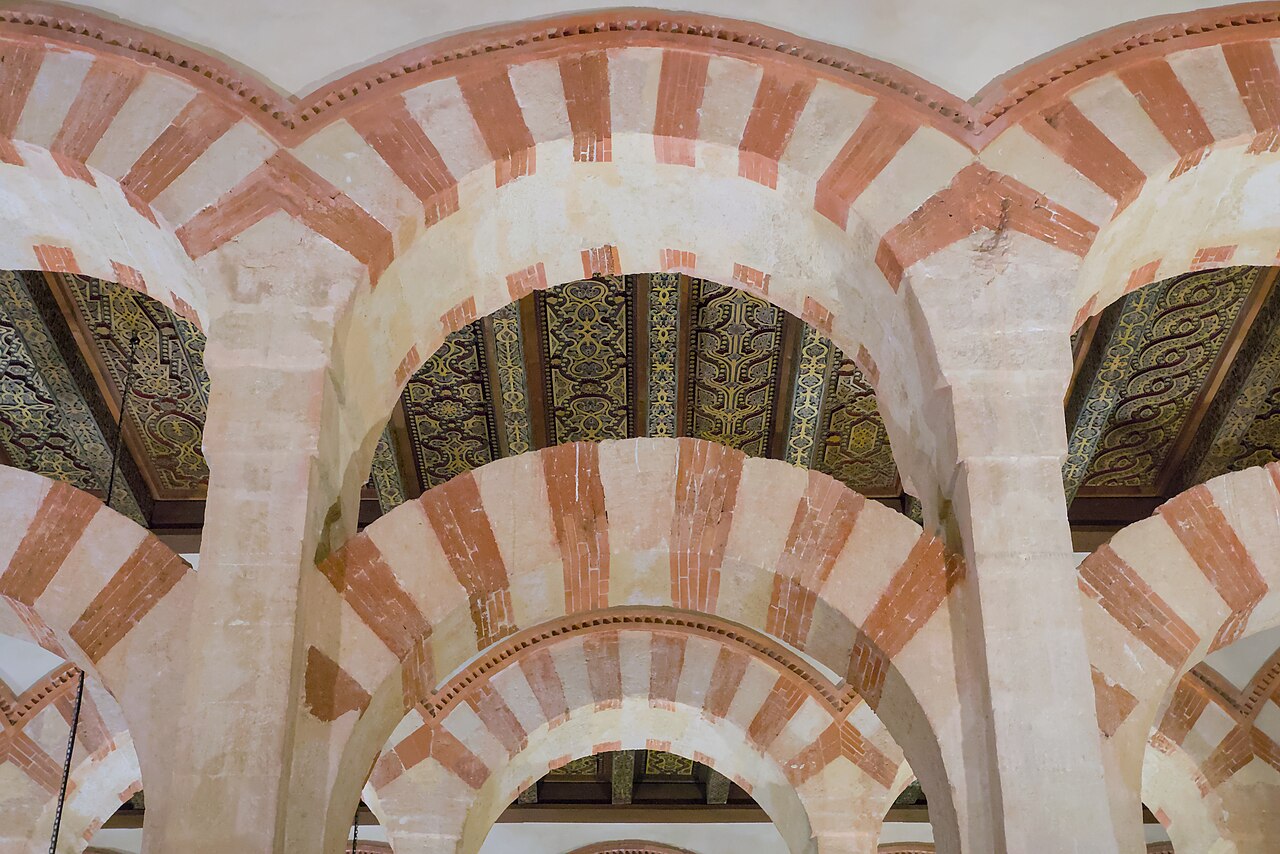
One of the supreme buildings of Islamic civilisation. Begun in 785 to 786 by Abd al-Rahman I and enlarged three times over two centuries, the hypostyle hall holds about 850 columns of jasper, onyx, marble, granite and porphyry beneath double-tiered horseshoe arches of alternating red brick and white stone, covering roughly 180 by 130 metres.
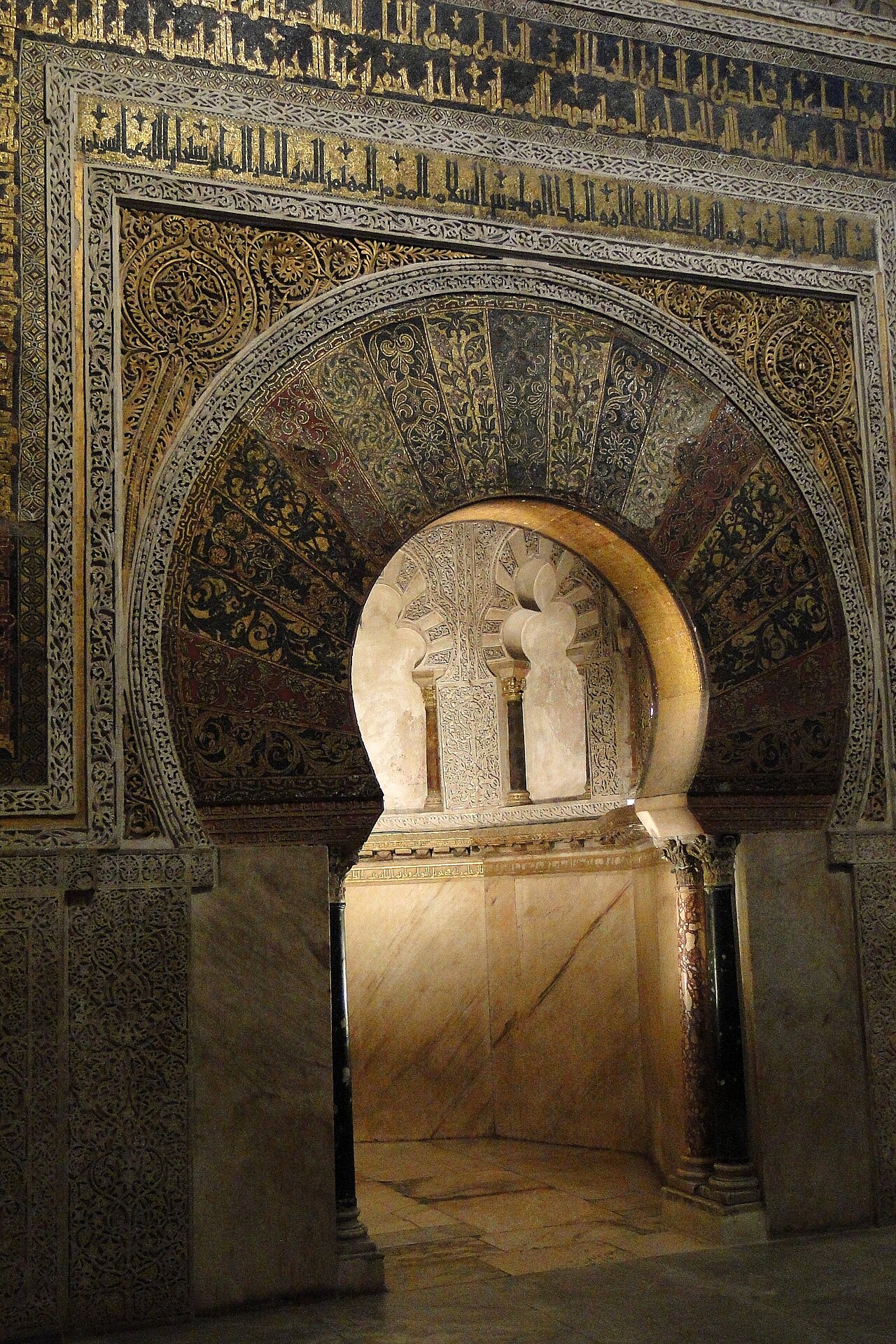
The mihrab of al-Hakam II, finished about 965 with mosaics completed in 970 to 971, is an octagonal chamber under a scallop-shell dome, its horseshoe arch sheathed in gold mosaics worked by a master craftsman the Byzantine emperor Nicephorus II sent from Constantinople along with a gift of tesserae.
A living cathedral in continuous use. Catholic worship has been celebrated here without interruption since 29 June 1236, when the mosque was consecrated after Ferdinand III took Córdoba, and since 1523 a full Renaissance nave and transept have risen at the centre of the Umayyad hall. UNESCO listed the monument in 1984 and extended the inscription to the whole historic centre in 1994.
The building that three ages built
Tradition holds that a Visigothic basilica of Saint Vincent stood here from the sixth century, shared for a time between Christians and the first Muslims of Córdoba. In 785 to 786 the emir Abd al-Rahman I, last of the Umayyads of Damascus, bought out the Christian half and raised a mosque on the site, reusing Roman and Visigothic columns and doubling the arches to lift the roof toward heaven. His heirs kept building as Córdoba grew into the great city of the medieval West: Abd al-Rahman II stretched the hall southward, Abd al-Rahman III raised a new minaret in 951 to 952, al-Hakam II added the most beautiful bays of all in the 960s with the golden mihrab at their heart, and Almanzor widened the whole mosque eastward in 987 to 988.
On 29 June 1236, after the city fell to Ferdinand III of Castile, the mosque was consecrated as the cathedral of Córdoba, and Mass has been offered beneath the arches every day since. For nearly three centuries the Christians of Córdoba worshipped within the Islamic fabric almost as they found it, adding chapels along the walls and a royal chapel under Mudéjar vaults.
In 1523 the cathedral chapter began a cruciform nave and transept in the centre of the hall, the work of Hernán Ruiz the Elder, his son, and finally Juan de Ochoa, who closed its vaults in 1607. Tradition says the emperor Charles V told the canons they had built what could be built anywhere, and destroyed something unique in the world; the story is told of him rather than by him, yet Córdoba repeats it still. When an earthquake shook the old minaret, Hernán Ruiz III wrapped it in a Renaissance bell tower, finished in 1617, and the muezzin's stair still climbs inside the belfry.
What you'll actually see
1
The forest of double arches
Nineteen aisles of columns run away into shadow, about 850 of them, no two capitals quite alike, salvaged from Roman Temples and Visigothic churches. Above each column a lower horseshoe arch and an upper semicircular one spring together, their voussoirs alternating red brick and pale stone, a rhythm that turns the whole hall into something like a grove of stone palms.
2
The golden mihrab and the maqsura
At the far south wall the caliph al-Hakam II's prayer niche opens as a small octagonal room under a carved shell dome. Its entrance arch and the domes of the maqsura before it glitter with gold and glass mosaics of Quranic script and flowering vines, laid by craftsmen trained by a master sent from Byzantium. The marble floor before it is worn by ten centuries of feet.
3
The cathedral rising through the roof
At the crossing of the hall the ceiling suddenly soars: the Capilla Mayor, begun in 1523, lifts Gothic, Renaissance and Mannerist vaulting sixty steps of light above the mosque roofline, crowned by an oval dome finished in 1607. Around it the building returns to lamplight and arches, so that a few paces carry you between two worlds and back.
Double horseshoe arches of red brick and white stone inside the Mosque-Cathedral of CórdobaThe gold mosaic mihrab of al-Hakam II in the Mosque-Cathedral of Córdoba
The double arches and the mihrab of al-Hakam II · photos CC BY-SA 4.0 (Benjamin Smith) and CC BY-SA 3.0 (Adam Jones), Wikimedia Commons
THE PROCESSION THROUGH THE PUERTA DEL PERDÓN
Corpus Christi · Thursday 27 May 2027
On the feast of Corpus Christi the cathedral's great Renaissance monstrance by Enrique de Arfe is carried out of the Puerta del Perdón after an evening Mass presided over by the Bishop, and borne through the streets of the old city past altars raised by the brotherhoods, returning to the cathedral by the same gate. In 2026 the Mass began at 18:30 and the procession at 19:30; in 2027 the feast falls on Thursday 27 May. In Holy Week, 21 to 28 March 2027, every penitential brotherhood in Córdoba passes along the official route through the Patio de los Naranjos and the interior of the cathedral itself.
For Corpus, take a place near the Puerta del Perdón before the evening Mass ends; for Holy Week processions inside the monument, expect the surrounding streets to be closed and very full.
Plan your visit
By air
Córdoba has no major commercial airport. Fly to Seville or Málaga and continue by train or road; the AVE reaches Córdoba in about 45 minutes from Seville and about 1 hr 45 min from Madrid.
By rail
Córdoba station is about 1.8 km north of the monument, a 20 to 25 minute walk downhill through the old town, or bus line 3 toward San Fernando.
In the city
Bus stop Puerta del Puente, urban lines 3 and 12; taxi stand at C/ Torrijos 6 beside the west facade. The old town around the monument is largely pedestrian.
Timings
Monday to Saturday 10:00 to 19:00 (to 18:00 in winter). Sundays and feast days 8:30 to 11:30 and 15:00 to 19:00 (to 18:00 in winter). Last entry half an hour before closing.
Entry fee
General €15, reduced €12 and €8; free Monday to Saturday 8:30 to 9:30 except on days of extraordinary celebration. Bell tower €4, half-hourly slots 9:30 to 14:30. Night visit El Alma de Córdoba €25, one tour daily at 22:00.
Best time
The free hour, 8:30 to 9:30 on weekdays, is the quietest the hall ever gets; groups are not admitted then and access closes at 9:20. Otherwise come at opening.
Dress
This is a consecrated cathedral in daily use: shoulders and knees covered, hats off indoors, and silence asked around the Capilla Mayor during worship.
Córdoba simply says la Mezquita, the mosque; the Church's own name is the Cathedral of Our Lady of the Assumption; this page uses Mosque-Cathedral, the name the monument itself now carries, and takes no side in the naming debate.
Muslims worldwide cherish the Mezquita as one of the most beloved monuments of Islamic civilisation. Under current cathedral policy Muslim prayer is not permitted inside; petitions since the early 2000s to share the space for worship have been declined by the Diocese and the Holy See. This page states both facts in each tradition's own voice and takes no side.
The bell tower ticket climbs past the remains of the tenth-century minaret of Abd al-Rahman III, which the 54-metre Renaissance tower encases like a shell.
The conventual Mass has been celebrated here every day since 29 June 1236; worshippers attend free, and the western doors open for the 9:30 Mass even before the visiting day begins.
Questions pilgrims ask
Is it a mosque or a cathedral?
Legally and liturgically it has been the Catholic cathedral of Córdoba since its consecration on 29 June 1236, and Mass is offered daily. Architecturally most of the building is the Great Mosque of Córdoba, built and enlarged between 786 and 988, and it is honoured worldwide as a masterwork of Islamic art. UNESCO inscribed it in 1984. Both identities are simply true at once.
Can Muslims pray inside?
No. Under current cathedral policy Islamic worship is not permitted in the building. Spanish Muslim organisations have petitioned the Diocese of Córdoba and the Vatican since the early 2000s for shared prayer, and the requests have been declined on the grounds that the building is a consecrated Catholic cathedral. Muslim visitors are welcome on the same terms as all visitors.
Can I visit free of charge?
Yes. Monday to Saturday from 8:30 to 9:30 entry is free for individual visitors, except on days of extraordinary celebration; groups are not admitted and access ends at 9:20. Attending Mass is always free.
What is El Alma de Córdoba?
A scripted night visit of the monument, one tour daily at 22:00, with sound and light through the darkened hall. General tickets cost €25, reduced €18, and children under 7 enter free with a ticketed adult. Book ahead through the official ticket portal.
When can I attend Mass?
The conventual Mass is sung Monday to Saturday at 9:30 in the cathedral choir, and on Sundays and feast days the Solemn Mass is at 12:00 at the high altar with a further Mass at 13:30. Confessions are heard at Mass times.
The Sthan in photographs
Darshan from afar
From the temple's own channels. Nothing loads until you press play.
Dharamshalas and guest houses near this Sthan, shared by devotees. Adisthan takes no bookings and no money; contact each stay directly.
No stays are listed here yet. Know one that serves pilgrims well?
Do you serve with the Cabildo Catedral de Córdoba? Claim this page to keep its hours, liturgies and guidance exact for every worshipper and visitor who comes to the Mosque-Cathedral.