
Nada Sahib
Gurdwara Nada Sahib · Nadha Sahib
About
Nada Sahib stands at the edge of the Śivālik Hills in Panchkula district, Haryana, its reflection shimmering in the waters of the Ghaggar-Hakra River. The gurdwara marks a moment of sacred pause: it was here that the tenth Sikh Gurū, Gurū Gobind Singh Ji, halted to rest while journeying from Paonta Sahib toward Anandpur Sahib in the aftermath of the Battle of Bhangani.
The present complex centres on a two-storey domed hall whose white forms rise above the riverbank, accompanied by a broad rectangular langar hall where the community gathers for collective worship and shared meals. A spacious brick courtyard connects these buildings, and on one side a tall flagstaff, reaching some 105 feet, carries the sacred Nishan Sahib aloft, marking the ground of the old memorial platform. Daily congregational prayers and the langar are held without interruption, and every pūrṇimā, the full moon night, draws large gatherings of devotees to this tranquil riverside precinct.
Within the complex, a Sikh heritage museum preserves and presents the sweep of Sikh history, offering visitors a deeper acquaintance with the tradition's sacred past. The Government of India's PRASAD scheme has supported significant improvements to the site's facilities, extending the welcome extended to pilgrims who arrive from across the region.
History
A local villager, Bhai Motha Singh, is remembered as the one who first marked the Guru's resting place with a simple platform, a Manji Sahib, though nothing more is recorded of his life or of exactly when he built it. The shrine passed through the Dharmarth Board of Patiala and the East Punjab States Union before the Shiromani Gurdwara Parbandhak Committee took charge after Punjab's 1956 reorganisation, and in February 2023 the Supreme Court and Haryana legislation transferred its management to the Haryana Sikh Gurdwara Management Committee. The Battle of Bhangani itself, fought near Paonta Sahib in 1686 (some accounts give 1688), was the first battle Guru Gobind Singh Ji led, at nineteen years old, and the Bachitar Natak records his forces as victorious.
Significance
For Sikh pilgrims, to stand on this riverbank is to walk the same ground Guru Gobind Singh Ji once crossed, and every full moon night the gurdwara fills with devotees who come for kirtan and ardas long into the evening. The daily langar, cooked and served without distinction to all who arrive, carries forward the same spirit of seva that has marked this site since Bhai Motha Singh first raised its platform, and a Sikh heritage museum within the complex now helps visitors carry that history further.
Architecture
Sikh gurdwara architecture; white marble domed hall with a 105-foot Nishan Sahib flagstaff
Visiting
Hours
Hours not listed.
Contact
No contact details listed yet.
Engage with Nada Sahib
Through the four pathways
Seva सेवा — Service
Offer your time and skills here. The following opportunities are open at Nada Sahib:
No Seva offerings listed yet.
Sādhana साधना — Practice
Learn the worship and practice associated with Nada Sahib:
No Sādhana offerings listed yet.
Sandhāna सन्धान — Wisdom
Unite with the wisdom of this tradition:
No Sandhāna offerings listed yet.
Sādhya साध्य — Giving
Support this sacred place according to your means:
No Sādhya offerings listed yet.
All giving flows directly to Nada Sahib. Adisthan does not take a commission.
Festivals & Events
- Jul
Puranmashi (monthly full moon)
29 July 2026 · annual
On every full moon night, the gurdwara fills with devotees for kirtan and ardas that carry on long after dark, the largest and most regular gathering this shrine keeps.
- Apr
Baisakhi
14 April 2027 · annual
The spring festival marking the founding of the Khalsa by Guru Gobind Singh Ji in 1699, observed here with kirtan and ardas in the same congregational spirit the Guru carried through these hills.
Gallery
Related sacred places
 Sikhism
Central Sikh Temple
Singapore · Singapore · gurdwara
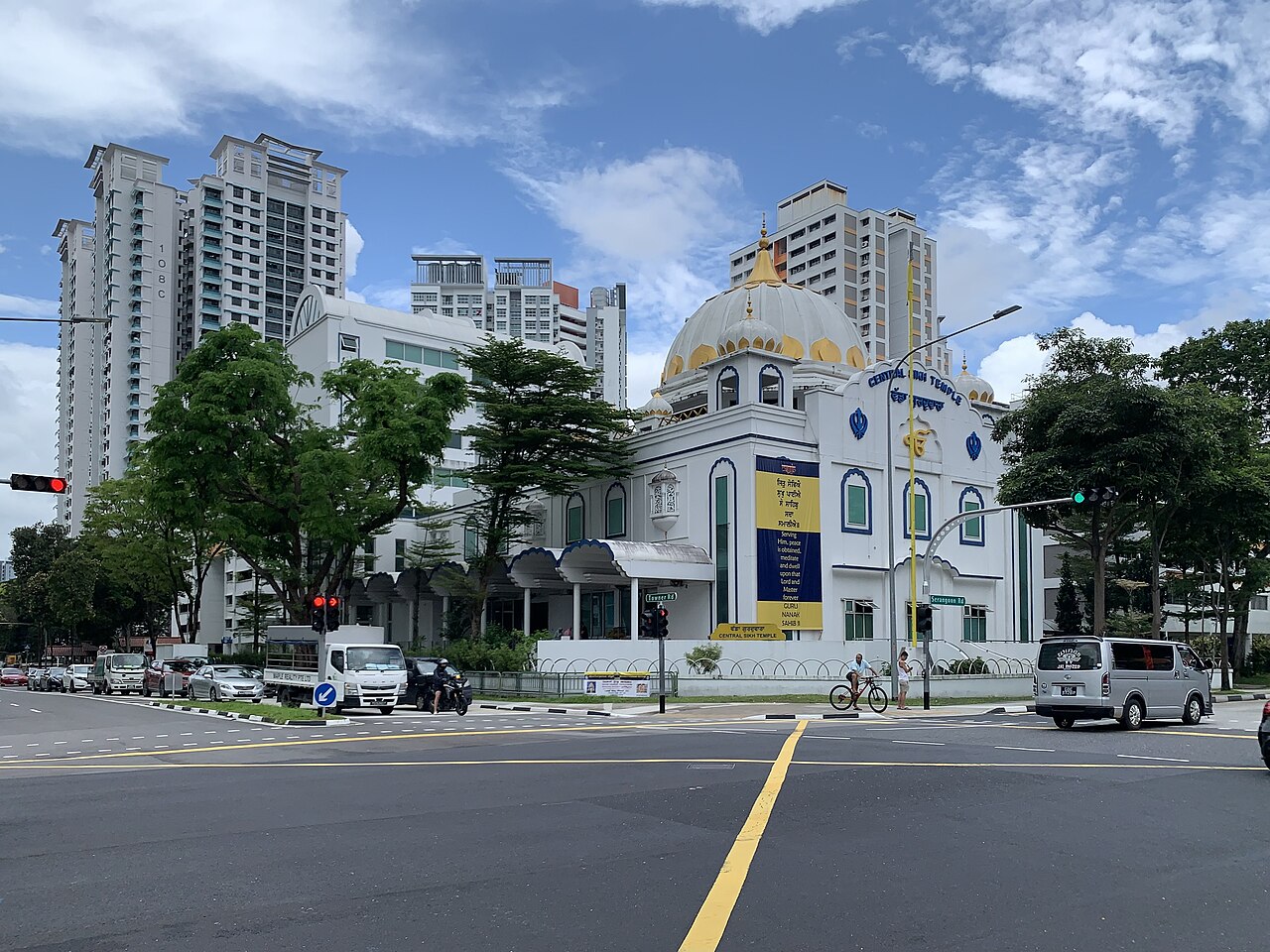
At the junction of Towner Road and Serangoon Road in Kallang, the Central Sikh Temple is Singapore's principal gurdwara, its gold-crowned dome rising over a congregation whose roots in the city reach back to 1912. A seven-storey community building stands beside it, carrying the gurdwara's life beyond the prayer hall into daily service and learning.
 Sikhism
Dongbaoxing Road Gurdwara
Shanghai · People's Republic of China · gurdwara
A red brick building in Shanghai's Hongkou District that served as a Sikh gurdwara from 1908 into the early 1970s, now protected as a cultural relic though it has stood deconsecrated, closed to worship, and repurposed as housing and a community clinic for more than fifty years.
 Sikhism
Gurdwara Baba Atal
Amritsar · India · gurdwara
A nine-storey gurdwara rising beside the Kaulsar sarovar in Amritsar, a short walk south of Sri Harmandir Sahib, built in memory of Baba Atal Rai Ji, the young son of Guru Hargobind Sahib.
._Painting_at_Gurdwara_Bal_Leela_Sahib%2C_Sri_Patna_Sahib.jpg%2F1280px-Painting_of_Guru_Gobind_Singh_in_their_Bal_Saroop_(child_form)._Painting_at_Gurdwara_Bal_Leela_Sahib%2C_Sri_Patna_Sahib.jpg&w=3840&q=75) Sikhism
SikhismGurdwara Bal Lila Maini Sangat
Patna · India · gurdwara
A small gurdwara in a quiet lane of Patna Sahib, marking the household of Raja Fateh Chand Maini, where the child Guru Gobind Singh Ji often sat in the queen's lap and shared her simple offering of boiled, salted gram.
 Sikhism
Gurdwara Beri Sahib
Sialkot · Pakistan · gurdwara
A gurdwara in Sialkot, Pakistan, built beside the berry tree under which Guru Nanak Dev Ji is said to have rested and met the Sufi saint Hamza Ghaus.
 Sikhism
Gurdwara Dukh Nivaran Sahib
Patiala · India · gurdwara
A gurdwara in Patiala whose sarovar is held to carry healing grace, raised where Guru Tegh Bahadur Ji rested beneath a banyan tree in 1672 and eased the suffering of the village of Lehal.