The Evangelist sleeps beneath the gold, and the whole church is his reliquary.
Be the first to check in
Coming up: Christmas at the Basilica · 25 DecEntry tended 25 May 2026
Visits 9:30 am to 5:15 pm · Sun from 2 pm Entry 10€ · online booking only Prayer free · Porta dei Fiori from 7:30 am Feast of St. Mark · 25 April Italo-Byzantine · consecrated 1094 8,000 m² of gold mosaic
You step out of a shadowed calle into the widest square in Venice, and the basilica is already watching you: five grey domes swelling above a facade of clustered marble columns, gold glinting in the arches, four bronze horses pawing the air over the central door. Inside it is dim at first. Then your eyes settle and the ceiling catches fire, gold mosaic running unbroken over vault after vault, dome after dome. Beneath the high altar lies the Evangelist himself. This is not a church that keeps a relic. The whole church is the reliquary.
Beneath the high altar rests the body venerated as that of St. Mark the Evangelist, carried out of Alexandria by two Venetian merchants in 828. The stone sarcophagus behind the altar bears four words: Corpus Divi Marci Evangelistae.
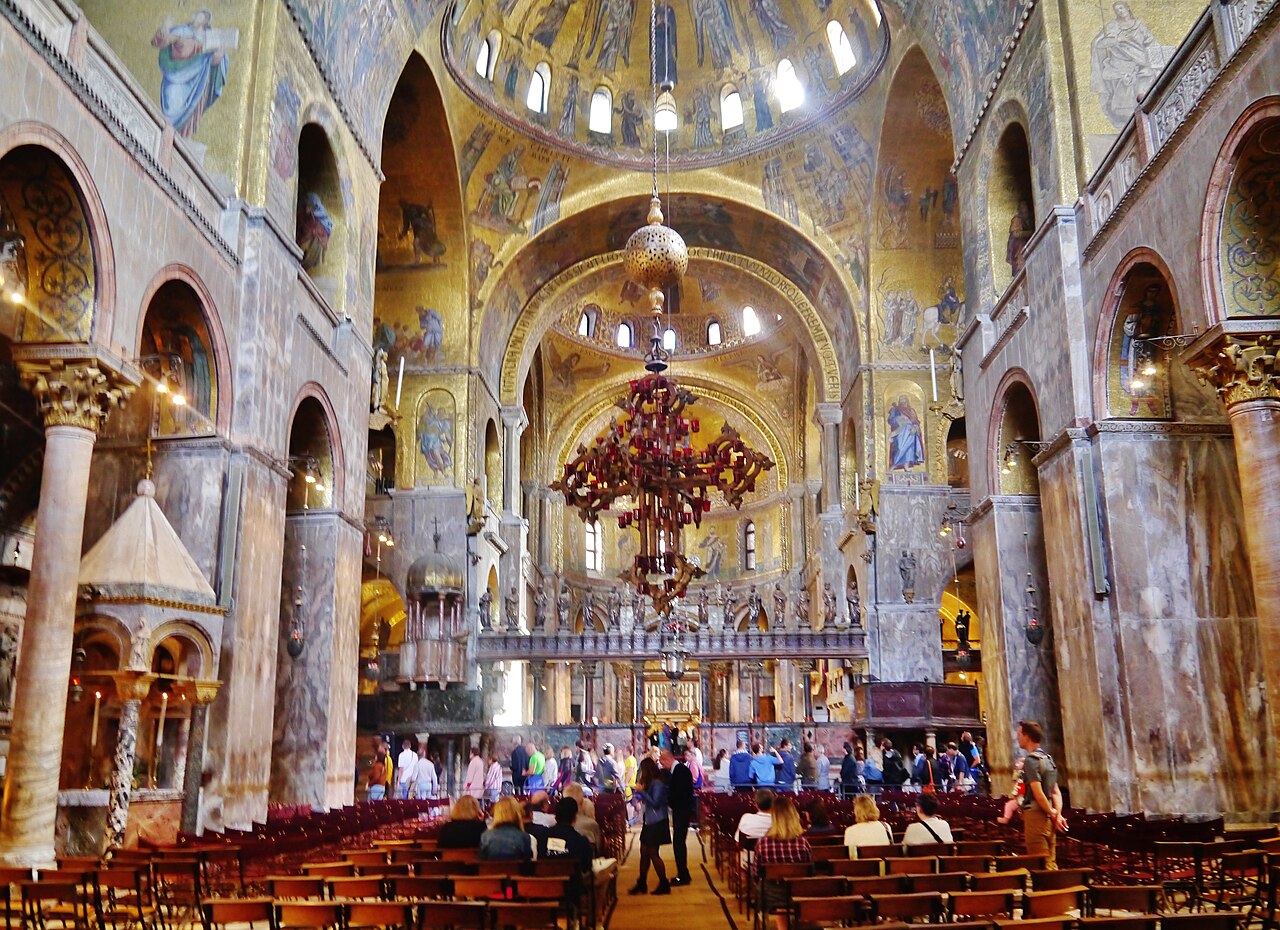
More than 8,000 square metres of gold-ground mosaic sheath the vaults and the five domes, the work of some eight centuries of mosaicists. Venetians simply call the building the Chiesa d'Oro, the Church of Gold.
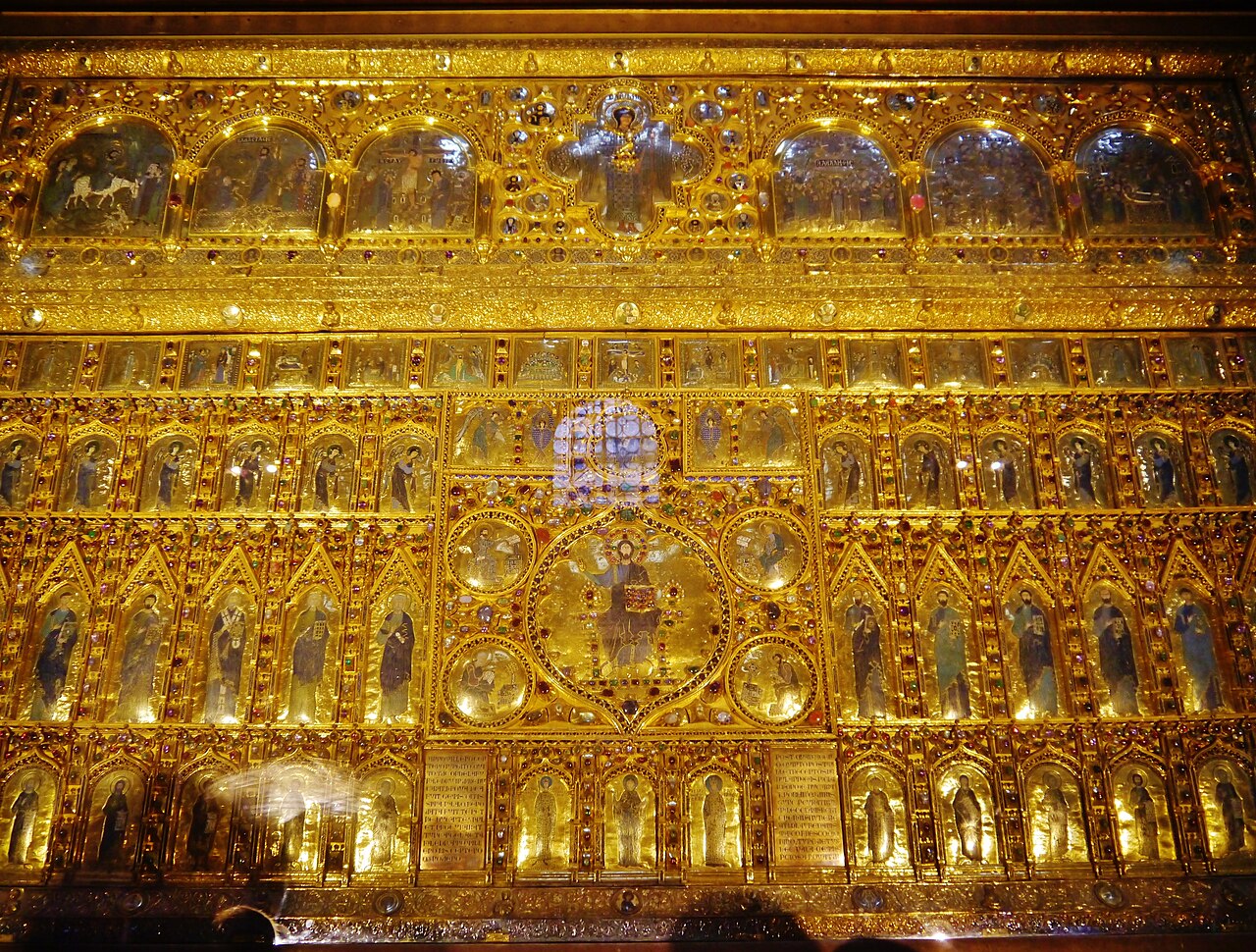
Behind the high altar stands the Pala d'Oro, an altarpiece of 187 Byzantine enamels on gilded silver set with 1,927 gems, first commissioned in 976 and completed in its Gothic frame in 1342. No other church holds Byzantine enamel work on this scale.
The merchants, the pork barrels, and the church built to hold one man
In 828 two Venetian merchants, remembered as Buono of Malamocco and Rustico of Torcello, sailed home from Alexandria with a cargo no customs officer would touch. Tradition holds they had taken the body of St. Mark from its Alexandrian shrine, fearing for its safety, and hidden it under a layer of salted pork so the inspectors would recoil and wave the chest through. Venice received the Evangelist as its own, and the doge raised a chapel beside his castle to hold him, completed by 836. The oldest mosaic on the facade, laid above the Sant'Alipio door in the 1260s, still shows the body being carried into this very church.
That first church burned in 976, when a rising against Doge Pietro IV Candiano set fire to the castle and the flames spread. It was repaired, and then, probably in 1063 under Doge Domenico Contarini, rebuilt entirely on the Greek-cross plan of the lost Church of the Holy Apostles in Constantinople, five domes over one tomb. At the consecration on 8 October 1094 the legend says the relics, lost in the rebuilding, revealed themselves when a pillar crumbled open to show the saint's arm. The body was laid in the new crypt, and in 1835 raised into the high altar where it rests today.
For nearly a thousand years this was not a cathedral at all but the private chapel of the Doge, the state church of the Republic, enriched after 1204 with the spoils of Constantinople: the four horses of the Hippodrome, the icon of the Madonna Nicopeia, the porphyry Tetrarchs clasped into the southern corner. Only in 1807, after the Republic fell, did it become the cathedral of the Patriarch of Venice.
What you'll actually see
1
The facade and the Horses
Five deep portals crusted with columns of every colour, carried home over centuries in Venetian holds. Above the northernmost door, the Sant'Alipio mosaic of the 1260s shows St. Mark's body arriving at the church. On the loggia above the central arch stand the four horses; the ones outside are replicas, and the originals wait upstairs in the museum.
2
The gold above you
Inside, more than 8,000 square metres of mosaic on gold ground cover the domes, vaults and upper walls: Christ, the prophets, the life of the Evangelist, laid tessera by tessera from the eleventh century onward. The light is low and the gold does the burning. Give your eyes a full minute to adjust.
3
Behind the high altar
The walkway behind the altar passes the sarcophagus inscribed Corpus Divi Marci Evangelistae, with the Pala d'Oro rising above it, 187 enamels and 1,927 gems in a golden Gothic frame about three metres wide. In the left transept, the altar of the Madonna Nicopeia holds the icon once carried before Byzantine emperors, brought from Constantinople in 1204; daily Mass is said there still.
The gold mosaic vaults of the nave of St. Mark's Basilica, looking east toward the high altarThe Pala d'Oro, the Byzantine enamel and gem altarpiece behind the high altar of St. Mark's
The gold of the nave, and the Pala d'Oro behind the high altar · photos CC BY-SA 4.0 Zairon, Wikimedia Commons
THE FEAST FOUND NOWHERE ELSE
Feast of St. Mark and the Festa del Bocolo · 25 April 2027
Every 25 April Venice keeps the feast of its patron. In the basilica the solemn Mass of St. Mark is celebrated, the Patriarch of Venice himself taking the great solemnities of the year, and the city outside keeps a rite of its own: the festa del bocolo, when a man gives a single red rosebud to the woman he loves. The old telling traces it to Tancredi, a Venetian who died far away in battle and sent back one bloodstained rosebud to the doge's daughter. Families mark the day at table with risi e bisi, rice and peas, once served to the Doge on this very feast. In 2027 the feast falls on a Sunday.
25 April is also Italy's Liberation Day and the Piazza is at its fullest; come as a worshipper for the morning Mass, since tourist visits on Sundays and holidays begin only at 2 pm.
Plan your visit
By air
Venice Marco Polo (VCE). The Alilaguna Blue or Orange line runs by water to the San Marco stop in about 60 to 90 min; or take a bus to Piazzale Roma and the vaporetto from there.
By rail
Venezia Santa Lucia, then vaporetto Line 1 or 2 down the Grand Canal to San Marco Vallaresso or San Zaccaria, each a short walk from the Piazza.
Timings
Visits Monday to Saturday 9:30 am to 5:15 pm, last entry 4:45 pm. On Sundays and holidays the basilica opens to visitors at 2 pm; the museum opens at 9:30 am.
Entry
Basilica 10€; with the Pala d'Oro or the museum 20€; complete ticket 30€; bell tower 15€. Children under 11 free. All tickets are booked online at the official ticket office; there is no ticket window.
For worship
Mass and prayer are free, through the Porta dei Fiori on the north side, daily 7:30 am to 7:30 pm. Weekday Masses 8 am, 10 am and 6:45 pm; Sunday Masses 8 am, 10 am (sung), noon and 6:45 pm.
Best time
Book the first slot at 9:30 am on a weekday; remember that Sunday mornings the basilica itself is closed to visitors and given over to worship.
Dress
Shoulders and knees covered, for men and women alike. The rule is strictly enforced at the door, ticket or no ticket.
The narthex floor is one of the lowest points in Venice; since 2022 a low glass wall has kept tides of up to 110 cm away from the doorways, and the MOSE barriers now close the lagoon against higher water, so acqua alta rarely stops a visit.
No large bags, backpacks or luggage inside; the cloakroom at the Ateneo San Basso, just off the Piazza, holds them free of charge.
The four horses on the loggia are replicas; the originals, ancient copper looted from the Hippodrome of Constantinople in 1204, were moved into the museum in the early 1980s to save them from the air.
For almost a thousand years this was the Doge's private chapel, not a cathedral; it has been the seat of the Patriarch of Venice only since 1807.
Questions pilgrims ask
Is St. Mark really buried here?
Tradition holds that his body has rested in Venice since the merchants brought it from Alexandria in 828, and that it survived fire and rebuilding to be found again at the consecration of 1094. Since 1835 it has lain in a stone sarcophagus beneath the high altar, inscribed Corpus Divi Marci Evangelistae. You see it from the walkway behind the altar, below the Pala d'Oro.
Do I have to pay to go in?
Not to pray. Worshippers enter free through the Porta dei Fiori on the north side, daily 7:30 am to 7:30 pm, for Mass and prayer. Sightseeing visits use the Porta San Pietro with a ticket booked online, from 10€.
Do I need to book in advance?
Yes. Since July 2025 all visit tickets are sold online through the basilica's official ticket office, tickets.basilicasanmarco.it, and there is no on-site ticket queue. The old 3€ door ticket no longer exists.
Are the four horses the originals?
The ones on the loggia are replicas. The original quadriga, taken from the Hippodrome of Constantinople in 1204 and displayed on the facade from the mid 1200s, was brought inside in the early 1980s because pollution was eating the metal. You stand next to them in St. Mark's Museum, on the basilica and museum ticket.
What happens during acqua alta?
The basilica is defended now. A glass barrier finished in 2022 seals the lowest doorways against tides up to 110 cm, and for anything higher the MOSE gates close the lagoon itself. Check the day's tide forecast in high autumn and winter, but flooding rarely interrupts a visit any longer.
Dharamshalas and guest houses near this Sthan, shared by devotees. Adisthan takes no bookings and no money; contact each stay directly.
No stays are listed here yet. Know one that serves pilgrims well?
Are you of the Procuratoria di San Marco or the Patriarchate of Venice? Claim this page to keep Mass times, visiting hours and feast-day notices true for the pilgrims who come to the Evangelist.