The largest church on earth stands guard over the grave of one fisherman.
Be the first to check in
Coming up: Christmas, Mass of the Nativity · 24 DecEntry tended 11 Jul 2026
Open daily from 7:00 am Basilica free · Dome from €8 Michelangelo's dome · 136 m Papal audience Wednesdays St. Peter's Square, Vatican City
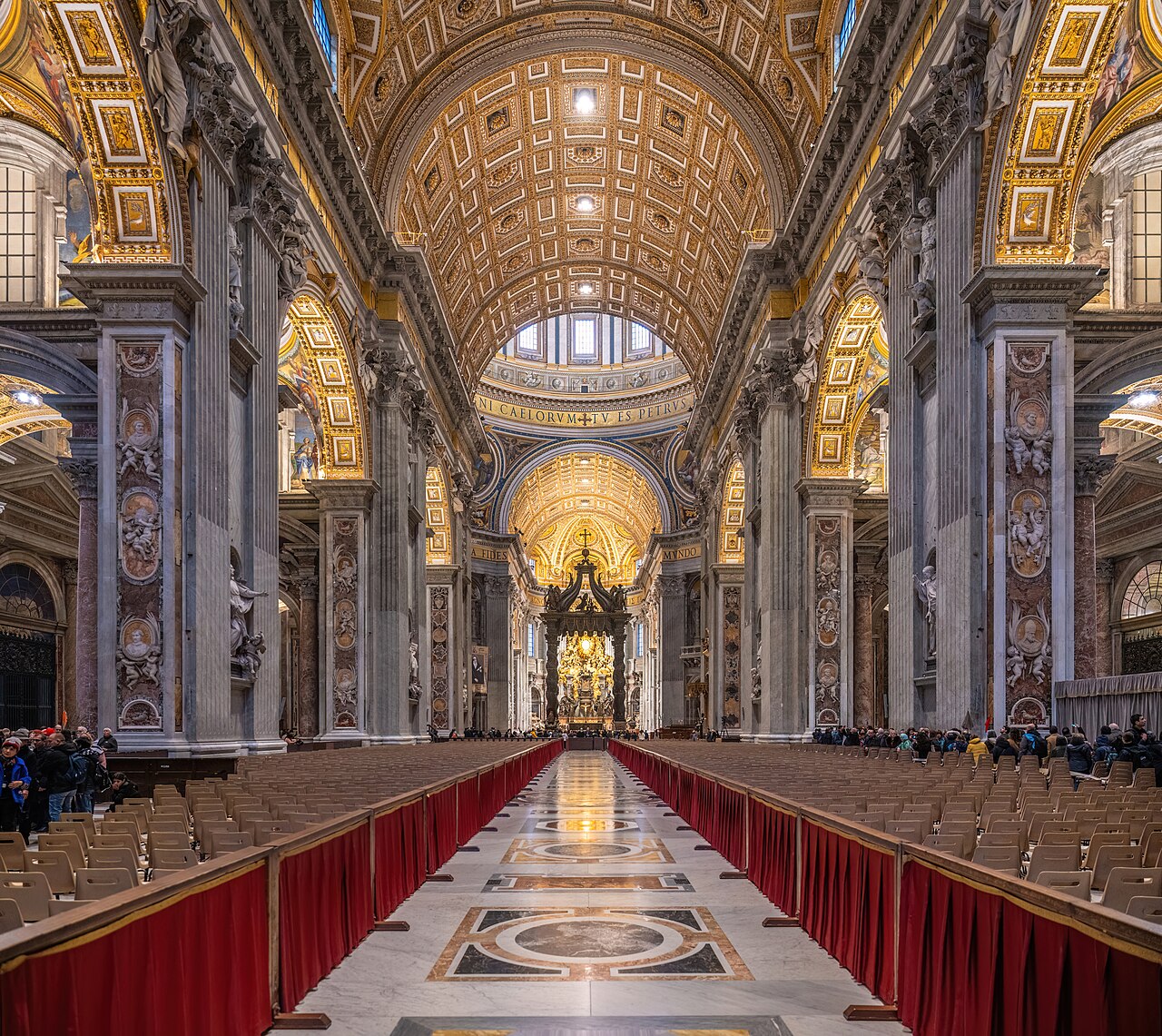
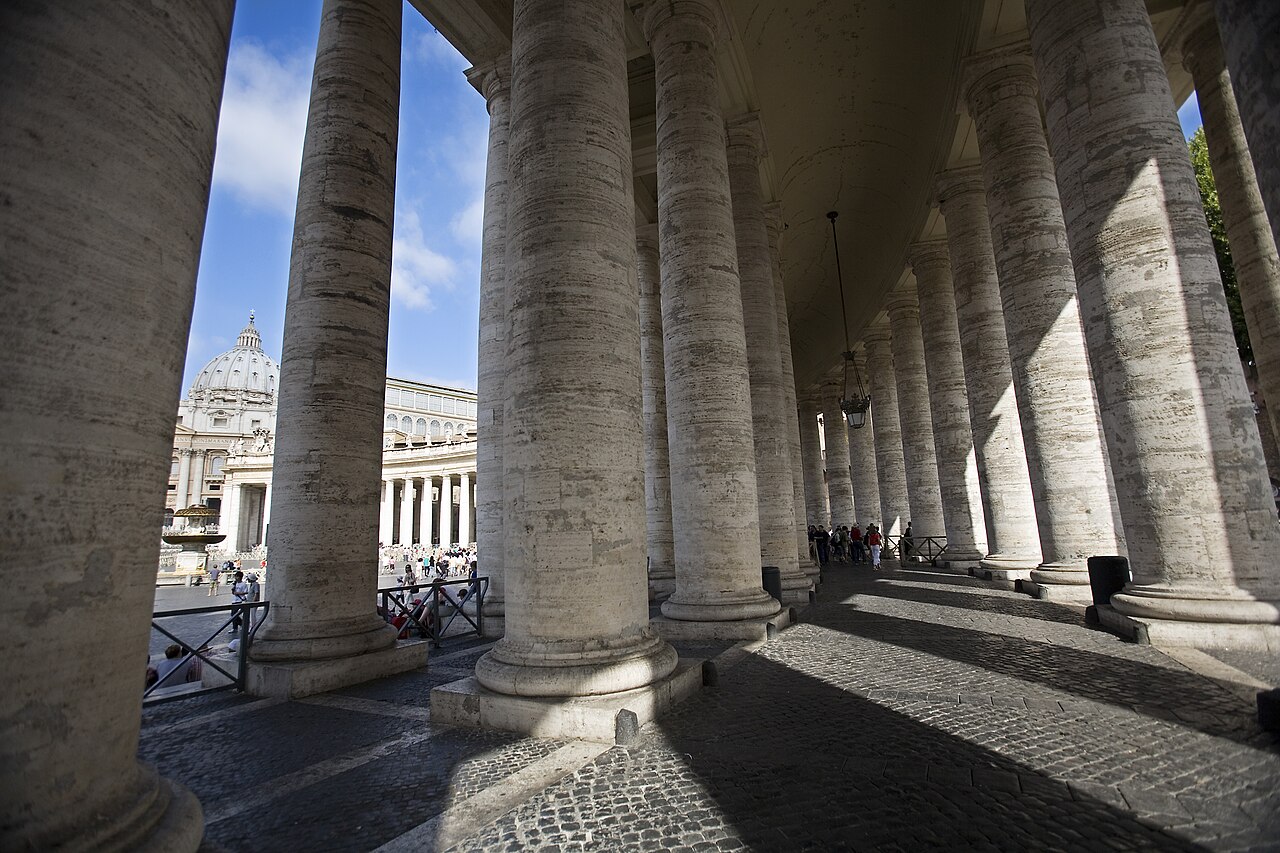
You come in through Bernini's colonnade, four columns deep, curved like two arms held open to the world. Past the security line the square tilts gently upward, and the facade rises with the dome floating behind it. Inside, the first feeling is not beauty but scale: bronze doors taller than houses, marble light, a canopy of dark bronze far away beneath the dome. Under that canopy, below the papal altar, lies the grave of a Galilean fisherman. The whole basilica exists because of that grave.
The high altar stands directly above the tomb of Saint Peter the Apostle. Excavations beneath the basilica from 1940 to 1949 uncovered a buried Roman necropolis and a second-century shrine, the trophy of Gaius, marking the grave; in 1968 Pope Paul VI announced that relics found beside it had been convincingly identified as the Apostle's.
It is the largest church interior in the world, about 15,160 square metres, beneath the tallest dome ever raised, 136 metres from the floor to the cross. Michelangelo designed the dome; Giacomo della Porta completed it in 1590.
Its makers read like a roll call of the Renaissance and the Baroque: Bramante drew the first plan, Raphael revised it, Michelangelo took charge of the dome at seventy, Maderno built the nave and facade, and Bernini gave it the baldachin and the embrace of the colonnade.
The fisherman's grave
Tradition holds that Peter, the fisherman from Galilee whom Christ named the rock of His Church, was martyred in the circus of Nero on the Vatican Hill around the year 64 and buried in the open cemetery beside it. Christians never lost the spot. Around the year 200 the Roman priest Gaius could already write of a trophy standing over the grave, a modest shrine that marked where the Apostle lay.
When the empire turned to the Church, the Emperor Constantine did something extraordinary: rather than build on easier ground nearby, he cut into the hillside and buried an entire street of Roman tombs so that the altar of his basilica would stand exactly over that shrine. Old St. Peter's, raised between 319 and 333, kept the tomb at its heart for more than a thousand years.
By 1506 the old basilica was failing, and Pope Julius II laid the foundation stone of a new one. The work consumed 120 years and the greatest architects alive before Pope Urban VIII consecrated the church on 18 November 1626. Then, in the 1940s, Pope Pius XII ordered quiet excavations beneath the crypt. Archaeologists found the necropolis Constantine had buried, and directly under the high altar, the trophy of Gaius itself. In 1968 Pope Paul VI announced that bones kept in a niche beside it, those of a robust man of sixty to seventy years, had been identified convincingly as the relics of Saint Peter. The altar has never moved.
What you'll actually see
1
The Pietà
Just inside, in the first chapel on the right, Michelangelo's Pietà: Mary holding her dead Son, carved from a single block of marble in 1498 and 1499, when the sculptor was in his early twenties. It is the only work he ever signed, his name cut into the sash across Mary's breast. Since a hammer attack in 1972 it stands behind bulletproof glass, which takes nothing from the silence in front of it.
2
The baldachin and the confessio
At the crossing rises Bernini's baldachin, a bronze canopy on four twisted columns above the papal altar, in place since 1634 and cleaned back to bright gilding in 2024, its first full restoration in over 250 years. Before it a double staircase descends to the confessio, where lamps burn day and night facing the niche above the tomb of Saint Peter.
3
The bronze Apostle and the dome
Against a pier of the nave sits the bronze statue of Saint Peter enthroned, keys in hand; centuries of pilgrims have touched and kissed the extended right foot until the toes have worn smooth. Above the crossing opens Michelangelo's dome, and around its base runs the promise in gold mosaic: Tu es Petrus, you are Peter, and on this rock I will build my Church.
The high altar of St. Peter's Basilica beneath Bernini's bronze baldachin, lit low under Michelangelo's domeThe four-deep travertine columns of Bernini's colonnade curving around St. Peter's Square
Interior by Wilfredor (CC0) · colonnade by Jorge Royan (CC BY-SA 3.0) · hero facade by Alvesgaspar (CC BY-SA 4.0), Wikimedia Commons
WHERE THE POPE MEETS THE WORLD
The Wednesday General Audience
Most Wednesday mornings when the Pope is in Rome, St. Peter's Square becomes his meeting hall: teaching, greetings in many languages, and a blessing for everyone present. Tickets are always free. Request them from the Prefecture of the Papal Household at eventi.pontificalisdomus.va, ideally two weeks or more ahead, and collect them at the Bronze Door of the Apostolic Palace. On Sundays at noon the Pope prays the Angelus with the crowd in the square, and for that no ticket is needed at all. At Easter and Christmas he gives the Urbi et Orbi blessing, to the city and to the world, from the central loggia of the facade.
Request audience tickets at least two weeks ahead and collect them in person at the Bronze Door; bring identification.
Plan your visit
By air
Fly into Rome Fiumicino or Ciampino; from Termini station take Metro Line A toward Battistini.
By rail
Roma San Pietro station, on the regional loop through Termini and Trastevere, is about a 10 minute walk from the square.
By metro
Metro Line A to Ottaviano, then about 8 minutes on foot down Via Ottaviano into St. Peter's Square.
Timings
Basilica daily from 7:00 am; until 8:00 pm in high season (from 1 June 2026), otherwise about 6:30 to 7:00 pm. Grottoes 9:00 am to 6:00 pm, free.
The dome
Summer 7:00 am to 6:00 pm, winter 7:30 am to 5:00 pm. 551 steps to the lantern; the lift removes all but 320. Narrow, sloping passages: not for claustrophobia or heart conditions.
Fees
Basilica and grottoes free. Dome about €8 by stairs or €10 with the lift at the door; online bundles with audio guide cost more. Confirm at booking.basilicasanpietro.va.
Dress
Shoulders covered for everyone; long trousers for men, skirts below the knee or trousers for women. Enforced at security.
The queue
Entry is free but everyone passes an airport-style security line. Come at 7:00 am or in the last two hours. Wednesday mornings belong to the papal audience, so plan basilica time for the afternoon; Sunday mornings fill for Mass and the Angelus.
Photography without flash is welcome in the basilica; tripods, selfie sticks and drones are not, and photography is forbidden in the grottoes where the popes are buried.
The Holy Door at the far right of the portico is opened only in Jubilee years: Pope Francis opened it on 24 December 2024, Pope Leo XIV closed it on 6 January 2026, and it is now walled up until the next Jubilee.
Vatican City is the world's smallest state, yet there is no border control: walk into the square and you have already crossed.
Confessions are heard daily in many languages, roughly 7:00 am to 12:30 pm and 4:00 to 7:00 pm on weekdays.
Questions pilgrims ask
Is St. Peter's the cathedral of Rome?
No. The cathedral of Rome, where the Pope holds his chair as the city's bishop, is the Archbasilica of St. John Lateran across the city. St. Peter's is a papal basilica built over the Apostle's tomb, and most great papal liturgies happen here simply because nowhere else can hold the world that comes.
Is Saint Peter really buried under the altar?
The Church holds that he is. Excavations from 1940 to 1949 found a Roman necropolis under the basilica and, directly beneath the high altar, a second-century shrine that the priest Gaius had described around the year 200 as the Apostle's trophy. In 1968, after long scientific study of bones found in a niche beside it, Pope Paul VI announced that the relics of Saint Peter had been identified in a way the Church considers convincing.
Do I need a ticket to enter?
No. The basilica and the grottoes are free; you only pass a security check. Fees apply only to the dome climb and to the small-group Scavi tour of the necropolis beneath the grottoes, which must be arranged in advance through the Vatican's Excavations Office.
How can I see the Pope?
Three free ways: the Wednesday General Audience in the square, with tickets requested in advance from the Prefecture of the Papal Household; the Sunday Angelus at noon, no ticket needed; and the great papal Masses of Easter, Christmas and major feasts, which are also ticketed without charge.
Can I simply attend Mass?
Yes, freely and daily. Weekday Masses run from 7:00 am at the Altar of Saint Joseph, with an 8:30 am Mass in the Blessed Sacrament Chapel followed by Eucharistic Adoration through the day, and later Masses at the Altar of the Chair up to 6:00 pm. On Sundays the solemn Mass is at 10:30 am. Tell the attendants you are coming for Mass.
The Sthan in photographs
Darshan from afar
From the temple's own channels. Nothing loads until you press play.
Dharamshalas and guest houses near this Sthan, shared by devotees. Adisthan takes no bookings and no money; contact each stay directly.
No stays are listed here yet. Know one that serves pilgrims well?
Are you a priest, canon, or official of the basilica's Chapter or the Fabbrica di San Pietro? Claim this page to keep Mass times, audience notices, and pilgrim guidance exact for the faithful worldwide.