Fifth of the Five Takhts · Where the eternal Guru took final form
Takht Sri Damdama Sahib
Talwandi Sabo · Bathinda district, Punjab, India
Here the Guru dictated the Word entire, and no Sikh again went without it.
Be the first to check in
Coming up: Guru Nanak Gurpurab · 24 NovEntry tended 28 Jun 2026
Talwandi Sabo, 30 km from Bathinda Sangat welcomed day and night Damdami Bir dictated here, 1705 to 1706 Baisakhi Mela · 14 Apr 2027 Present hall built in the 1970s Entry free, always
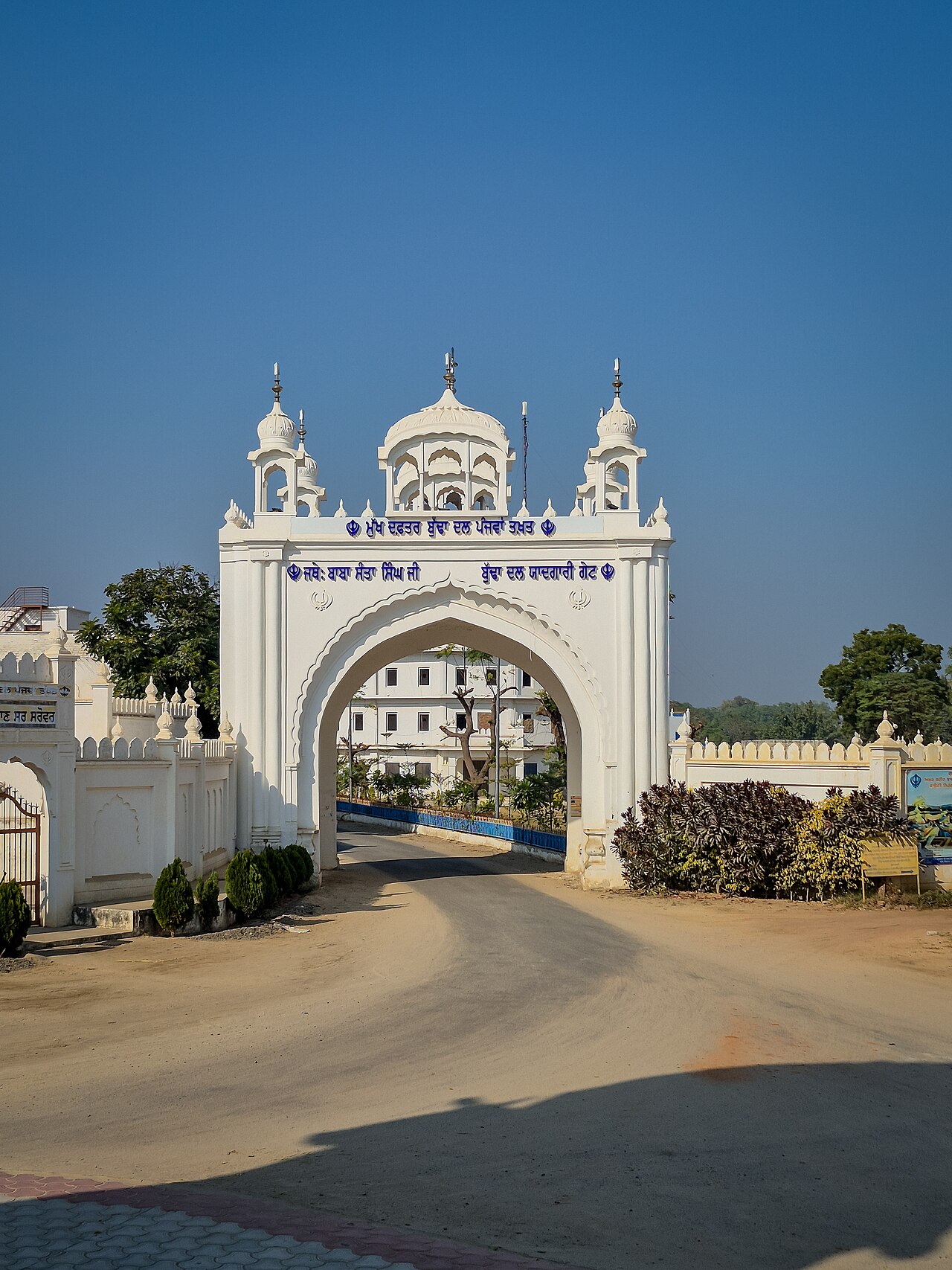
The plains of the Malwa run flat to every horizon here, and the domes of Talwandi Sabo rise out of them like a fleet at anchor. Pass under the Budha Dal's white memorial gate, where Nihang sentries in blue keep an unbroken watch, and the ground turns quiet. This is not the Takht the Guru died at, nor the one his birth is marked by. This is the Takht where the Guru's own Word was finished, and a Sikh who could not read was told that would no longer stand.
In the months after Chamkaur and the Battle of Muktsar, Guru Gobind Singh Ji dictated to Bhai Mani Singh Ji, with Baba Deep Singh Ji at the work beside him, the final and authoritative recension of the Sikh scripture, now called the Damdami Bir, adding for the first time the hymns of Guru Tegh Bahadur Ji, his own father and the ninth Guru.
The Guru himself named this ground Guru Ki Kashi, the Guru's own Varanasi, for the scholarship gathered here. Tradition holds he flung a handful of reed pens over the sangat and said no Sikh of his should remain unable to read the Word; the school that grew from that charge became the Damdami Taksal, still among Sikhi's most respected seats of Gurbani learning.
Damdama Sahib is the most recently confirmed of the Five Takhts: though Sikhs had revered its scriptural ground since 1705, the Shiromani Gurdwara Prabandhak Committee formally recognised it as the fifth Takht only on 18 November 1966, after a six-year review, a status the Government of India separately marked in April 1999.
The nine months that finished the Word
Guru Gobind Singh Ji came to Talwandi Sabo battered by loss. The Mughal siege of Anandpur Sahib, broken promises of safe passage, the drowning crossing of the Sarsa, the martyrdom of his two elder sons at Chamkaur and his two younger sons and his mother at Sirhind, and the Battle of Muktsar all lay behind him. Tradition holds he arrived at this quiet village in the last days of 1705 or the first weeks of 1706, and damdama, a breathing place, a place to rest, is what the Sikhs came to call the ground where he finally stopped.
He did not rest long in idleness. Calling for Bhai Mani Singh Ji to write, and with Baba Deep Singh Ji at the work beside him, the Guru dictated the Sikh scripture whole, resolving its variant copies into one final text and adding, for the first time, the hymns of his own father, Guru Tegh Bahadur Ji. Tradition says he flung reed pens over the gathered sangat and vowed that none of his Sikhs would remain illiterate; the town took the name Guru Ki Kashi for the learning that followed, and Baba Deep Singh Ji stayed on for decades after to teach the correct reading of Gurbani, founding the Damdami Taksal. The Guru remained at Talwandi Sabo some nine months before journeying on toward the Deccan, where he would pass into Joti Jot at Nanded in 1708.
The ground he left behind became a centre of Sikh scholarship and, in time, the headquarters of the Budha Dal, the oldest order of the Nihang Sikhs, who still keep a base within the complex. The Takht was formally recognised as the fifth seat of the Panth's temporal authority only in 1966, and the present prayer hall, raised over the platform where the Guru sat, was built in the 1970s.
What you'll actually see
1
The Budha Dal's memorial gate
A tall white archway, domed and finialled, greets pilgrims first, its Gurmukhi lettering naming it the head office of the Budha Dal, the oldest Nihang order, whose blue-robed sentries have kept a base at Damdama Sahib since the Guru's own stay. Beyond it a walled avenue leads toward the Darbar Sahib.
2
The Darbar Sahib hall and the Takht platform
The prayer hall raised in the 1970s over the Guru's own resting ground holds, at its southern end, a two-metre marble platform ringed with columns, the Takht proper, where the Guru Granth Sahib Ji is seated. Above it a domed pavilion carries a gold-plated pinnacle and an umbrella-shaped finial topped by a khanda.
3
Gurdwara Lakhnsar Sahib and the sarovars
A short walk from the Darbar Sahib, Gurdwara Lakhnsar Sahib, the writing-tank shrine, marks where Bhai Mani Singh Ji is remembered to have copied the scripture; nearby, wide sarovars ring a mango grove, and open halls double as akharas where Nihangs still train with the old weapons.
The white memorial gate of the Budha Dal's head office at Takht Sri Damdama Sahib, Talwandi SaboRooftop view over the domes and sarovar of the Takht Sri Damdama Sahib complex, Talwandi Sabo
Photos: Kuldeepburjbhalaike, Teerserv (CC BY-SA 4.0), via Wikimedia Commons
THE DAY THE MALWA PLAINS FILL WITH SANGAT
The Baisakhi Mela at Talwandi Sabo
Every year on Baisakhi, the fixed new-year day of the Nanakshahi solar calendar, Talwandi Sabo draws the largest crowd the Takht sees all year. Nagar kirtan and Akhand Path readings run through the nights before, and the fair that follows carries a double memory: the spring harvest and Khalsa new year kept across Punjab, and the tradition, held locally, that the Guru himself gathered the sangat here at Baisakhi during his nine months at Damdama Sahib. Villages across the district take turns serving langar to the crowd.
Roads into Talwandi Sabo grow crowded on the days around Baisakhi; arrive early and expect the darshan line at the Darbar Sahib to move slowly rather than stop.
Plan your visit
By air
Bathinda Airport is about 55 km away with limited scheduled domestic flights; Chandigarh and Amritsar's international airports, each roughly 200 km distant, offer wider connections.
By rail
Bathinda Junction, the district's main railhead, is about 30 km away.
By road
Talwandi Sabo sits about 30 km southeast of Bathinda city on State Highway 17, roughly 35 to 40 minutes by taxi.
Timings
The complex welcomes sangat through most of the day and night, and Guru ka Langar is served around the clock. Confirm current Prakash and Sukhasan timings with the Takht before travelling.
Best time
October to March is the kindest season on the open Malwa plains; Baisakhi in mid-April brings the largest gathering and the first heat of summer.
Dress
Cover your head at all times inside the complex; loose, modest clothing is best for sitting on the floor. Caps and hats are not accepted as head covering. Shoes go into the free cloakroom.
Entry
Free, always, for everyone, as is the langar meal.
Damdama means a breathing place or a resting place; the Sikhs named it for the Guru's own rest here after Chamkaur and Muktsar, and Guru Ki Kashi for the scholarship that followed.
The Damdami Taksal, Sikhi's historic school of Gurbani reading and exegesis, traces its founding to Baba Deep Singh Ji's charge here from the Guru; it is a distinct institution today, and this page describes only its origin.
The Budha Dal, the oldest order of Nihang Sikhs, keeps its head office within the complex, and its blue-robed members are a common sight at Damdama Sahib.
As at any gurdwara, tobacco, alcohol, and intoxicants are never brought onto the grounds, and langar is vegetarian, served to all without distinction of faith.
Questions pilgrims ask
Is this really where the Guru Granth Sahib Ji was completed?
Sikh tradition holds so without qualification. Over some nine months in 1705 to 1706, Guru Gobind Singh Ji dictated the scripture's final, authoritative text to Bhai Mani Singh Ji, with Baba Deep Singh Ji assisting, adding the hymns of Guru Tegh Bahadur Ji for the first time. That recension is remembered as the Damdami Bir, and it is why this ground is honoured above almost any other in Sikh scriptural history.
Why is Damdama Sahib called the fifth Takht only from 1966?
Sikhs had honoured this ground's scriptural significance since the Guru's own stay in 1705 to 1706. Its formal status as one of the Five Takhts, the Panth's seats of temporal authority, came later: a Shiromani Gurdwara Prabandhak Committee sub-committee studied the question from 1960, and the SGPC's general body approved the recognition on 18 November 1966. The Government of India marked the same status separately in April 1999. Sources agree on these dates; this page does not take a position on the intra-Panth debate the recognition involved.
What does Damdama mean?
A breathing place, or a resting place. Guru Gobind Singh Ji is remembered to have taken dam, rest and breath, here after the losses at Chamkaur, Sirhind, and the Battle of Muktsar, and the name has stayed with the site since.
What is the Damdami Taksal, and is it the same as the Takht?
No. The Damdami Taksal is a historic school of Gurbani reading and interpretation that traces its founding to this site, when Guru Gobind Singh Ji charged Baba Deep Singh Ji, who remained here for decades afterward, to teach the correct pronunciation and meaning of the scripture. It grew into its own institution and operates independently of the Takht today.
Can anyone visit, or only Sikhs?
Anyone may come. As at every gurdwara, cover your head, remove your shoes at the free cloakroom, and you are welcome to take darshan of the Guru Granth Sahib Ji and eat in the langar, free of charge and without being asked your faith.
Darshan from afar
From the temple's own channels. Nothing loads until you press play.
Dharamshalas and guest houses near this Sthan, shared by devotees. Adisthan takes no bookings and no money; contact each stay directly.
No stays are listed here yet. Know one that serves pilgrims well?
Are you a sevadar or officer of the SGPC or the Budha Dal serving Takht Sri Damdama Sahib? Claim this page to keep timings, Baisakhi Mela dates, and the Takht's own word true for the sangat worldwide.