A mother waited out the rains in this river city, and a Guru was born before he ever raised a sword.
Be the first to check in
Coming up: Guru Nanak Gurpurab · 24 NovEntry tended 28 Jun 2026
Patna City, Bihar, by the Ganga's ghats Open daily, roughly 5 am to 9 pm Parkash Purab of Guru Gobind Singh Ji · 28 Dec 2026 White marble Takht, rebuilt 1948 to 1957 Relics: the Guru's cradle, sword, arrows, sandals Entry free, always
You climb from the lanes of old Patna City, past shopfronts selling bamboo and steel, and the noise falls away as three white marble domes rise over a quiet forecourt. Inside, past a railing wound with marigold, an ordinary room has become the reason five Takhts exist at all. No sword was drawn here, no court held. A child was simply born, and Patna has not stopped remembering it.
This Takht rises over the room where Mata Gujri Ji gave birth to Gobind Rai on 22 December 1666, while his father Guru Tegh Bahadur Ji travelled on toward Bengal and Assam. Gobind Rai spent his first four years in Patna before the family moved on to Anandpur Sahib in 1670.
Three Gurus touched this city before it became a Takht. Guru Nanak Dev Ji stayed some four months here in the early sixteenth century at the house of a Patna jeweller, Salis Rai Johri; Guru Tegh Bahadur Ji himself passed through in person; and it was in a house tradition ties to that same family that the tenth Guru was born.
Patna Sahib is the only one of the Five Takhts standing in eastern India, over 1,200 km from Amritsar, in a state, Bihar, with almost no other Sikh sacred geography around it.
The house that became a throne
Long before there was a Takht here, tradition holds, Guru Nanak Dev Ji came to Patna on his travels east in the early sixteenth century. A jeweller of the city, Salis Rai Johri, was moved by what he heard and asked the Guru to stay in his own house; Guru Nanak Dev Ji remained about four months, and a sangat gathered there daily, morning and evening, long after he moved on.
Generations later, Guru Tegh Bahadur Ji, the ninth Guru, set out from Punjab toward Dhaka and Assam. He arranged for his aged mother, Mata Nanaki Ji, and his wife, Mata Gujri Ji, who was expecting a child, to wait out the hardest part of the journey in Patna, in a house tradition connects to Salis Rai's own family. There, on 22 December 1666, Mata Gujri Ji gave birth to a son, Gobind Rai, who spent his first four years playing in Patna's lanes while his father completed his mission in the east.
Sikh tradition also holds that far away, on the very day of the birth, a Muslim Pir named Bhikhan Shah felt something stir and turned to bow in the child's direction, then travelled to Patna to see him, carrying sweets from both a Hindu and a Muslim confectioner to learn whom the infant would favour. In 1670 the family left for Lakhnaur and then Anandpur Sahib, and Gobind Rai grew into the Guru who founded the Khalsa. The house of his birth remained a place of pilgrimage; Maharaja Ranjit Singh raised it into a proper Takht in the nineteenth century, the 1934 earthquake brought much of that building down, and the white marble Takht standing today was rebuilt between 1948 and 1957, its foundation stone laid on 19 November 1954.
What you'll actually see
1
The white marble facade and domes
Three fluted domes crown a white marble front lined with arched windows, jharokha balconies, and a Gurmukhi inscription naming the Takht across its width. Two tall Nishan Sahibs stand in the forecourt before the doors, and the whole building answers the older gurdwaras of Punjab in stone brought and worked far from home.
2
The sanctum over the birth room
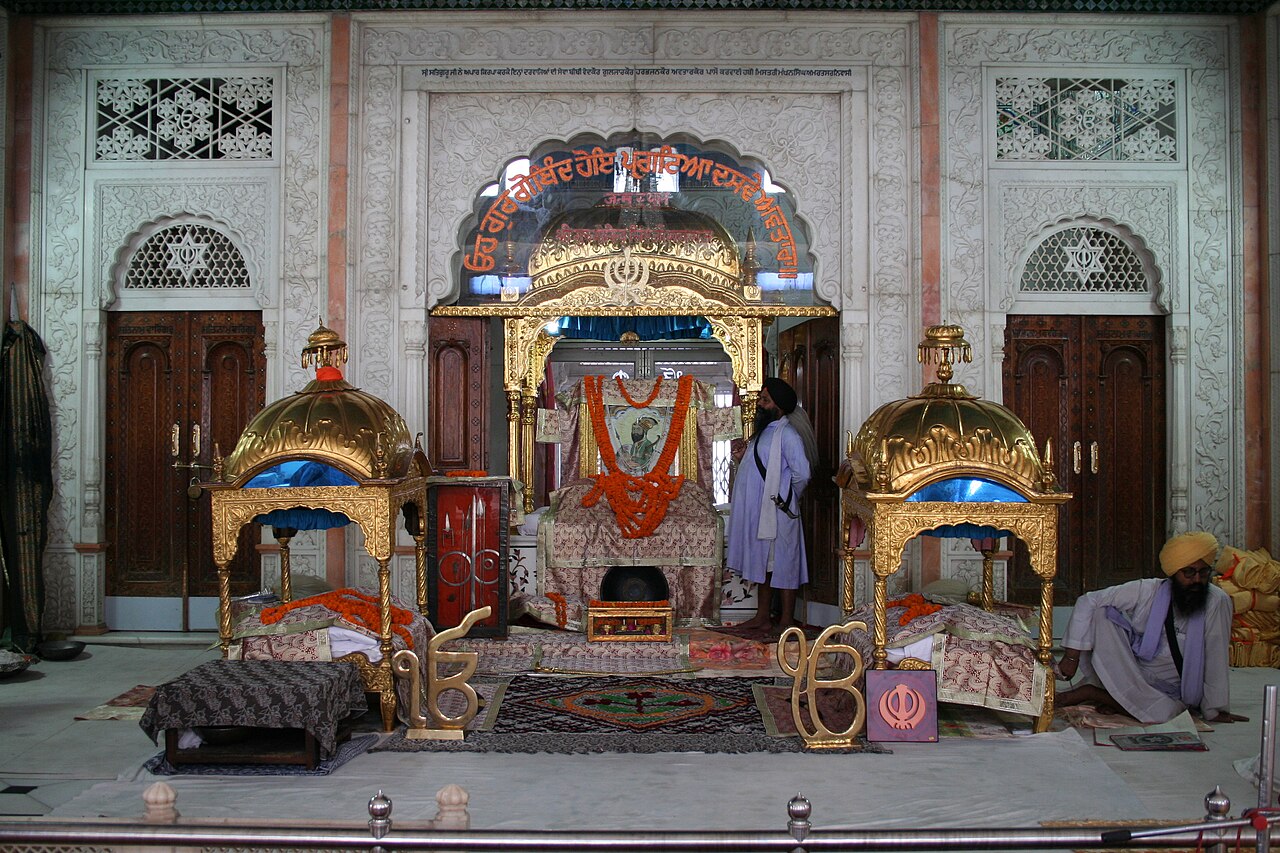
Inside, under a gilded canopy hung with marigold, the Sri Guru Granth Sahib Ji is enthroned on the spot tradition marks as the room of the Guru's birth, with the Sri Dasam Granth installed beside it, a pairing also kept at Takht Sachkhand Sri Hazur Sahib. Twin gold-domed palanquins flank the seat, and granthis keep watch through the day.
3
The relic hall
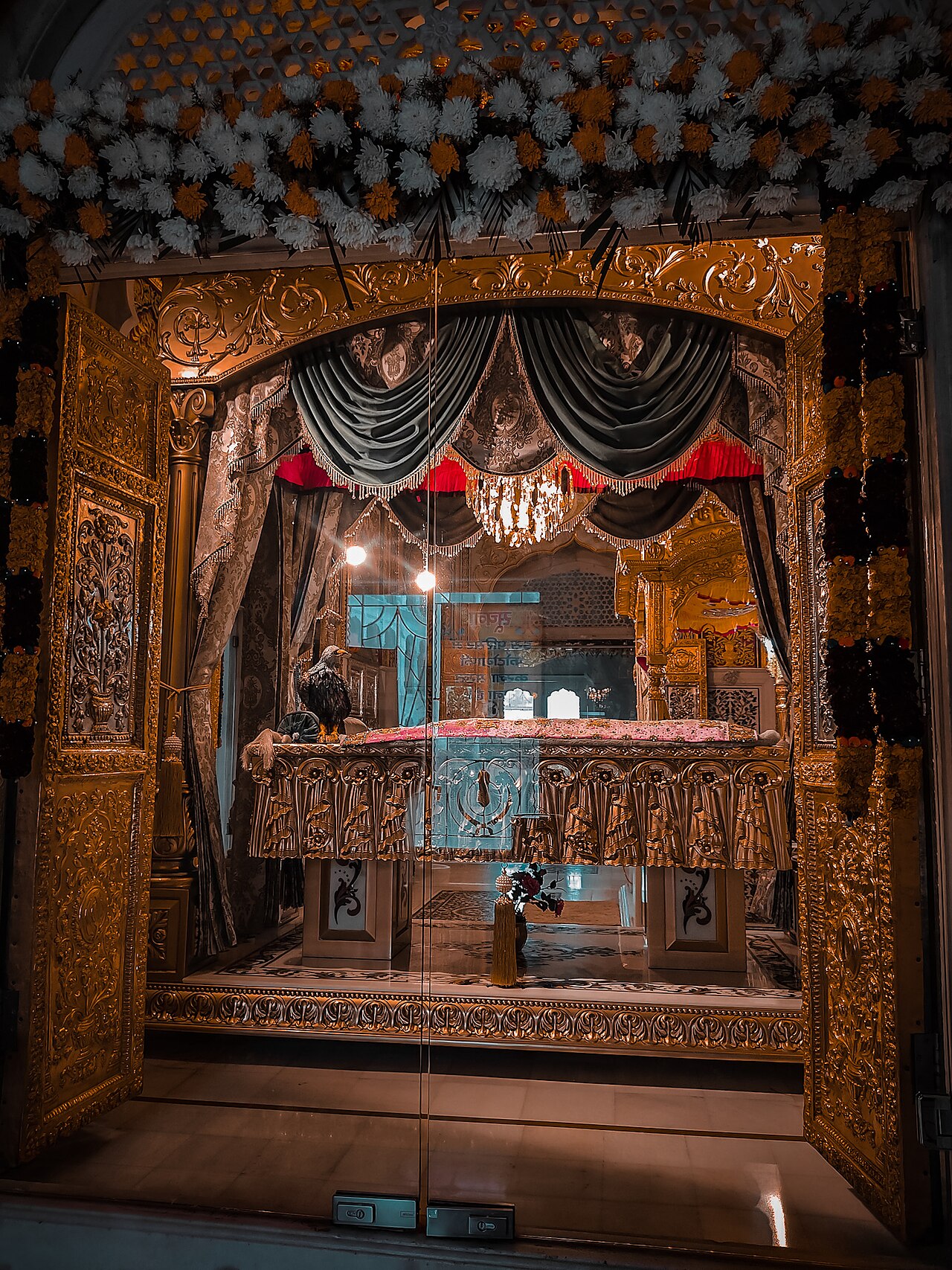
A museum within the complex keeps what the Takht holds as the Guru's own: a gilded cradle, or Panghura Sahib, a sword, four iron arrows, a khanda, ivory sandals, a wooden comb, and handwritten Hukamnamas of Guru Gobind Singh Ji and Guru Tegh Bahadur Ji, alongside a preserved baaz, the hawk that remains one of the Guru's most recognised symbols.
The gold-canopied sanctum inside Takht Sri Patna Sahib, marking the room where Guru Gobind Singh Ji was bornA preserved baaz, the hawk of Guru Gobind Singh Ji, displayed in a gilded case in the Takht's relic hall
Once a year Patna Sahib turns fully toward the birth that gave it its name. Akhand Path readings run through the nights before, kirtan darbars retell the tenth Guru's Patna childhood, a nagar kirtan procession moves through the old city with Gatka displays of the martial arts he later gave the Khalsa, and langar runs without pause for crowds that can multiply the old city's population for the week; the 350th Parkash Purab in 2016-17 alone drew pilgrims in the millions. The birth is reckoned by Sikh tradition on the lunar Bikrami date of Saptami, Paush, Shukla Paksha, a date that drifts on the Gregorian calendar and is fixed separately, and sometimes differently, by the Nanakshahi calendar and by Sikh bodies in different Indian states. In 2026 the gazetted observance in Bihar and Punjab falls on 28 December.
The Gregorian date shifts every year and different Sikh calendars can disagree by more than a week; confirm the date the Takht itself is observing at takhatpatnasahib.in before you travel.
Plan your visit
By air
Jay Prakash Narayan Airport, Patna, is roughly 16 km away, about 30 to 40 minutes by taxi.
By rail
Patna Sahib railway station, named for the Takht, is about 2 km away; Patna Junction is roughly 10 km.
Timings
Open daily, roughly 5:00 am to 9:00 pm, with morning Ardaas around 5:45 am and evening Rehras and Ardaas around 6:00 pm. Confirm current timings at takhatpatnasahib.in.
Best time
October to February for kinder weather; Parkash Purab week in December for the fullest atmosphere, or an ordinary weekday morning for quiet darshan.
Dress
Cover your head at all times inside; scarves are available near the entrance. Dress modestly and leave shoes at the free cloakroom.
The approach
There is no separate paid queue; sangat moves together through the halls to the sanctum and the relic hall.
Entry
Free, always, for everyone, as is the langar meal served in the complex.
Takht means throne in Punjabi; of the Five Takhts, Patna Sahib is the only one marking a birthplace rather than a court, a battle, or the end of the living Gurus' line.
Sikh tradition holds that a Muslim Pir named Bhikhan Shah, far from Patna, turned to bow in the infant Guru's direction on the day he was born, then travelled to see him for himself.
The Sri Dasam Granth is enthroned beside the Sri Guru Granth Sahib Ji here, a pairing also kept at Takht Sachkhand Sri Hazur Sahib in Nanded.
As at any gurdwara, tobacco, alcohol, and other intoxicants are never brought onto the grounds, and the langar is vegetarian, cooked and served without distinction of faith or status.
Questions pilgrims ask
Was Guru Gobind Singh Ji really born in this exact building?
The building standing today is not the original house. Sikh tradition holds that the birth took place in a haveli connected to the Patna jeweller Salis Rai Johri, later marked as a dharamsala. Maharaja Ranjit Singh raised it into a formal Takht in the nineteenth century, the 1934 earthquake badly damaged that structure, and the present white marble building was rebuilt between 1948 and 1957. The ground and the continuous line of memory are the same; the marble is not the seventeenth-century room itself.
Why is a Takht of the Sikhs located so far from Punjab, in Bihar?
Because Guru Gobind Singh Ji, the tenth Guru, was born here in 1666 while his father Guru Tegh Bahadur Ji was travelling in the east. A Takht marks where authority or a defining event in the Gurus' lives took place, not a region's population, which is why Patna Sahib stands over 1,200 km from Amritsar as the only Takht in eastern India.
Is Takht Sri Patna Sahib open to non-Sikhs?
Yes. As at every gurdwara, anyone may enter, take darshan of the Sri Guru Granth Sahib Ji, and eat in the langar, free of charge and without being asked their faith.
What relics can I actually see?
The Takht's museum displays what it holds as Guru Gobind Singh Ji's own cradle, sword, four iron arrows, a khanda, ivory sandals, and a wooden comb, alongside handwritten Hukamnamas of the ninth and tenth Gurus and a preserved baaz, the hawk long associated with Guru Gobind Singh Ji. Museum and relic-hall hours can run shorter than the Takht's own opening hours, so ask on arrival.
Should I try to visit during Parkash Purab?
Only if you want the fullest possible experience of the crowd and the kirtan; the 350th Parkash Purab in 2016-17 drew pilgrims in the millions, and even an ordinary year's observance fills the old city for a week. For a quieter darshan, come on an ordinary weekday morning instead.
The Sthan in photographs
Darshan from afar
From the temple's own channels. Nothing loads until you press play.
Dharamshalas and guest houses near this Sthan, shared by devotees. Adisthan takes no bookings and no money; contact each stay directly.
No stays are listed here yet. Know one that serves pilgrims well?
Are you a sevadar or officer of the Takhat Sri Harimandir Ji Patna Sahib Prabandhak Committee? Claim this page to keep timings, Parkash Purab dates, and the Takht's own word true for the sangat worldwide.