Darasuram, Kumbakonam · Thanjavur district, Tamil Nadu, India
The Cholas built their Lord a chariot of stone, then tuned its steps until the stone could sing.
Be the first to check in
Coming up: Maha Shivaratri · 6 MarEntry tended 29 Jun 2026
Worship 8 am to 12, 4 to 8 pm 12th-c. Chola · Rajaraja II Seven steps that ring like bells Maha Shivaratri · 6 Mar 2027 Entry free
You step through the gateway and the courtyard opens quiet and low, no crowd pressing, only birdsong and the slap of bare feet on warm granite. Then the front hall comes into focus and you realise it is rolling: great stone wheels stand carved against its sides, spokes and hubs complete, horses straining before them. Climb toward the porch and pause at the small balustraded stair, for these are the singing steps, and pilgrims say each one answers a tap with its own musical note. This shrine was not merely built. It was composed.
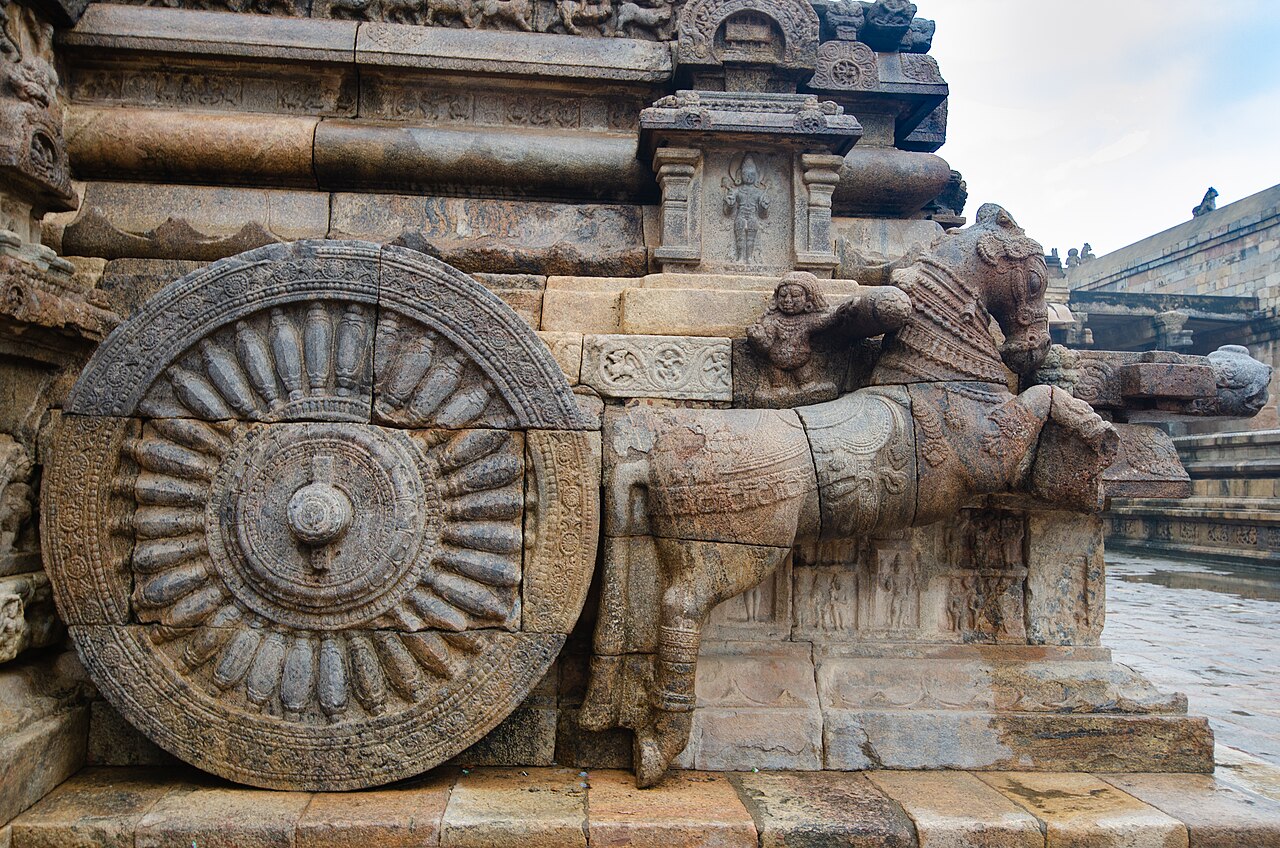
The front hall, named the Rajagambhiran tirumandapam in the Temple's own inscriptions, was conceived whole as a chariot with carved stone wheels and horses, a conception UNESCO calls unique among the Chola Temples.
One of the Three Great Living Chola Temples inscribed by UNESCO with the Brihadisvara Temples of Thanjavur and Gangaikondacholapuram: smaller than both, and the most highly ornate of the three, with worship in the Agamic tradition continuing to this day.
A Temple of stone that behaves like an instrument and a library at once: seven balustraded steps ring musical notes when struck, and labelled miniature friezes along the walls tell the lives of the sixty-three Nayanmars, the Shaiva saints of Tamil devotion.
The elephant, the god of death, and the king who carved a chariot
The name is a story in itself. Tradition holds that Airavata, the majestic white elephant who carries Indra across the heavens, lost the radiance of his skin, and that he bathed in the sacred tank of this place and rose from the water white again. The Lord Who Received his worship here became Airavatesvara, the Lord Of Airavata. And the tellings do not stop with the elephant: Yama, the god of death himself, burning under a rishi's curse, prayed To Lord Shiva at this shrine and bathed in the same tank, and the burning left him. The tank, fed by a channel from the Cauvery river, is called Yamateertham to this day.
The Temple as it stands is the prayer of one king. Rajaraja Chola II, who ruled from about 1146 to 1173 CE, raised it at Darasuram beside his capital, and it was completed around 1166 CE. His ancestors had built for scale at Thanjavur and Gangaikondacholapuram; he built for delicacy, a sanctum crowned by a 24 metre vimana, a front hall shaped as a chariot, and sculpture so dense that the walls read like an illuminated manuscript. The complex once spread through seven courts and seven streets, like Srirangam. War and the centuries took the outer rings; the innermost court survived, and inscriptions record gifts from Chola, Pandya, and Vijayanagara rulers who kept its lamps lit.
In 1987 UNESCO inscribed the Brihadisvara Temple at Thanjavur on the World Heritage list, and in 2004 the listing grew to take in Gangaikondacholapuram and Darasuram as the Great Living Chola Temples: living, because the worship established here more than eight centuries ago has never ceased.
What you'll actually see
1
The chariot hall and its wheels
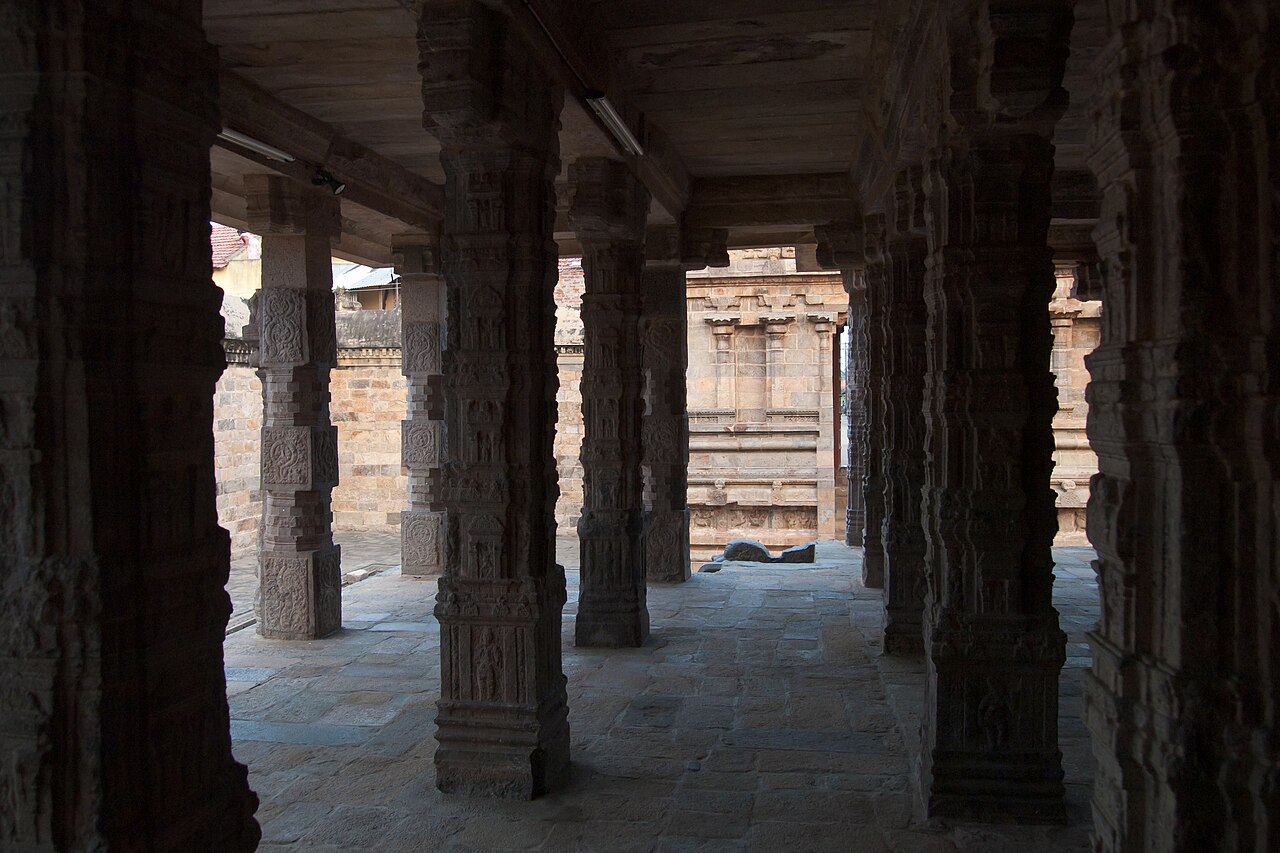
The agra mandapa, the Rajagambhiran tirumandapam of the inscriptions, meets you first: a pillared hall whose eastern face is carved as a chariot, with great spoked stone wheels at its sides and horses rearing before them. Its pillars are among the most ornate the Cholas ever cut, every surface alive with dancers, deities, and miniature stories.
2
The singing steps
At the hall's eastern porch a short flight of balustraded steps, intricately carved, rings a musical note when tapped. Pilgrims count seven steps for the seven notes of the scale. Touch them gently if at all; they have been singing for over eight hundred years.
3
The vimana and the Nayanmar friezes
The sanctum is a 12 metre square crowned by a vimana rising about 24 metres, elegant rather than colossal. Along the base run labelled miniature friezes narrating the lives of the sixty-three Nayanmars, the Shaiva saints whose hymns still shape Tamil worship, with niches of deities standing guard on the outer walls.
A carved stone chariot wheel on the Rajagambhiran tirumandapam of the Airavatesvara Temple, its spokes and hub completeThe ornately carved pillared mandapa of the Airavatesvara Temple at Darasuram
The carved chariot wheel, and the pillared mandapa · photos by Ganesh.Subramaniam85 (CC BY-SA 4.0) and Vyacheslav Argenberg (CC BY 4.0), Wikimedia Commons
A HALL BUILT AS A CHARIOT
The Rajagambhiran tirumandapam, with steps that sing
Temple halls are usually rooms; this one is a vehicle. The front mandapa was conceptualised, in UNESCO's own words, as a chariot with wheels, its stone wheels carved complete with spokes and hubs and its horses frozen mid-stride, as if the whole shrine were about to be drawn out in procession. And at its porch the builders left a flourish found almost nowhere else: a small flight of carved balustraded steps that answers a gentle tap with a clear musical note, the celebrated singing steps of Darasuram. Sculpture, engineering, and music meet in a single granite gesture, which is why art historians treat this smaller Temple as the most ornate achievement of Chola hands.
Come in early morning or late afternoon, when slanting light throws the wheel carvings into deep relief and the courtyard is at its quietest.
Plan your visit
By air
Tiruchirappalli International Airport (TRZ), about 90 km by road.
By rail
Darasuram station is about 1 km away; Kumbakonam, on the main line with better connections, is about 5 km.
By road
About 5 km from Kumbakonam bus stand, about 40 km northeast of Thanjavur, and about 290 km from Chennai.
Timings
Monument open 6:30 am to 8:30 pm daily; sanctum worship hours 8 am to 12 noon and 4 pm to 8 pm.
Entry
Free. Still photography with handheld cameras is also free.
Best time
November to February for cool weather; early morning for soft light and near-empty courtyards.
The Chola circuit
Many pilgrims take darshan at all Three Great Living Chola Temples, Thanjavur, Gangaikondacholapuram, and Darasuram, in a single day by road.
Airavatesvara means the Lord Of Airavata: Lord Shiva here Is named for the white elephant of Indra who, tradition holds, regained his lustre by bathing in the Temple tank.
The shrine of The Goddess, the Maa Periya Nayaki Amman Temple, stands as a detached Temple just north of the main complex, one of the earliest signs of the Amman shrine becoming essential to the South Indian Temple.
This is both a living shrine and a protected monument: worship is administered with the Thanjavur Palace Devasthanam under Tamil Nadu's HR&CE department while the Archaeological Survey of India cares for the fabric, so remove footwear and treat every carved surface as sacred.
Carl Sagan filmed at this Temple for his 1980 series Cosmos, using its stones to speak of Hindu cosmology and its cycles of cosmic time.
Questions pilgrims ask
Is this a working Temple or only a monument?
Both, and that is the point of its UNESCO name. The Great Living Chola Temples are called living because Agamic worship begun over eight centuries ago continues daily. The sanctum of Lord Shiva as Airavatesvara receives regular worship, generally 8 am to 12 noon and 4 pm to 8 pm, while the ASI maintains the monument around it.
Why is the Temple named after an elephant?
Tradition holds that Airavata, the white elephant who carries Indra, bathed in the sacred tank here and regained the radiance of his skin, and worshipped Lord Shiva in gratitude. The Lord Of this place therefore Carries the elephant's name: Airavatesvara.
What are the singing steps?
A short flight of intricately carved balustraded steps at the eastern porch of the chariot hall. Struck gently, they ring musical notes; pilgrims count seven steps for the seven notes. They are fragile and centuries old, so be gentle or simply listen when a guide demonstrates.
Where Is the shrine of The Goddess?
Maa Periya Nayaki Amman, the consort of Lord Shiva here, Is Worshipped in a separate Temple standing just north of the main complex. Scholars believe it stood within the outer courts before the Temple's seven enclosures were reduced to one.
How is Darasuram different from the other two Chola Temples?
Thanjavur and Gangaikondacholapuram were built for scale; Darasuram was built for detail. It is much smaller, but UNESCO's listing singles out its highly ornate execution: the chariot-form hall, the singing steps, and friezes of the sixty-three Nayanmars are found here alone.
Dharamshalas and guest houses near this Sthan, shared by devotees. Adisthan takes no bookings and no money; contact each stay directly.
No stays are listed here yet. Know one that serves pilgrims well?
Do you serve Lord Airavatesvara as a priest, trustee, or officer of the Devasthanam? Claim this page to keep its worship hours, festival days, and pilgrim guidance true for every devotee who comes to hear the stone sing.