Swaminarayan Akshardham (Gandhinagar)
Akshardham Gandhinagar · Swaminarayan Akshardham Gujarat · Gandhinagar Akshardham
About
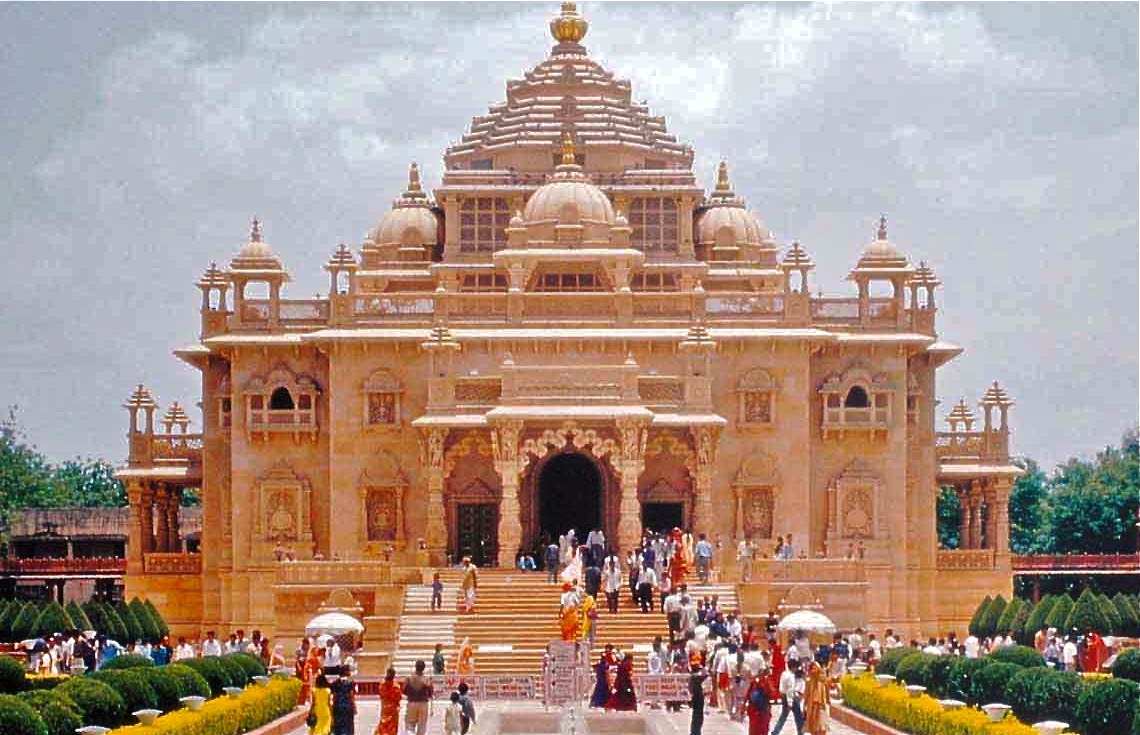
Occupying 23 acres at the heart of Gandhinagar, the mandir at Akshardham rises 108 feet, stretches 240 feet in length, and spans 131 feet across, its entire mass drawn from approximately 6,000 metric tons of pink sandstone brought from quarries in Rajasthan. Vedic architectural convention governs its construction: no iron or steel appears anywhere within the structure; 20-foot stone beams, each tipping the scales at five tons, bear the weight of the building throughout. Across the mandir's outer surfaces: 264 sculpted figures, 220 stone beams, 97 intricately carved pillars, 17 domes, and 8 balconies, each element a cumulative act of devotion rendered in stone.
Within the central chamber, a sacred image of Swaminarayan stands seven feet tall, covered in gold leaf and seated on a pedestal three feet high; the murti weighs 1.2 tons. To either side are images of Aksharbrahma Gunatitanand Swami and Aksharmukta Goplanand Swami, each rendered in an attitude of loving reverence toward Swaminarayan. Marble figures at the four corners of the mandir represent the lineage of successors venerated by BAPS followers. Higher up, the Vibhuti Mandapam floor presents lotus-shaped displays devoted to Swaminarayan's spiritual character, while the Prasadi Mandapam below houses a collection of sacred relics from his life.
Surrounding the shrine, the complex opens into a wide constellation of spaces for practice, learning, and community. The Abhishek Mandapam invites every visitor to pour sanctified water over a murti of Neelkanth Varni, Swaminarayan in his youthful yogic form, a ritual accompanied by Vedic recitations. Five exhibition halls employ dioramas, audio-visual technology, and a 40-minute IMAX film to trace Swaminarayan's teachings and pilgrimage. The evening Sat-Chit-Anand Water Show, taking its name from the Sanskrit triad for Truth, Consciousness, and Bliss, dramatizes the Nachiketa parable from the Kaṭhopaniṣad through fire, fountains, laser projections, and live performance. Beyond the halls, Sahajanand Van offers fifteen acres of gardens, sculpted cultural wisdom spots, and an outdoor assembly ground for 9,000.
History
Pramukh Swami Maharaj, fifth spiritual successor of Bhagwan Swaminarayan within the BAPS tradition, laid the foundation stone on 14 December 1979, carrying forward a vision first held by his own predecessor, Yogiji Maharaj. Temple architect Chandrakant Sompura designed the mandir, and craftsmen shaped some 6,000 metric tons of pink sandstone into its finished form by 1985, after which the surrounding exhibition halls and gardens took several more years to complete. The full complex opened to the public on 4 November 1992. On 24 September 2002 the complex suffered an armed attack that killed thirty-three people and wounded seventy; Pramukh Swami Maharaj's call for a prayer assembly of peace five days later, attended by more than 30,000 people, became known among observers as the Akshardham Response, and the mandir reopened within a fortnight.
Significance
Within BAPS theology, Akshardham names Bhagwan Swaminarayan's own eternal abode, the state a soul reaches upon liberation, so the mandir stands as an earthly likeness of that transcendent home rather than a shrine built around a single object of worship. The Akshardham Centre for Applied Research in Social Harmony, housed within the complex, holds a library of more than 7,000 works in Sanskrit, Hindi, Gujarati, and Tamil and hosts scholarly conferences on Hindu philosophy, extending the site's purpose from devotion into study. Devotees come to offer abhishek to a murti of Neelkanth Varni, Bhagwan Swaminarayan's own youthful pilgrim form, continuing in miniature the wandering vow he kept as a young ascetic.
Architecture
Traditional North Indian Hindu Temple architecture in pink Rajasthan sandstone, designed by Temple architect Chandrakant Sompura and built entirely without iron or steel in keeping with Vedic construction convention.
Visiting
Daily worship
| Mandir Darshan | 10:00 AM to 7:30 PM | |
| Morning Arti | 10:00 AM to | |
| Evening Arti | 6:30 PM to |
Hours
Hours not listed.
Contact
Engage with Swaminarayan Akshardham (Gandhinagar)
Through the four pathways
Seva सेवा — Service
Offer your time and skills here. The following opportunities are open at Swaminarayan Akshardham (Gandhinagar):
No Seva offerings listed yet.
Sādhana साधना — Practice
Learn the worship and practice associated with Swaminarayan Akshardham (Gandhinagar):
No Sādhana offerings listed yet.
Sandhāna सन्धान — Wisdom
Unite with the wisdom of this tradition:
No Sandhāna offerings listed yet.
Sādhya साध्य — Giving
Support this sacred place according to your means:
No Sādhya offerings listed yet.
All giving flows directly to Swaminarayan Akshardham (Gandhinagar). Adisthan does not take a commission.
Festivals & Events
- Nov
Diwali and Annakut (Festival of Lights)
8 November 2026 · annual
Each year around Diwali the mandir lights more than ten thousand traditional lamps across the complex and complements them with a glow garden, running through to the Gujarati new year, when an Annakut of offerings is laid before Bhagwan Swaminarayan in the tradition BAPS Temples keep worldwide.
- Apr
Swaminarayan Jayanti
15 April 2027 · annual
The birth anniversary of Bhagwan Swaminarayan (1781-1830), founder of the tradition BAPS carries forward, observed with devotion at Swaminarayan mandirs worldwide including this one.
Gallery
Related sacred places
 Hinduism
Airavatesvara Temple, Darasuram
Darasuram (Kumbakonam) · India · temple
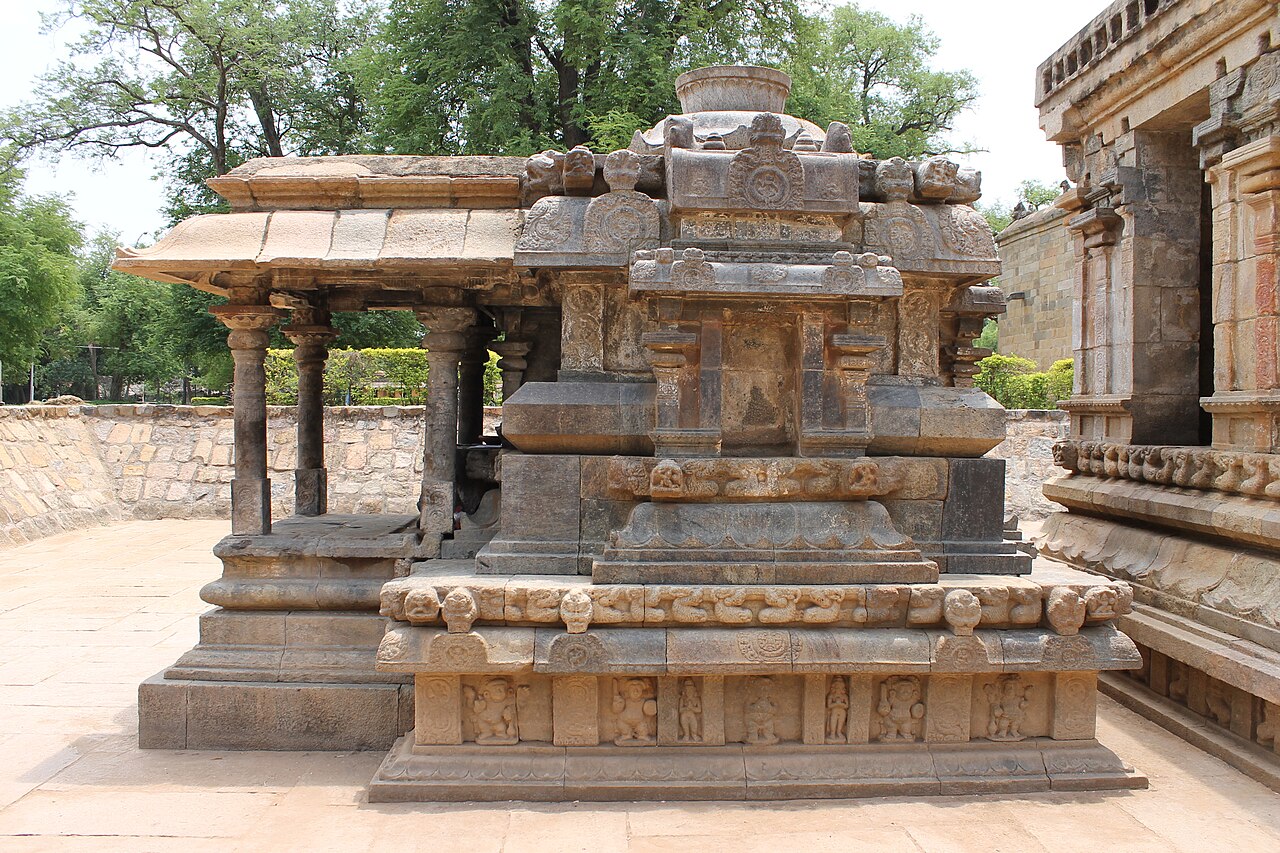
The third of the Great Living Chola Temples, raised by Rajaraja Chola II around 1166 CE at Darasuram near Kumbakonam: a chariot-form shrine of Lord Shiva as Airavatesvara, famed for its carved stone wheels, its singing steps, and worship that has continued for over eight centuries.
Aisanyesvara Siva Temple
Bhubaneswar · India · temple
A living thirteenth-century Shiva shrine in the Old Town of Bhubaneswar, standing close to the western wall of the great Lingaraj Temple, where a Shivalinga set within a circular yonipitha still receives daily worship in the Kalinga architectural tradition.
 Hinduism
Akhadachandi Temple
Bhubaneswar · India · temple
A tenth-century Kalinga-style shrine on the southwestern bank of Bhubaneswar's sacred Bindusagar tank, Akhadachandi Temple honours Maa Mahishasuramardini, the Goddess in her form as slayer of the buffalo demon, within the dense cluster of ancient shrines that fills the city's Old Town.
 Hinduism
Akshardham
New Delhi · India · temple
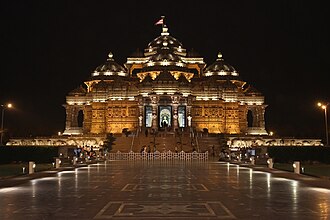
A vast contemporary Hindu mandir campus on the Yamuna's west bank in East Delhi, raised without structural steel by 11,000 artisans and volunteers, and recognised by Guinness World Records in 2007 as the world's largest comprehensive Hindu Temple.
 Hinduism
Amarnath Temple
· India · temple
A high Himalayan cave shrine in Jammu and Kashmir where a naturally forming ice lingam is venerated as Lord Śiva, drawing one of India's great seasonal pilgrimages.
 Hinduism
Ambalappuzha Sri Krishna Temple
Ambalappuzha · India · temple
A Vaishnava shrine on the Kerala backwaters consecrated to Sri Krishna in his Parthasarathy form, counted among the seven great Temples of the former kingdom of Travancore and famed across South India for its Ambalapuzha Paal Payasam offering.