Darshan 5:30 am to 9:30 pm Free darshan Karthigai Deepam · 24 Nov 2026 Girivalam · 14 km barefoot 11-tier, 66 m Rajagopuram
The eastern gopuram climbs eleven painted tiers above the bazaar, two hundred feet of gods and guardians, and still it is not the tallest thing in front of you. Behind the tower stands Arunachala itself, 814 metres of bare red rock, and every pilgrim in the street walks with one eye on it. Pass beneath the gateway, cross courtyards the size of village squares, and you come at last to a dark sanctum and a lingam of fire. But the elder shrine is the one you saw from the train. Here, the mountain Is the Lord.
One of the five Pancha Bhoota Sthalams, where Lord Shiva Is Worshipped as a single element. This is the shrine of fire: the presiding lingam is the Agni lingam, the Lord as flame.
Lord Annamalaiyar Is Worshipped as the embodiment of the hill itself. Sri Ramana Maharshi taught that other holy hills are the abodes of the Lord, but Arunachala is Lord Shiva Himself.
The worship here is a walk: girivalam, the 14 km barefoot circling of the hill, past the eight Ashta Lingams of the directions, drawing hundreds of thousands of devotees every full moon night.
The Hill the fire became
The old telling begins with a moment of play. On Kailash, Maa Parvati covered the eyes of Lord Shiva with Her hands, and in that instant the light of the worlds went out. To dissolve what that darkness had wrought, She was sent south, to perform tapas at the ashram of the sage Gautama at the foot of this hill. The Lord tested Her, and on the full moon of the Tamil month of Karthigai He appeared before Her as a column of fire on the summit of Arunachala, and accepted Her. That flame returns to the hilltop every Karthigai Pournami as the Maha Deepam.
Another telling explains why the fire became stone. Brahma and Vishnu, tradition holds, fell to arguing over which of them was supreme, and Lord Shiva rose between them as a blazing column without top or bottom. Vishnu took the form of a boar and dug downward through the ages; Brahma became a swan and flew up; neither found an end. Humbled, they worshipped the fire, and the Lord, too fierce to approach as flame, settled into stillness as the hill itself, taking form as a lingam at its base. That lingam is Arunachaleswarar, and the Temple grew around it.
The sung history is nearly as old as the stone. Sambandar and Appar, the seventh-century Tevaram saints, each praised Lord Annamalaiyar and Maa Unnamulai in ten verses, making this a Paadal Petra Sthalam. The present masonry rises from the ninth century, under the Cholas, whose kings gave land and cattle by inscription. Vijayanagara made it vast: the great eastern gopuram was begun in the reign of Krishnadevaraya and completed under Sevappa Nayaka. And in September 1896 a sixteen-year-old boy walked out of Madurai, entered this Temple, and reported his arrival to his Father in the inner shrine. The world came to know him as Sri Ramana Maharshi.
What you'll actually see
1
The Rajagopuram and the walled city
The eastern tower rises 66 metres in eleven storeys, among the tallest Temple gopurams in India, begun under Krishnadevaraya and finished in the Nayaka years. It opens into a 25-acre complex of nested courtyards, tanks and shrines, with a gopuram guarding each of the four directions.
2
The thousand-pillared hall and the Pathala Lingam
In the outer court stands the late-Vijayanagara hall of a thousand pillars, its columns carved with yali, the lion-bodied, elephant-headed beast. Beneath its raised floor lies the Pathala Lingam, the underground vault where the young Sri Ramana Maharshi sat absorbed in the Self, oblivious to the ants and vermin that bit him.
3
The sanctum of fire
At the heart of the complex, in the oldest stone, Lord Arunachaleswarar Is present as the Agni lingam, the element of fire itself. Maa Unnamulai, Whom the Ramana tradition reveres as Mother Apeethakuchamba, abides in Her own shrine, and the hill fills every doorway you turn to face east.
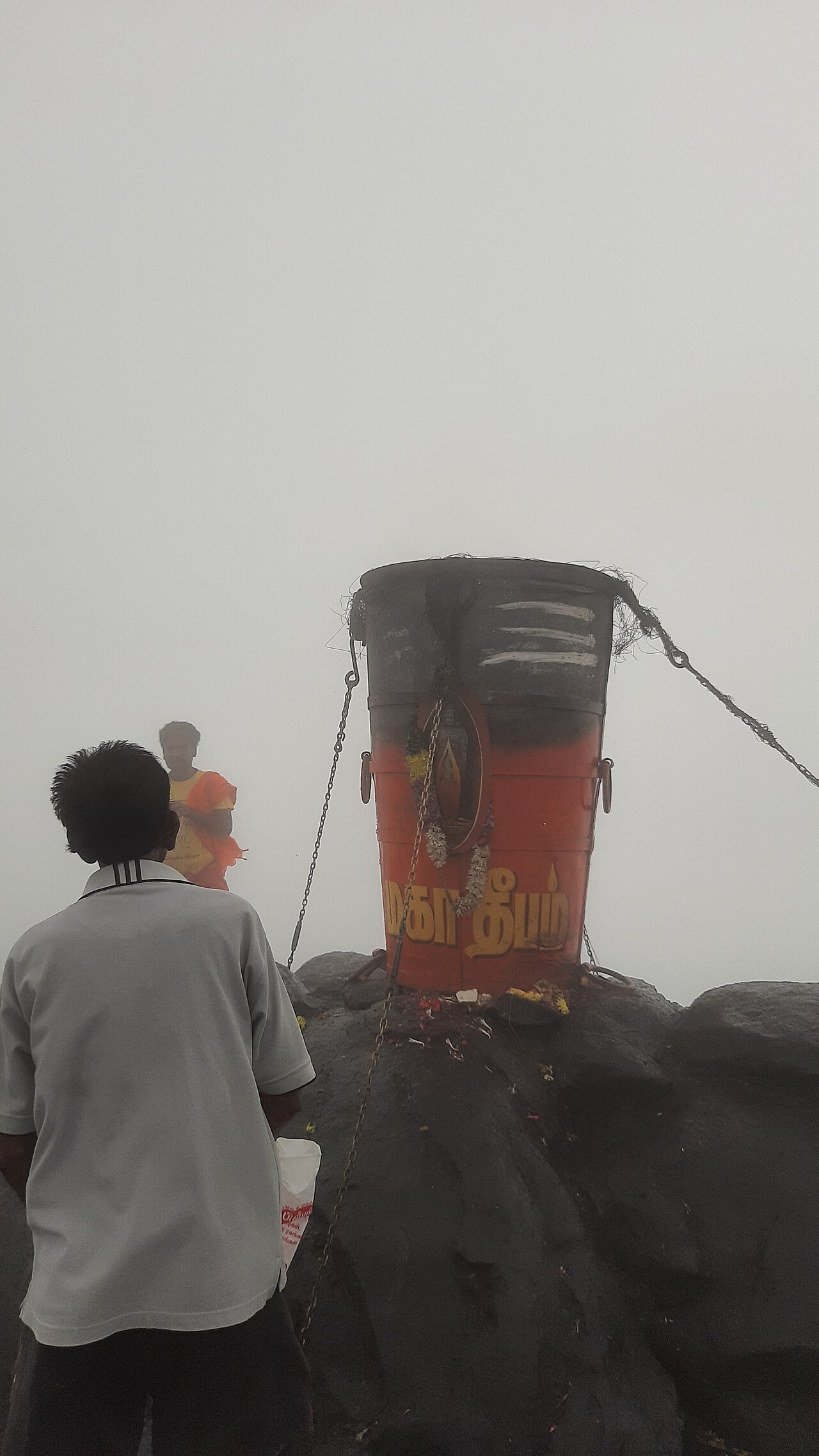
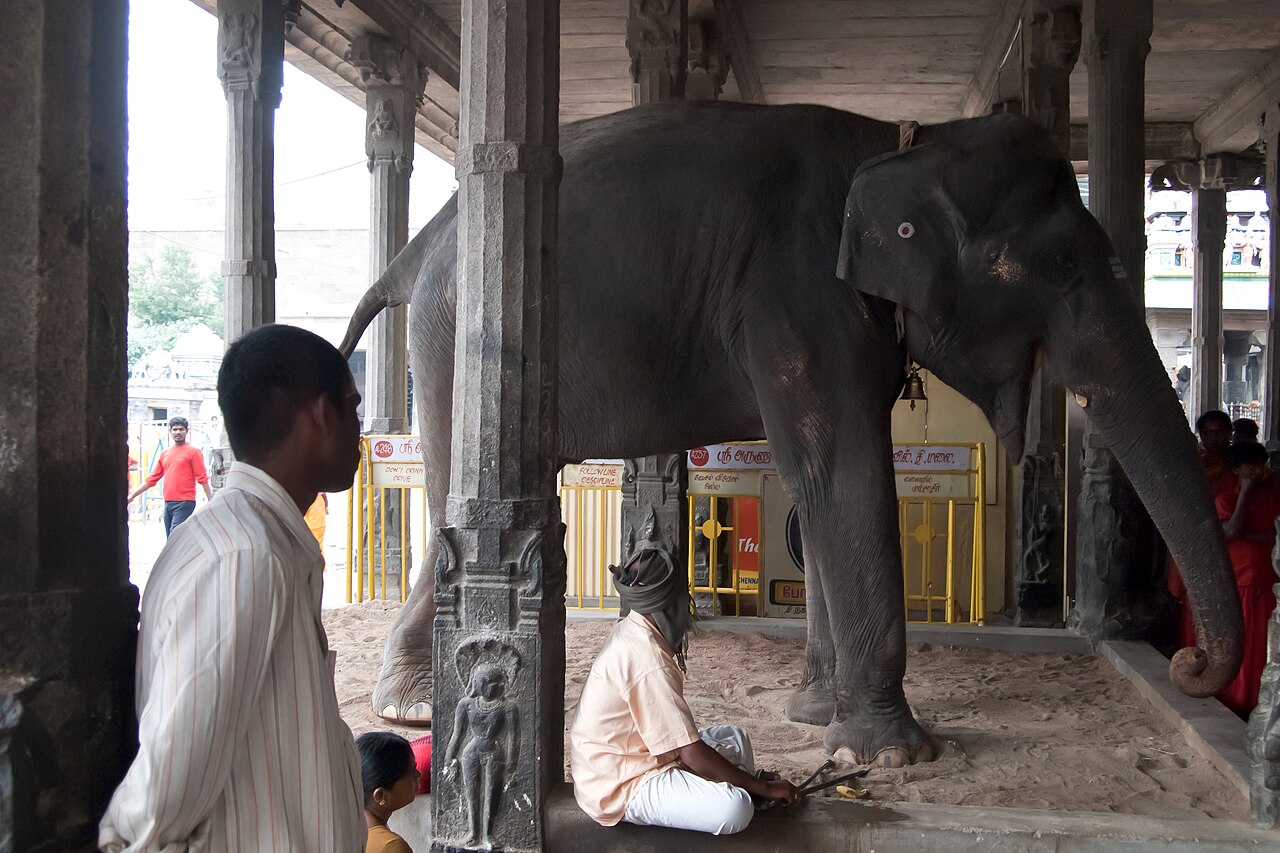
The Karthigai Maha Deepam flame burning at the summit of Arunachala hill at duskThe Temple elephant blessing devotees inside Arunachaleswarar Temple, Tiruvannamalai
The Maha Deepam on the summit, and the temple elephant in the courts · photos CC BY-SA 4.0 Accesscrawl and CC BY 4.0 Vyacheslav Argenberg, Wikimedia Commons
THE FLAME ON THE MOUNTAIN
Karthigai Deepam · 24 November 2026
For ten days, 15 to 24 November 2026, Tiruvannamalai keeps the Karthigai Brahmotsavam, the deities in procession through the four great streets. Then, on the morning of the tenth day, around four o'clock, the Bharani Deepam is lit inside the Temple. At about six that evening, as the Karthigai full moon rises, its flame is carried to the summit and the Maha Deepam flares from a huge copper cauldron, fed, the Temple town's chroniclers record, with some 3,500 kg of ghee on a wick of cloth, a fire visible for roughly 35 km in every direction. Below it, lakhs upon lakhs of devotees begin the girivalam under the burning hill, the column of fire of the legend made annual and visible.
This is among the largest single-night gatherings in Tamil Nadu; book rooms months ahead, or come on one of the nine processional days before the flame.
Plan your visit
By air
Chennai International Airport is the practical gateway, about 185 km away, 4 to 5 hours by road.
By rail
Tiruvannamalai station (TNM), on the Villupuram to Katpadi line, is about 2 km from the Temple.
By road
About 185 km from Chennai and about 205 km from Bengaluru; frequent buses run from Chennai, Bengaluru, Vellore and Puducherry.
Timings
5:30 am to 12:30 pm and 3:30 pm to 9:30 pm daily; festival and full moon days run longer.
Darshan
General darshan is free; paid special-darshan tickets are offered at the Temple.
Best time
A weekday morning for quiet darshan; a Pournami night if you have come to walk the hill.
Girivalam
14 km around the hill, walked barefoot with the hill on your right; most devotees walk through the cool of the full moon night.
Annamalai, the Lord's Tamil name, is understood as the unreachable mountain: the hill whose top and bottom even Brahma and Vishnu could not find.
Sri Ramanasramam, where Sri Ramana Maharshi lived from 1922 until 1950, stands at the foot of the hill on the girivalam road, and many pilgrims pair the Temple with the ashram and the caves where he lived on the slopes.
Each January, in the Thai month, the Thiruvoodal festival enacts a lovers' quarrel between Lord Annamalaiyar and Maa Unnamulai on the streets outside the walls, ending in reconciliation.
Eight Ashta Lingams ring the girivalam path, one for each direction: Indra, Agni, Yama, Niruthi, Varuna, Vayu, Kubera and Esanya.
Questions pilgrims ask
Is the deity the lingam in the sanctum, or the hill?
Both, and that is the point. Lord Annamalaiyar Is Worshipped as the embodiment of Arunachala hill itself; the Agni lingam in the sanctum is that same presence given a form that can be approached and served. Devotees who circle the hill and devotees who enter the sanctum are worshipping one Lord.
What is girivalam, and can anyone do it?
Girivalam is the barefoot circumambulation of the hill, about 14 km on a paved road, keeping the hill on your right, past the eight Ashta Lingams. Anyone may walk it. On full moon nights hundreds of thousands walk together; on other days you may have long stretches of the road to yourself.
What happens at Karthigai Deepam?
On 24 November 2026, the tenth day of the festival, the Bharani Deepam is lit inside the Temple around 4 am, and at about 6 pm its flame lights the Maha Deepam in a great cauldron of ghee on the summit, visible for many kilometres. Lakhs of devotees walk the girivalam beneath the flame that night.
What is the Pathala Lingam?
An underground shrine beneath the raised hall near the thousand-pillared mandapam. In 1896 the newly arrived Sri Ramana Maharshi sat there in unbroken absorption, unaware of his own body. It is kept as a shrine, and pilgrims on the Ramana path make a point of it.
Is there an entry fee?
No. General darshan is free at all times; the Temple offers paid special-darshan tickets for a shorter queue, and separate fees apply for sevas such as abhishekams.
The Sthan in photographs
Darshan from afar
From the temple's own channels. Nothing loads until you press play.
Dharamshalas and guest houses near this Sthan, shared by devotees. Adisthan takes no bookings and no money; contact each stay directly.
No stays are listed here yet. Know one that serves pilgrims well?
Are you a priest, trustee or sevak of Arulmigu Arunachaleswarar Temple? Claim this page to keep darshan hours, girivalam guidance and Deepam schedules exact for the pilgrims who plan their year around the Hill.