Astasambhu Siva Temples
Ashtasambhu Siva Temples · Astasambhu Temple
About
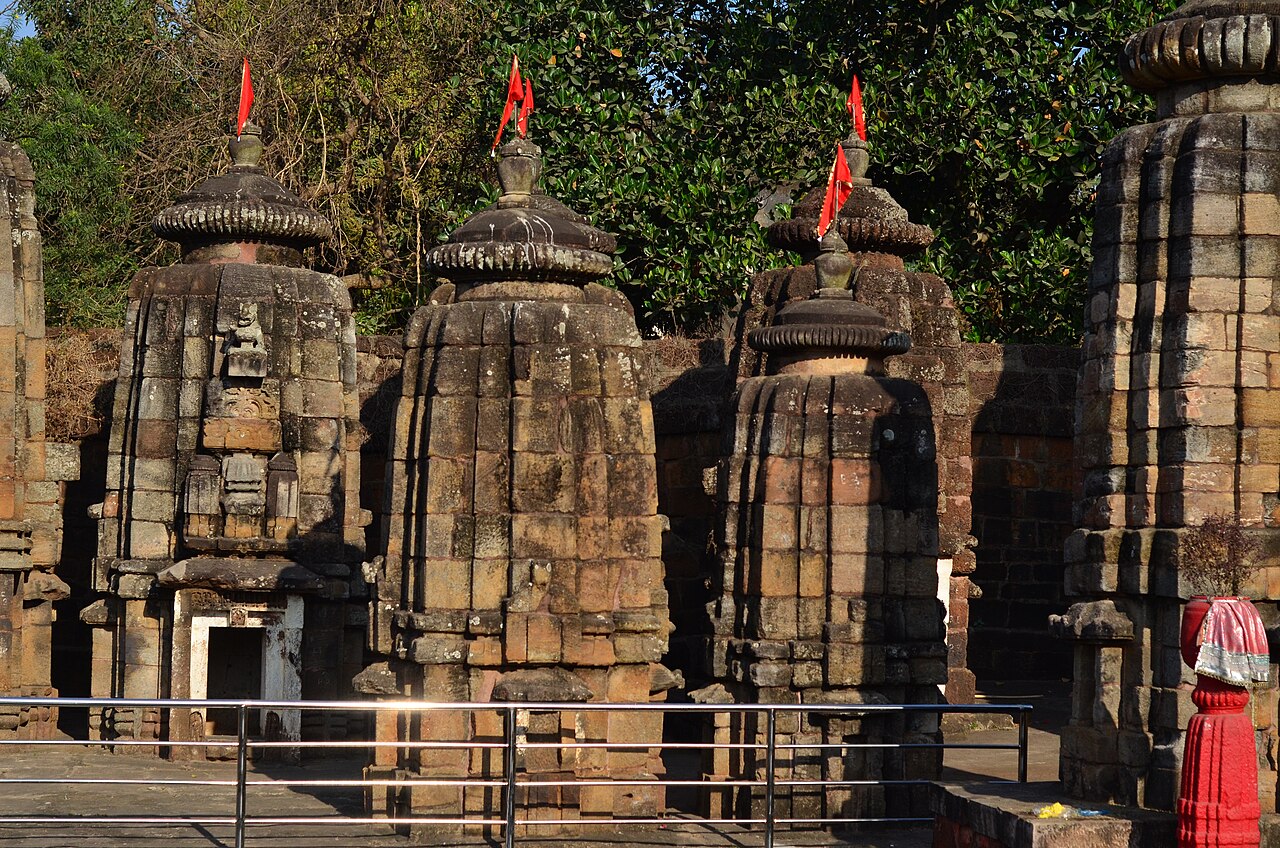
Nestled inside the walled compound of the Uttareśvara Śiva Temple in Bhubaneswar, the capital of Odisha, these eight small shrines share a devotional kinship announced in their very name: aṣṭa (eight) and Śambhu, a beloved epithet of Lord Śiva meaning the bestower of peace. Five of the Temples stand in a single continuous row, a grouping the local community has long called Panchu Pāṇḍava, evoking the five heroic brothers of the Mahābhārata.
Each shrine follows the Kālingan rekha deul form, a curvilinear tower rising from a square base, rendered in coarse grey sandstone laid without mortar in the dry masonry style. The square garbhagṛha measures roughly two and a half metres across, preceded by a modest frontal porch. A pancharatha plan organises the exterior walls into five projecting vertical bands: a central raha flanked by pairs of anuratha and kanika pagas, lending the compact structure a rhythmic play of light and shadow.
The elevation rises through three canonical divisions, bāḍa, gaṇḍī, and mastaka. The lower bāḍa carries four base mouldings (khura, kumbha, pāta, and basanta) before ascending through the jāṅghā to a baranda cornice. Above, the unadorned gaṇḍī tapers to the mastaka, which is crowned with beki, āmalaka, khapuri, and kalaśa. On the exterior walls, parsvadevata niches punctuate the north, west, and south faces of the jāṅghā. The southern niche shelters a four-armed Gaṇeśa, flanked overhead by two celestial vidyādharas bearing garlands.
The setting itself enriches the devotional atmosphere: the Godāvarī tank lies to the east, the broad Binduśāgar tank beyond the southern wall, and the enclosure of Uttareśvara to the west, water, stone, and prayer arranged in quiet proximity.
History
Architectural analysis of the Temples' base mouldings and wall divisions places their construction in the tenth century CE, within the great wave of Kalinga Temple building that shaped Bhubaneswar's Old Town. The eight shrines stand together as a single planned group rather than a scattered accumulation, sharing identical proportions, a westward orientation, and the same dry ashlar masonry of grey sandstone. Five of the eight stand in a continuous row that local memory has long called the Panchu Pandava, after the five brothers of the Mahabharata, while the remaining three complete the cluster within the same walled precinct. The group takes its name directly from its number and its dedication: ashta for eight, and Sambhu, an epithet of Lord Shiva meaning the source of auspiciousness.
Significance
Clustered beside the Godavari tank and the wider Bindusagar, the great sacred lake around which much of Old Town Bhubaneswar's devotional life still turns, the Astasambhu shrines let a pilgrim greet Lord Shiva eight times within a single walk. Their carved doorways preserve a seated Gajalakshmi at the threshold and a four armed Lord Ganesha in the surviving niche, guardians placed here by builders working in the same idiom that raised Bhubaneswar's grander towers. As a coordinated tenth century ensemble still standing within a living Temple precinct, the group is a quiet but complete record of how Kalinga architects thought in multiples as well as monuments.
Architecture
Kalingan Rekha Deul, pancharatha plan, dry ashlar masonry in coarse grey sandstone
Visiting
Hours
Hours not listed.
Contact
No contact details listed yet.
Address
Engage with Astasambhu Siva Temples
Through the four pathways
Seva सेवा — Service
Offer your time and skills here. The following opportunities are open at Astasambhu Siva Temples:
No Seva offerings listed yet.
Sādhana साधना — Practice
Learn the worship and practice associated with Astasambhu Siva Temples:
No Sādhana offerings listed yet.
Sandhāna सन्धान — Wisdom
Unite with the wisdom of this tradition:
No Sandhāna offerings listed yet.
Sādhya साध्य — Giving
Support this sacred place according to your means:
No Sādhya offerings listed yet.
All giving flows directly to Astasambhu Siva Temples. Adisthan does not take a commission.
Gallery
Related sacred places
 Hinduism
Airavatesvara Temple, Darasuram
Darasuram (Kumbakonam) · India · temple
The third of the Great Living Chola Temples, raised by Rajaraja Chola II around 1166 CE at Darasuram near Kumbakonam: a chariot-form shrine of Lord Shiva as Airavatesvara, famed for its carved stone wheels, its singing steps, and worship that has continued for over eight centuries.
Aisanyesvara Siva Temple
Bhubaneswar · India · temple
A living thirteenth-century Shiva shrine in the Old Town of Bhubaneswar, standing close to the western wall of the great Lingaraj Temple, where a Shivalinga set within a circular yonipitha still receives daily worship in the Kalinga architectural tradition.
 Hinduism
Akhadachandi Temple
Bhubaneswar · India · temple
A tenth-century Kalinga-style shrine on the southwestern bank of Bhubaneswar's sacred Bindusagar tank, Akhadachandi Temple honours Maa Mahishasuramardini, the Goddess in her form as slayer of the buffalo demon, within the dense cluster of ancient shrines that fills the city's Old Town.
 Hinduism
Akshardham
New Delhi · India · temple
A vast contemporary Hindu mandir campus on the Yamuna's west bank in East Delhi, raised without structural steel by 11,000 artisans and volunteers, and recognised by Guinness World Records in 2007 as the world's largest comprehensive Hindu Temple.
 Hinduism
Amarnath Temple
· India · temple
A high Himalayan cave shrine in Jammu and Kashmir where a naturally forming ice lingam is venerated as Lord Śiva, drawing one of India's great seasonal pilgrimages.
 Hinduism
Ambalappuzha Sri Krishna Temple
Ambalappuzha · India · temple
A Vaishnava shrine on the Kerala backwaters consecrated to Sri Krishna in his Parthasarathy form, counted among the seven great Temples of the former kingdom of Travancore and famed across South India for its Ambalapuzha Paal Payasam offering.