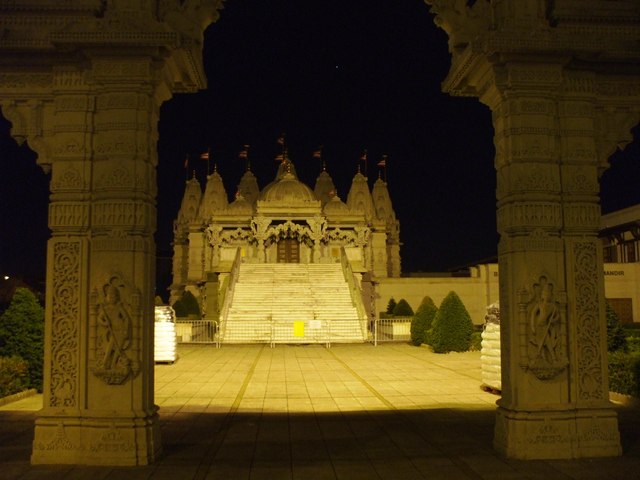
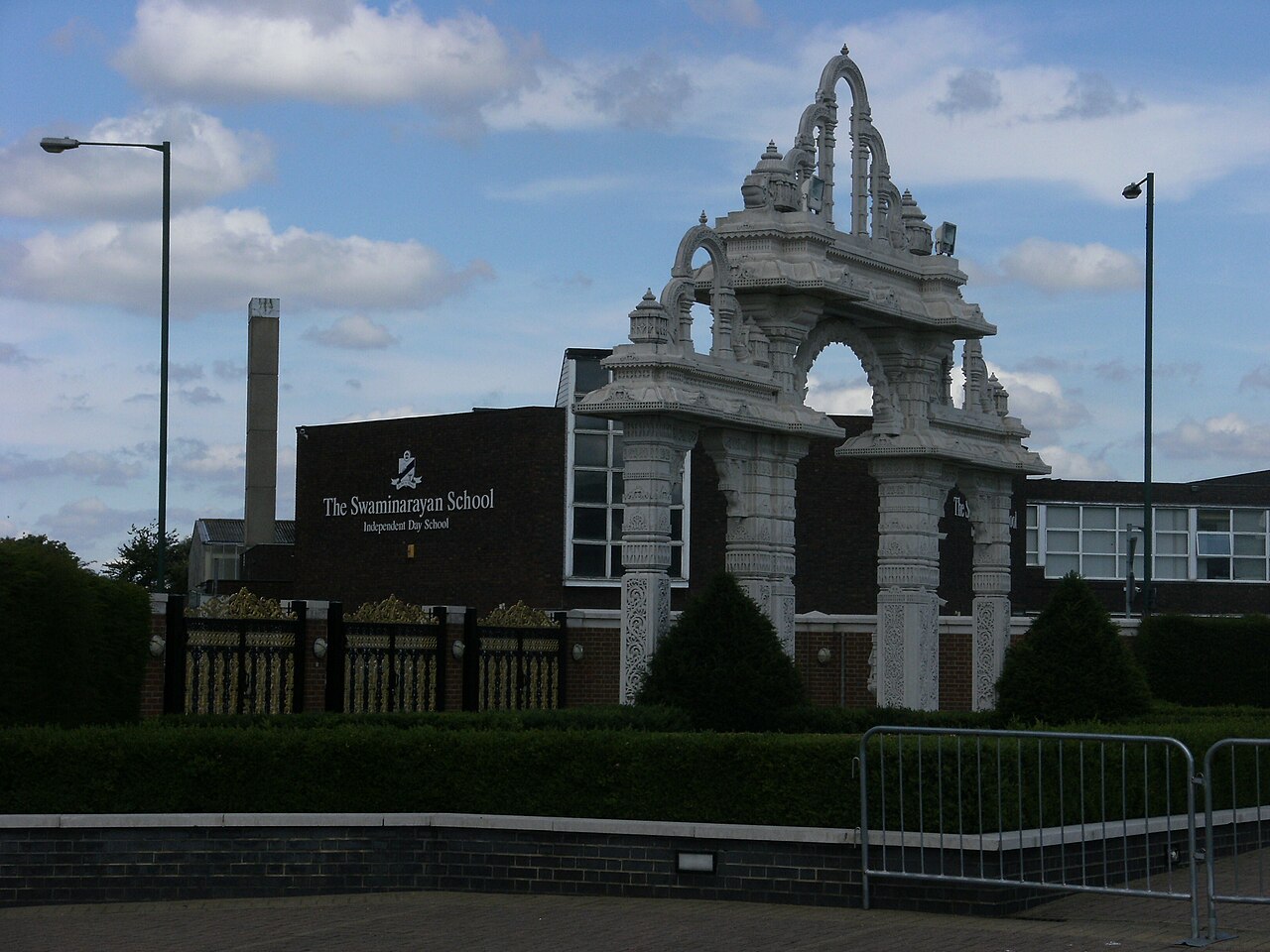
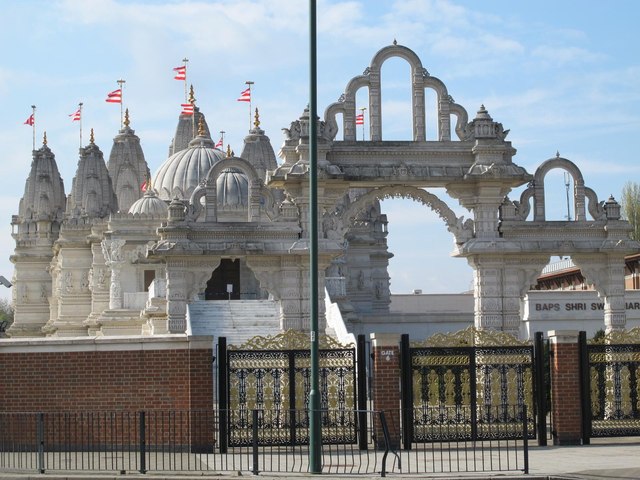
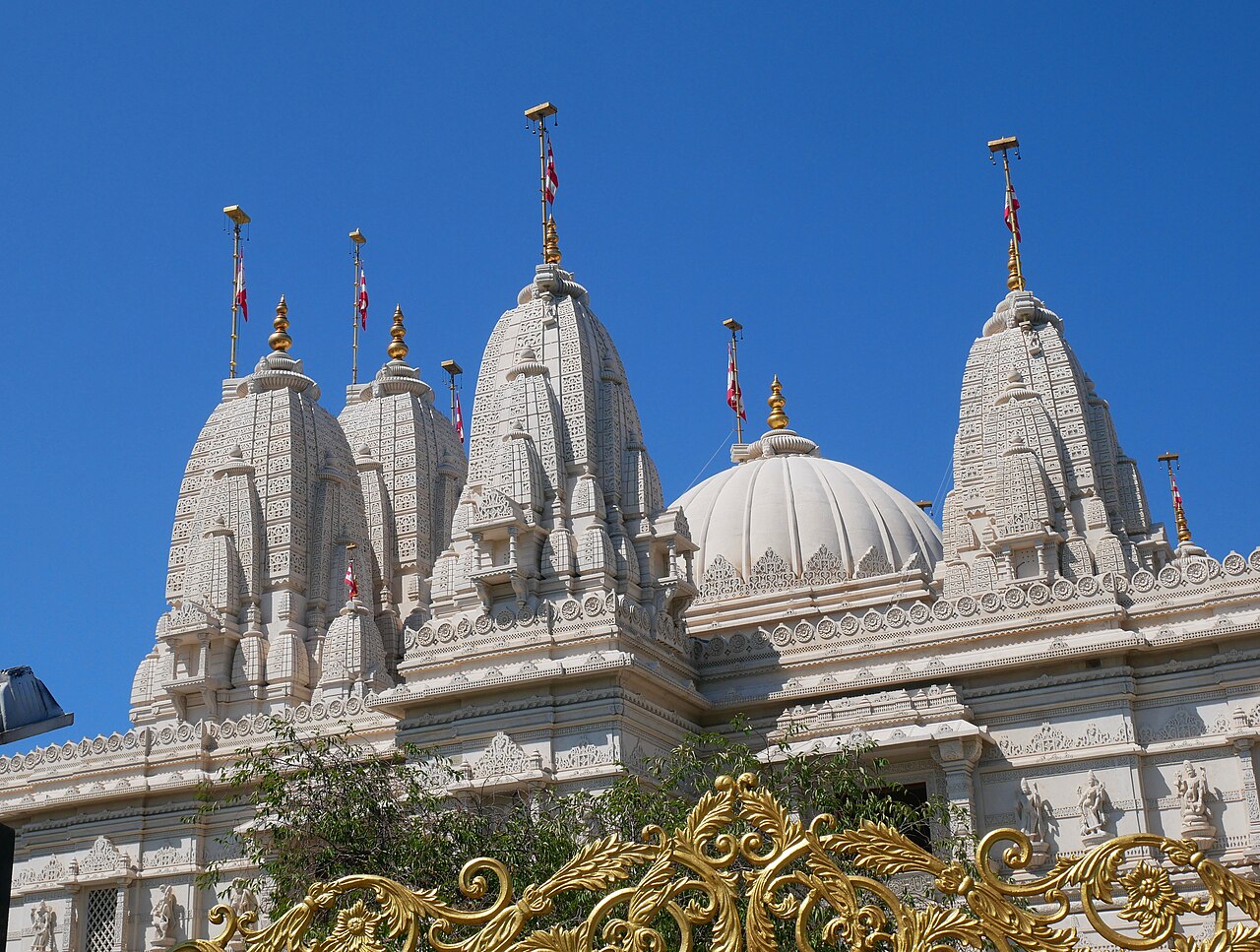
Carved on one continent, it was married here, stone by numbered stone, to a housing estate in northwest London.
Be the first to check in
Coming up: Diwali · 8 NovEntry tended 24 May 2026
Open daily · 9 am to 6 pm Free entry Diwali & Annakut · 8 to 10 Nov 2026 1995 · hand-carved stone, no steel Five artis a day, from 6 am
Walk up from the North Circular Road, past terraced houses and a car park, and marble domes rise without warning above the rooftops of Neasden. Bells and Sanskrit chant drift through open doors, incense meets London rain. Inside, shoes come off on cold stone and eyes go up into ceilings carved into marble roses, each ring different, held together without a single piece of steel. This mandir was not built in London so much as carved on another continent and married here, stone by numbered stone, to a housing estate in northwest London.
Europe's first traditional Hindu stone mandir, raised in the ancient discipline of the Shilpa Shastras: nearly 5,000 tonnes of Bulgarian limestone and Indian and Italian marble, carved by around 1,500 sculptors across India into more than 26,300 pieces, then shipped to London and set without a single piece of structural steel.
Five artis mark the day here, from Mangla Arti before dawn to Shayan Arti at night, offered before Bhagwan Swaminarayan and, beside Him, Gunatitanand Swami and Gopalanand Swami, with Radha-Krishna, Rama-Sita and Shiva-Parvati shrines set around the same hall.
Beside the mandir stands the Haveli, a cultural centre in carved English oak and Burmese teak reviving the vernacular building style of 17th-century Gujarat and Rajasthan, home to the Understanding Hinduism exhibition and an assembly hall for 3,000.
Carved on one continent, raised on another
BAPS worship in Britain began humbly: a converted church in Islington in 1970, then a former warehouse in Neasden from 1982. By 1990 the community, under the spiritual guidance of Pramukh Swami Maharaj, had begun planning something else entirely: not an adapted building, but a mandir raised the traditional way, in stone, by hand, according to the old canons. Planning permission followed in August 1992.
The architect C.B. Sompura designed the mandir from the Shilpa Shastras, the ancient Indian canons of Temple building, with the Delwara Jain Mandir of Mount Abu as one guide for its central dome. Nearly 5,000 tonnes of Bulgarian limestone and Indian and Italian marble were shipped to India, where around 1,500 sculptors across several workshops spent years cutting it by hand into more than 26,300 individual pieces and 55 distinct ceiling patterns. The finished stone travelled on to London, where roughly 450 construction craftsmen and over a thousand volunteers assembled it like a vast three-dimensional puzzle, fitted together without any structural steel.
Pramukh Swami Maharaj inaugurated the completed mandir on 20 August 1995. It was recognised by Guinness World Records as the largest Hindu Temple outside India, a record since surpassed by other mandirs BAPS itself has since built. The Haveli and the Understanding Hinduism exhibition grew alongside it. Then-Prince Charles and the Duchess of Cornwall first visited for Holi in 2009; as King and Queen, Charles III and Camilla returned on 29 October 2025 to mark the mandir's thirtieth anniversary, welcomed by the Temple's trustees at the height of its Diwali season.
What you'll actually see
1
The Haveli's carved timber
Visitors meet the complex first through the Haveli, a two-storey structure of English oak and Burmese teak carved by more than 150 craftsmen brought from India over three years, its doors, verandas and balconies cut in the profuse, layered style of a Gujarati merchant's house.
2
The Understanding Hinduism exhibition
On the mandir's lower level, a 3,000 square foot exhibition uses dioramas, paintings and traditional craftwork, alongside an eleven-minute film, to walk visitors of any background through Hindu belief and through the building of the mandir itself.
3
The marble sanctum
Up in the mandir proper, 193 sthambhas rise to a ceiling of carved marble domes, no two alike, framing gilded sinhasans where the murtis stand dressed and garlanded, watched over by devotees seated on the marble floor below.
Carved stone pillars and ceiling rings inside BAPS Shri Swaminarayan Mandir, LondonThe carved timber facade of the Haveli cultural centre beside the mandir
The carved stone pillars of the mandir, and the timber-carved Haveli beside it · photos CC BY-SA 2.0 David Howard, and public domain Anuradha Dullewe Wijeyeratne, Wikimedia Commons
WHERE LONDON'S DIWALI GATHERS
Diwali & Annakut · 8 to 10 November 2026
The mandir describes its own Diwali and Hindu New Year celebration as the largest in the country, and on these nights the marble courtyards fill with tens of thousands of visitors. Lakshmi Puja falls on 8 November 2026; two days later, on 10 November, the mandir keeps Annakut, the Gujarati New Year, when devotees may sponsor a prasad-thali added to a mountain of vegetarian dishes offered before the deities before it is shared as prasad.
Come for the evening of Diwali itself for the fullest lighting, but expect the mandir's busiest crowds and a full car park; the Annakut spread is at its largest at the New Year darshan on 10 November.
Plan your visit
Where it stands
Pramukh Swami Road, Neasden, London NW10 8HW, in the London Borough of Brent.
By tube
Stonebridge Park (Bakerloo line) is the closest, about 15 to 18 minutes' walk; Neasden (Jubilee line) is about 20 minutes' walk; from Wembley Park, bus 206 stops directly outside.
Opening hours
Mandir and Haveli open daily 9:00 am to 6:00 pm, including bank holidays; allow at least two hours for a full visit.
Arti times
Mangla Arti 6:00 am, Shangar Arti 7:30 am, Rajbhog Arti 11:45 am, Sandhya Arti 7:00 pm, Shayan Arti 8:00 pm; visitors are welcome at the midday Rajbhog Arti.
Entry
Free admission; free guided tours run for individual visitors through the day.
Dress and conduct
Shoulders, chest, navel and upper arms covered, leg-wear below the knee; shoes off in the Haveli; no photography or filming inside either building, and phones must be silent.
Bags and food
Large bags and cameras are left in the car park's Baggage Cabin; no food or drink is allowed on the premises.
The mandir and the Haveli are two different buildings under one visit: the mandir is the marble shrine itself, the Haveli is the carved timber cultural centre beside it with the exhibition, shop and halls.
"Neasden Temple" is the popular English name; the mandir's own name is BAPS Shri Swaminarayan Mandir, London.
Interior photography is not permitted at all; images of the shrines are sold at the Souvenir Shop for those who want to take the mandir home.
As of mid-2026 the garden was closed for renovation work; check current access before planning a visit centred on the grounds.
Questions pilgrims ask
Is this really the biggest Hindu Temple outside India?
It held that Guinness World Records title when it opened in 1995, and the claim is still widely repeated. Since then BAPS has built larger mandirs elsewhere, including its own Akshardham complexes, so the record no longer stands, though Neasden remains the one that proved a mandir this size could be built by hand in Europe at all.
Do I have to be Hindu to visit?
No. Entry is free and open to everyone. Visitors of any faith or none are welcome to walk through the mandir and Haveli, watch the artis, and join the free guided tours, provided the dress code and photography rules are followed.
Can I take photographs inside?
Outside, at ground level, personal mobile phone photos are allowed. Inside both the mandir and the Haveli, no photography or filming of any kind is permitted; cameras and large bags must be left in the car park's Baggage Cabin before entering.
What is the difference between the mandir and the Haveli?
The mandir is the stone shrine building, carved from Bulgarian limestone and Indian and Italian marble, where the murtis are enshrined and the daily artis are held. The Haveli is the adjoining timber-carved cultural centre, built in a 17th-century Gujarati style, holding the Understanding Hinduism exhibition, the assembly hall, the souvenir shop and the Shayona restaurant.
When is the best time to go?
A weekday late morning lets visitors see the Rajbhog Arti at 11:45 am with a shorter queue. Diwali and Annakut, 8 to 10 November 2026, show the mandir at its most crowded and most lit, if a longer wait is welcome.
Dharamshalas and guest houses near this Sthan, shared by devotees. Adisthan takes no bookings and no money; contact each stay directly.
No stays are listed here yet. Know one that serves pilgrims well?
Are you a trustee or sadhu representing BAPS Shri Swaminarayan Mandir, London? Claim this page to keep timings, festival dates and visitor guidance accurate for everyone who comes to Neasden in search of Him.