Slopes of Mount Agung, Karangasem · Bali, Indonesia
On the shoulder of the great mountain, all Bali keeps one house, and once a year all the gods come down to sit in it.
Be the first to check in
Entry tended 25 May 2026
Visitors 7 am to 6 pm 23 puras · six terraced levels Ida Bhatara Turun Kabeh · Purnama Kedasa, April Megalithic origins · Balinese pura Foreign IDR 150,000 incl. sarong & shuttle
The air cools as the road climbs into cloud country, and then the grey stone rises out of the mist: a stairway of volcanic andesite mounting terrace over terrace toward a split gate open to the sky. Incense drifts from the courtyards. Processions in Temple dress climb past you, offerings balanced high, while the black thatched tiers of the meru towers step up toward the summit of Mount Agung. This is not one Temple. It is twenty-three, and for Balinese Hindus it is the mother of them all.
The Mother Temple of Bali: Pura Agung Besakih is one sacred precinct of 23 separate but related puras, terraced on six levels nearly 1,000 metres up the slope of Mount Agung, with Pura Penataran Agung, the great central sanctuary, at its heart.
The ritual focus of the whole complex is the padmasana tiga, the triple lotus throne, where Ida Sang Hyang Widhi Wasa is worshipped as Sang Hyang Tri Purusa: Paramasiwa on the throne dressed in black, Sadasiwa in white and yellow, and Siwa in red, through whom God manifests as the Tri Murti.
In 1963 Mount Agung erupted while the once-a-century Eka Dasa Rudra rites were under way, killing some 1,700 people across eastern Bali. The lava flows missed the Temple complex by mere metres, and the Balinese read its survival as a sign.
The sage, the mountain, and the fire
Tradition holds that in the eighth century the sage Rsi Markandeya came from Java to the slopes of the great mountain and buried the panca datu, five sacred metals of gold, silver, copper, iron and bronze, in the earth where the Temple now stands. The shrine raised over them was called Basukian, from basuki, an old word for safety and well-being, and from that seed the Mother Temple grew. The stones themselves reach back further still: the bases of several shrines resemble megalithic stepped pyramids at least two thousand years old, and the sanctity of this ground almost certainly predates Hinduism itself.
Written history finds Besakih already holy. It was in use as a Hindu place of worship by 1284, when the first Javanese conquerors settled in Bali, and by the fifteenth century it had become the state Temple of the powerful Gelgel dynasty. The lotus throne that now anchors the entire complex was raised around the seventeenth century. Ever since, the pura has kept the whole island's calendar: at least seventy festivals turn through its shrines each year, for nearly every one keeps its own odalan anniversary on the 210-day Pawukon cycle.
The Temple's gravest hour came in 1963. The rarest of all its rites, Eka Dasa Rudra, the purification of the eleven directions held once a Balinese century, had been called, and while the ceremonies were under way Mount Agung erupted, killing some 1,700 people. The lava passed the sanctuary by metres. The rites were held again in 1979, this time in peace, reaching their climax on Tilem Kesanga, 28 March, with the mountain silent above the prayers.
What you'll actually see
1
The great stairway and split gate
From the base of the complex a broad andesite stairway climbs terrace after terrace to the candi bentar, the split gateway of Pura Penataran Agung, its two carved halves framing nothing but sky and the mountain. Beyond it the Kori Agung gate opens to the second courtyard. Guardian figures line the climb, dressed in checked and coloured cloth.
2
The meru towers
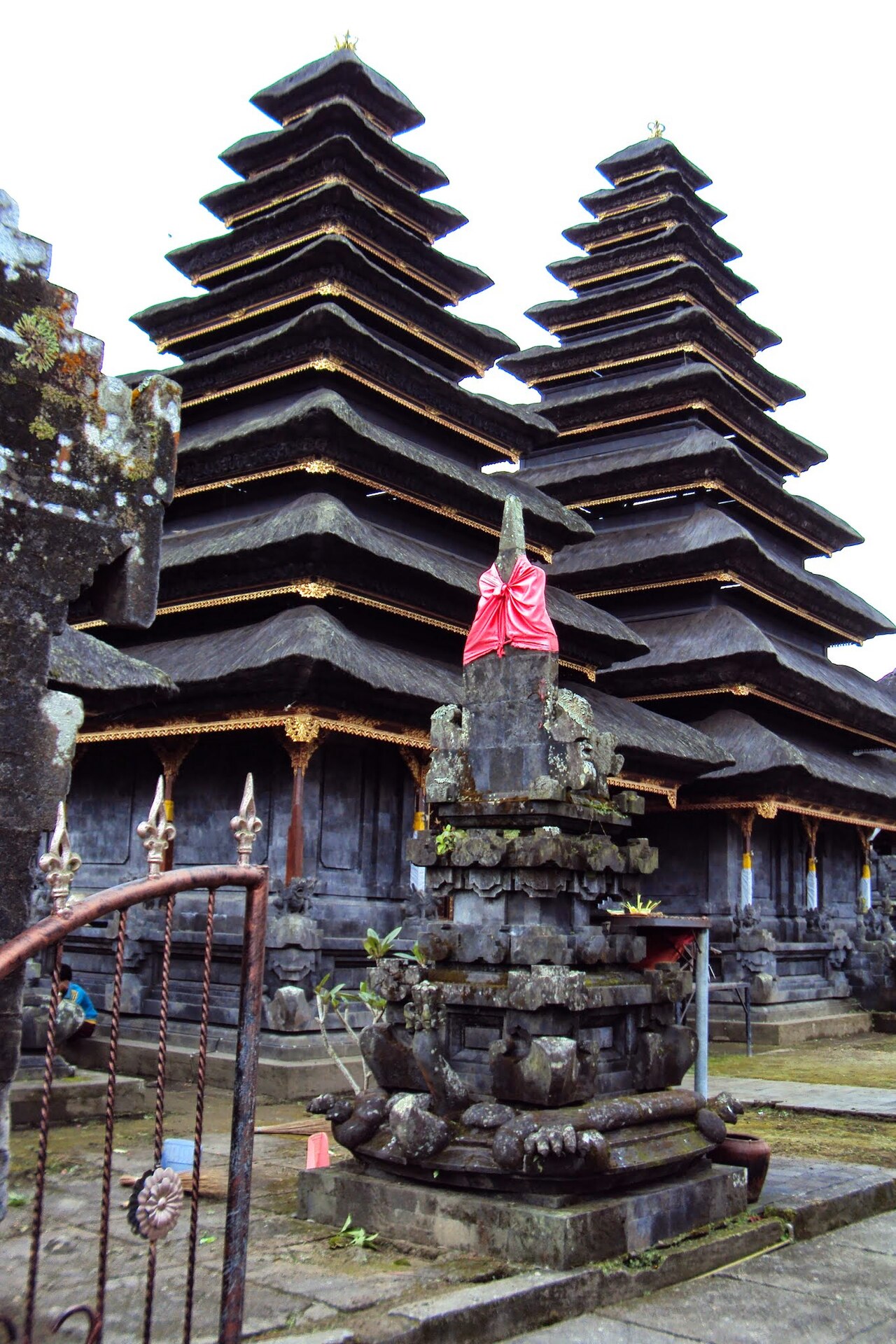
Above the courtyard walls rise the pagoda-like meru towers, their black thatched roofs stacked in odd-numbered tiers, three, five, seven, up to eleven, each tower the seat of a deity. Seen from the upper terraces they stand in ranks against the volcano, with the rice lands of eastern Bali falling away below.
3
The padmasana tiga
At the ritual centre of Penataran Agung stands the triple lotus throne: three stone seats on one base, open to the sky above Mount Agung. The right throne is dressed in black for Paramasiwa, God beyond all qualities; the centre in white and yellow for Sadasiwa; the left in red for Siwa, whose activity unfolds as the Tri Murti. Worshippers face it with offerings from the courtyard below.
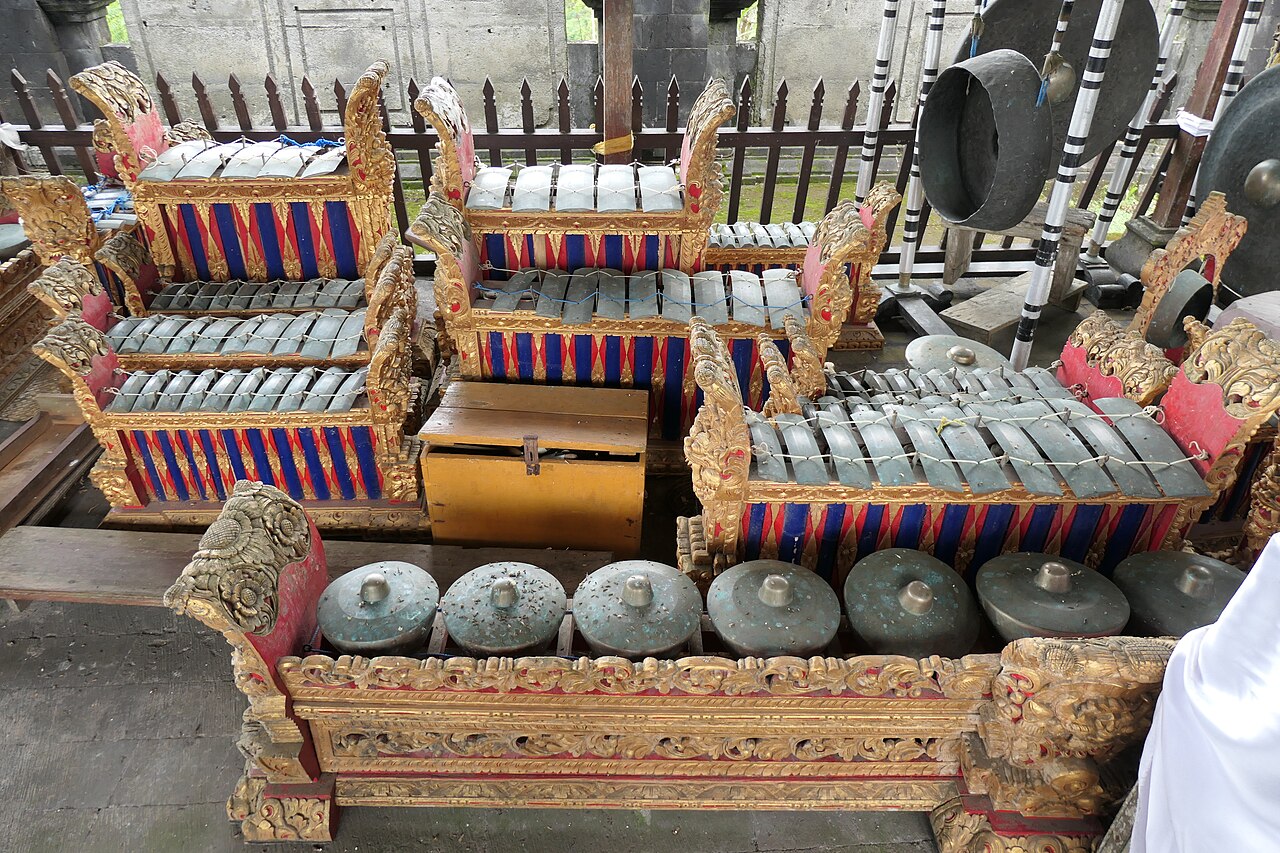
Meru towers of Pura Penataran Agung rising behind a stone shrine wrapped in red cloth at BesakihThe Temple gamelan of Pura Besakih, its gilded frames and gongs waiting under a pavilion
Meru towers above a cloth-wrapped shrine, and the temple gamelan under its pavilion · photos CC BY-SA 4.0 DayakSibiriak and Anandajoti Bhikkhu, Wikimedia Commons
When all the gods come down
Ida Bhatara Turun Kabeh
Once a year, on Purnama Kedasa, the full moon of the tenth Balinese month in late March or April, the deities of every Temple in Bali are invited to descend together and take their seats at Pura Penataran Agung. For weeks the complex belongs wholly to worship: the 2026 rites peaked on 2 April and ran for 21 days, with delegations from every regency of Bali presenting bhakti penganyar offerings in turn until the closing ceremony on 23 May. Pemedek arrive by the tens of thousands, offering towers on their heads, filling the stairway from first light.
Dates follow the Balinese lunar calendar and shift each year; confirm the current schedule before travelling, and come as a guest of the worship rather than a spectator of it.
Plan your visit
By air
Ngurah Rai International Airport (DPS) serves all of Bali; from the southern resort belt around Kuta and Seminyak the drive up to Besakih takes about 2.5 hours.
By road
In Besakih village, Rendang district, Karangasem regency, eastern Bali. From Ubud about 1.5 to 2 hours; from Denpasar and Sanur 2 to 2.5 hours.
Timings
Ticketed visitor hours run about 7 am to 6 pm daily. As a living Temple, worship itself does not keep visitor hours, and festival days reshape everything.
Fees
Foreign visitors IDR 150,000 (children 80,000); domestic visitors IDR 80,000 (children 40,000). Tickets are sold at the site only, cash or card, and include sarong and sash, a local guide, and a one-way electric shuttle from the parking area.
The climb
The shuttle covers the road up from the parking building; the return ride costs IDR 20,000, or walk down in 10 to 15 minutes. Inside, the terraces and stairways are steep and long, so give the complex unhurried time.
Dress
Sarong and sash are mandatory and included with the ticket. Dress modestly with shoulders covered, and do not climb onto shrines or walls.
Best time
Between 7 and 9 in the morning, before the crowds arrive and before cloud wraps Mount Agung. The dry season, April to October, gives the clearest mountain.
The name Besakih traces to basuki, an old word for safety and well-being; the first shrine here was called Basukian.
Besakih was placed on UNESCO's tentative World Heritage list in 1995 and later withdrawn from nomination; Bali chose to keep its holiest Temple a living sanctuary rather than a listed attraction.
Mount Agung is an active volcano. Its 2017 to 2019 eruptions closed the area at times; it has been quiet since mid 2019, but check its status if it stirs again.
A state renovation of the sacred precinct, inaugurated in March 2023, added the parking building, market kiosks, and electric shuttles at the base; the Temples themselves are unchanged.
Questions pilgrims ask
Does the entrance ticket let me into the Temples themselves?
No. Visitors walk the stairways, outer and middle courtyards, and viewpoints of the complex, but the jeroan, the inner sanctums where the shrines stand, are reserved for Hindu worshippers at prayer. You see the padmasana tiga and the meru towers from the gateways and terraces, and photographing people at prayer is prohibited.
Is Besakih a single Temple?
It is a precinct of 23 separate but related puras terraced up the mountainside, of which Pura Penataran Agung is the largest and the ritual centre. Each pura keeps its own shrines and its own odalan anniversary, which is why the complex holds at least seventy festivals a year.
How old is the Temple?
Older than any record. The stepped stone bases suggest megalithic worship at least two thousand years old, tradition credits the sage Rsi Markandeya in the eighth century, written history attests Hindu worship from 1284, and the lotus throne at its centre dates to around the seventeenth century.
Is it safe to visit, given the volcano?
Mount Agung's 2017 to 2019 eruptions brought exclusion zones that closed the Temple area at times, and in 1963 an eruption during the Eka Dasa Rudra rites killed some 1,700 people while sparing the Temple itself. The volcano has been quiet since mid 2019; if it becomes active again, follow the official alert levels and local guidance.
Dharamshalas and guest houses near this Sthan, shared by devotees. Adisthan takes no bookings and no money; contact each stay directly.
No stays are listed here yet. Know one that serves pilgrims well?
Are you with the management body of the Besakih sacred precinct, a pemangku, or one of the Temple's custodial families? Claim this page to keep its hours, fees, and festival calendar true for every pemedek and every visitor.