Bhalka Tirtha
Bhalka · Bhalka Teerth · Shri Bhalka Tirth Mandir · Shri Krishna Nijdham Prasthan Tirth · Golokdham Tirth
About
Set within the coastal city of Veraval in Gujarat, western India, Bhalka Tirtha, tīrtha meaning a sacred crossing-point, enshrines one of the most poignant moments in all of Vaishnava theology: the instant at which Sri Krishna chose to withdraw his presence from the mortal world. The Temple sits barely four kilometres from the celebrated Somnath Jyotirlinga shrine, and together these two sites form the devotional heartland of the Saurashtra coast.
The sacred episode recorded in both the Mahābhārata and the Bhāgavata Purāṇa unfolded beneath a forest tree, where Krishna had settled into deep meditation, one foot resting across his knee. A hunter by the name of Jara, glimpsing the reddish sole of that foot amid the undergrowth, took it for a deer and loosed an arrow. Rushing forward to find his quarry, Jara discovered instead the four-armed divine form of Krishna already seated in composed readiness. Overcome with remorse, he prostrated himself; Krishna met his anguish with reassurance, affirming that the moment had come to pass entirely by divine will, and then graciously granted the hunter passage to his own spiritual realm.
In the scriptural tradition this departure is celebrated as the Śrī Kṛṣṇa Nijdhām Prasthān Līlā, the sacred play of Krishna's return to his eternal abode. Far from bearing the weight of tragedy, the site carries an atmosphere of serene completion: devotees who come here contemplate the teaching that the divine does not perish but simply withdraws, and that surrender to that withdrawal is itself a form of grace. Bhalka Tirtha belongs to the wider Krishna pilgrimage circuit linking Mathurā, Vṛndāvana, Barsānā, Govardhana, Kurukṣetra, and Dvārakā.
History
The Mahabharata's Mausala Parva and the Bhagavata Purana record that after the Yadu clan destroyed itself in an internal conflict at Prabhasa, Lord Krishna withdrew alone into the forest and sat in meditation beneath a tree on this spot, his foot resting across his knee. A hunter named Jara, mistaking the mark of his foot for a deer, loosed an arrow that struck him; finding Lord Krishna seated before him in his four armed divine form, Jara begged forgiveness and was granted passage to the spiritual realm. The shrine's own plaque, raised by Shree Somnath Trust, records the moment as occurring at 2:27:30 on the first day of the bright fortnight of Chaitra, corresponding to 18 February 3102 BCE, the Puranic boundary between the Dvapara and Kali Yugas, and notes that Lord Balarama took his own last journey nearby, in his original serpent form, from a cave still known as Dauji ni Gufa. Shree Somnath Trust maintains the tirtha today, about 4 kilometres from the Somnath Jyotirlinga Temple.
Significance
For Vaishnava pilgrims the tirtha carries a meaning distinct from any other stop on the Krishna circuit: not birth, play, or deed, but a willed and sovereign departure. The Bhagavata Purana's own telling insists that Jara's arrow was only the occasion for what Lord Krishna had already chosen, so devotees come here to contemplate that teaching rather than to mourn.
Architecture
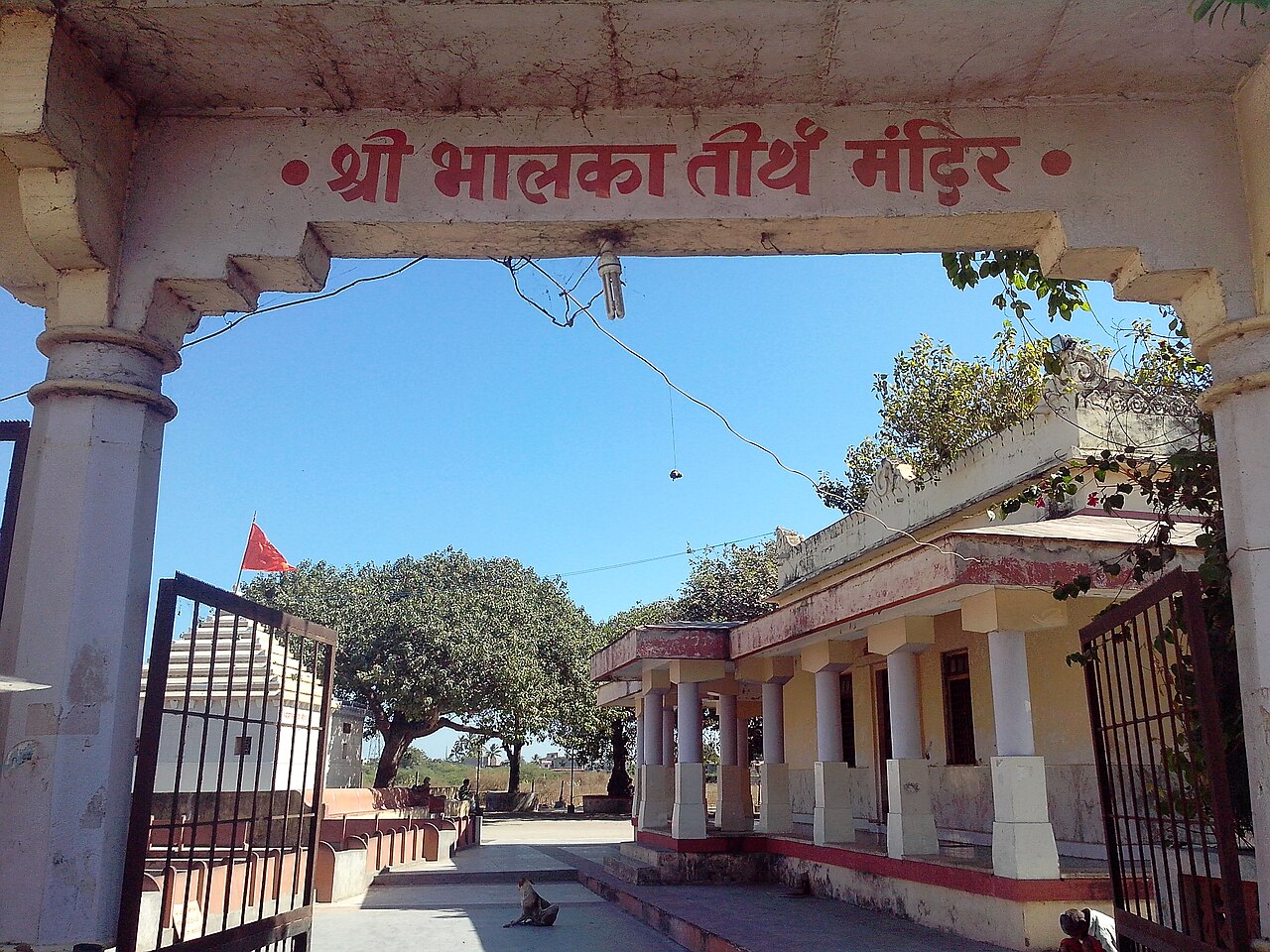
A modest Gujarati temple-trust shrine hall with a pillared portico and plastered masonry, maintained by Shree Somnath Trust; no specific architectural era is established in available sources.
Visiting
Daily worship
| Darshan (Temple open to visitors) | 06:00 to 22:00 |
Hours
Hours not listed.
Contact
Address
Engage with Bhalka Tirtha
Through the four pathways
Seva सेवा — Service
Offer your time and skills here. The following opportunities are open at Bhalka Tirtha:
No Seva offerings listed yet.
Sādhana साधना — Practice
Learn the worship and practice associated with Bhalka Tirtha:
No Sādhana offerings listed yet.
Sandhāna सन्धान — Wisdom
Unite with the wisdom of this tradition:
No Sandhāna offerings listed yet.
Sādhya साध्य — Giving
Support this sacred place according to your means:
No Sādhya offerings listed yet.
All giving flows directly to Bhalka Tirtha. Adisthan does not take a commission.
Festivals & Events
- Sept
Janmashtami
4 September 2026 · annual
The birth anniversary of Lord Krishna draws the largest crowds of the year to Bhalka Tirtha; Gujarat Tourism's own visitor guidance names it, alongside the cooler months of November to February, as the best time to visit.
Gallery
Related sacred places
 Hinduism
Airavatesvara Temple, Darasuram
Darasuram (Kumbakonam) · India · temple
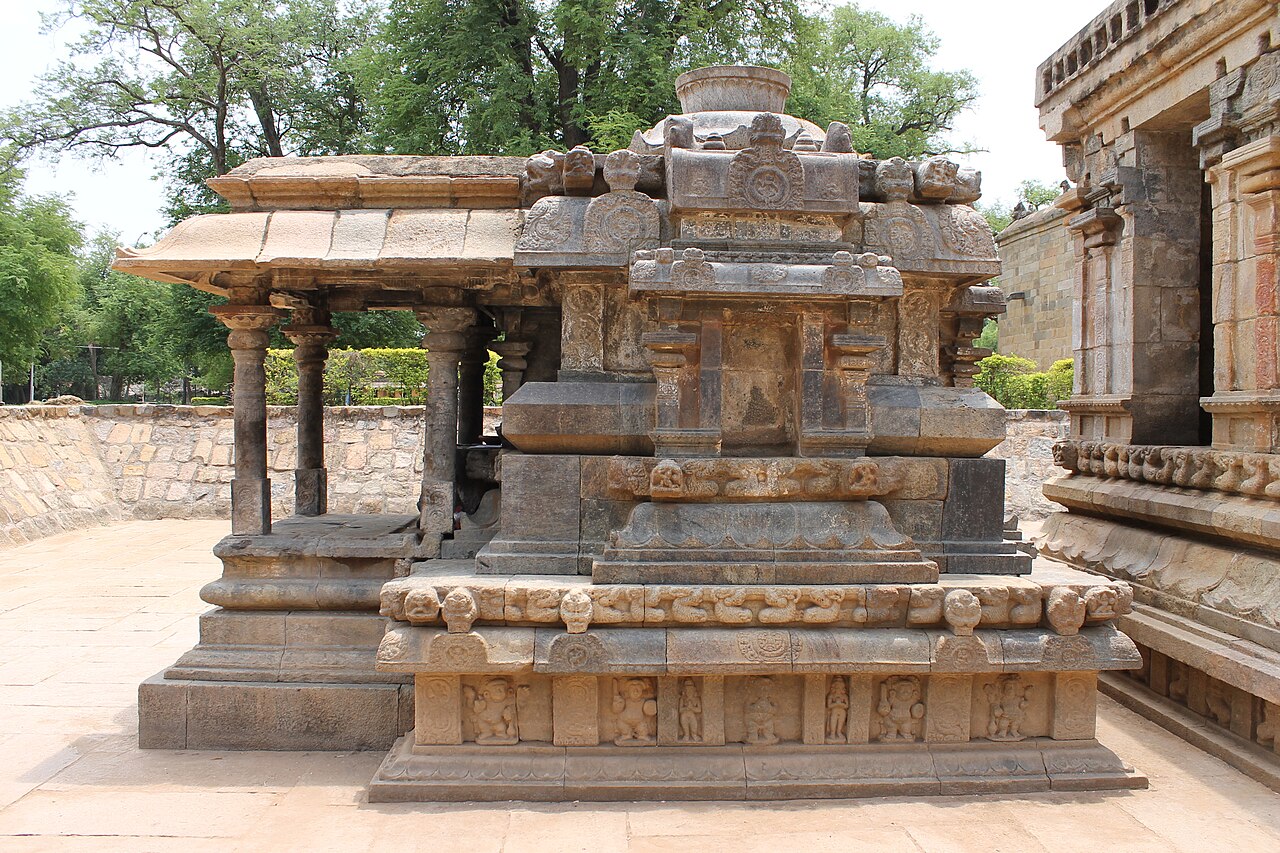
The third of the Great Living Chola Temples, raised by Rajaraja Chola II around 1166 CE at Darasuram near Kumbakonam: a chariot-form shrine of Lord Shiva as Airavatesvara, famed for its carved stone wheels, its singing steps, and worship that has continued for over eight centuries.
Aisanyesvara Siva Temple
Bhubaneswar · India · temple
A living thirteenth-century Shiva shrine in the Old Town of Bhubaneswar, standing close to the western wall of the great Lingaraj Temple, where a Shivalinga set within a circular yonipitha still receives daily worship in the Kalinga architectural tradition.
 Hinduism
Akhadachandi Temple
Bhubaneswar · India · temple
A tenth-century Kalinga-style shrine on the southwestern bank of Bhubaneswar's sacred Bindusagar tank, Akhadachandi Temple honours Maa Mahishasuramardini, the Goddess in her form as slayer of the buffalo demon, within the dense cluster of ancient shrines that fills the city's Old Town.
 Hinduism
Akshardham
New Delhi · India · temple
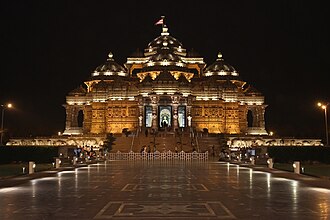
A vast contemporary Hindu mandir campus on the Yamuna's west bank in East Delhi, raised without structural steel by 11,000 artisans and volunteers, and recognised by Guinness World Records in 2007 as the world's largest comprehensive Hindu Temple.
 Hinduism
Amarnath Temple
· India · temple
A high Himalayan cave shrine in Jammu and Kashmir where a naturally forming ice lingam is venerated as Lord Śiva, drawing one of India's great seasonal pilgrimages.
 Hinduism
Ambalappuzha Sri Krishna Temple
Ambalappuzha · India · temple
A Vaishnava shrine on the Kerala backwaters consecrated to Sri Krishna in his Parthasarathy form, counted among the seven great Temples of the former kingdom of Travancore and famed across South India for its Ambalapuzha Paal Payasam offering.