Darshan 4:30 am to 9:30 pm Source of the Bhima river Mahashivaratri · 6 Mar 2027 Nagara · 18th-c. shikhara Darshan free Inside a wildlife sanctuary
The bus grinds up the ghats and the world turns green. Cloud drifts through the windows, cicadas drown out the engine, and at the crest the road simply ends at a forest. You walk down, step after stone step, until a dark shikhara rises out of the trees with saffron flags streaming above it, and a bell rings somewhere below the mist. Most Jyotirlingas preside over cities. This One hides inside a cloud forest, at the birthplace of a river you crossed in the plains far below.
One of the Twelve Jyotirlingas: here Lord Shiva Is Worshipped as Bhimashankara, the colossal form tradition says He Took to end the tyranny of the demon Tripurasura. The linga is held to be swayambhu, self-manifested, and rests below the floor of the sanctum, reached by a short descent.
The Bhima river rises here. Tradition holds it sprang from the sweat that streamed from the Lord's body as He rested after the battle, and the same water flows on to Pandharpur, where devotees know it as the Chandrabhaga.
The Temple stands inside the Bhimashankar Wildlife Sanctuary, about 131 square kilometres of Western Ghats forest protected since 1984 for the shekru, the Indian giant squirrel and the state animal of Maharashtra. Darshan here begins with a forest.
The battle that became a river
The Temple's own telling reaches back to the Treta Yuga. The demon Tripurasura, swollen with power, had made the three worlds unlivable, and the gods came to the Sahyadri crest to plead for help. There, the legend says, Lord Shiva Took a form of overwhelming size and fury, Bhima, and met the demon on the heights. The old telling of these hills remembers the Shakini and Dakini spirits standing with Him in the fight, and a shrine To Maa Kamalaja, a form Of Maa Parvati, still keeps Her presence beside the Jyotirlinga.
The battle ended, tradition holds, on the full moon of Kartik. Victorious and exhausted, the Lord sat upon the crest to rest, and the sweat that poured from His body gathered into streams and became the Bhima river. At the request of the gods He agreed to remain, and He Is Worshipped here as Bhimashankara, the Jyotirlinga of the Sahyadris.
The shrine that holds Him is old and layered. Its dark stone core is dated to the 13th century, and medieval sources associate the saints Jnanesvar and Namdev with this place. Chhatrapati Shivaji Maharaj is recorded to have granted the village of Kharosi for the Temple's upkeep. In the 18th century the Peshwa statesman Nana Phadnavis raised the sabhamandap and the carved shikhara that crowns the shrine today, and Chimaji Appa, brother of Peshwa Bajirao I, presented the Temple with a great Portuguese church bell taken at the Battle of Vasai in 1739.
What you'll actually see
1
The descent through the village
From the bus stand the Temple is reached not by climbing but by descending: around 150 stone steps drop through a lane of flower sellers and prasad stalls until the black basalt shrine appears in its hollow of the crest, forest pressing in on every side.
2
The bell of Chimaji Appa
Before the shrine hangs a large bell of European casting, one of the Portuguese church bells Chimaji Appa carried back from the Battle of Vasai in 1739 and offered to the great Temples of the Deccan. Pilgrims ring it as they enter, a Maratha victory still sounding over the ghats.
3
Five steps down to the swayambhu linga
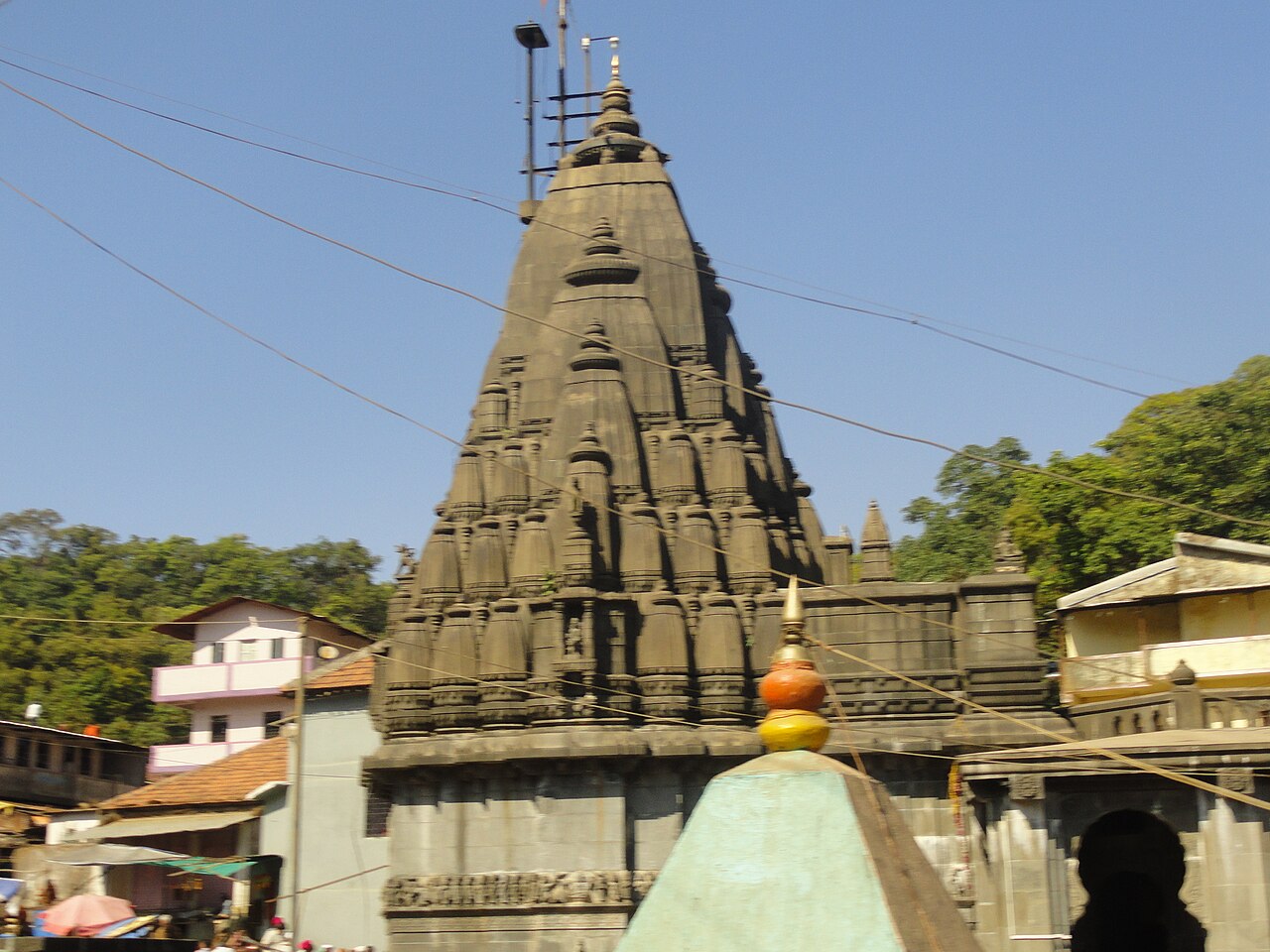
The garbhagriha lies lower than the hall around it: worshippers descend about five steps to the self-manifested linga, roughly 75 centimetres across, over which abhishek is poured through the morning hours. Above, the 18th-century Nagara shikhara rises in carved tiers of dark stone.
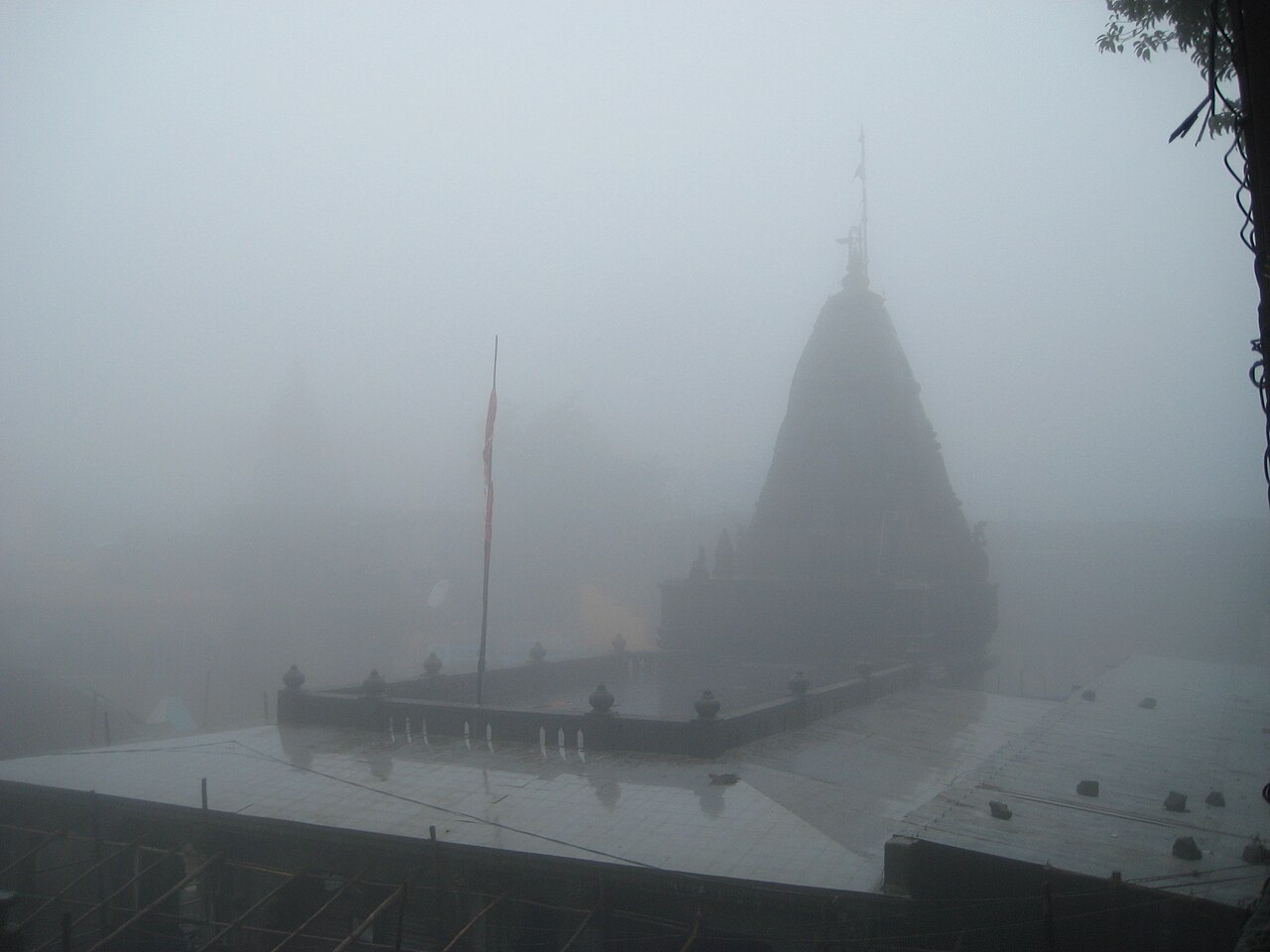
The carved dark stone Nagara shikhara of Shri Bhimashankar Temple against a clear Sahyadri skyBhimashankar Temple and its saffron flag dissolving into monsoon mist on the Sahyadri crest
The shikhara in dark stone, and the shrine in monsoon cloud · photos by Suratha Kumar Padhi and Pradeep245, CC BY-SA 3.0, Wikimedia Commons
THE NIGHT THE MOUNTAIN FILLS
Mahashivaratri at Bhimashankar · 6 March 2027
On the Krishna paksha chaturdashi of Magha the quiet forest crest transforms. Pilgrims climb through the night, the lanes around the shrine become a fair of stalls and lamps, and worship continues through a night-long vigil To the Lord. On this day, as on Shravan Mondays and Pradosh, the Temple keeps abhishek inside the sanctum open till 6 pm instead of the usual 2 pm. The next Mahashivaratri falls on Saturday 6 March 2027, in the same season the Kumbh Mela comes to Nashik, for which the Temple's approaches and assembly hall have just been rebuilt.
Arrive the previous evening or well before dawn, expect hours in the queue, and check the trust website for darshan-pass rules before travelling.
Plan your visit
By air
Pune (Lohegaon) Airport, about 125 km; roughly 3.5 hours by road via Rajgurunagar and Manchar.
By rail
Pune railway station, about 125 km; taxis and state buses run onward to the crest.
By bus
MSRTC buses leave Pune's Shivajinagar stand from 5:30 am, with departures roughly every half hour to hourly until 4 pm; there are also morning services from Kalyan and Ghatkopar.
On foot
Trekkers climb from Khandas village near Karjat: Ganesh Ghat is the longer, gentler route and Shidi Ghat the steep ladder route, about 4 to 5 hours up through the sanctuary forest.
Timings
Kakada aarti at 4:30 am and darshan until the 9:30 pm close; the Temple pauses for about 45 minutes at 3 pm for the madhyan aarti.
Darshan and abhishek
Darshan is free. Abhishek inside the sanctum runs from 5:30 am until 2 pm on ordinary days, and until 6 pm on Mondays, Pradosh, Shravan and Mahashivaratri, with a naivedya pause from noon to 12:30 pm.
Best time
Weekday mornings outside Shravan are quietest; in the monsoon the ghats run with waterfalls and the Temple floats in cloud, at the cost of heavy rain on the roads.
2026 works
Renovation for the 2027 Kumbh continues after the Temple's reopening on 15 June 2026; darshan has been limited to 7 to 11 am with online registration at shreebhimashankar.com, so check the trust site before travelling.
The name joins the river and the Lord in one word: Bhima, the river born of His sweat, and Shankara, the Lord Himself; downstream at Pandharpur the same river is worshipped as the Chandrabhaga.
The Temple sits in a hollow of the crest, not on its summit: you descend around 150 steps from the village to reach it, and climb them again on the way out.
The surrounding forest is a wildlife sanctuary, home to the shekru, leopards, sambar and barking deer; walk quietly, keep to the paths, and leave nothing behind.
The dvadasha jyotirlinga hymn places Bhimashankara in Dakini, and shrines in Assam and elsewhere also carry the name; this Sahyadri Temple in Pune district is the most widely venerated of them, its forest identified in tradition with the Dakini of the hymn.
Questions pilgrims ask
Is the Temple fully open in 2026?
Yes, it is open, but with limits. The Temple was closed from 9 January to 15 June 2026 for renovation ahead of the 2027 Nashik Kumbh Mela, and after reopening the trust has kept darshan to a restricted morning window of 7 to 11 am with online registration on shreebhimashankar.com while work on the sabhamandap and steps is finished. Check the trust site for the current rule before you travel.
Why is Bhimashankar counted among the Twelve Jyotirlingas?
A Jyotirlinga is a place where Lord Shiva Is Held to have manifested as a column of light, and the twelve are named together in the dvadasha jyotirlinga hymn. Here tradition says He Took the vast Bhima form to destroy the demon Tripurasura and, at the gods' request, remained in the self-manifested linga that stands in the sanctum.
Can I offer abhishek myself?
Yes. Abhishek inside the sanctum is performed from 5:30 am to 2 pm on ordinary days and until 6 pm on Mondays, Pradosh, the Shravan month and Mahashivaratri, with a pause from noon to 12:30 pm for the naivedya pooja. The trust also takes online pooja bookings through its official websites.
Is the trek route safe in the monsoon?
The Ganesh Ghat route from Khandas is the safer, more gradual climb and is walked through the monsoon; the Shidi Ghat route uses iron ladders on steep rock and becomes genuinely risky in rain. Go with company, start early, and remember the path runs through a wildlife sanctuary.
Will I see the shekru?
Sightings are a matter of luck and quiet. The sanctuary exists to protect the Indian giant squirrel, and early mornings on the forest paths give the best chance, but it is a shy canopy animal; the forest itself, with its birds and mist, is the sure blessing.
Dharamshalas and guest houses near this Sthan, shared by devotees. Adisthan takes no bookings and no money; contact each stay directly.
No stays are listed here yet. Know one that serves pilgrims well?
Are you a pujari, trustee, or sevak of Shri Kshetra Bhimashankar Devasthan? Claim this page to keep darshan hours, pooja bookings, and festival dates true for the pilgrims who climb to the Lord of the Sahyadris.