
Budhanilkantha Temple
Narayanthan Temple · Jal Narayan Temple · Budanilkantha · बूढानीलकण्ठ मन्दिर
About
At the foot of Shivapuri Hill, roughly nine kilometres from the heart of Kathmandu, the open-air sanctuary of Budhanilkantha presents one of the Himalayan world's most arresting devotional sights. A colossal form of Lord Mahavishnu rests at the centre of an elongated water tank, carved from a single block of black basalt and measuring five metres in height. The deity reclines across the surface of a pool thirteen metres in length, cradled by the cosmic waters just as Vaikuntha theology describes, serene, immovable, vast.
In his four hands the figure holds the Sudarshana Chakra, a mace, a conch, and a precious gem, the traditional emblems of Vishnu's sovereign power. A crown engraved with repeated Kirtimukha faces, sometimes overlaid with a silver crown placed by worshippers, adorns the head of the image, which scholars estimate to be over fourteen centuries old. The sculpture is also known as Jalasayana Narayana, the Narayana who reposes upon the waters.
The Temple carries resonance beyond a single tradition. On the deity's forehead devotees of the Buddhist path perceive the presence of Avalokiteshvara, and the place name itself, from the Nepali बुढानिलकण्ठ, meaning 'Old Blue Throat', weaves together iconographies of Shiva, Vishnu, and the Buddha in a manner that has defined the valley's syncretic religious culture for centuries. Pilgrims from both Hindu and Buddhist backgrounds visit the water's edge, some believing its spring-fed waters carry healing properties.
History
Tradition holds that the image was uncovered rather than built: a farmer ploughing this ground struck the buried reclining form of Lord Vishnu as Jalasayana Narayana, said to have revealed his location in a dream to a devotee named Haridatta Barma, who then dug him free, raised the tank around him, and gave the site its name. Carved from a single block of black basalt, the image is popularly dated to the Licchavi era and described as more than fourteen centuries old, though no inscription fixes an exact year. A seventeenth century legend holds that King Pratap Malla, who reigned from 1641 to 1674, received a prophetic warning against visiting the shrine, after which Nepal's monarchs are said to have avoided it for generations.
Significance
For Vaishnava Hindus, Budhanilkantha is one of the Kathmandu Valley's four sacred Narayana shrines, and each year at Haribodhini Ekadashi thousands gather to ritually wake Lord Vishnu from the four month cosmic sleep that begins months earlier at Harishayani Ekadashi. Buddhist devotees venerate the same image as a form of Avalokiteshvara, and this shared reverence across two traditions has long been read as a living emblem of the Kathmandu Valley's religious harmony.
Architecture
Open-air Licchavi-era shrine: a single monolithic black basalt image reclining within a sunken stone water tank, without an enclosing sanctum in the conventional Temple sense
Visiting
Hours
Hours not listed.
Contact
No contact details listed yet.
Engage with Budhanilkantha Temple
Through the four pathways
Seva सेवा — Service
Offer your time and skills here. The following opportunities are open at Budhanilkantha Temple:
No Seva offerings listed yet.
Sādhana साधना — Practice
Learn the worship and practice associated with Budhanilkantha Temple:
No Sādhana offerings listed yet.
Sandhāna सन्धान — Wisdom
Unite with the wisdom of this tradition:
No Sandhāna offerings listed yet.
Sādhya साध्य — Giving
Support this sacred place according to your means:
No Sādhya offerings listed yet.
All giving flows directly to Budhanilkantha Temple. Adisthan does not take a commission.
Festivals & Events
- Jul
Harishayani Ekadashi
25 July 2026 · annual
The day Lord Vishnu is believed to enter his four month cosmic sleep upon the serpent Shesha, marked at the tank with a large mela drawing pilgrims from across the valley.
- Nov
Haribodhini Ekadashi
20 November 2026 · annual
The signature festival of the Temple, when Lord Vishnu is ritually woken from his cosmic sleep; thousands of pilgrims gather at the tank for the mela marking the day.
Gallery
Related sacred places
 Hinduism
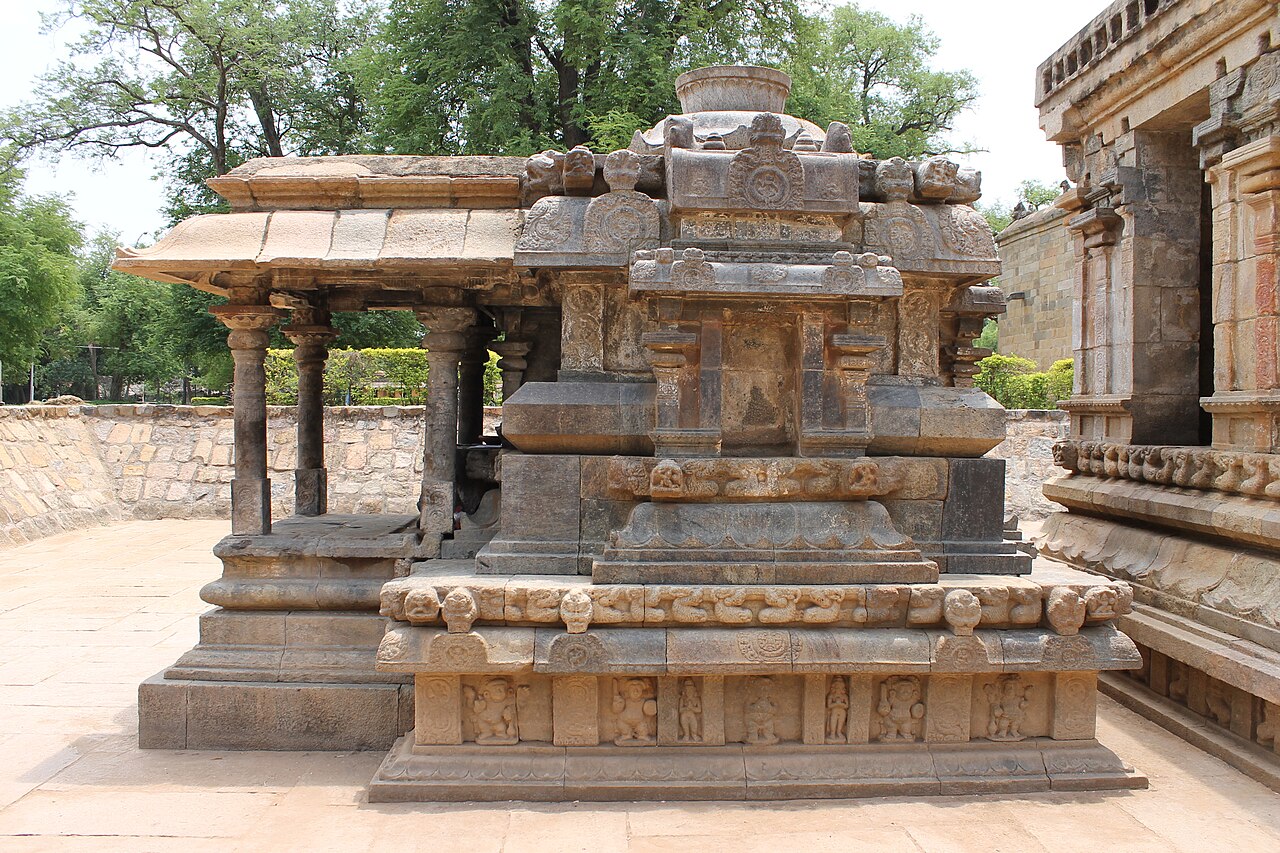
Airavatesvara Temple, Darasuram
Darasuram (Kumbakonam) · India · temple
The third of the Great Living Chola Temples, raised by Rajaraja Chola II around 1166 CE at Darasuram near Kumbakonam: a chariot-form shrine of Lord Shiva as Airavatesvara, famed for its carved stone wheels, its singing steps, and worship that has continued for over eight centuries.
Aisanyesvara Siva Temple
Bhubaneswar · India · temple
A living thirteenth-century Shiva shrine in the Old Town of Bhubaneswar, standing close to the western wall of the great Lingaraj Temple, where a Shivalinga set within a circular yonipitha still receives daily worship in the Kalinga architectural tradition.
 Hinduism
Akhadachandi Temple
Bhubaneswar · India · temple
A tenth-century Kalinga-style shrine on the southwestern bank of Bhubaneswar's sacred Bindusagar tank, Akhadachandi Temple honours Maa Mahishasuramardini, the Goddess in her form as slayer of the buffalo demon, within the dense cluster of ancient shrines that fills the city's Old Town.
 Hinduism
Akshardham
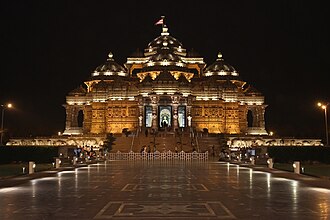
New Delhi · India · temple
A vast contemporary Hindu mandir campus on the Yamuna's west bank in East Delhi, raised without structural steel by 11,000 artisans and volunteers, and recognised by Guinness World Records in 2007 as the world's largest comprehensive Hindu Temple.
 Hinduism
Amarnath Temple
· India · temple
A high Himalayan cave shrine in Jammu and Kashmir where a naturally forming ice lingam is venerated as Lord Śiva, drawing one of India's great seasonal pilgrimages.
 Hinduism
Ambalappuzha Sri Krishna Temple
Ambalappuzha · India · temple
A Vaishnava shrine on the Kerala backwaters consecrated to Sri Krishna in his Parthasarathy form, counted among the seven great Temples of the former kingdom of Travancore and famed across South India for its Ambalapuzha Paal Payasam offering.