Open daily, 6 am to 7 pm Foreigners NPR 350 · Nepalis free Kalash Yatra · 24 Aug 2026 Pagoda rebuilt 1702, on a site from 464 CE UNESCO World Heritage since 1979
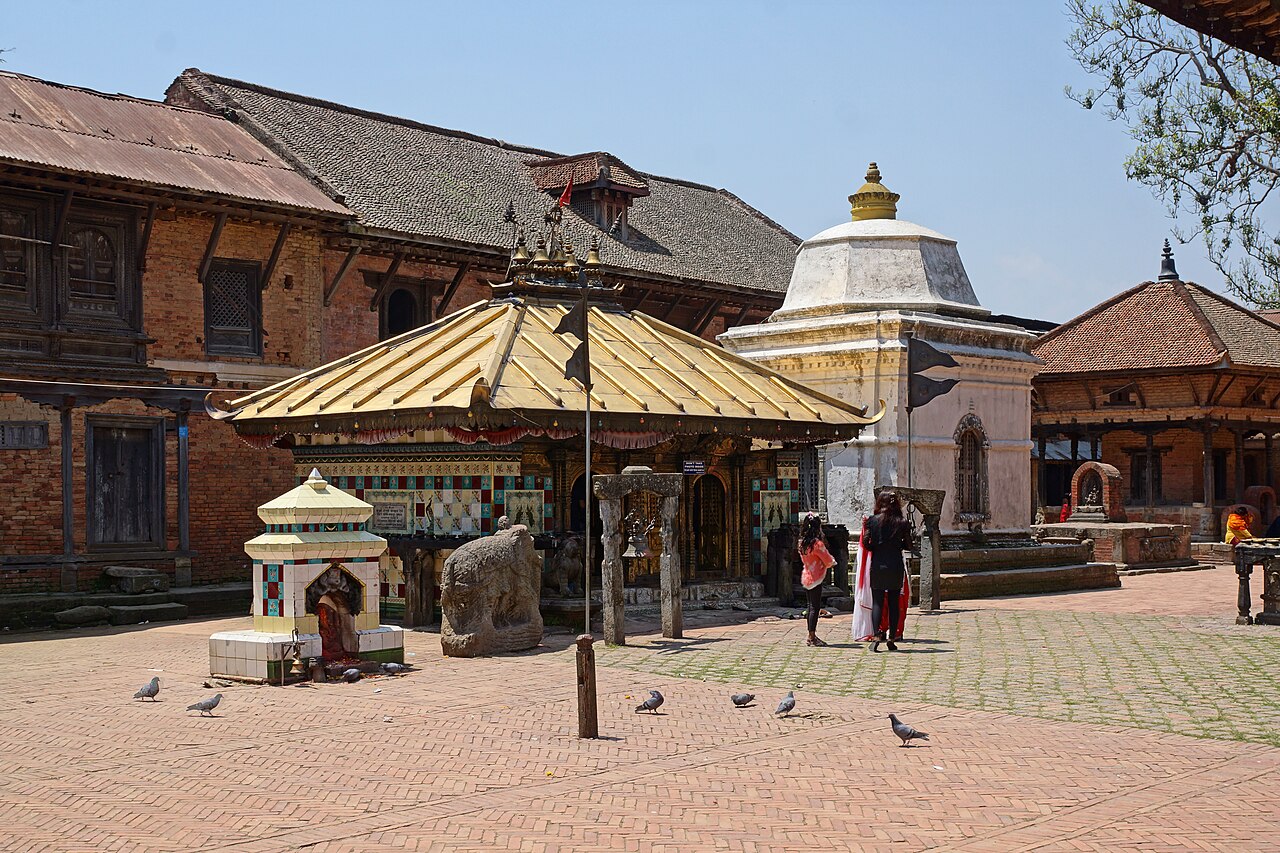
The lane climbs out of the valley into a hill of pine and champak forest, and the noise of the world falls away before the first gilded roof appears. Stone lions and griffins watch from every gate. Woodsmoke and marigold hang in the courtyard air, where century upon century of carved stone stands shoulder to shoulder with the living rite: a priest circling with a brass lamp, pigeons startling off a strut carved centuries before the Temple's own roof last burned and rose again.
The stone pillar standing in the courtyard, raised by the Licchavi king Manadeva in 464 CE, carries the oldest dated inscription yet found in Nepal, a thousand years older than the daily rites still spoken over it today.
This is not, strictly, Nepal's oldest standing building. Tradition holds worship here reaches to the 4th century CE, but the pagoda a pilgrim climbs to today was rebuilt after a fire in the early 18th century, commonly dated 1702, and repaired again after the 2015 earthquake.
The sanctum's hidden image is Lord Vishnu shared: Hindus know Him as Garuda Narayan, Buddhists as Hariharihari Vahan Lokeshwara, and only the officiating priest may see His face, whichever name is given.
The Lord who chose to stay headless
The legend says a Brahmin named Sudarshan once kept a sacred Kapila cow on this forested hill, and drew from her milk his daily offerings to the gods. Each day the milk ran short, until Sudarshan hid himself and watched a beautiful stranger step from the trunk of a champaka tree to drink what the cow gave. In fury he cut the stranger down with his sword, and the figure at his feet resolved into Lord Vishnu Himself, headless, bearing conch and mace and lotus, mounted on Garuda. The Lord told the grieving Brahmin that the blow had been fated long before, a curse laid by the sage Shukracharya for an old wrong done in a former battle, and that He had chosen this hill, of all hills, to receive it. Here, He said, He would remain, worshipped without His severed head, and Sudarshan should grieve no more but ask instead for a boon.
Written history reaches back nearly as far. In the courtyard stands a stone pillar raised by the Licchavi king Manadeva in 464 CE, its Sanskrit inscription the oldest dated record yet found in Nepal. Nineteenth century scholars fought for access to it: the Temple's priests turned away the Indologist Sylvain Levi in 1899, and he had to content himself with ink rubbings, which he carried home to Paris and published in Le Nepal. The pagoda that stands today is not that fourth century building. It burned and was raised again in the early eighteenth century, commonly dated to 1702, its gilt roofs added soon after, and it fell once more in a different way in 2015, when the Gorkha earthquake brought down its walls, its plinth and two of its courtyard shrines. A Chinese restoration team worked alongside Nepal's Department of Archaeology, and the main Temple was reported whole again by November 2017, though the hillside beneath it, cut by landslides and encroaching construction, remains a documented worry for the priests who keep it.
What you'll actually see
1
Four gates, four guardians
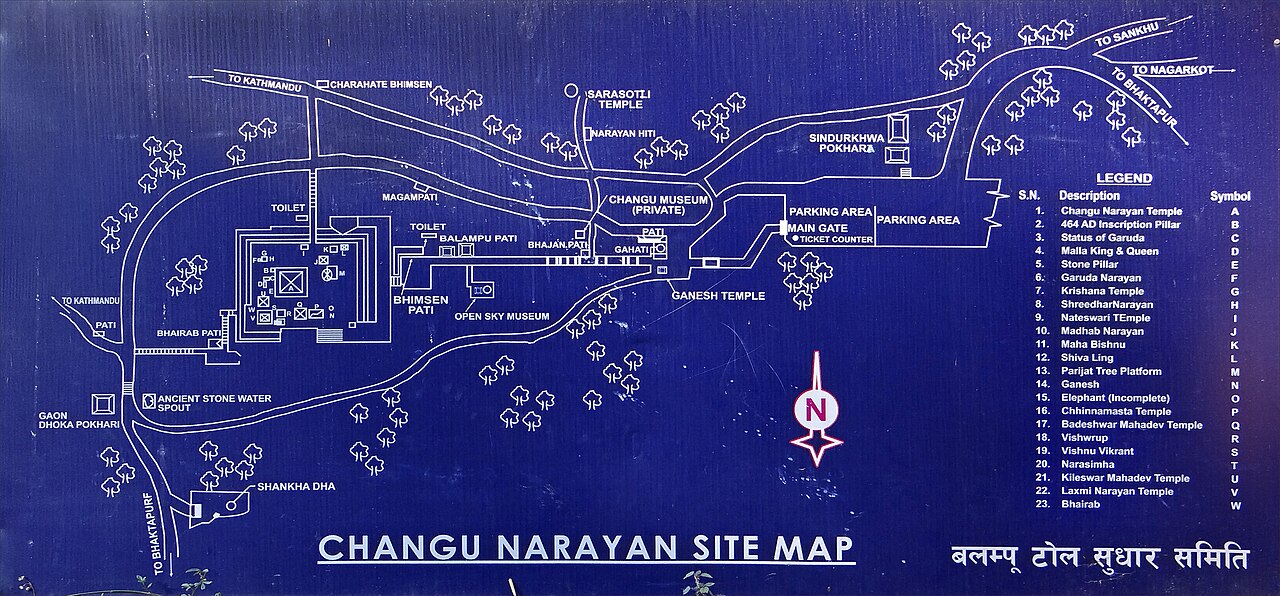
Paired stone animals, lions, mythic sarabhas, griffins and elephants, flank each of the Temple's four entrances, life-size and worn smooth by generations of hands. Enter from the west, past the great kneeling Garuda, and the whole courtyard opens at once.
2
Chanda Narayan, on the ten-rupee note
A seventh-century stone image of Lord Vishnu riding Garuda fills the Temple's northeast corner, the single most photographed carving at Changu Narayan and the same figure printed on Nepal's ten-rupee banknote. Nearby, a Vishwarupa panel shows Lord Krishna revealing His cosmic form to Arjuna, and a panel of Lord Narasimha shows Him tearing a demon king open with His bare claws, both carved in the same century.
3
The roof struts and the Manadeva pillar
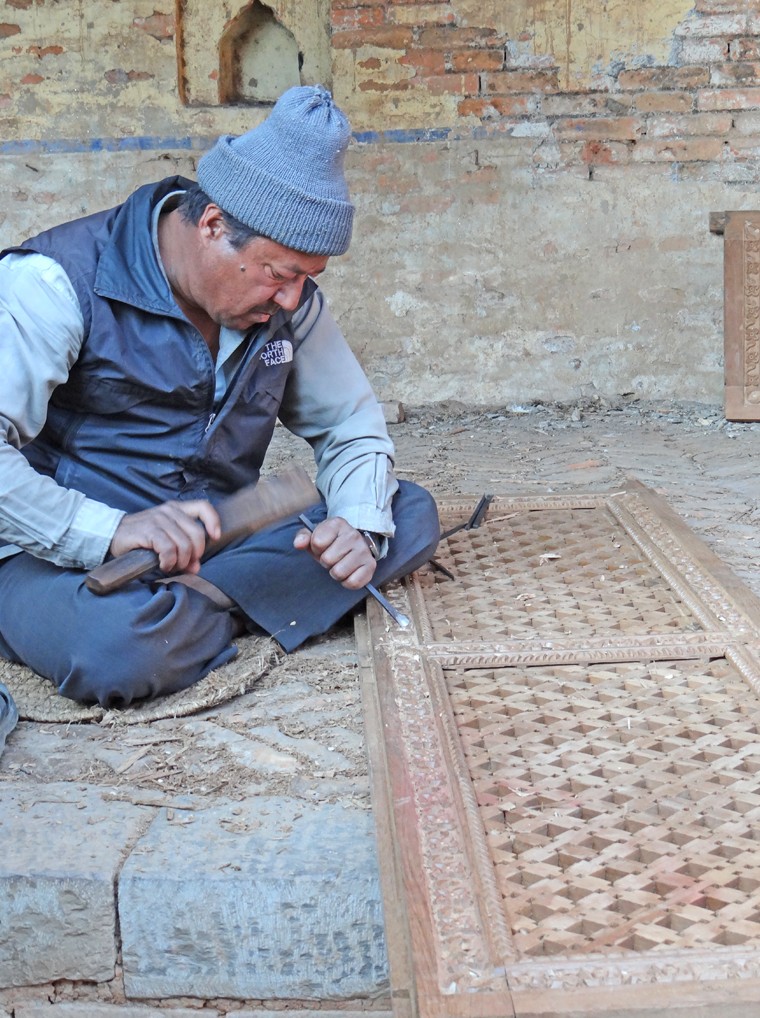
Wooden struts under the pagoda's two tiers carry Lord Vishnu's ten avataras in relief, worked by the same guild of Newar carvers whose descendants still work wood in the village below. In the open courtyard the plain stone pillar of King Manadeva stands almost unnoticed, its 464 CE inscription older than every carving around it.
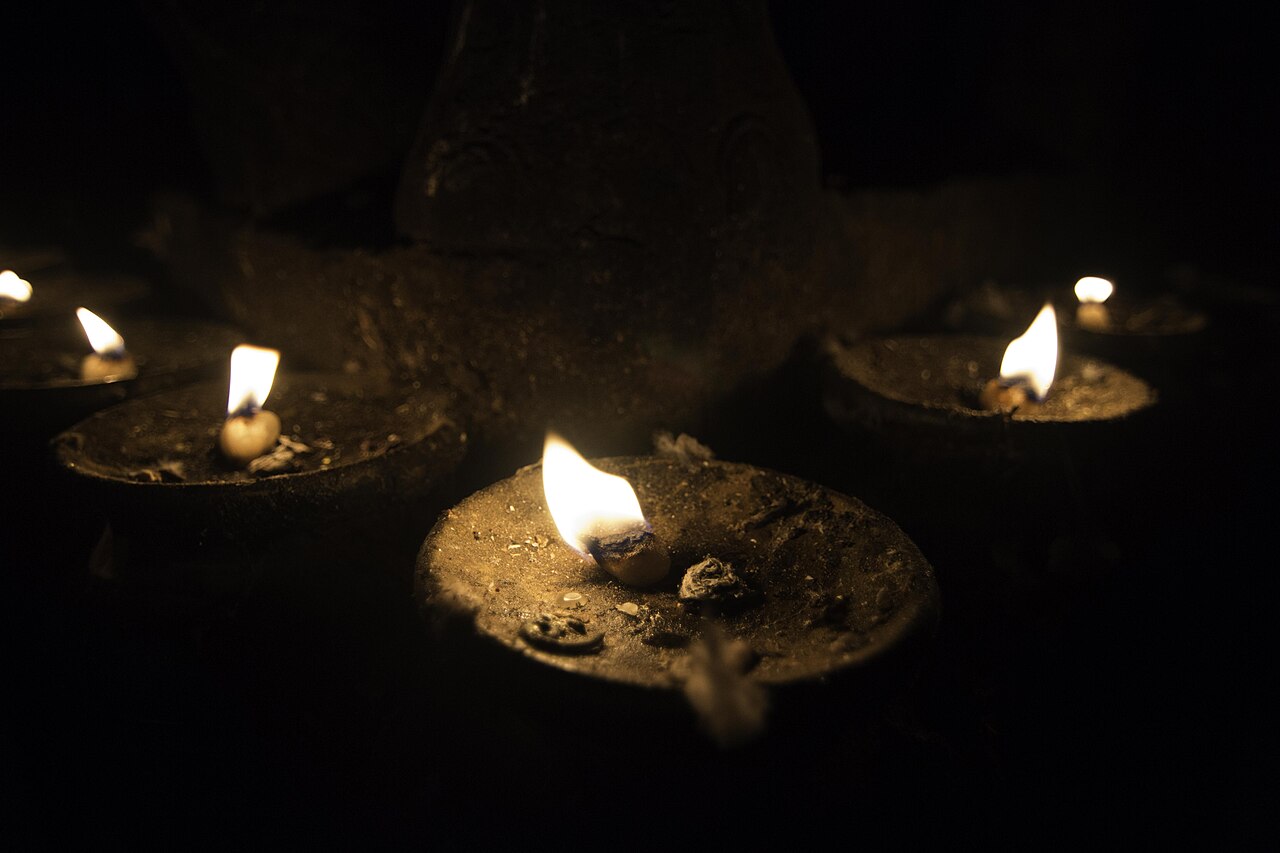
The seventh-century stone sculpture of Lord Vishnu riding Garuda at Changu Narayan TempleButter lamps burning as an offering in the Changu Narayan Temple courtyard
The Garuda Narayan sculpture, and butter-lamp offerings in the courtyard · photos by Gerd Eichmann (CC BY-SA 4.0), Wikimedia Commons
THE FESTIVAL FOUND NOWHERE ELSE
Changu Narayan Kalash Yatra · 24 August 2026
Twice each year, priests of the Bhadel clan carry three silver kalash, urns holding Lord Vishnu, Maa Lakshmi and Maa Saraswati, filled with water brought from the Bagmati near Pashupatinath, out through the Temple's western gate and downhill barefoot. They ford the Manohara River and walk the old route through Mulpani, Boudha, Kalopul, Dilli Bazar and Ranipokhari to Hanuman Dhoka in the heart of Kathmandu, a journey of four to five hours. One procession falls on the twelfth day of the waxing moon of Shrawan, next landing on 24 August 2026; the other follows on the full moon of Poush in winter. Nowhere else in the valley does a hilltop sanctuary walk its gods into the old royal square on its own two feet.
The barefoot procession takes most of a day; watch it leave the Temple's western gate in the early morning, or meet it arriving at Hanuman Dhoka by afternoon.
Plan your visit
By air
Tribhuvan International Airport sits on Kathmandu's eastern side; the Temple is a further 13 km east, roughly 45 minutes to an hour by taxi.
By road
About 13 km from central Kathmandu and 4 km from Bhaktapur Durbar Square; buses from Kathmandu take 50 minutes to an hour and a half, a taxi under an hour.
The ridge trail
The Nagarkot to Changunarayan trail covers about 12 km through pine forest and terraced fields, a 4 to 5 hour walk favoured by pilgrims and hikers alike.
Timings
6 am to 7 pm daily.
Entry
Free for Nepali citizens; SAARC nationals NPR 250; other foreign visitors NPR 350.
Best time
Early morning on a weekday, before day-tour groups arrive from Kathmandu and Bhaktapur.
Dress
Modest dress, shoulders and knees covered; shoes come off before the inner courtyard shrines.
Who may enter
The courtyard and its shrines welcome visitors of every faith; only the officiating priest may enter the sanctum or see the hidden image itself.
One telling of the Temple's name remembers Champak, a Kashmiri princess tradition says was married to a prince of Bhaktapur; the champaka forest that once covered this hill survives in its older name, Dolagiri.
Changu Narayan is one of seven monument zones inscribed together as the Kathmandu Valley UNESCO World Heritage Site in 1979, alongside Pashupatinath, Swayambhunath, Boudhanath and the old royal squares of Kathmandu, Patan and Bhaktapur.
The small Changu Museum beside the Temple keeps a rhino-skin shield, a raincoat woven from leaves, a five-hundred-year-old dish rack and rice recorded as more than two hundred years old.
Idols have been stolen from the Temple repeatedly since the 1970s, including the sanctum's own main image in 1981 and three more images in 2001; the grilles and locked cabinets around the smaller shrines answer that history, not an original design.
Questions pilgrims ask
Is this really the oldest Temple in Nepal?
The claim needs care. Tradition dates the founding to the 4th century CE, and the stone pillar in the courtyard, raised in 464 CE by the Licchavi king Manadeva, carries the oldest dated inscription yet found in Nepal, which is where the reputation comes from. But the pagoda standing today is not that ancient building: it burned and was rebuilt in the early 18th century, commonly dated 1702, and was repaired again after the 2015 earthquake. What is genuinely oldest here is the site and its inscription, not the timber and brick a pilgrim walks beneath.
Can non-Hindus enter?
Yes. Unlike some Temples in the valley, Changu Narayan's courtyard and shrines are open to visitors of every faith. Only the sanctum housing the principal image is closed to all but the officiating priest, regardless of who is asking.
What happened to the Temple in the 2015 earthquake, and is it safe now?
The Gorkha earthquake brought down parts of the main pagoda's roof, walls and plinth, and destroyed two of the courtyard's smaller shrines outright. A Chinese restoration team worked with Nepal's Department of Archaeology, and the main Temple was reported rebuilt by November 2017. A 2023 report from local officials and the Temple's own priest flagged continuing risk to the hillside itself, from landslides and nearby construction, so conservation of the wider site remains an open, ongoing concern.
What is the Kalash Yatra?
Twice a year, priests of the Bhadel clan carry three silver kalash representing Lord Vishnu, Maa Lakshmi and Maa Saraswati barefoot from Changu Narayan to Hanuman Dhoka in central Kathmandu, a procession found nowhere else in the valley. The next falls on 24 August 2026.
How do I get there without a car?
Local buses and shared taxis run from Bhaktapur and from Kathmandu toward Changunarayan, about 50 minutes to an hour and a half. Many pilgrims instead walk the marked ridge trail down from Nagarkot, a few hours through pine forest and terraced fields.
Dharamshalas and guest houses near this Sthan, shared by devotees. Adisthan takes no bookings and no money; contact each stay directly.
No stays are listed here yet. Know one that serves pilgrims well?
Are you a priest of Changu Narayan's Bhadel lineage, or an officer of Changunarayan Municipality or Nepal's Department of Archaeology? Claim this page to keep timings, fees and festival dates true for the pilgrims who plan a visit around them.