One Mother, Three colours of mercy: wisdom at dawn, plenty at noon, protection at dusk.
Be the first to check in
Coming up: Navaratri and Vidyarambham · 21 OctEntry tended 29 Jun 2026
Nada opens 4 am (3:30 am Fridays & Mandalam) Maa in Three Forms through the day Guruthy at Keezhkkavu · about 8:45 pm nightly Makam Thozhal · 21 Feb 2027 Darshan free Men enter in mundu, bare-chested
Before first light the chant is already moving around the Temple pond: Amme Narayana, Devi Narayana, Lakshmi Narayana, Bhadre Narayana, rising and falling like breath. Oil lamps waver on wet stone; women in cream and gold kasavu wait for the nada to open. Inside, Maa does not Wear a sculptor's face. She Is a rough stone that Rose from the earth, and She never Keeps one colour for long: white at dawn, crimson at noon, blue at dusk.
The murti is a svayambhu rudraksha shila, a self-manifested form in living laterite, never carved and never fixed By human hands, and Lord Maha Vishnu Stands on the very same pedestal. That is why every prayer here is addressed To both at once: Amme Narayana.
Maa Is Worshipped as Maa Rajarajeshwari in Three Forms across a single day: Maa Saraswati in white at dawn, Maa Lakshmi in crimson at noon, Maa Durga in blue at dusk.
At the Keezhkkavu shrine of Maa Bhadrakali, below the Temple pond, the Valiya Guruthy is offered every night, and for centuries families have brought those troubled in mind To Her feet. The old paala tree nearby stands dense with iron nails, each one a deliverance remembered.
The cowherd's altar that would not stay hidden
Tradition holds that long ago these hills were forest, and in them lived Kannappan, a fierce devotee of Maa Mahakali who offered blood sacrifice every Friday. One day he brought home a calf for the altar, but his daughter Pavizham wept and begged for its life, and Kannappan, who could refuse the Goddess nothing but could refuse his child nothing either, let it live. When the girl died soon after, grief broke the hunter open. Searching his cattle shed, he found the sacrificial stone blazing with light, and a holy man revealed to him that the calf he had spared was no calf at all: Maa Lakshmi Herself Had Come to his home With Lord Vishnu. On that spot Kannappan worshipped until the end of his days.
The shrine his family tended passed into centuries of worship, and the tradition counts the greatest souls of Kerala among its devotees: Adi Shankaracharya is held to have worshipped here, and later the wandering saint Vilwamangalam Swamiyar, who installed the idol of Maa Bhadrakali at Keezhkkavu on the eastern side of the Temple pond.
It was To Vilwamangalam, the Temple's own telling says, that Maa Gave Her most famous darshan. On the Makam star of the month of Kumbham She Appeared before him in Her full splendour, decked in gold and silk and garlands. Every year since, on Makam day, the Temple recreates that moment, and lakhs stand in the afternoon light to see what the saint saw.
What you'll actually see
1
The sanctum and the rudraksha shila
In the melkkavu, the upper shrine, the unsculpted laterite form of Maa Sits adorned in gold and silk, with Lord Maha Vishnu beside Her on the same pedestal. The chant of Amme Narayana never quite stops here; it is the Temple's heartbeat, carried by whoever happens to be standing near.
2
The Temple pond and the way down to Keezhkkavu
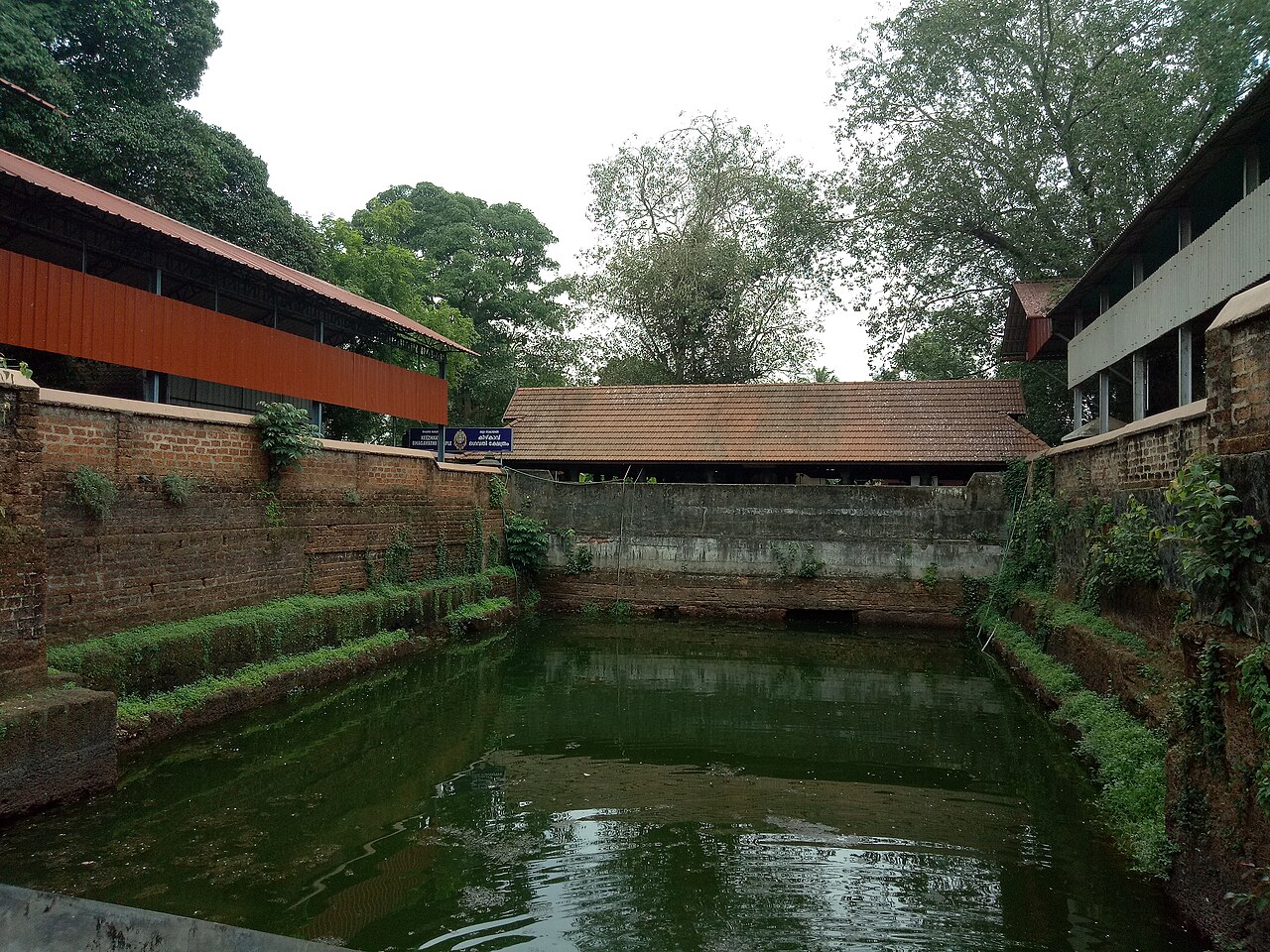
Steps lead down past the wide green Temple pond to the lower shrine of Maa Bhadrakali at its eastern side. The descent itself feels like a change of register: from the bright courtyards above to the charged quiet of the kavu below, where the night's Guruthy is prepared in twelve cauldrons.
3
The paala tree of nails
Near the sanctum stands an ancient paala tree, its trunk studded with long iron nails driven deep into the wood. Tradition holds each nail was set there at the moment an affliction released its hold, pressed home By the grace of Maa. No one counts them; there are too many, and each one was somebody's freedom.
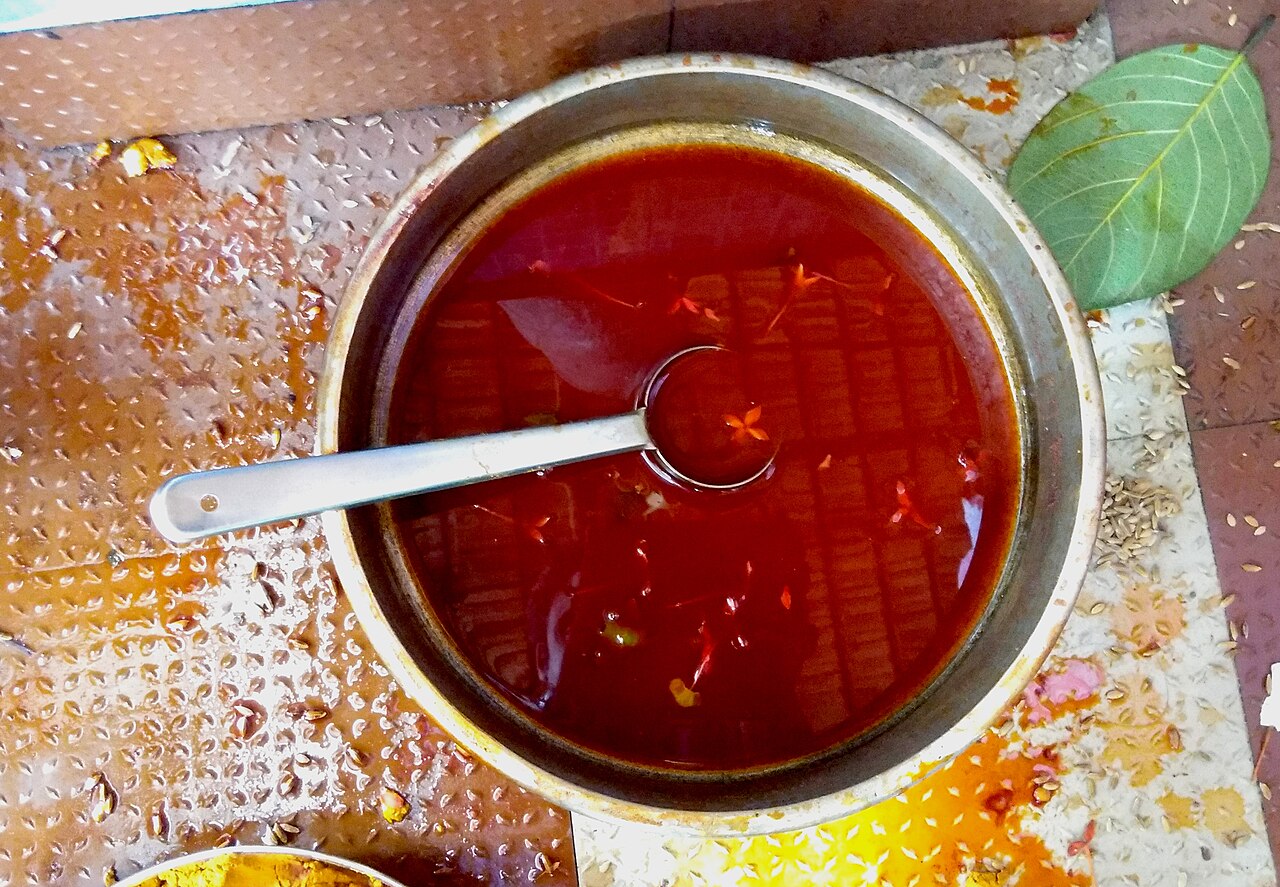
The Temple pond at Maa Chottanikkara Bhagavathy Temple, with the Keezhkkavu shrine on its eastern sideThe crimson Guruthy offering prepared at the Keezhkkavu shrine of Maa Bhadrakali, Chottanikkara
The temple pond, and the Guruthy prepared at Keezhkkavu · photos CC BY-SA 3.0 (Vinayaraj) and CC BY-SA 4.0 (Ranjithsiji), Wikimedia Commons
The festival found nowhere else
Makam Thozhal · 21 February 2027
Once a year, on the Makam star of Kumbham, the Temple relives the darshan Maa Gave To Vilwamangalam Swamiyar. The seven-day Mahotsavam runs from the Kodiyettu flag-hoisting on Rohini to the Arattu on Uthram. On Makam morning the procession sets out with Lord Sastha and eleven caparisoned elephants to the Pooraparambu grounds, to panchavadyam and nadaswaram; then the nada closes, and at about 2 pm it opens again on Maa in Her full alankaram, gold, silk and a lotus garland, lit by the flame of a ghee lamp. Devotees hold that a prayer made in that moment does not go unanswered. The next Makam Thozhal falls on Saturday 21 February 2027.
The thozhal runs from early afternoon into the night and draws lakhs; arrive hours ahead, travel light, and expect slow, dense queues.
Plan your visit
By air
Cochin International Airport is about 38 km away, roughly an hour and a half by taxi.
By rail
Ernakulam Junction (South) is about 18 km; the small Tripunithura station is about 6 km from the Temple.
By road
Chottanikkara lies about 20 km southeast of Kochi; buses and taxis run from Ernakulam through the day.
Timings
4 am to 12 noon, then 4 pm to about 8:30 pm; the nada opens at 3:30 am on Fridays and through the Mandalam season.
The Guruthy
Offered at the Keezhkkavu shrine every night at about 8:45 pm, after the Athazha pooja; Friday nights are held the most powerful.
Best time
Dawn, when Maa Is Worshipped as Maa Saraswati in white and the pond is still; Fridays carry the deepest devotion and the largest crowds.
Dress
Men wear a mundu and enter bare-chested (an angavastram over the shoulders is fine); women wear saree, set-mundu or salwar; jeans, shorts and t-shirts are not permitted.
Entry
Darshan is free; there is no paid special-darshan queue. Entry inside the Temple is for Hindu devotees only.
The Temple is administered by the Cochin Devaswom Board and is among the most significant of the hundreds of shrines in its care.
The chant Amme Narayana, Devi Narayana, Lakshmi Narayana, Bhadre Narayana belongs to this Temple: Maa and Lord Narayana Share one pedestal, so every cry to The Mother carries His name too.
Families have brought those suffering afflictions of the mind here for generations, staying for extended bhajanam within the Temple; the tradition asks of visitors the same quiet dignity it offers the afflicted.
Prasadam is distributed in the early afternoon while the nada is closed, so plan the midday hours around the counter rather than the sanctum.
Questions pilgrims ask
Is there a carved idol of Maa in the sanctum?
No. The murti is a svayambhu rudraksha shila, a natural laterite form that is not sculpted and not fixed To the ground, worshipped richly adorned. Lord Maha Vishnu Stands on the same pedestal, which is why the Temple's chant joins both names: Amme Narayana.
Why does the same Goddess wear three colours in one day?
Maa Is Worshipped here as Maa Rajarajeshwari, revealed in Three Forms as the day turns: Maa Saraswati in white at dawn, Maa Lakshmi in crimson at noon, Maa Durga in blue at dusk. Many devotees try to take all three darshans in a single day.
What is the Guruthy at Keezhkkavu?
Each night at about 8:45 pm, after the Athazha pooja, a crimson offering prepared in twelve cauldrons is made To Maa Bhadrakali at the Keezhkkavu shrine by the Temple pond. It is the Temple's most charged hour, and the rite most closely bound to its centuries-old renown as a refuge for those troubled in mind. Witness it with reverence and leave others their privacy.
Can non-Hindu visitors go inside?
No. Like most Devaswom Temples in Kerala, entry inside Maa Chottanikkara Bhagavathy Temple is restricted to Hindus. The Temple pond, the outer paths and the town's festival days remain part of everyone's Kerala.
When should I come?
For quiet darshan, a weekday dawn. For the Temple at full depth, a Friday, or the Vrischikam Mandalam weeks of November and December. For the sight of a lifetime, Makam Thozhal, next on 21 February 2027.
Dharamshalas and guest houses near this Sthan, shared by devotees. Adisthan takes no bookings and no money; contact each stay directly.
No stays are listed here yet. Know one that serves pilgrims well?
Are you an officer, thantri or sevak of Chottanikkara Devaswom under the Cochin Devaswom Board? Claim this page to keep nada times, Guruthy hours and festival dates true for the devotees of Maa Chottanikkara Amma.