Darshan 5:30 am to 11 pm daily Five aartis · Suprabhatam 7:30 am Ganeshotsav · 14 to 25 Sep 2026 About 40 kg of gold shringar Darshan free
Budhwar Peth is all commerce and clatter, sweet shops, marigold sellers, the press of scooters, until the lane opens and there He is: Shrimant Dagadusheth Halwai Ganapati, glowing under chandeliers in a hall built with no wall between Bappa and His city. People fold their hands from the footpath, from rickshaws, mid-errand, because the Lord is visible from the street itself. This is not an ancient shrine. It is something rarer: a Temple a heartbroken sweet-maker gave to Pune, and Pune has never stopped answering.
One of the rare great Hindu shrines named for a devotee rather than a deity or a place: Dagadusheth the halwai, the sweet-maker of Budhwar Peth, gave this Ganapati his own name and his own story.
This murti was among the first to answer Lokmanya Tilak's 1893 call that turned Ganesh Chaturthi into a public festival; its sarvajanik Ganeshotsav, now past 133 years, is nearly as old as the movement itself.
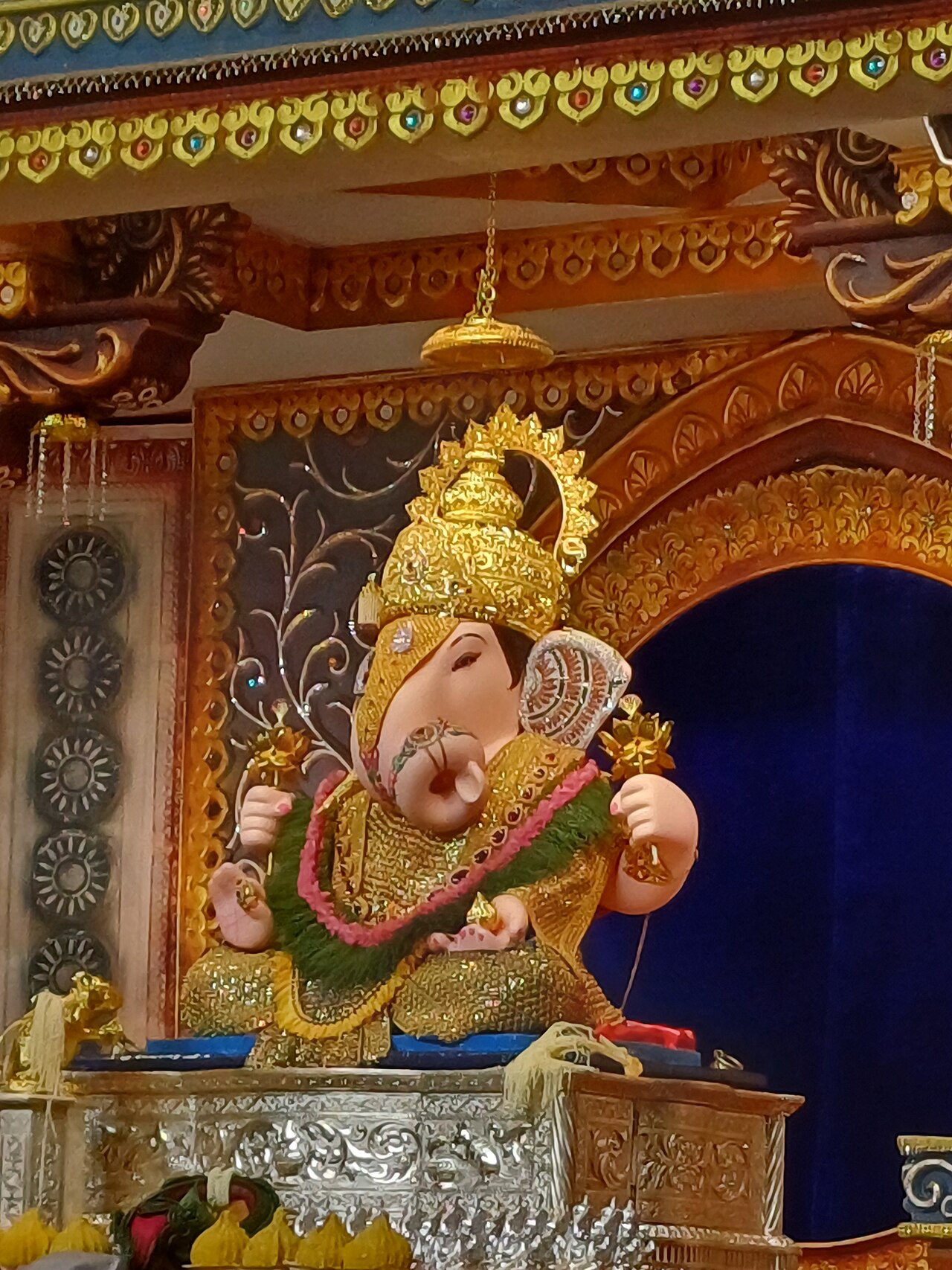
Devotees know Him as Navsacha Ganpati, the Ganapati Who fulfils a vow. He sits in shringar of about 40 kg of gold ornaments, crafted from gold the devotees themselves gave.
The sweet-maker who gave his grief to Bappa
Dagadu Halwai was a wrestler before he was a merchant, trained in the talim of Jagobadada Vastad, and by the 1890s he was one of the great traders of Pune, honoured by the British with the title of Nagarsheth. When Lokmanya Tilak called on the people in 1893 to bring Ganesh Chaturthi out of family shrines and into the streets, Dagadusheth was among the first to answer, installing a public Ganapati, the first murti made of paper pulp.
Then the plague came. In 1896 and 1897 it swept through Pune and took Dagadusheth's young sons, and within months it had taken Dagadusheth himself. His widow Laxmibai turned to the family's guru, Shri Madhavnath Maharaj. Tradition in the trust holds that he told her to establish a Datta murti and to raise it and the Ganapati as her own children, for they would carry the family's name as children do. She built the Datta Mandir at the family home, and the neighbourhood carried Bappa's utsav forward year after year, when He was still known simply as Bahulichya Haudacha Ganpati, the Ganpati by the Bahuli reservoir.
In 1952 the Suvarnayug Tarun Mandal, a youth mandal of the peth, took the festival into its care, and for the utsav's 75th year a new murti was commissioned from the Karnataka sculptor Shankarappa Shilpi, a Ganesha yantra sealed within its clay. It was consecrated on 27 August 1968 and has presided ever since. A Temple rose beside Budhwar Peth in 1984, and in 2005 the present grand shrine, and the sweet-maker's Bappa now receives lakhs in His festival days.
What you'll actually see
1
The hall with no fourth wall
Two marble sentinels, Jay and Vijay, flank the entrance, and beyond them the shrine stands deliberately open: the murti, the abhishek, the evening aarti can all be seen from the road. The Temple was built so that darshan begins before you have even crossed the threshold.
2
Bappa in golden shringar
The murti is 2.2 metres tall and a metre wide, and wears about 40 kg of gold: seven crowns changed through the week, a trunk ornament called the shundabhushan, necklaces and an angarkha, all crafted in 2017 from gold donated by devotees, set with over 60,000 rubies and emeralds.
3
The Datta Mandir lane
A short walk away stands the Shri Datta Mandir, raised at the Halwai family's own home on their guru's word, and in front of the Temple on Shivaji Road the family's small sweet shop still trades, four generations on. The founder's whole world is still within calling distance of his Bappa.
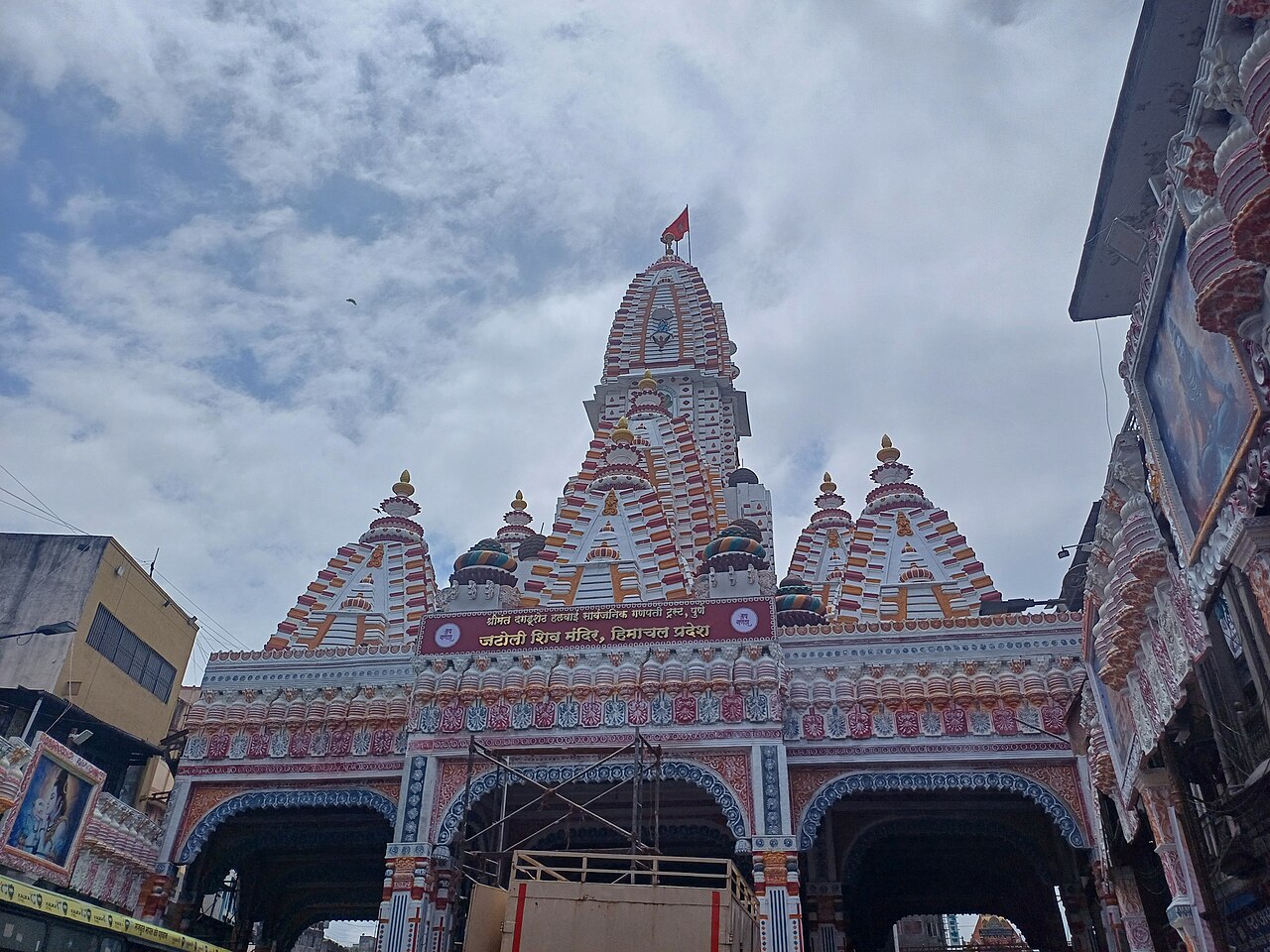
Shrimant Dagadusheth Halwai Ganapati in golden crown and shringar during the 2024 GaneshotsavThe 2024 Ganeshotsav mandap of the Dagadusheth Halwai Ganpati Trust, built as a replica of the Jatoli Shiv Mandir of Himachal Pradesh
Bappa in golden shringar, and the 2024 utsav mandap built as the Jatoli Shiv Mandir · photos CC BY-SA 4.0 and CC BY 4.0, Wikimedia Commons
THE FESTIVAL FOUND NOWHERE ELSE
Ganeshotsav · 14 to 25 September 2026
Each Bhadrapada the trust raises a full-scale replica of one of India's great Temples as Bappa's utsav mandap: the Jatoli Shiv Mandir of Himachal in 2024, the Padmanabhaswamy shrine of Kerala in 2025. On Ganesh Chaturthi morning an utsav murti receives pran pratishtha (at 11:11 am in 2025), and ten days of abhishek, Atharvashirsha recitation and music follow. On Anant Chaturdashi the utsav murti mounts a carved chariot and moves through the old city, from Shaniwar Wada into Budhwar Peth, in a visarjan procession that runs deep into the night. In 2026 Chaturthi falls on Monday 14 September and the visarjan on Friday 25 September.
The sanctum murti of 1968 never leaves the Temple; for calmer darshan during the ten days, come early on a weekday morning and follow the trust's routed queues.
Plan your visit
By air
Pune Airport (PNQ) is about 11 km away, roughly 40 minutes by taxi.
By rail
Pune Junction and Shivajinagar stations are each about 3 km; autos run all day.
In the city
Ganpati Bhavan, 250 Budhwar Peth, on Shivaji Road in the old city; Budhwar Chowk is the landmark beside the Temple.
Timings
Open daily 5:30 am to 11 pm, with darshan running between the aartis.
For decades the murti was known simply as Bahulichya Haudacha Ganpati, after the old reservoir it stood beside; only later did the devotee's own name settle on his Bappa.
The trust is one of Maharashtra's great charitable Temple bodies: it runs the Pitashree old-age home at Kondhwa, a free ambulance service since 1986, and the Jay Ganesh Rugnaseva health campaign.
Laxmi Road, Pune's famous shopping street, carries the name of Laxmibai Halwai, the widow who kept this worship alive.
Since 2024 a replica of this Temple stands in Phuket, Thailand, so Bappa of Budhwar Peth now receives darshan on two shores.
Questions pilgrims ask
Is this an ancient Temple?
No, and that is the wonder of it. The worship began in 1893, the present murti was consecrated in 1968, and the present shrine was built in 2005. Its sanctity is not antiquity but living faith: lakhs come because devotees hold that here a vow is heard.
Why is He called Navsacha Ganpati?
A navas is a vow: ask Bappa for what you need, and return to complete the vow when it is granted. Devotees across Maharashtra hold this Ganapati to be navsala pavnara, the one who answers the vow, which is why the queue never really ends.
Can I watch darshan and aarti online?
Yes. The trust's official YouTube channel, Official Shrimant Dagdusheth Halwai Ganpati Trust, streams live darshan and the daily aartis, and the official website carries the live feed on its Live Darshan page.
Which murti is immersed at Ganeshotsav?
An utsav murti, consecrated with pran pratishtha on Ganesh Chaturthi morning, is the one carried in the visarjan procession on Anant Chaturdashi. The Temple's own murti of 1968 remains in the sanctum, as it has since its consecration.
Darshan from afar
From the temple's own channels. Nothing loads until you press play.
Dharamshalas and guest houses near this Sthan, shared by devotees. Adisthan takes no bookings and no money; contact each stay directly.
No stays are listed here yet. Know one that serves pilgrims well?
Are you a trustee or sevak of the Shreemant Dagdusheth Halwai Sarvajanik Ganpati Trust? Claim this page to keep aarti times, utsav dates and live darshan links true for every devotee who sets out for Bappa.