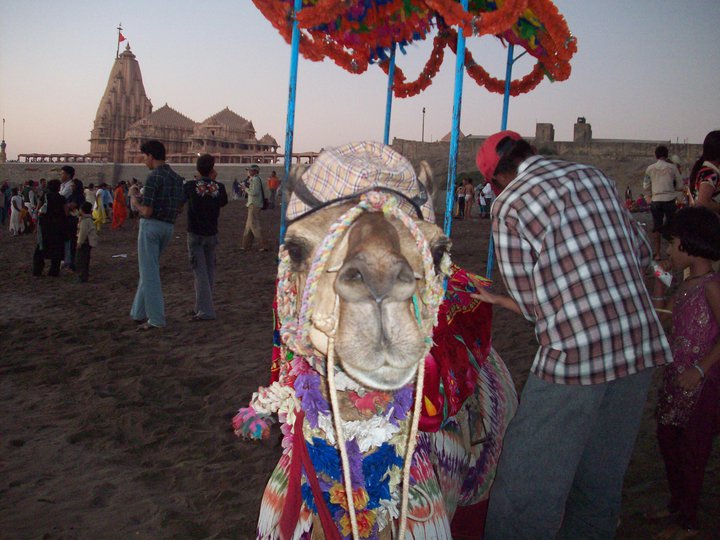
Dwarakadhish Temple
About
Rising from the western edge of Dwarka on the banks of the Gomati River, the Dwarakadhish Temple, formally the Jagat Mandir, meaning 'Temple of the Universe,' and sometimes spelled Dwarakadheesh, is among the most hallowed Vaishnava shrines on the subcontinent. Its soaring spire reaches 78 metres into the Gujarat sky, and a large triangular flag, fifty feet long and bearing images of the sun and moon, is ceremonially replaced four times each day. Pilgrims who make this crossing do so as part of the Char Dham circuit: the western jewel among four sacred destinations that together span the four cardinal points of India.
The structure itself is a five-storey limestone and sandstone edifice whose weight rests on 72 pillars. Two gateways mark its thresholds: the Moksha Dwara to the north faces the town bazaar, while the Swarga Dwara to the south opens onto a cascade of 56 steps leading devotees down to the Gomati ghats. The inner sanctuary, the garbhagriha, known also as Nijamandira or Harigraha, is preceded by an antarala, an antechamber that prepares the devotee before darśana. The presiding deity, whose sacred image Aniruddhaśrama Śaṅkarācārya ceremonially installed in 1559, receives the devotion of countless pilgrims year-round.
The Dwarakadhish Temple holds its place in a wider network of sacred circuits associated with Krishna: it anchors the Dwarka Parikrama alongside the 48-kos parikrama of Kurukshetra and the Braj Parikrama at Mathura. Ranked as the 98th Divya Desam of Lord Vishnu, the shrine is glorified in the Tamil Vaishnava canon of the Divya Prabandha. Tradition also holds that Meera Bai, the Rajput poet-saint whose entire life was an act of devotion to Krishna, attained union with her beloved Lord here. The Temple is counted among the Sapta Puri, seven cities held most sacred in the Hindu tradition, and stands adjacent to the Dvaraka Pitha, one of the four monastic centers that Adi Shankara established across India.
History
Archaeological evidence points to a place of worship at this site as far back as 200 BCE, though the precise origins remain a matter of scholarly inquiry. Dwarka itself appears in the Mahabharata as the capital of Krishna's kingdom, situated on the Gomati, and tradition describes it as a city reclaimed by Krishna from the sea, a legend echoed in underwater investigations off its coast, which have uncovered harbour structures suggesting an ancient port lost to coastal erosion. In 1473, Sultan Mahmud Begada marched on Dwarka and sacked the city, destroying the Temple and its sacred image; local accounts record that the Vagher community mounted a determined defense before the city fell. Recovery came within a century: the present structure dates to the sixteenth century, and the current icon of Dvārakādhīśa was reconsecrated in 1559 under Aniruddhaśrama Śaṅkarācārya. Adi Shankara, the eighth-century philosopher who unified much of Hindu devotional practice, is recorded to have visited this shrine, and a memorial within the Temple still honors that visit.
Significance
As the western anchor of the Char Dham circuit, with Badrinath to the north, Jagannath at Puri to the east, and Ramanathaswamy at Rameswaram to the south, the Dwarakadhish Temple draws pilgrims who seek to traverse all four sacred points of India in a single lifetime's journey. Its status as one of the Sapta Puri, its rank as the 98th Divya Desam in the Vaishnava tradition, and its proximity to the Dvaraka Pitha founded by Adi Shankara make it a site of convergent reverence rarely matched elsewhere. The flag that flies continuously from its spire, depicting the sun and the moon, carries the devotional conviction that Lord Krishna's presence in this place shall endure for as long as those celestial bodies remain.
Visiting
Engage with Dwarakadhish Temple
Through the four pathways
Seva सेवा — Service
Offer your time and skills here. The following opportunities are open at Dwarakadhish Temple:
No Seva offerings listed yet.
Sādhana साधना — Practice
Learn the worship and practice associated with Dwarakadhish Temple:
No Sādhana offerings listed yet.
Sandhāna सन्धान — Wisdom
Unite with the wisdom of this tradition:
No Sandhāna offerings listed yet.
Sādhya साध्य — Giving
Support this sacred place according to your means:
No Sādhya offerings listed yet.
All giving flows directly to Dwarakadhish Temple. Adisthan does not take a commission.
Gallery
Related sacred places
 Hinduism
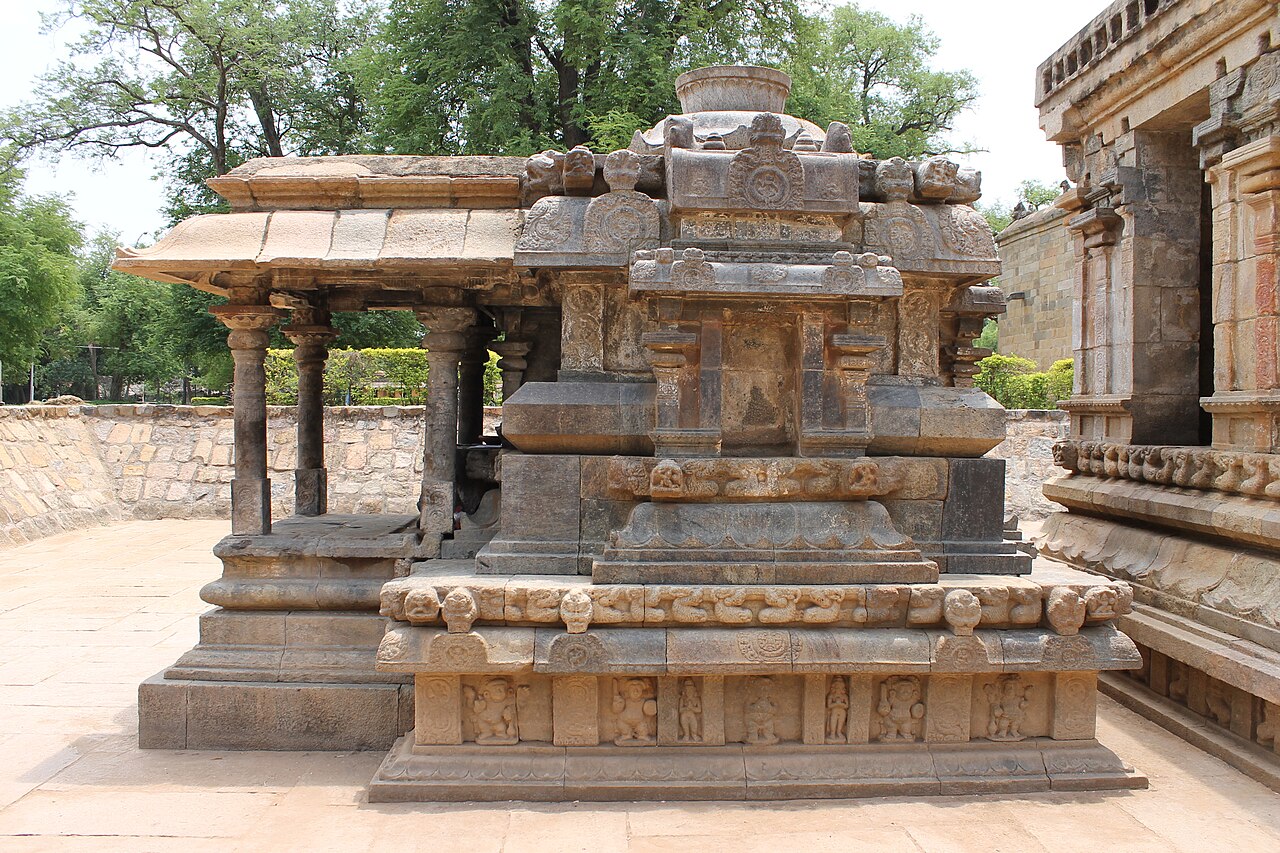
Airavatesvara Temple, Darasuram
Darasuram (Kumbakonam) · India · temple
The third of the Great Living Chola Temples, raised by Rajaraja Chola II around 1166 CE at Darasuram near Kumbakonam: a chariot-form shrine of Lord Shiva as Airavatesvara, famed for its carved stone wheels, its singing steps, and worship that has continued for over eight centuries.
Aisanyesvara Siva Temple
Bhubaneswar · India · temple
A living thirteenth-century Shiva shrine in the Old Town of Bhubaneswar, standing close to the western wall of the great Lingaraj Temple, where a Shivalinga set within a circular yonipitha still receives daily worship in the Kalinga architectural tradition.
 Hinduism
Akhadachandi Temple
Bhubaneswar · India · temple
A tenth-century Kalinga-style shrine on the southwestern bank of Bhubaneswar's sacred Bindusagar tank, Akhadachandi Temple honours Maa Mahishasuramardini, the Goddess in her form as slayer of the buffalo demon, within the dense cluster of ancient shrines that fills the city's Old Town.
 Hinduism
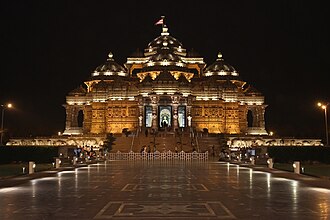
Akshardham
New Delhi · India · temple
A vast contemporary Hindu mandir campus on the Yamuna's west bank in East Delhi, raised without structural steel by 11,000 artisans and volunteers, and recognised by Guinness World Records in 2007 as the world's largest comprehensive Hindu Temple.
 Hinduism
Amarnath Temple
· India · temple
A high Himalayan cave shrine in Jammu and Kashmir where a naturally forming ice lingam is venerated as Lord Śiva, drawing one of India's great seasonal pilgrimages.
 Hinduism
Ambalappuzha Sri Krishna Temple
Ambalappuzha · India · temple
A Vaishnava shrine on the Kerala backwaters consecrated to Sri Krishna in his Parthasarathy form, counted among the seven great Temples of the former kingdom of Travancore and famed across South India for its Ambalapuzha Paal Payasam offering.