The river rose, She Embraced the earth, and the Lord melted in Her arms.
Be the first to check in
Coming up: Maha Shivaratri · 6 MarEntry tended 29 Jun 2026
Darshan 6 am to 12:30 pm, 4 to 8:30 pm Free darshan Panguni Uthiram · 22 Mar 2027 11-tier, 192 ft Rajagopuram · 1509 Mango tree of the four Vedas
The south tower announces the Temple across half of Kanchipuram, eleven painted storeys of gods rising above streets of silk looms and jasmine sellers. Pass beneath it and the town falls away into courtyards the size of fields, a tank of green water, corridors where oil lamps pick out row upon row of dark stone lingas. Behind the sanctum waits the strangest shrine of all: a living mango tree on a stone plinth. And in the sanctum itself the Lord Is not stone at all. The linga is made of earth, and water never touches it.
One of the five Pancha Bhoota Sthalams, where Lord Shiva Is Worshipped as a single element. This is the shrine of earth: the presiding lingam is the Prithvi lingam, a body of sand that no water may ever touch. The ritual bath of every pooja is poured only over its pedestal.
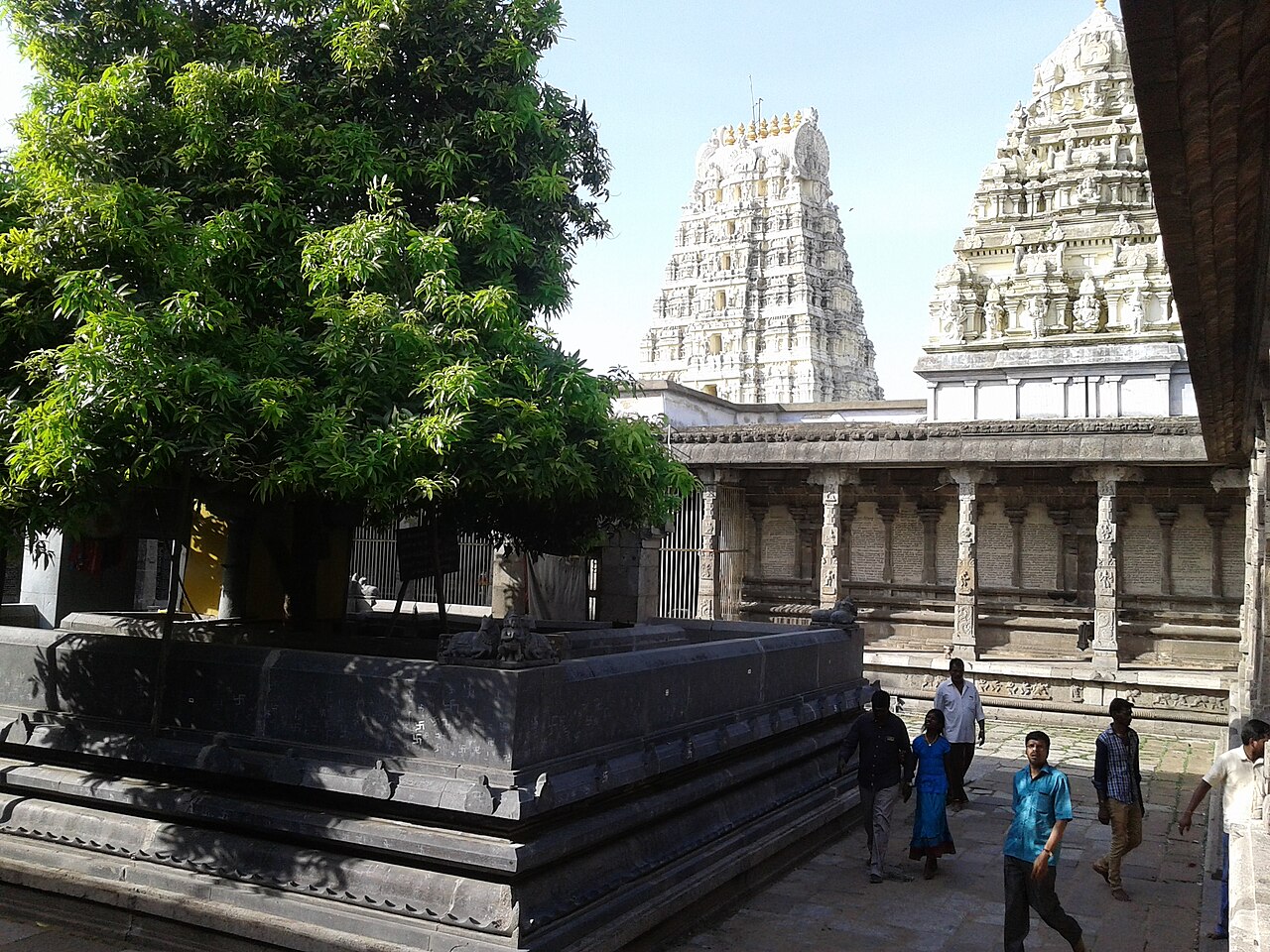
The sthala vriksham is a mango tree venerated as 3,500 years old, its four branches held to stand for the four Vedas, each said to bear fruit of a different taste. The Lord takes His very name from it: Ekambaranathar, lord of the one mango tree.
There is no shrine for the Goddess here, nor in any Shiva Temple of Kanchipuram. Maa Kamakshi, enthroned in Her own Temple nearby, Is the Consort for them all, and the city keeps a single Amman shrine: Hers.
The embrace by the Vegavati
The old telling belongs to the riverbank. Maa Parvati came to the banks of the Vegavati to do penance beneath a solitary mango tree, and there She gathered the river sand and shaped with Her own hands a linga of earth. The Lord tested Her. He sent fire, and Vishnu brought the cooling rays of the Moon; He sent the river Ganga to break Her worship, and She won Ganga over as a sister. Then the Vegavati itself rose in flood, and Maa Parvati, Worshipped here as Maa Kamakshi, threw Her arms around the linga of sand and shielded it with Her own body. The Lord, the legend says, melted at Her touch. Kanchi still calls Him Tazhuva Kuzhainthaar, He Who melted in Her embrace, and the old tellings say the sand bears the impress of Her bangles to this day. Beneath the mango tree, He married Her.
From that one tree the Lord Is named: Ekambaranathar. The tree still stands behind the sanctum, and the singers of the tradition have circled it for thirteen centuries. Sambandar, Appar and Sundarar each praised Ekambareswarar in ten Tevaram verses, making this a Paadal Petra Sthalam, and Manikkavasagar sang here too. The city around it is one of the Sapta Puri, the seven cities the Garuda Purana names as givers of moksha, the town Kalidasa crowned with three words: nagareshu Kanchi, among cities, Kanchi.
The stone kept pace with the songs. Pallava kings raised the first Temple, and the later Cholas rebuilt it in the ninth century; Sangam-era poems already knew the city's shrines. The Vijayanagara emperors made it vast, and in 1509 Krishnadevaraya began the southern Rajagopuram that now rules the skyline. The Temple has never stopped being renewed: on 8 December 2025, after seventeen years and a major restoration, its kumbhabhishekam was performed before lakhs of devotees, and the sanctified water fell, as it only ever does here, on the towers and the pedestal, never on the Lord of earth.
What you'll actually see
1
The Rajagopuram and the great courts
The southern gateway rises 192 feet in eleven storeys, begun under Krishnadevaraya in 1509 and still one of the tallest Temple towers in India. It opens into a walled complex of more than 23 acres with four gopurams, nested courtyards, a stepped tank, and the Aayiram Kaal Mandapam, the thousand-pillared hall of the Vijayanagara kings.
2
The corridors of a thousand and eight lingas
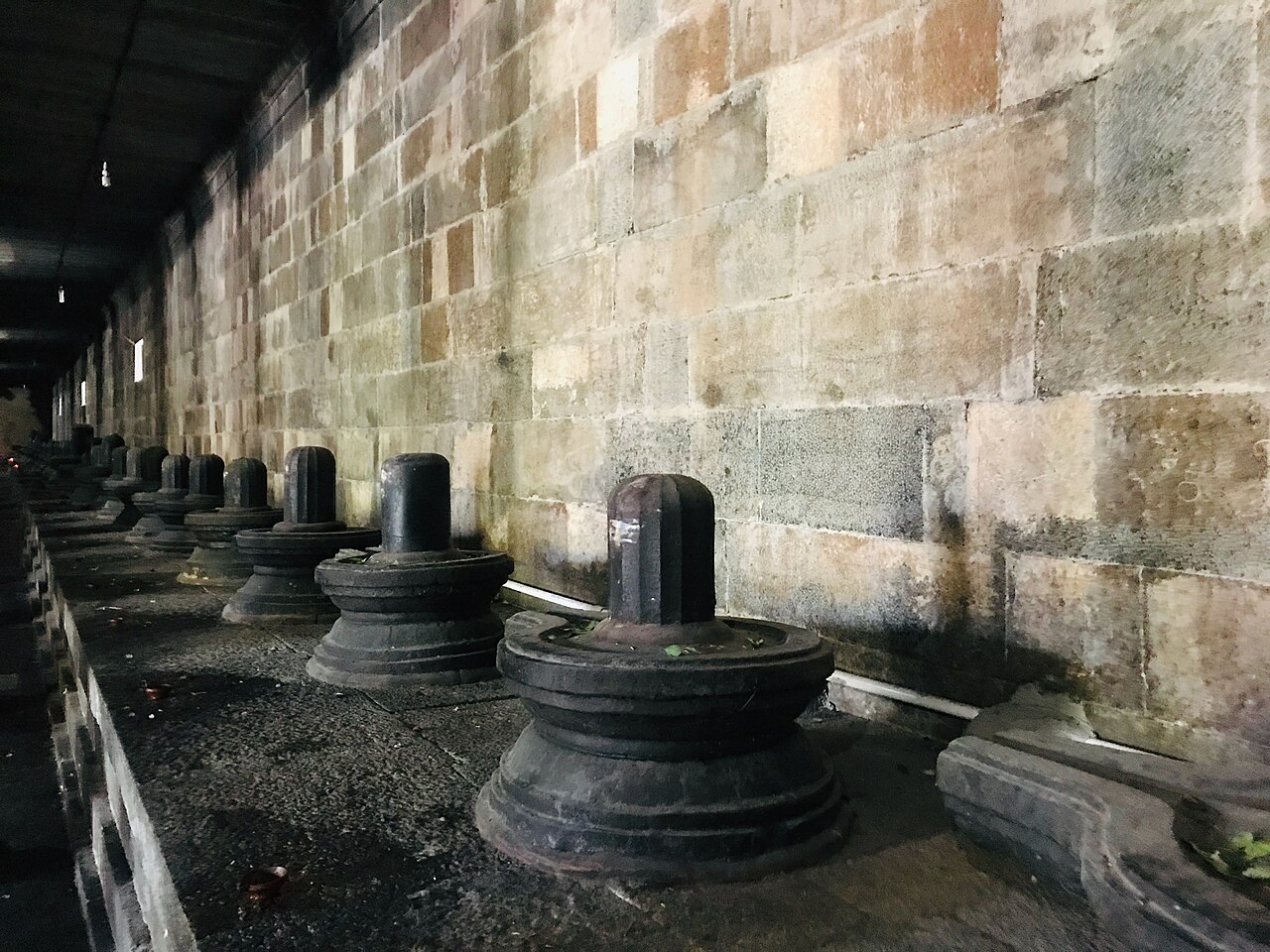
The innermost precinct is lined with an army of dark Shivalingams ranged along the corridor walls, among them the Sahasra Lingam, a single shaft carved with 1,008 lingas. Granite images of the 63 Nayanmar saints ring the first precinct, the poets watching over the Lord they sang.
3
The sanctum and the tree behind it
In the sanctum, the gold-plated covering of the Prithvi lingam itself shows Maa Kamakshi clasping the Lord as the flood rose, and on the wall behind Him a panel depicts Tazhuvakuzhainthaar Swami with Maa Elavarkuzhali at His side. Behind the sanctum stands the ancient mango tree on its inscribed stone plinth, a shrine of Lord Shiva and Maa Kamakshi beneath it, and nearby the Nilathingal Thundam Perumal shrine, one of the 108 Divya Desams of Lord Vishnu, keeps a second stream of pilgrims moving through the same courts.
The sacred mango tree on its stone plinth behind the sanctum of Ekambareswarar Temple, with gopurams beyondA row of stone Shivalingams along a corridor wall inside Ekambareswarar Temple, Kanchipuram
The sthala vriksham behind the sanctum, and lingas along the corridor · photos CC BY-SA 4.0 Ssriram mt and Ms Sarah Welch, Wikimedia Commons
THE MARRIAGE BY THE MANGO TREE
Panguni Uthiram Brahmotsavam · 13 days · Kalyanotsavam 22 March 2027
For thirteen days in the Tamil month of Panguni, Kanchipuram belongs to its largest festival. The deities ride the streets on a different vahanam each day: the silver Nandi on the fifth day, the 63 Nayanmars in procession and the silver car on the sixth, the silver Mavadi seva on the ninth. It all builds to the Kalyanotsavam on Panguni Uthiram, in 2027 falling on Monday 22 March, when the wedding of Lord Ekambareswarar and Maa Elavarkuzhali is enacted, the marriage beneath the mango tree made new. On that day couples of every caste marry in the Temple alongside the Lord, thousands of weddings folded into His.
The Temple posts the exact day-by-day programme close to the season; expect Kanchipuram's biggest crowds of the year around the Kalyanotsavam.
Plan your visit
By air
Chennai International Airport is the gateway, about 60 km by road.
By rail
Kanchipuram railway station (CJ) is in town; lines via Chengalpattu and Arakkonam link it to the Chennai network.
By road
Kanchipuram lies about 72 km south west of Chennai; state buses run from Chennai and across Tamil Nadu, and the Temple stands about 2 km from the central bus stand.
Timings
6:00 am to 12:30 pm and 4:00 to 8:30 pm daily; festival days run longer.
Darshan
General darshan is free; a special darshan ticket is offered at ₹50, and abhishekam sevas at the counter from ₹151.
Best time
A weekday morning for unhurried darshan in the cool of the corridors; the Panguni season if you have come for the festival.
Pair it
Most pilgrims pair the Temple with the Kamakshi Amman Temple, Maa Kamakshi's own shrine a short ride away in the same town.
Ekambaranathar is understood as the lord of the one mango tree, from the solitary tree beneath which Maa Parvati shaped Her linga of river sand.
Because the linga is a mound of earth, the sacred bath of every pooja is poured only over the avudaiyar, the pedestal; the Lord's earthen body stays forever dry.
Kanchipuram is one of the Sapta Puri, the seven moksha-giving cities of the Garuda Purana, alongside Ayodhya, Mathura, Haridwar, Kashi, Ujjain and Dwarka.
The town's famous silks remember the Temple: a classic Kanchipuram sari design named Ekambaranathar takes its pattern from these shrines.
Questions pilgrims ask
If water would dissolve the linga, how is abhishekam done?
The poojas run through the day as in any great Shiva Temple, with abhishekam, decoration, food offering and lamps. But here the sacred bath is offered only to the pedestal beneath the Lord, never to the earthen linga itself. The Prithvi lingam has kept its shape this way for as long as the shrine has stood.
Why is there no shrine for the Goddess in so vast a Temple?
By Kanchi's own tradition, no Shiva Temple in the city keeps a separate shrine for the Goddess, because Maa Kamakshi, from Her own Kamakshi Amman Temple nearby, Is the Consort of them all, Ekambareswarar included. Inside the sanctum She Is present in the story itself: the panel behind the linga shows the Lord as Tazhuvakuzhainthaar with Maa Elavarkuzhali beside Him.
Is the mango tree really 3,500 years old?
That is the tradition, and it is held with love: four branches for the four Vedas, each said to bear fruit of a different taste. The old tree has needed care in recent years, withering and being nursed back, and agricultural scientists have raised a sapling from its tissue that now grows at the Kamakshi Amman Temple. Worship at the shrine beneath the tree continues unbroken.
Why do Vishnu pilgrims also come here?
Within the Temple complex stands the shrine of Nilathingal Thundam Perumal, where Lord Vishnu Is Worshipped as Vamana. The Alvar saints sang it as one of the 108 Divya Desams, so pilgrims on the Divya Desam circuit enter these same gates.
Is there an entry fee?
No. General darshan is free at all times; the Temple offers a special darshan ticket at ₹50, and separate fees apply for sevas such as the abhishekam offered at the pedestal.
Dharamshalas and guest houses near this Sthan, shared by devotees. Adisthan takes no bookings and no money; contact each stay directly.
No stays are listed here yet. Know one that serves pilgrims well?
Are you a priest, trustee or sevak of Arulmigu Ekambaranathar Temple? Claim this page to keep darshan hours, pooja times and the Panguni festival programme exact for the pilgrims who plan their year around the earth Lord of Kanchi.