A king gave up his own palace so the child of Vrindavan could keep it, and built himself a new one just to watch Him.
Be the first to check in
Coming up: Govardhan Puja and Annakut · 10 NovEntry tended 28 Jun 2026
Darshan roughly 4:15 am–12 noon · 4–8:30 pm Seven aartis daily, Mangla to Shayan City Palace complex · shrine built 1735 Janmashtami · 4 Sep 2026 Free · separate from the City Palace ticket
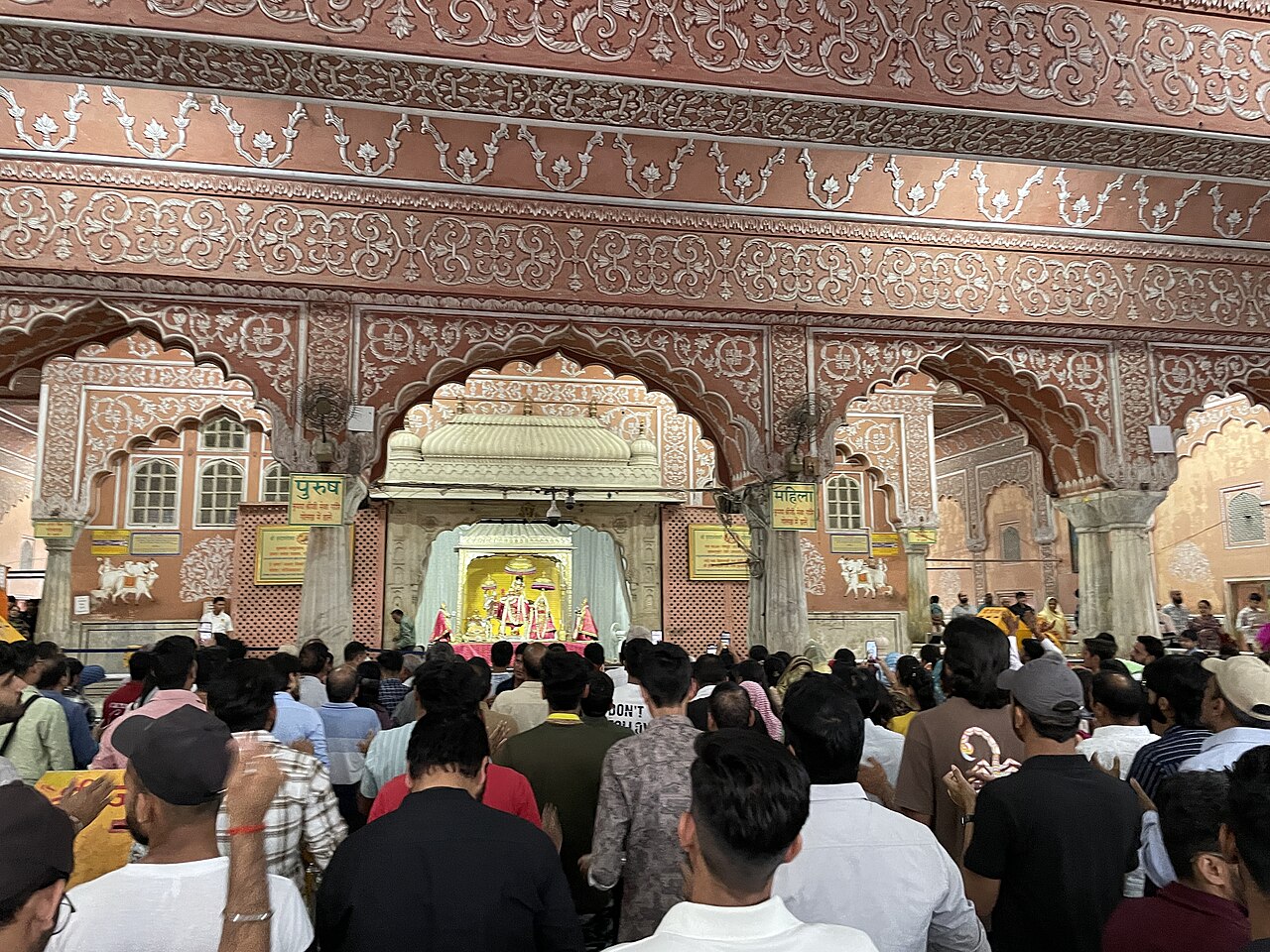
Walk in through Jalebi Chowk under the pink scalloped arches of the City Palace, past darshan lines marked purush and mahila, and the crowd's chant reaches you before your eyes do: Govind Dev Ji ki Jai. Then the hall opens and there He Is, small and dark beneath a canopy of gold and marigold, Radha Rani beside Him in red and gold. Other Temples give you a whole body to look at. Here, tradition holds, you are looking at only the face.
Tradition holds that Bajranabh, Lord Krishna's own great-grandson, shaped three images of Him after He Left the earth: one for His feet, one for His chest, one for His face. The face became Govind Dev Ji, so pilgrims here are told they stand before Krishna's own countenance.
When Sawai Jai Singh II built Jaipur, tradition holds he dreamed the ground he had marked for his own palace belonged to Govind Dev Ji. He gave the site to the deity and raised Chandra Mahal behind it instead, its windows aligned so a Maharaja could take darshan without leaving home.
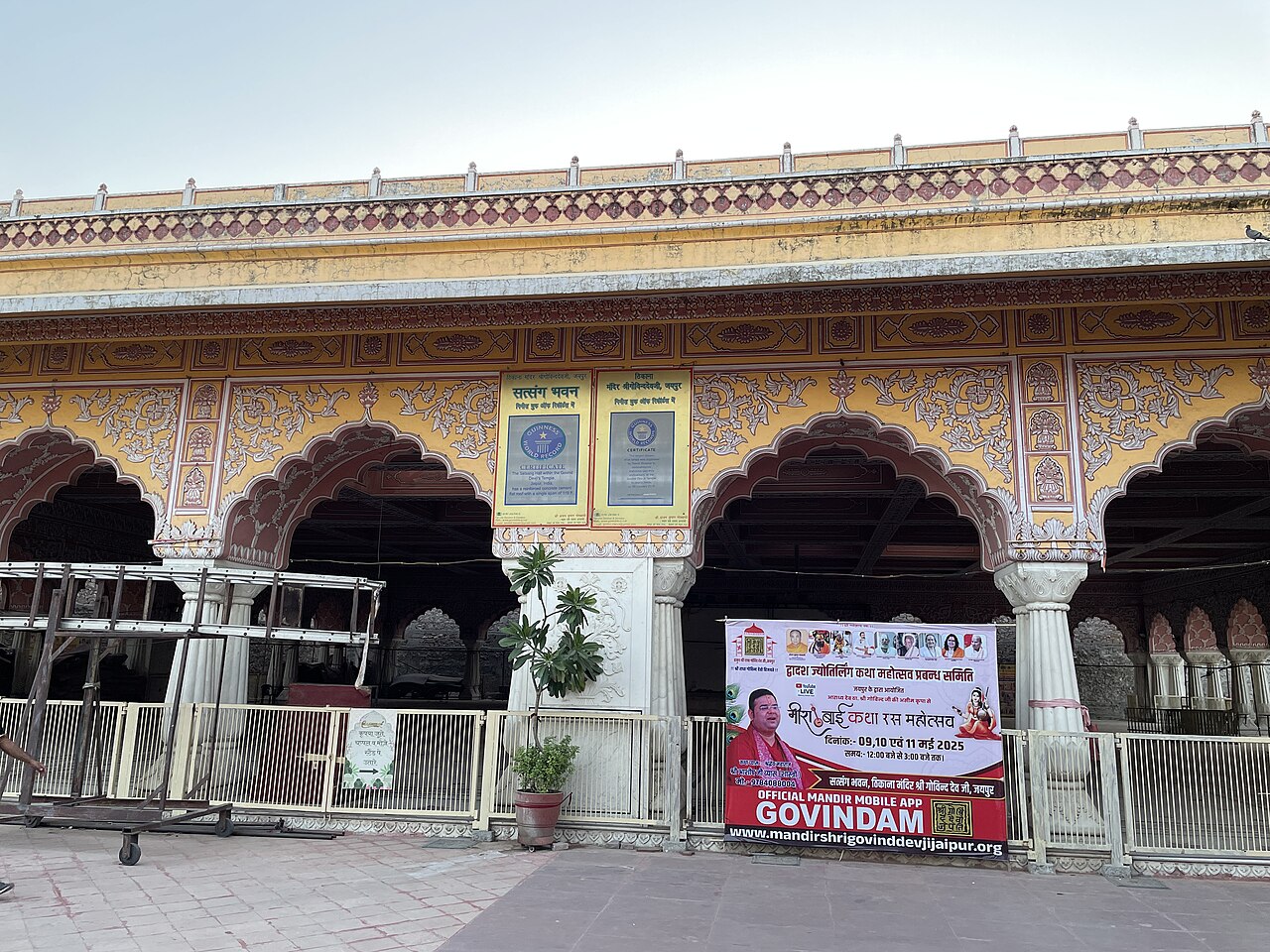
Seven aartis divide the day here, from Mangla before dawn to Shayan at night, and beside the sanctum stands the Satsang Bhawan: a pillarless concrete roof spanning 119 feet, raised between 2007 and 2009 and recognised by Guinness World Records as the widest of its kind.
The face that fled an empire
Tradition holds that Bajranabh, Krishna's great-grandson, shaped three images of the Lord after His disappearance from the earth: one for His feet, one for His chest, one for His face. Rupa Goswami, one of the six Goswamis of Vrindavan, is remembered as the one who rediscovered the face and named it Govind Dev Ji. Raja Man Singh I of Amber raised a seven-storeyed sandstone Temple for the deity at Vrindavan, the stone itself a gift from the Mughal emperor Akbar, and in 1570 the scholar-saint Jiva Goswami consecrated it.
In 1670 Aurangzeb's forces threatened Vrindavan, and Govind Dev Ji Was Carried out ahead of them by the priests who served Him. For decades afterward He Moved through the safer ground of Braj and the Amber kingdom, Temple accounts naming halts at Radhakund, Barsana, Kaman and Govindpura, sheltered under the protection Amber's rulers extended to the Vaishnava orders. The worship never stopped; only the address changed, again and again, while the line of priests who had served the deity in Vrindavan kept its rhythm alive on the road.
When Sawai Jai Singh II raised his new capital of Jaipur, tradition holds that he dreamed the very ground he had marked for his own palace belonged to Govind Dev Ji. He gave the site to the deity instead, and in 1735 the Suraj Mahal was rebuilt as His Temple. Jai Singh moved his own household to a new palace, Chandra Mahal, and had it built so that from his own windows he could still take darshan of Govind Dev Ji without leaving home. The arrangement has outlived the kingdom that made it.
What you'll actually see
1
Jalebi Chowk and the arched courtyard
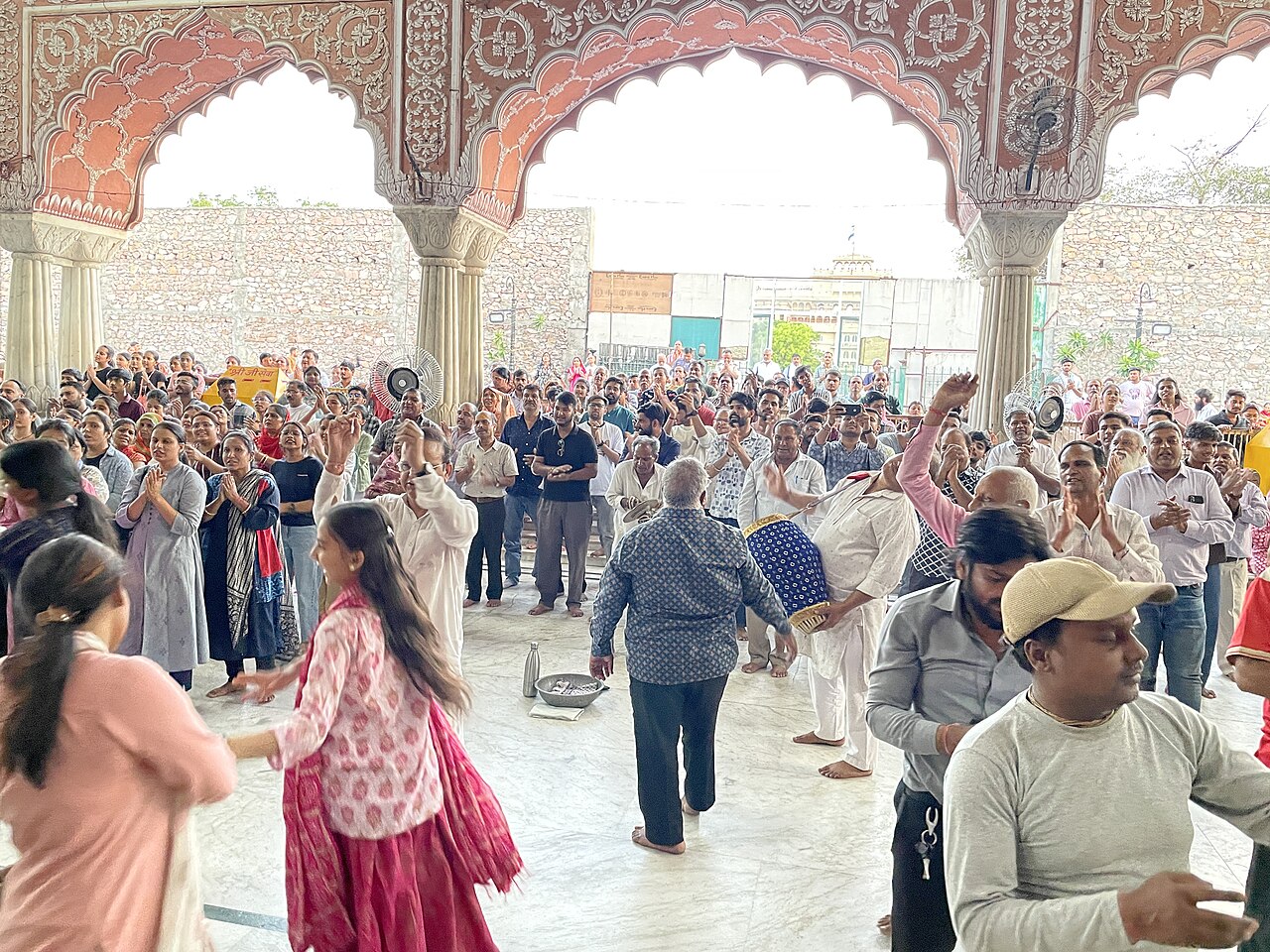
You reach the Temple through Jalebi Chowk, the wide square before the City Palace, and climb into a courtyard of scalloped pink arches, white marble pillars and stucco relief worked by the same hands that built the palace beside it. The darshan lines split here, marked in Hindi purush and mahila, before the hall opens ahead.
2
The silver throne and the two Forms
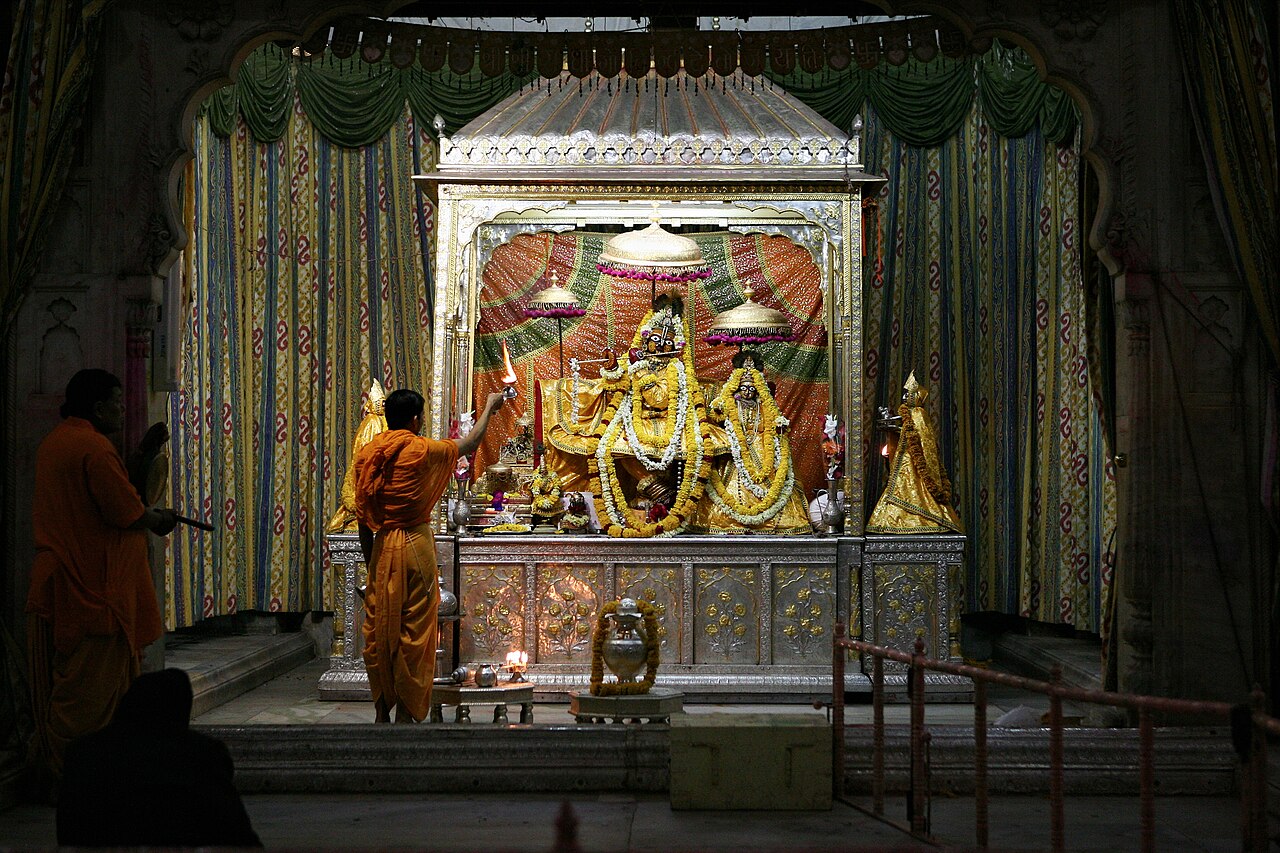
Inside, Govind Dev Ji and Radha Rani Stand on a silver-worked altar beneath a domed canopy of gold, and Are Dressed daily in fresh flowers, silk and jewels by the Temple's Goswami priests. Krishna's image is small, dark and strikingly plain against the ornament around it, which is exactly what tradition says marks it as the face carved to resemble the Lord Himself.
3
The Satsang Bhawan
Beside the sanctum stands the Satsang Bhawan, a pillarless hall of 15,827 square feet raised between July 2007 and July 2009: a single flat concrete roof spanning 119 feet on 290 tons of steel, holding up to 5,000 devotees at once. Two Guinness World Records certificates hang on its outer wall, plain proof beside the plain, ordinary crowd of worshippers who gather beneath it.
A priest performs aarti before the silver-throned images of Govind Dev Ji and Radha Rani, garlanded in flowers beneath a gold canopyDevotees sing and clap under a carved pink arch in the Govind Dev Ji Temple courtyard during a kirtan gathering
The evening aarti before the silver throne, and devotees in kirtan under the courtyard arch · photos CC BY-SA 3.0 by Ananda Govinda Dasa and CC0 by Anildiggiwal, Wikimedia Commons
THE NIGHT FOUND NOWHERE ELSE
Janmashtami: the whole city keeps vigil
On the night of Krishna's birth the Temple does not close. Reports describe two to three lakh devotees filling Jalebi Chowk and the courtyards through the evening, waiting for midnight, when the curtain Is Drawn back on a cradle holding the infant Lord and the hall answers with bells, conch shells and the cry Govind Dev Ji ki Jai. Accounts describe the moment marked with a ceremonial 31-gun salute, a royal honour surviving from the kingdom that built this Temple. Janmashtami 2026 falls on 4 September, with Nandotsav celebrations continuing the following day.
Arrive before 9 pm to hold a place in the courtyard; roads around the City Palace close to traffic for the night.
Plan your visit
By air
Jaipur International Airport is about 13 km away, 30 to 40 minutes by taxi depending on Pink City traffic.
By rail
Jaipur Junction is about 5 km from the Temple; autos and taxis run the short distance into the walled city.
Getting in
The Temple sits inside the City Palace complex but keeps its own free entrance through Jalebi Chowk and the Tripolia Gate; you do not need a City Palace museum ticket to reach it.
Timings
Widely reported hours are roughly 4:15 am to 12 noon and 4 to 8:30 pm, with the sanctum closed at midday; aarti times shift by season, so confirm the day's schedule on the noticeboard or by phone.
Best time
Mangla aarti at first light is the calm option; the courtyard is fullest in the hour before Shringar and Sandhya aarti, and on Tuesdays.
Dress
Modest dress, shoulders and knees covered, as at any Rajasthani Temple; footwear stays outside the hall.
The queue
Darshan lines are separated for men and women and move quickly on ordinary days; only Janmashtami and the major festivals bring hours-long waits.
Govind is one of Krishna's own names, the protector of cows, and Dev Ji is an honorific meaning the god himself, so the Temple's own name is simply a way of naming the Lord directly.
The Temple's entrance is free and separate from the paid City Palace museum ticket next door; the two are easy to confuse from outside Jalebi Chowk.
Phones and cameras are commonly asked to stay away from the inner sanctum, though festival crowds are often seen photographing the deity from behind the rail; when in doubt, ask a Temple attendant before raising a camera.
The Temple keeps a live darshan stream for devotees who cannot travel, a practice continued alongside centuries-old seva under the current Mahant, Anjan Kumar Goswami.
Questions pilgrims ask
Do I need to buy a City Palace ticket to visit Govind Dev Ji Temple?
No. The Temple has its own free entrance through Jalebi Chowk and the Tripolia Gate, separate from the paid museum ticket for the rest of the City Palace complex.
Why does the Temple close in the middle of the day?
Between the Rajbhog offering around midday and the Gwal aarti in the late afternoon, the Temple closes its doors, in keeping with the daily rhythm most Krishna Temples of this tradition follow: the Lord Is Understood to rest.
What will I actually see in the sanctum?
A small, dark image of Govind Dev Ji beside Radha Rani, both dressed in flowers, silk and jewels on a silver-worked altar beneath a golden canopy. Tradition holds this image Was Shaped to be Krishna's own face, one of three images made from His likeness.
Is Janmashtami really that crowded?
Reports describe two to three lakh devotees passing through the Temple and Jalebi Chowk over the festival, making it among the largest single religious gatherings in Jaipur each year. Arrive early, and expect the roads around the City Palace to close for the night.
Can I watch the darshan online if I cannot travel to Jaipur?
The Temple maintains a live darshan stream, a practice continued alongside its centuries-old worship. Check the Temple's own website or its YouTube live channel for the current feed.
The Sthan in photographs
Darshan from afar
From the temple's own channels. Nothing loads until you press play.
Dharamshalas and guest houses near this Sthan, shared by devotees. Adisthan takes no bookings and no money; contact each stay directly.
No stays are listed here yet. Know one that serves pilgrims well?
Are you a Goswami priest or trustee of Shri Govind Dev Ji Temple? Claim this page to keep aarti timings, festival dates and the deity's own story true for devotees worldwide.