Verul, beside the Ellora caves · Chhatrapati Sambhaji Nagar, Maharashtra, India
Where the Twelve Lights end, a mother's faith holds the Lord at Verul forever.
Be the first to check in
Coming up: Mahashivaratri · 6 MarEntry tended 25 May 2026
Darshan 5:30 am to 9:30 pm Twelfth Jyotirlinga · the last Mahashivaratri · 6 Mar 2027 Red stone · 18th-c. Holkar rebuild Entry free
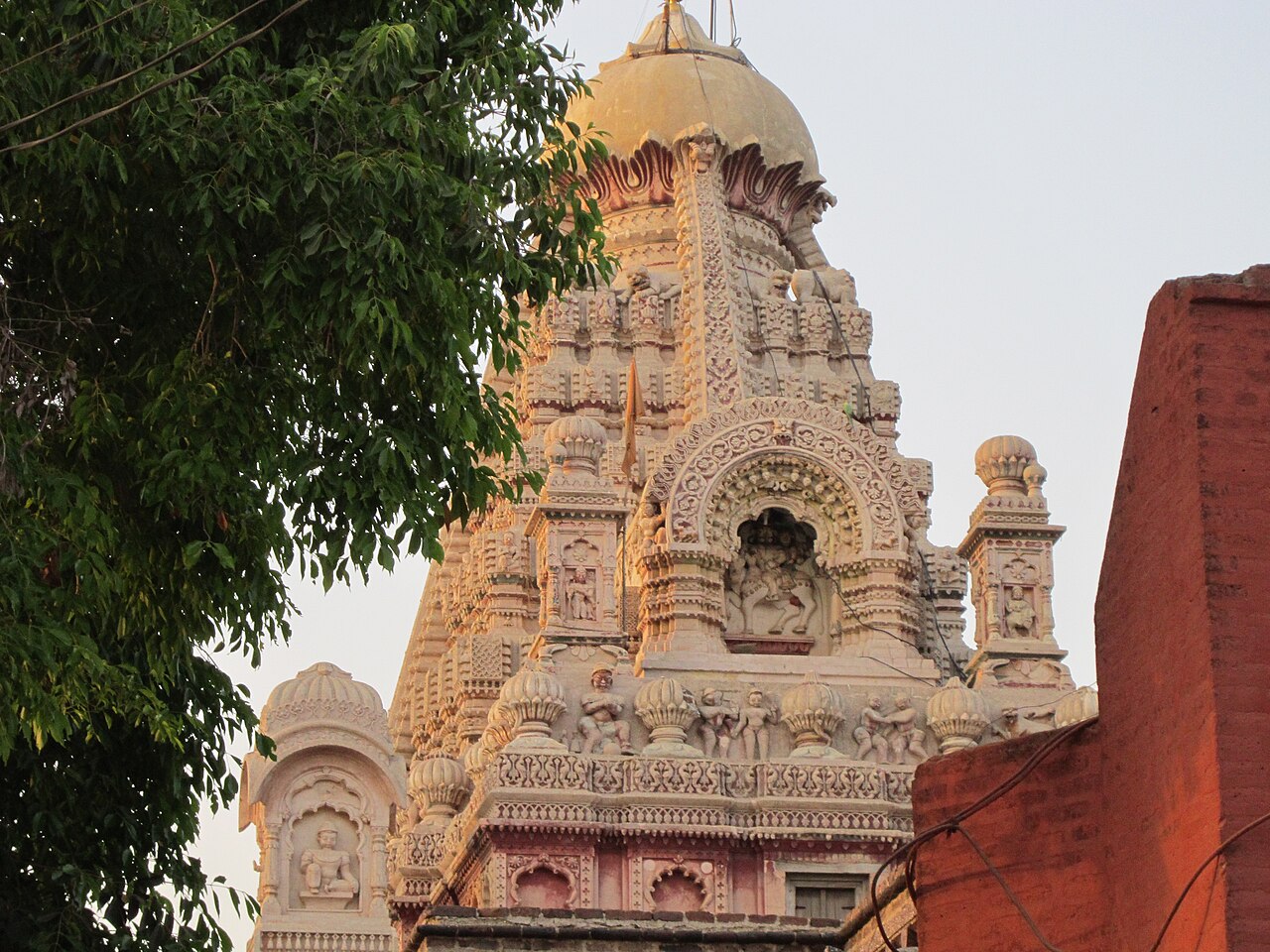
The Deccan road runs past the black basalt of the Ellora caves, and then, in the small village of Verul, a spire of warm red stone climbs against the sky, carved from base to dome with gods. Chants of Har Har Mahadev drift over the courtyard wall. Inside, the sanctum is small, close, and lamplit, and the queue moves toward it with a hush. This is the twelfth Jyotirlinga, the last of the Twelve Lights, and here you do not only see the Jyotirlinga. You reach out and touch it.
The twelfth and final Jyotirlinga in the traditional enumeration of the Twelve. Pilgrims who undertake the great circuit of the Jyotirlingas regard their journey as fulfilled only when they stand at Grishneshwar.
A darshan of touch. Devotees may lay bare hands on the Jyotirlinga in the garbhagriha, and local tradition asks that men enter the sanctum bare-chested for the abhishek.
A shrine that refused to die. Destroyed under the Delhi Sultanate, raised again in the 16th century by Maloji Bhosale of Verul, grandfather of Chhatrapati Shivaji Maharaj, and rebuilt in red stone by the Holkar queens of Indore.
The mother who would not stop worshipping
The Shiva Purana tells of Sudharma, a brahmin of the Devagiri hills, and his wife Sudeha, who could bear no child. Sudeha arranged her husband's marriage to her own younger sister Ghushma, a woman of quiet, unbreakable devotion, who shaped one hundred and one lingas of earth each day, worshipped them, and immersed them in the lake nearby. By the grace her worship won, Ghushma bore a son. But the honour shown the younger sister curdled in Sudeha's heart, and one night she killed the young man in his sleep and threw his body into the same lake that held the discarded lingas.
Morning came, and grief with it. Ghushma did not stop. She shaped her lingas, finished her worship, and walked to the lake as she always had, and the legend says her son rose living from the water. Lord Shiva Appeared before her, ready to punish Sudeha, but Ghushma asked forgiveness for her sister instead. Moved by her compassion, the Lord granted her prayer to remain at that place forever, and He Is Worshipped here as Ghushmeshwar, the Lord known by His devotee's name.
The shrine her faith called into being has outlived every hand raised against it. The Temple was destroyed in the Sultanate wars of the 13th and 14th centuries, and it was Maloji Bhosale of Verul, grandfather of Chhatrapati Shivaji Maharaj, who raised it again in the 16th century. In the 18th century the Holkar queens of Indore rebuilt it in carved red stone: records place a reconstruction around 1730 under Gautamabai Holkar, and Devi Ahilyabai Holkar, the great restorer of India's Temples, is widely credited with the Temple and the Shivalaya Tirtha as they stand today.
What you'll actually see
1
The red shikhara and its Dashavatara
The Temple is built of red volcanic rock in the Hemadpanthi manner, and its five-tiered shikhara carries carvings of the Dashavatara, the ten descents of Lord Vishnu, alongside tier upon tier of deities, dancers, and elephants, all glowing at sunrise and sunset.
2
The court hall of twenty-four pillars
Before the sanctum stands a spacious court hall borne on 24 carved pillars, their panels telling the legends of Lord Shiva, with the Nandi bull facing the garbhagriha. The whole precinct spans some 44,000 square feet behind its enclosure wall.
3
The Shivalaya Tirtha
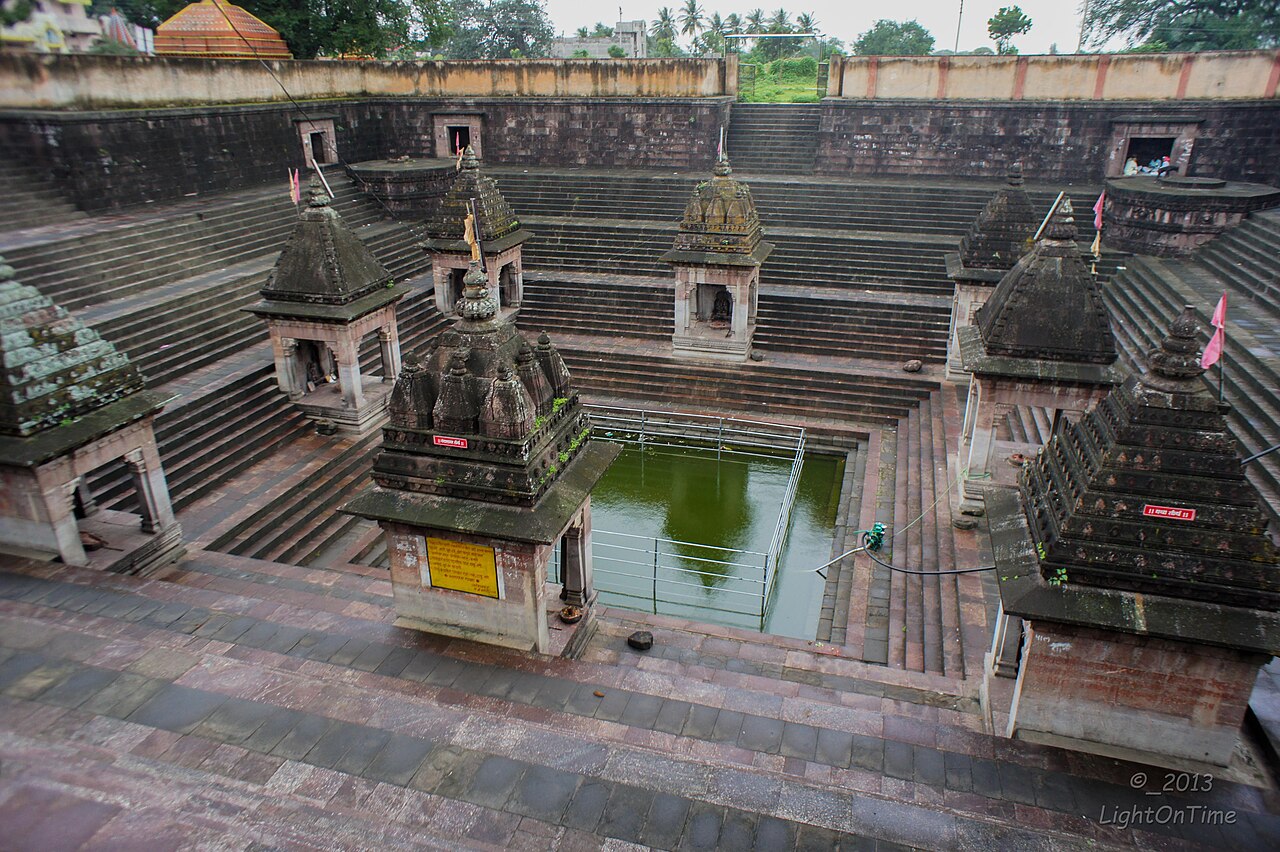
A short walk from the Temple lies the great stepped tank of Verul, its square of green water ringed by flights of stone steps and small spired shrines. Tradition ties the waters of this place to Ghushma's lake, where her lingas were immersed and her son was restored to life.
Carved figures and floral bands on the red stone shikhara of Grishneshwar Temple at duskThe stepped Shivalaya Tirtha tank at Verul, its water ringed by stone steps and small spired shrines
The carved shikhara at dusk, and the stepped Shivalaya Tirtha at Verul · photos by Sharma.aditya1006 (CC BY-SA 3.0) and Udaykumar PR (CC BY 3.0), Wikimedia Commons
THE DARSHAN FOUND ALMOST NOWHERE ELSE
Touching the Jyotirlinga
At most of the great Jyotirlinga shrines the sanctum is glimpsed from a rail. At Grishneshwar the devotee enters the garbhagriha itself and offers water and bilva leaves with bare hands laid on the Jyotirlinga. Local tradition asks that men remove their upper garments before stepping into the sanctum for the abhishek; it is a rule kept matter-of-factly, and cloth is simply carried over the arm. On Shravan Mondays (17 and 24 and 31 August and 7 September 2026, by Maharashtra's reckoning) and on Mahashivaratri (6 March 2027) the Temple runs extended hours and the village fills with pilgrims.
Come on an ordinary weekday morning for an unhurried darshan; on Shravan Mondays and Mahashivaratri expect long queues and plan for several hours.
Plan your visit
By air
Chhatrapati Sambhaji Nagar Airport (IXU), about 35 km; taxis take 1 to 1.5 hours.
By rail
Aurangabad (Chhatrapati Sambhaji Nagar) station, about 30 km; taxis, or Verul and Ellora buses from the Central Bus Stand every 30 to 45 minutes.
Timings
5:30 am to 9:30 pm daily; hours extend during Shravan and on Mahashivaratri.
Best time
An ordinary weekday morning is quietest. Shravan Mondays and Mahashivaratri bring the year's great crowds.
Dress
Modest dress throughout; men remove upper garments to enter the garbhagriha for abhishek.
Ellora caves
The UNESCO-listed Ellora caves are about 1.5 km away; pilgrims commonly take darshan and the caves in a single visit.
The name is told from the legend: Ghushmeshwar, the Lord known by His devotee Ghushma's name; the Temple is also called Ghrneshwar and, locally, Grishneshwar of Verul.
This is the smallest of the Twelve Jyotirlinga Temples, and its sanctum is correspondingly close and intimate; the queue moves through in single file.
An old Audumbar tree stands in the Temple grounds, said to be over three centuries old, where devotees tie threads with their prayers.
Verul was the seat of the Bhosale family: Maloji Bhosale, who restored the Temple in the 16th century, was the grandfather of Chhatrapati Shivaji Maharaj.
Questions pilgrims ask
Is Grishneshwar inside the Ellora caves?
No. It is a free-standing structural Temple of red stone in Verul village, about 1.5 km from the rock-cut caves. The caves are carved from basalt; the Temple was built, destroyed, and rebuilt across centuries, most recently by the Holkar queens in the 18th century.
Can I touch the Jyotirlinga?
Yes. Devotees enter the garbhagriha and may touch the Jyotirlinga with bare hands during darshan and abhishek. Local tradition asks that men enter the sanctum bare-chested.
Why is Grishneshwar called the last Jyotirlinga?
The traditional enumeration of the Twelve Jyotirlingas, recited in the Dvadasha Jyotirlinga stotra, names Grishneshwar twelfth. Pilgrims making the full circuit therefore end their yatra here, and many treat this darshan as the journey's completion.
Is Grishneshwar the same as Ghushmeshwar?
Yes. Grishneshwar, Ghushmeshwar, and Ghrneshwar are names of the same Jyotirlinga at Verul, all flowing from the Shiva Purana's story of the devotee Ghushma.
When are the big festival days?
Mahashivaratri, next on Saturday 6 March 2027, is the Temple's greatest night, and the four Shravan Mondays, which in Maharashtra's Amanta reckoning fall on 17, 24, 31 August and 7 September in 2026, each draw vast crowds.
Dharamshalas and guest houses near this Sthan, shared by devotees. Adisthan takes no bookings and no money; contact each stay directly.
No stays are listed here yet. Know one that serves pilgrims well?
Are you a pujari, trustee, or sevak of Shri Grishneshwar Jyotirlinga? Claim this page to keep timings, festival dates, and darshan guidance true for the pilgrims who close their circle of the Twelve at Verul.