Open 4 am to 10 pm 76 steps to the sanctum Besan laddoo bhog Hanuman Jayanti · 20 Apr 2027 18th-c. fortress Temple Free entry
The climb begins in a bazaar of laddoo shops, the air thick with ghee and marigold. Seventy-six steps rise between painted walls where monkeys wait on every ledge, until the white gateway of Shri Hanuman Garhi opens onto drums, bells, and a courtyard whose very walls are engraved with prayer. In the small silver-doored sanctum sits a six-inch child. In Ayodhya, darshan begins here, not at the palace of the King, but at the post of His guard.
Tradition holds that Lord Ram, on His return from Lanka, gave Lord Hanuman this rise of ground beside Ramkot and made Him the kotwal, the guardian of Ayodhya. Pilgrims still take Bajrangbali's darshan here before approaching Ram Janmabhoomi, asking the doorkeeper's leave to meet the King.
The murti is unlike almost any other Hanuman shrine in India: a six-inch Bal Hanuman, Lord Hanuman as a child, seated on the lap of His mother, Maa Anjani, wearing a silver tulsi garland inscribed with the name of Lord Ram.
The Temple is a true garhi, a four-sided fortress with circular bastions at each corner, raised through the 18th century with land and revenue grants from the Nawabs of Awadh and held ever since by the Bairagi mahants of the Ramanandi Sampradaya's Nirvani Akhara.
The guard who never left
When Lord Ram returned from Lanka and the lamps of Ayodhya burned for His homecoming, every companion of the war was given a gift. To Lord Hanuman, the tradition says, He gave something greater than a kingdom: a dwelling within sight of His own palace, and the charge of the city itself. The Skanda Purana tradition tells of Bajrangbali living in a cave on this mound by Ramkot, watching over the birthplace forever, and credits king Vikramaditya with raising an early Temple upon it. That is why the Temple stands on Ayodhya's high ground: a watchman chooses the point from which everything can be seen.
The fort that stands today is the work of an unlikely devotion. Records of the Awadh court tell that land here was granted to the Ramanandi sadhu Abhayaram Das in the early 18th century, in the time of Nawab Saadat Khan, and the Temple's own telling adds a miracle: the Nawab's ailing son healed by the saint's blessing, and a grateful court gifting land for the shrine. Grants continued under Safdarjung and Shuja-ud-Daula, and by 1799, under Asaf-ud-Daula with his minister Tikait Rai supervising, the garhi was complete: ramparts, bastions, and the long stair of 76 steps.
In 1855 the fort weathered a violent dispute over the hill, after which the Nawab endowed land revenue for the Temple that anchored its future; the historian Sarvepalli Gopal notes that the great Ayodhya conflict of that year centred on Hanuman Garhi itself. Today the guardianship continues unbroken. The Nirvani Akhara's mahants keep the worship, some twenty quintals of besan laddoos are rolled for the bhog every day, and every pilgrim bound for the new Ram Mandir still climbs these steps first.
What you'll actually see
1
The 76 steps and the gateway
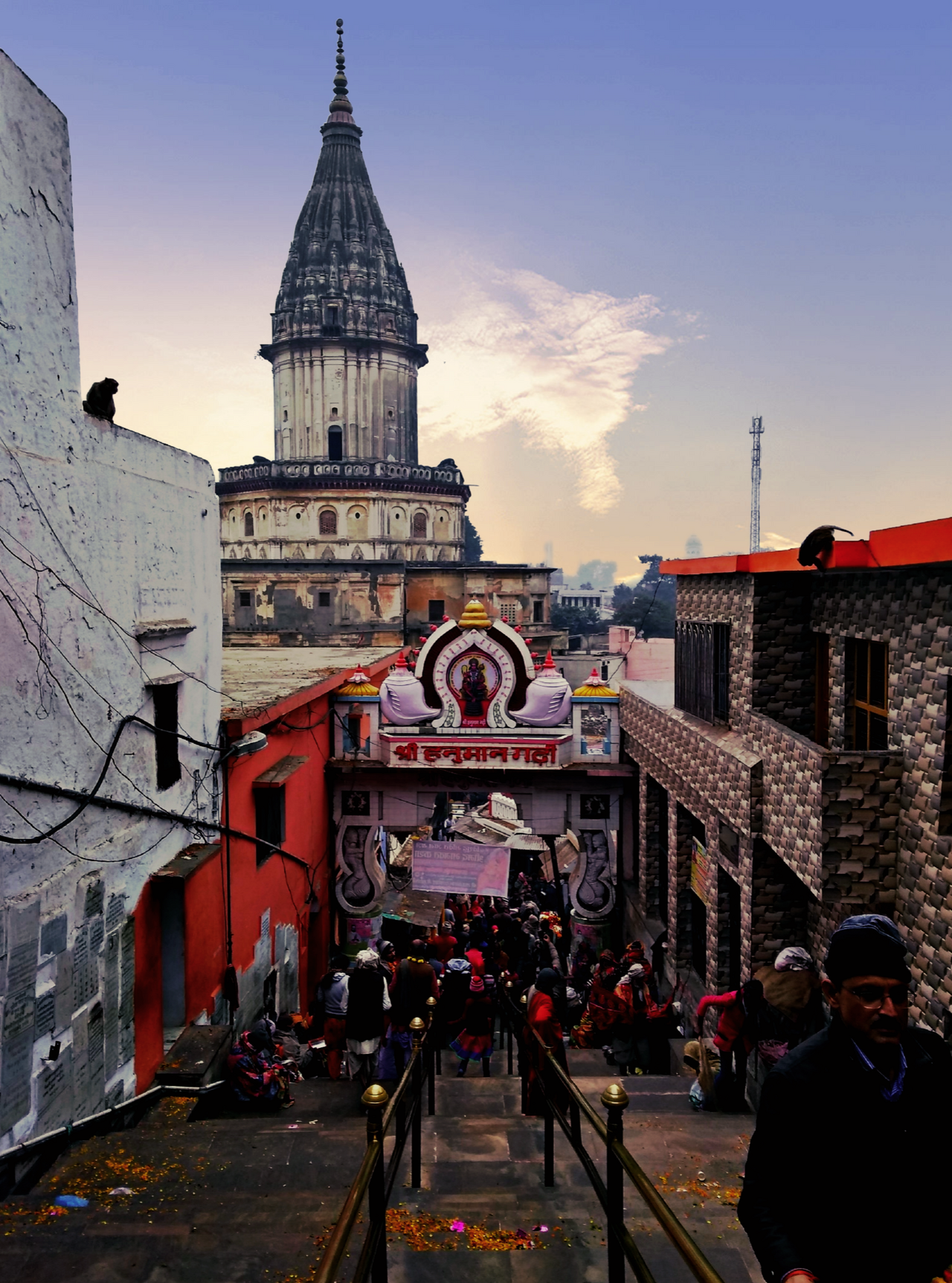
A steep stone stair climbs straight from the market crossing, flanked by prasad stalls and patrolled by monkeys who know exactly what is in your bag. At the top, a white arched gateway crowned with the image of Bal Hanuman and Maa Anjani carries the name Shri Hanuman Garhi in Devanagari, with the Temple's shikhara rising behind.
2
The silver sanctum
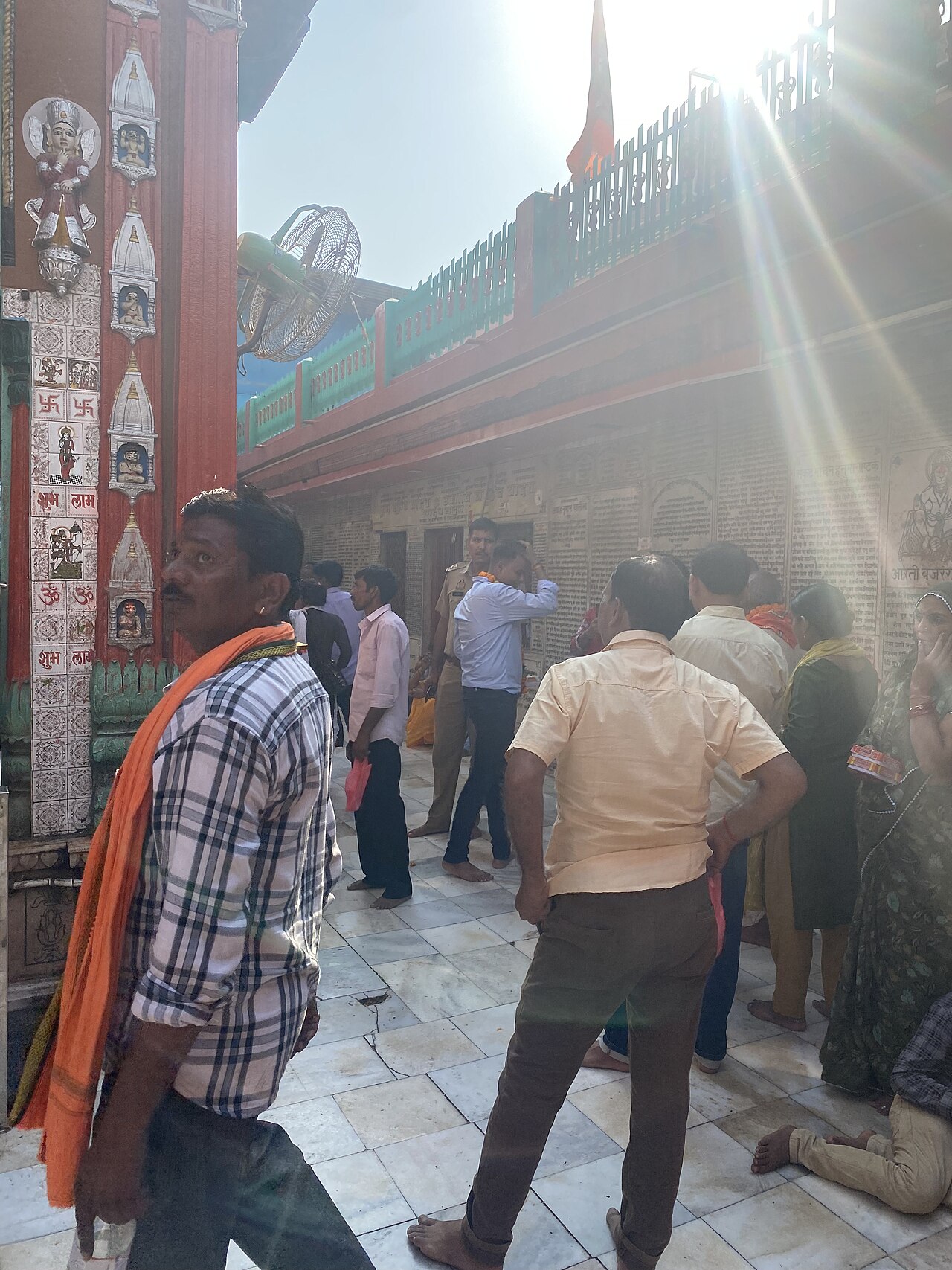
Three silver-worked doors open into a small garbhagriha where the six-inch murti of Bal Hanuman sits on Maa Anjani's lap beneath layers of flowers and vermilion. Around the courtyard, the verses of the Hanuman Chalisa and other prayers are engraved into the very walls, so that the fort itself recites.
3
The ramparts of the garhi
The Temple is a quadrangle with a circular bastion at each corner, each bastion holding its own small shrine. From the upper walkways the whole of Ayodhya Dham spreads below: rooftops, Temple spires, and the shikhara of the Ram Mandir barely a kilometre away, the city Bajrangbali still watches.
Looking down the 76 steps to the arched gateway of Hanuman Garhi at dusk, monkeys on the rooftops and the shikhara behindPilgrims in the marble courtyard of Hanuman Garhi, its walls engraved with prayers
The stair to the gateway, and pilgrims in the engraved courtyard · photos Kumar aj95 CC BY-SA 4.0 and Immanuelle CC BY 4.0, Wikimedia Commons
THE CUSTOM FOUND NOWHERE ELSE
First darshan: taking the kotwal's leave
In every other pilgrim city you go straight to the presiding deity. In Ayodhya you do not. Because tradition holds that Lord Ram Himself Appointed Lord Hanuman the kotwal of the city, custom asks every pilgrim to climb the 76 steps and take Bajrangbali's darshan before standing at Ram Janmabhoomi, and the custom is kept by everyone from village yatris to the President of India, who offered puja here on 1 May 2024 before her darshan of Ram Lalla. On Ram Navami, 15 April 2027, and through the Deepotsav week around 7 November 2026, the fort receives the Janmabhoomi's vast crowds first, one laddoo at a time.
Come at first light to make both darshans in one unhurried morning; on Tuesdays and Saturdays, Lord Hanuman's own days, expect the stair to be full.
Plan your visit
By air
Maharishi Valmiki International Airport, Ayodhya Dham, is about 10 to 11 km away, roughly half an hour by taxi.
By rail
Ayodhya Dham Junction is about 1 to 2 km from the Temple, a few minutes by e-rickshaw; Ayodhya Cantt is about 8 km.
To Ram Mandir
Shri Ram Janmabhoomi Mandir is about 1 km away; the two darshans pair naturally into one morning, Hanuman Garhi first.
Timings
Open roughly 4 am to 10 pm daily; rhythms stretch on festival days and Bada Mangal Tuesdays.
Best time
Dawn on a weekday, before the stair fills; October to March is the gentle season on the plain.
The climb
76 steep steps from the market crossing; there is no lift, so pilgrims who cannot climb are usually carried or assisted by family.
Dress
Modest, shoulders and knees covered; shoes are left at the foot of the stair.
Garhi means fort: the name is a plain description, a four-sided rampart with a bastion at each corner, said to be built high and steep in part to keep elephants out.
The besan laddoo of Hanuman Garhi, rolled from gram flour and desi ghee for Bajrangbali's bhog, is so distinctive that its Geographical Indication application was accepted by the GI Registry in January 2024.
Hold your prasad bag close on the steps; the resident monkeys are quick, and feeding them is part of many pilgrims' offering anyway.
Ayodhya keeps its own Hanuman tradition: Temple lore holds that on Chhoti Diwali Lord Hanuman brought the news of Lord Ram's return, and Hanuman Garhi marks His birth at midnight that night, alongside the Chaitra Purnima Hanuman Jayanti kept across north India.
Questions pilgrims ask
Why do pilgrims visit Hanuman Garhi before the Ram Mandir?
Tradition holds that Lord Ram made Lord Hanuman the kotwal, the guardian, of Ayodhya, and that He still resides here watching over Ramkot. Taking His darshan first is asking the guardian's leave to enter, and the custom is kept by ordinary pilgrims and visiting heads of state alike.
What does the murti look like?
A six-inch Bal Hanuman, Lord Hanuman as a child, seated on the lap of His mother Maa Anjani, wearing a silver tulsi garland inscribed with the name of Lord Ram. The mother-and-child form is found in very few Hanuman Temples anywhere.
Is there an entry fee or a pass system?
No. Darshan is free and there are no paid queues or passes; you simply climb the 76 steps and join the line. Only the crowd decides your wait, so Tuesdays, Saturdays and festival days run longest.
How hard is the climb?
The 76 steps are steep and usually busy, but railings run the whole way and most pilgrims manage them slowly. There is no wheelchair route to the sanctum, so devotees who cannot climb take blessings from the gateway at the foot of the stair.
Dharamshalas and guest houses near this Sthan, shared by devotees. Adisthan takes no bookings and no money; contact each stay directly.
No stays are listed here yet. Know one that serves pilgrims well?
Are you a mahant or sevak of the Nirvani Akhara at Hanuman Garhi? Claim this page to keep darshan hours, festival dates and the fort's own story true for pilgrims across the world.