Halebidu (old Dorasamudra) · Hassan district, Karnataka, India
The capital around it fell to ruin; the prayer carved into its stone still stands.
Be the first to check in
Coming up: Maha Shivaratri · 6 MarEntry tended 29 Jun 2026
Hoysala twin shrines · begun c. 1121 CE Lord Shiva as Hoysaleswara UNESCO World Heritage 2023 Open 6:30 am to 9 pm Entry free · ASI museum ₹5 Maha Shivaratri · 6 Mar 2027
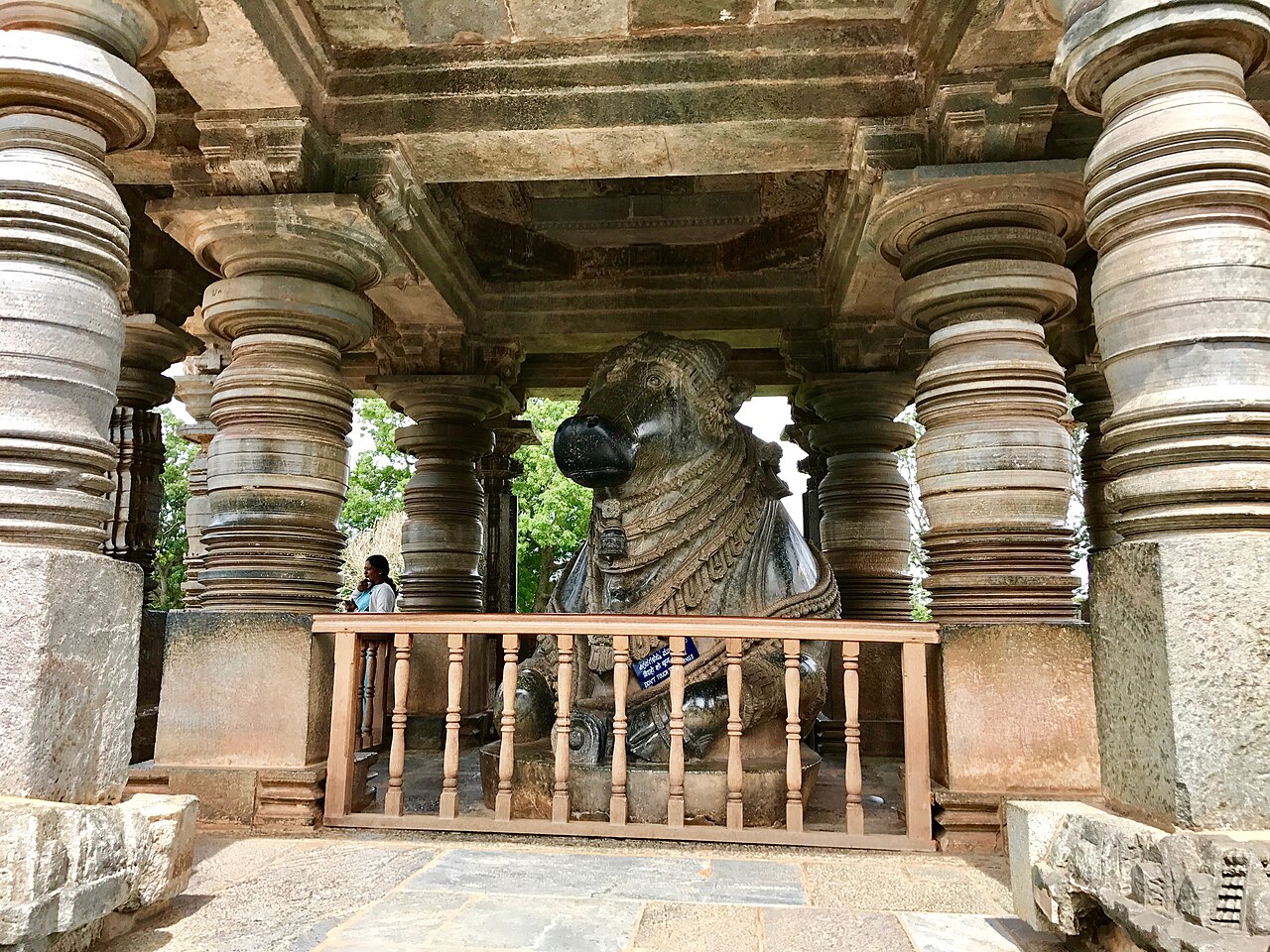
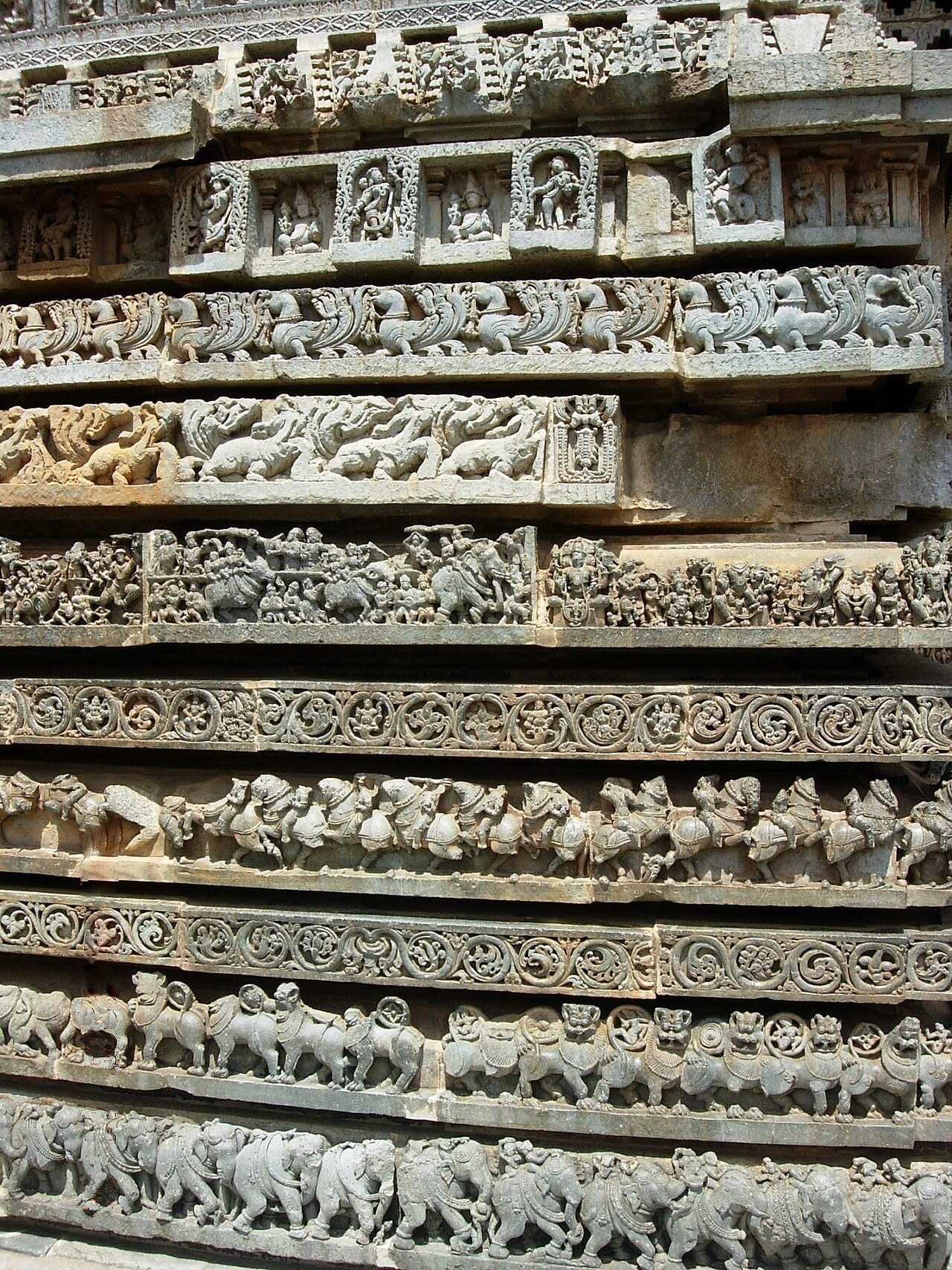
You cross a wide lawn beside an old man-made lake and climb onto a star-shaped platform of dark soapstone. Then the wall arrives: elephants beneath lions beneath horsemen beneath gods, band over band, every hand's breadth of it carved, folding away around the Temple like pleated cloth. In two open pavilions sit two colossal Nandis, each gazing in at the Shiva linga he serves. The capital this Temple was raised for vanished seven centuries ago. The prayer in its stone did not.
The largest Temple the Hoysalas ever raised to Lord Shiva: two complete sanctums standing side by side, Hoysaleswara for the king and Shantaleswara for Queen Shantala Devi, each holding its own Shiva linga, each faced by its own colossal Nandi.
A wall that reads like a scripture: friezes of elephants, lions, scrolls, horsemen and scenes from the Ramayana, the Mahabharata and the Bhagavata run around the Temple, beneath large images of the gods that scholars count in the hundreds, from over 240 to about 340.
One of the three Sacred Ensembles of the Hoysalas inscribed by UNESCO in 2023, together with Belur and Somanathapura: soapstone carving at its zenith, soft under the chisel when quarried, hardening in the air to hold its detail for nine hundred years.
The Temple that outlived its city
Around 1121 CE, the Hoysala capital Dorasamudra stood at the height of its power beside a great man-made lake, and King Vishnuvardhana's court set out to raise a Temple worthy of it. An inscription remembers Ketamalla, an officer in the king's employ, as the man who had it built. The Temple rose as a twin: one sanctum consecrated as Hoysaleswara, Lord Shiva honoured in the king's name, and beside it a second, equal sanctum, Shantaleswara, carrying the name of Queen Shantala Devi. Both lingas face the sunrise, and before each was set a pavilion with a great seated Nandi.
The carvers chose chloritic schist, the stone called soapstone, which comes from the quarry soft enough to cut like dense wood and slowly hardens in the open air. Generations of sculptors worked it through the decades to about 1160 CE, wrapping the outer walls in continuous friezes and large images of the gods, work UNESCO now describes as hyper-real carving covering the entire architectural surface, some of it signed by the artists themselves.
In 1311 the army of Malik Kafur, general of the Delhi Sultan Alauddin Khalji, besieged Dorasamudra, and King Ballala III surrendered the city's treasure as tribute. In 1326 another Sultanate army under Muhammad bin Tughlaq returned, and this time the capital was ruined. The court moved away, the city emptied, and the place became known simply as Halebidu, the old capital. The Temple was plundered and scarred, yet it stood. Today it is a protected monument in the care of the Archaeological Survey of India, and in 2023 it was inscribed by UNESCO among the Sacred Ensembles of the Hoysalas.
What you'll actually see
1
The friezes at the plinth
Circling the whole Temple at the base run stacked bands of carving: elephants for strength, then lions, then flowering scrolls with tiny dancers, then horsemen, then scenes from the Hindu epics, then makaras and swans. You read the Temple by walking it, the way earlier pilgrims did.
2
The two Nandi pavilions
East of the shrines sit two great polished Nandis in open pillared pavilions, each aligned to gaze on the linga of his own sanctum. Behind the southern Nandi is a small shrine of Surya, where a statue of the sun god stands seven feet tall.
3
The lathe-turned pillars and the doorways
Inside, the walls go quiet and the light falls on rows of gleaming lathe-turned pillars running between the north and south entrances. The doorways answer the plainness: their lintels carry dancing images of Lord Shiva as Nataraja, framed in bands of ornament.
A colossal seated Nandi in its pillared pavilion at the Hoysaleswara Temple, facing the sanctum of Lord ShivaStacked molding friezes of elephants, lions, scrolls and horsemen circling the outer wall of the Hoysaleswara Temple
A Nandi in his pavilion, and the stacked friezes of the outer wall · photos by Ms Sarah Welch (CC BY-SA 4.0) and Calvinkrishy (CC BY-SA 3.0), Wikimedia Commons
A SCRIPTURE WRITTEN IN STONE
The wall that never stops
Most Temples give you a shrine and a story; Hoysaleswara gives you a wall you can read for hours. From the plinth upward the soapstone is cut into continuous horizontal bands, elephants, lions, scrolls, horsemen, then a narrative frieze where the Ramayana, the Mahabharata and the Bhagavata unfold scene after scene as you walk. Above the bands stand the large images of the gods, counted by scholars at more than 240, with one careful tally reaching about 340: Lord Shiva Dancing, Ravana straining beneath Kailasa, Narasimha, Brahma, Vishnu With Maa Lakshmi, gods and their stories shoulder to shoulder around the entire building. Nowhere else did the Hoysala chisel run this long without resting.
Walk clockwise with the wall on your right in the early morning light, and give it at least two hours.
Plan your visit
By air
Bengaluru (BLR) is about 210 km away via NH75; Mangaluru airport is about 185 km.
By rail
Hassan, about 30 km away, is the nearest railhead, with lines toward Bengaluru, Mysuru and Mangaluru; buses and taxis run onward to Halebidu.
By road
Buses leave Hassan every ten to fifteen minutes; from Belur, 16 km away, a bus runs about every half hour, stopping opposite the Temple.
Timings
The Temple complex is open daily, 6:30 am to 9 pm.
Entry
Entry to the Temple is free. The ASI museum on the lawn charges ₹5, open 9 am to 5 pm, closed Fridays.
Best time
Early morning, in the cool months from October to February; Maha Shivaratri in late winter brings the year's largest crowds.
Guides
Guides are available near the entrance, typically about ₹300; the carvings reward a slow, guided reading.
Halebidu means the old capital: the city here was Dorasamudra, seat of the Hoysalas, built beside the great man-made lake that still borders the Temple lawn.
The Kedareshwara Temple and a lane of Jain basadis stand a short walk away: Shaiva, Vaishnava and Jain sanctuaries shared this one capital.
The Temple is a protected monument of the Archaeological Survey of India; the lingas remain enshrined, and Maha Shivaratri is still kept here with festival worship.
On the lawn stands the Garuda pillar of the general Lakshmana, whose inscription tells that he and his followers gave up their lives after the death of their king, and it breaks off in mid-sentence.
Questions pilgrims ask
Is the Hoysaleswara Temple still a place of worship?
It is primarily a protected monument under the Archaeological Survey of India rather than a Temple with an elaborate daily liturgy. The Shiva lingas remain enshrined in both sanctums, devotees still offer their reverence before them, and Maha Shivaratri is observed here each year with festival worship and large crowds.
Why does the Temple have two shrines?
It was conceived as a twin: one sanctum, Hoysaleswara, honours Lord Shiva in the name of King Vishnuvardhana, and the second, Shantaleswara, carries the name of his queen, Shantala Devi. The two sanctums are of equal size, each with its own linga, its own Nandi pavilion, and a shared inner hall.
Did the Temple survive the invasions?
The city did not; the Temple did. Dorasamudra was besieged in 1311 by Malik Kafur, when King Ballala III bought peace with tribute, and was sacked in 1326 by the army of Muhammad bin Tughlaq, after which the capital was abandoned. The Temple was plundered and damaged, yet its structure and most of its sculpture still stand; recovered pieces are kept in the ASI museum on the grounds.
How many carvings are on the walls?
No one number settles it. The friezes hold thousands of small figures, elephants, lions, horsemen and epic scenes, and above them stand the large wall images of the gods, which scholars have counted at more than 240, with one detailed study placing the figure at about 340.
How does Halebidu relate to Belur?
The Chennakeshava Temple of Belur stands 16 km away, raised by the same dynasty in the same century, and the two, with the Keshava Temple of Somanathapura, were inscribed together by UNESCO in 2023 as the Sacred Ensembles of the Hoysalas. Most devotees visit Belur and Halebidu in a single day.
Dharamshalas and guest houses near this Sthan, shared by devotees. Adisthan takes no bookings and no money; contact each stay directly.
No stays are listed here yet. Know one that serves pilgrims well?
Do you serve in the worship, stewardship, or study of the Hoysaleswara Temple? Claim this page to keep its timings, festival days, and visiting details true for every devotee who comes to read the walls.