One basalt rock · carved from the top down 8th-c. Rashtrakuta · Cave 16 of 34 Sunrise to sunset · closed Tuesdays ₹40 Indian · ₹600 foreign · under 15 free Lord Shiva as Kailasanatha
You enter through a gateway cut in a screen of rock, and the mountain opens. A courtyard lies below the cliff, its walls carved into storeyed galleries, and at its centre stands a complete Temple: gateway, Nandi pavilion, victory pillars, elephants, a tower climbing a hundred feet against the black basalt. Voices drop to a hush here, and then the fact arrives slowly: nothing in this place was ever built. Every hall and every god was released from a single living rock, and whatever was not Temple was carried away.
The largest single monolithic excavation in the world: the whole Temple, with its courtyard, galleries, and shrines, was cut from one basalt hillside, and archaeologists estimate that roughly 200,000 tonnes of rock were removed with hammer and chisel.
A complete structural Temple with gopuram, Nandi pavilion, flagstaff pillars, and a Dravidian tower, yet with no joint and no laid stone: it was conceived as Mount Kailash itself, the Himalayan abode of Lord Shiva, made present in the Deccan.
The heart of the Ellora escarpment, where thirty-four sanctuaries of three faiths, Buddhist, Hindu, and Jain, were carved side by side across six centuries and inscribed together by UNESCO in 1983.
The mountain that astonished its own architect
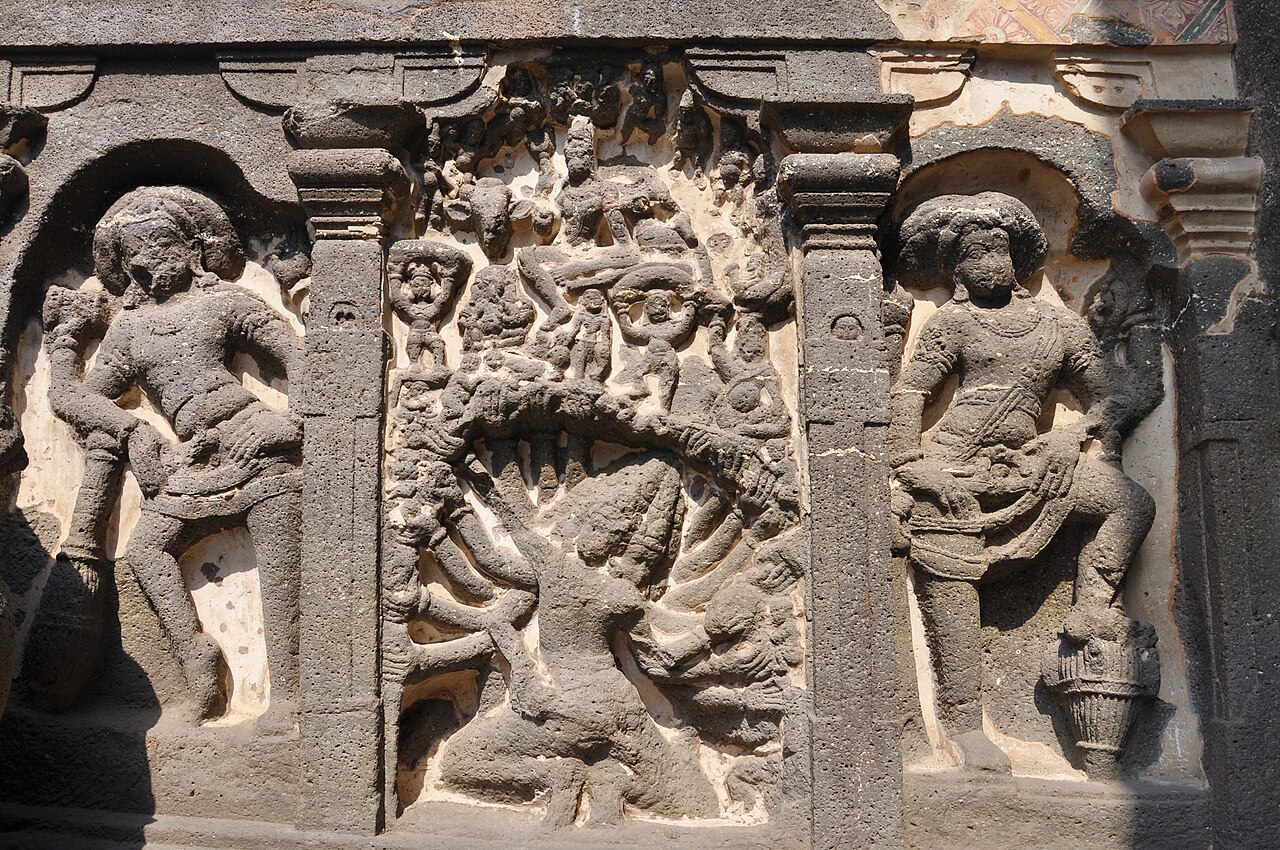
Every stone of this Temple retells one mountain. Tradition holds that Ravana, the mighty king of Lanka, once presumed to lift Mount Kailash itself, the snow abode where Lord Shiva Sits in meditation with Maa Parvati. The mountain trembled, and Maa Parvati Reached in alarm for Her Lord, and Lord Shiva, unmoved, Pressed the summit down with a single toe, holding the boastful king beneath it for an age until his pride broke into hymns of praise. It was that whole cosmos, the mountain, its Lord, and the lesson in its stone, that the Rashtrakutas set out to carve into the Deccan basalt.
Inscription and chronicle attribute the work to Krishna I, the Rashtrakuta king who reigned from about 756 to 773 CE, at the place then called Elapura. Scholars debate how many reigns the carving truly spanned, and some see beginnings under his predecessor Dantidurga and elaborations long after, but the great body of the Temple is placed in Krishna's own years. A copper-plate grant of about 812 CE remembers the wonder it caused: a Temple on the hill at Elapura so marvellous that even the gods and its own architect were astonished by it.
The carvers began at the summit of the hill and worked downward, finishing the crown of the tower while the base was still bedrock, cutting galleries back into the cliff until a freestanding Temple stood alone in a courtyard open to the sky. Centuries later the Temple received coats of plaster and paint, and traces of them still cling to the stone. Today Kailasa is a protected monument in the care of the Archaeological Survey of India, no longer a shrine of daily worship: a prayer completed in stone, held open for all who come.
What you'll actually see
1
The gopuram and the sky-open court
You enter through a low gopuram cut in the rock screen wall. Beyond it the courtyard runs 82 metres deep and 46 metres wide, ringed by pillared galleries carved into the cliff on three sides, their alcoves holding gods and guardians at more than human scale.
2
The Nandi pavilion, the pillars, the elephants
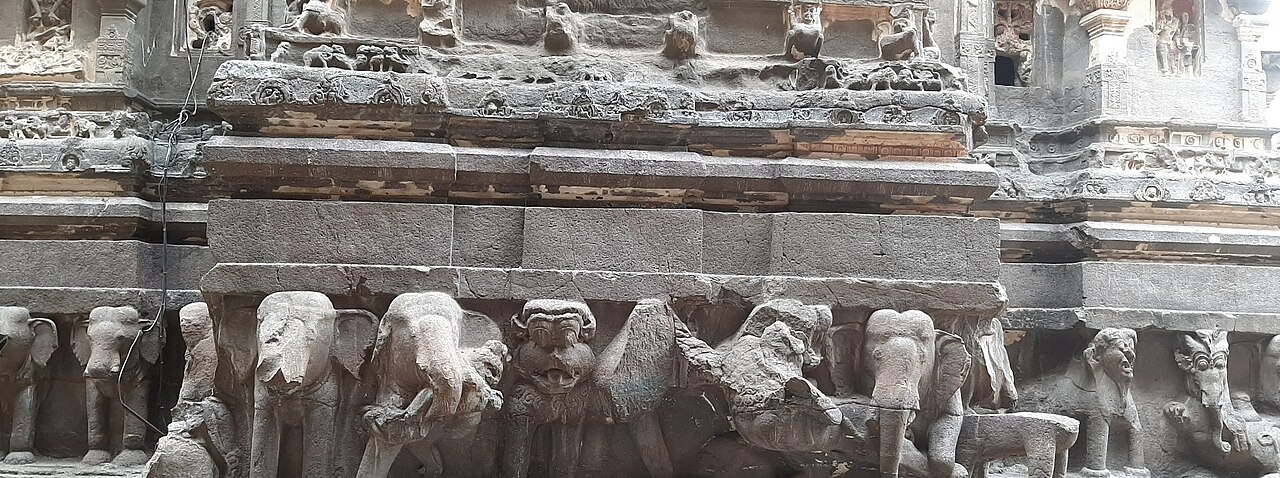
Facing the sanctum stands a two-storey Nandi mandapa about seven metres high, flanked by two carved flagstaff pillars, the dhvajastambhas, and by great stone elephants. Around the Temple's base runs a frieze of elephants that seem to carry the whole shrine upon their backs.
3
Ravana beneath the mountain
On the Temple's south side is the panel counted among the summits of Indian sculpture: many-armed Ravana straining in the cavern beneath Kailash, the mountain's court in alarm above him, and Lord Shiva Calm at the centre of it all, Pressing the world back into stillness with a toe.
The Ravana shaking Mount Kailasa relief on the Kailasa Temple, the many-armed king straining beneath the mountainThe frieze of stone elephants carved around the base of the Kailasa Temple, seeming to bear the shrine on their backs
Ravana beneath Mount Kailash, and the elephant frieze at the temple's base · photos by Prof Ranga Sai (CC BY-SA 4.0) and Ankur22Oct (CC BY-SA 4.0), Wikimedia Commons
A TEMPLE MADE BY TAKING AWAY
Carved from the summit down
Temples are raised course upon course from the ground; Kailasa was released downward out of a hill. The carvers began on the brow of the basalt escarpment and cut their way toward the earth, so the crown of the tower was finished while its base was still bedrock, and no scaffolding was ever raised and no stone was ever laid upon another. The excavation freed a tower rising 32.6 metres above the court, a Nandi pavilion, flagstaff pillars, elephants, and whole galleries of gods, with an estimated 200,000 tonnes of rock removed by hand. One modern calculation suggests 250 workers labouring for about five and a half years could have done it; however long it truly took, it remains the largest single monolithic excavation in the world.
Climb the path along the cliff rim to see the Temple whole from above: it is the one viewpoint from which the top-down carving explains itself.
Plan your visit
By air
Chhatrapati Sambhaji Nagar Airport (IXU), about 35 km; taxis take around an hour.
By rail
Aurangabad (Chhatrapati Sambhaji Nagar) station, about 28 km; MSRTC buses to Ellora leave from the Central Bus Stand.
From the city
Ellora is about 29 km north-west of Chhatrapati Sambhaji Nagar (Aurangabad) by road.
Timings
Sunrise to sunset; closed every Tuesday.
Entry
₹40 for Indian and SAARC/BIMSTEC visitors (₹35 online), ₹600 for other foreign visitors (₹550 online); children under 15 free. One ticket covers all the Ellora caves.
Best time
Early morning on a weekday, in the cooler months from November to February; late afternoon light warms the basalt for the view from the rim.
Grishneshwar
The living Jyotirlinga shrine of Grishneshwar stands about 1.5 km away in Verul; pilgrims take darshan there and the caves in a single visit.
No daily worship is offered at the Kailasa Temple today; it is a protected monument of the Archaeological Survey of India. Pilgrims seeking a living darshan of Lord Shiva go to the Grishneshwar Jyotirlinga, a short distance away in Verul.
The place was called Elapura in the old inscriptions; the name of the modern village, Verul, became the Ellora of the caves.
The line of caves runs along the escarpment with Buddhist, Hindu, and Jain sanctuaries in sequence; wear walking shoes, carry water, and give the whole site at least half a day.
Traces of later plaster and painting still cling to the Temple, evidence that the grey basalt was once brightly finished.
Questions pilgrims ask
Is the Kailasa Temple still a working Temple?
No. Cave 16 is a protected monument under the Archaeological Survey of India, without a daily liturgy or resident priests. It is honoured today as a monument of devotion, and the living worship of Lord Shiva in this valley continues at the Grishneshwar Jyotirlinga about 1.5 km away.
Is it really carved from a single rock?
Yes. The gateway, the Nandi pavilion, the tower, the elephants, the galleries, and the courtyard walls were all cut from one basalt hillside, worked from the top of the cliff downward. Nothing was built and nothing was added; roughly 200,000 tonnes of rock were removed to reveal it.
Who carved it, and when?
The Temple is attributed to the Rashtrakuta king Krishna I, who reigned from about 756 to 773 CE, though scholars debate whether the work began earlier under Dantidurga and continued after him. A copper-plate inscription of about 812 CE credits Krishnaraja with a Temple at Elapura that astonished the gods themselves.
How is Cave 16 different from the other Ellora caves?
Most of Ellora's sanctuaries are halls carved into the cliff. Kailasa was carved out of it: a freestanding Temple standing in an open courtyard, complete on all sides. The same escarpment holds Buddhist viharas (Caves 1 to 12), Hindu Temples (Caves 13 to 29), and Jain shrines (Caves 30 to 34), carved side by side across six centuries.
Where is the Ravana panel?
On the Temple's south side, at the level of the plinth: a many-armed figure straining in a dark recess beneath the mountain, with the court of Kailash carved in the registers above him. Guides and the ASI signboards point it out.
Dharamshalas and guest houses near this Sthan, shared by devotees. Adisthan takes no bookings and no money; contact each stay directly.
No stays are listed here yet. Know one that serves pilgrims well?
Do you serve in the stewardship, conservation, or study of the Ellora monuments? Claim this page to keep its timings, fees, and closure notices true for every seeker who comes to stand inside the mountain's prayer.