
Kailasanathar Temple, Kanchipuram
Kailasanatha Temple · Rajasimheshvaram · Kanchi Kailasanathar Temple
About
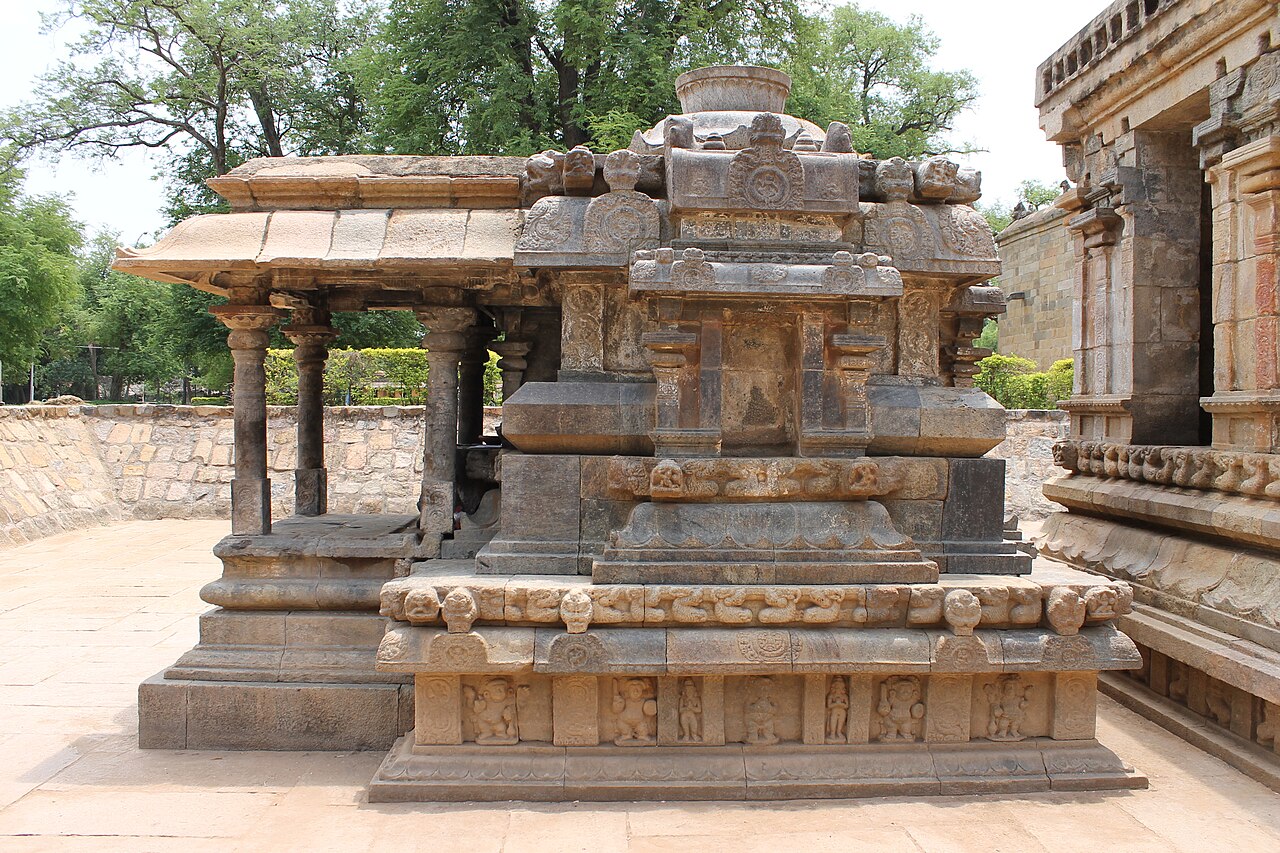
Rising from the western quarter of Kanchipuram, the Kailasanathar Temple, whose name honours Śiva as Lord of Mount Kailāsa, embodies the Pallava dynasty's confident transformation of temple-building from rock-cut chambers and wooden structures into freestanding masonry. Its foundations rest on granite, while the soaring superstructure and its wealth of carvings were fashioned from sandstone, a choice that gave sculptors the latitude to render divine forms with extraordinary delicacy.
The plan is organized around a sixteen-sided Śivaliṅga enshrined in the innermost sanctum sanctorum, approached through a progression of halls, the entrance hall (mukha-maṇḍapa), the gathering hall (mahā-maṇḍapa), and a connecting antechamber, before arriving at the garbhagṛha itself, crowned by a four-storey pyramidal vimāna. Nine subsidiary shrines surround the principal sanctum, seven positioned outside and two flanking its entrance, all consecrated to varying aspects of Śiva. Enclosing the entire complex is a high compound wall whose inner face holds fifty-eight small shrine niches, each bearing Somaskanda reliefs of Śiva with his consort Pārvatī.
The sculptural programme speaks across multiple Hindu traditions simultaneously. Alongside Śaiva scenes, Śiva as Dakṣiṇāmūrti seated in serene wisdom, as Liṅgodbhava emerging as a column of flame, as Tripurāntaka destroying the three cities, and as Ūrdhva Tāṇḍava in ecstatic cosmic dance, the walls also carry imagery from Vaiṣṇavism and Śāktism: Narasiṃha, Trivikrama, Durgā, and Garuḍāruḍha-Viṣṇu. Preserved murals on the courtyard's interior walls, executed in a style related to those of the Ajanta Caves, offer some of the earliest surviving examples of painted sacred art in Tamil Nadu.
History
The Pallava emperor Narasimhavarman II, known as Rajasimha, commissioned the Temple around 700 CE as the capital Kanchipuram grew into one of the great cities of the Pallava kingdom. His son, Mahendravarman III, completed the entrance facade and gopuram, giving the Temple its finished form. Earlier sacred building in the region had been carved into rock or raised in wood, as at Mahabalipuram, so the Kailasanathar Temple stands as the first freestanding stone Temple in the area, a template the rest of South India would follow. In later centuries the Temple absorbed Chola and Vijayanagara influence, and tradition holds that Rajaraja Chola I visited and drew inspiration here before building the Brihadishvara Temple at Thanjavur. The Archaeological Survey of India now cares for the monument.
Significance
The Temple honours Lord Shiva in the Smartha tradition, which worships Shiva, Vishnu, Devi, Surya, Ganesha and Kartikeya together, and stands in the part of Kanchipuram traditionally called Shiva Kanchi. Its compound wall preserves an early stone inscription recording the twenty eight Shaivagamas, in which Rajasimha declares his own Shaiva faith, among the earliest such records in South India. A narrow crawl passage along the inner wall, entered through the Gate of Death and left through the Gate of Birth, carries devotees through a physical symbol of the cycle of life, death and release. On Maha Shivaratri, worshippers still gather through the night in numbers, keeping a vigil that has continued here for well over a thousand years.
Architecture
Pallava Dravidian architecture; granite foundation with a sandstone superstructure; four storey pyramidal vimana; 58 subsidiary shrines set into the compound wall; among Tamil Nadu's earliest surviving Temple murals
Visiting
Daily worship
| Morning darshan | 09:00 to 12:30 | |
| Evening darshan | 16:00 to 18:30 |
Hours
Hours not listed.
Contact
No contact details listed yet.
Engage with Kailasanathar Temple, Kanchipuram
Through the four pathways
Seva सेवा — Service
Offer your time and skills here. The following opportunities are open at Kailasanathar Temple, Kanchipuram:
No Seva offerings listed yet.
Sādhana साधना — Practice
Learn the worship and practice associated with Kailasanathar Temple, Kanchipuram:
No Sādhana offerings listed yet.
Sandhāna सन्धान — Wisdom
Unite with the wisdom of this tradition:
No Sandhāna offerings listed yet.
Sādhya साध्य — Giving
Support this sacred place according to your means:
No Sādhya offerings listed yet.
All giving flows directly to Kailasanathar Temple, Kanchipuram. Adisthan does not take a commission.
Festivals & Events
- Mar
Maha Shivaratri
6 March 2027 · annual
The Temple's principal festival, when thousands of worshippers keep an all night vigil of prayer before Lord Shiva, continuing a tradition observed here since the Temple's Pallava foundation.
Gallery
Related sacred places
 Hinduism
Airavatesvara Temple, Darasuram
Darasuram (Kumbakonam) · India · temple
The third of the Great Living Chola Temples, raised by Rajaraja Chola II around 1166 CE at Darasuram near Kumbakonam: a chariot-form shrine of Lord Shiva as Airavatesvara, famed for its carved stone wheels, its singing steps, and worship that has continued for over eight centuries.
Aisanyesvara Siva Temple
Bhubaneswar · India · temple
A living thirteenth-century Shiva shrine in the Old Town of Bhubaneswar, standing close to the western wall of the great Lingaraj Temple, where a Shivalinga set within a circular yonipitha still receives daily worship in the Kalinga architectural tradition.
 Hinduism
Akhadachandi Temple
Bhubaneswar · India · temple
A tenth-century Kalinga-style shrine on the southwestern bank of Bhubaneswar's sacred Bindusagar tank, Akhadachandi Temple honours Maa Mahishasuramardini, the Goddess in her form as slayer of the buffalo demon, within the dense cluster of ancient shrines that fills the city's Old Town.
 Hinduism
Akshardham
New Delhi · India · temple
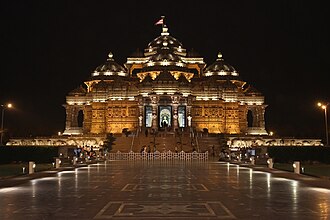
A vast contemporary Hindu mandir campus on the Yamuna's west bank in East Delhi, raised without structural steel by 11,000 artisans and volunteers, and recognised by Guinness World Records in 2007 as the world's largest comprehensive Hindu Temple.
 Hinduism
Amarnath Temple
· India · temple
A high Himalayan cave shrine in Jammu and Kashmir where a naturally forming ice lingam is venerated as Lord Śiva, drawing one of India's great seasonal pilgrimages.
 Hinduism
Ambalappuzha Sri Krishna Temple
Ambalappuzha · India · temple
A Vaishnava shrine on the Kerala backwaters consecrated to Sri Krishna in his Parthasarathy form, counted among the seven great Temples of the former kingdom of Travancore and famed across South India for its Ambalapuzha Paal Payasam offering.