Western Group of Temples · Khajuraho, Chhatarpur, Madhya Pradesh, India
They raised a mountain of stone so the Lord of the Cave would have a cave to dwell in.
Be the first to check in
Coming up: Khajuraho Dance Festival · 20 FebEntry tended 25 May 2026
31 m shikhara · 84 subsidiary spires Lord Shiva · a marble linga Sunrise to sunset daily ₹40 Indian · ₹600 foreign · under 15 free Dance Festival · 20 to 26 Feb 2027
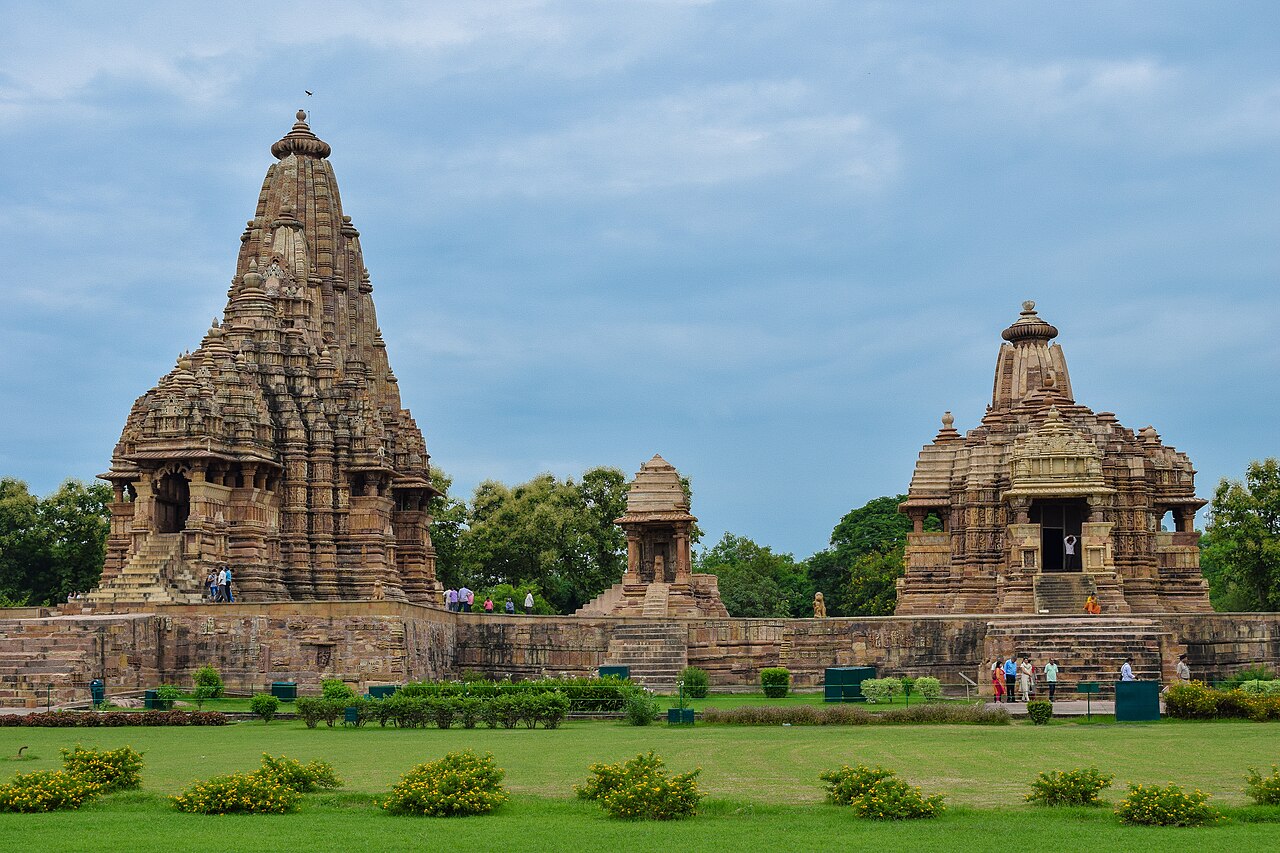
You climb to it. Four metres of stepped plinth lift the Temple above the lawns of the western group, and as you rise, the tower resolves into a range of peaks: 84 lesser spires pressed against one great one, the whole mass surging upward like the mountain it remembers. Around the walls run three bands of carved figures, more than 870 of them, gods and dancers and lovers caught mid-gesture in golden sandstone. The name gives away the secret. Kandariya comes from kandara, a cave. The Temple is a mountain, and deep inside it waits the cave of the Lord.
The largest and tallest surviving Temple of Khajuraho: a shikhara about 31 metres high, clustered with 84 subsidiary spires, the urushringas, so that the whole superstructure reads as one cosmic mountain, remembered in tradition as Meru and as Kailash, the abode of Lord Shiva.
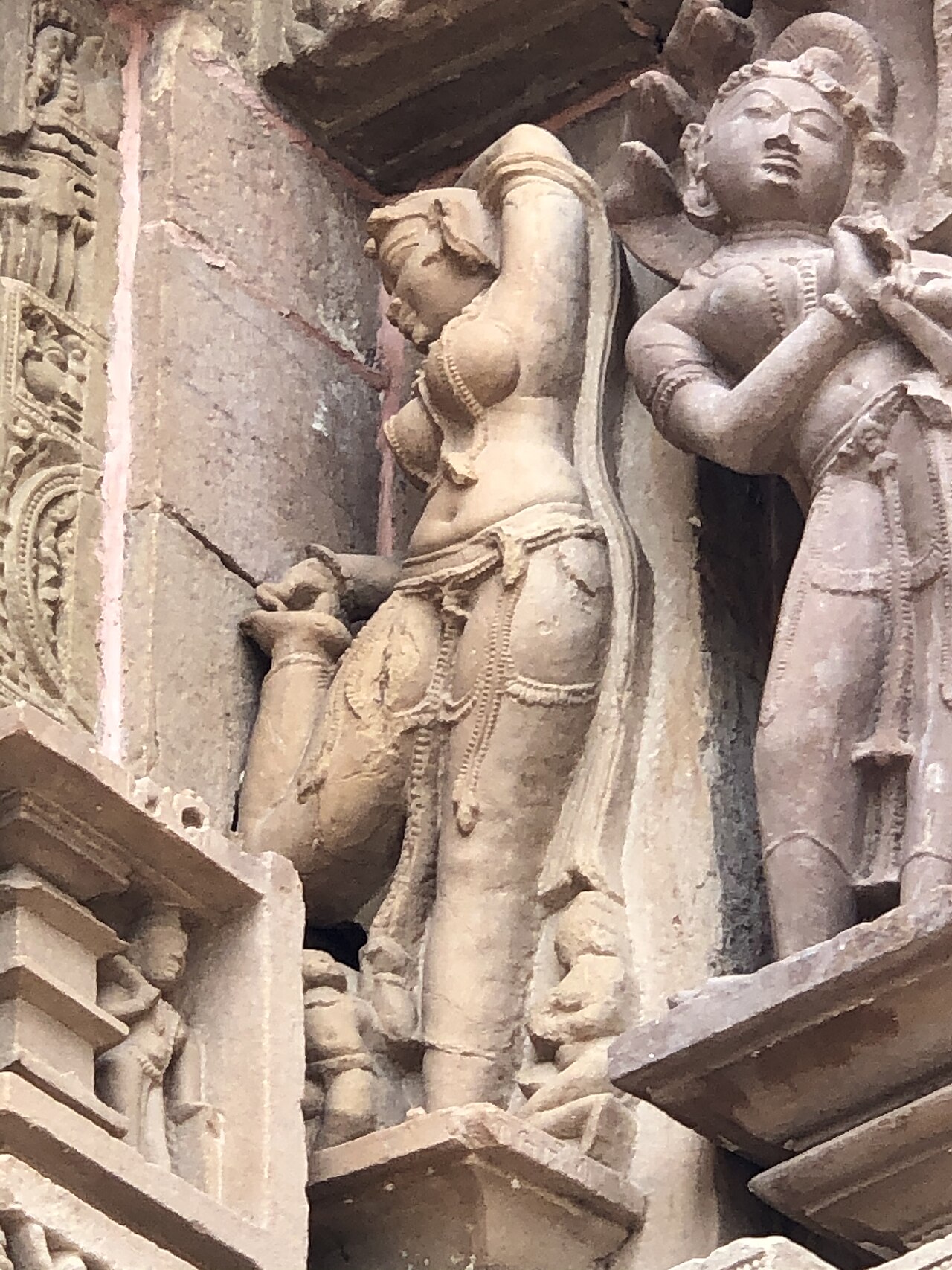
More than 870 sculpted figures, most of them half life-size, wrap the Temple in three carved bands. The famous erotic panels are fewer than one in ten of them; the rest is the whole of life: gods and guardians, musicians and dancers, couples, ascetics, and scenes of the everyday world of a thousand years ago.
The crowning monument of the Khajuraho Group, inscribed by UNESCO in 1986: of some 85 Temples the Chandela kings raised here by the twelfth century, about 25 survive, and Kandariya Mahadeva is held to be the summit of their art.
The king's mountain
A thousand years ago this was Chandela country, and Khajuraho, the ancient Kharjuravahaka, was its ceremonial heart. For over a century the dynasty's kings had been raising Temples on this plain, to Lord Shiva, to Lord Vishnu, to The Devi, to Surya, and to the Jain Tirthankaras, each generation building higher than the last. Then came the storm from the north west. Mahmud of Ghazni marched against King Vidyadhara in 1019 and again in 1022, besieged his hill fort, and failed to break him. Vidyadhara celebrated his success, and the greatest Temple of Khajuraho is placed in exactly these years, its unmatched scale often read as a king's thanksgiving to Lord Shiva.
An inscription on a pilaster of the Temple's mandapa names the builder as Virimda, which scholars interpret as a pseudonym of Vidyadhara himself, and the construction is dated to the period between 1025 and 1050 CE. What his craftsmen made was not a building so much as a geography: a stepped mountain of sandstone entered through a garland arch carved from a single stone, rising hall by hall, each roof higher than the one before, to the sanctum where a marble linga stands in near darkness at the Temple's core.
Worship in the great Temple ceased centuries ago, and today Kandariya Mahadeva is a protected monument in the care of the Archaeological Survey of India, honoured as architecture rather than served with daily ritual. The living worship of Lord Shiva at Khajuraho never stopped, though: it simply stayed at the small Matangeshwar Temple beside the western group, where the milk and bilva leaves are offered to this day.
What you'll actually see
1
The makara torana and the climbing halls
You enter beneath a torana, an ornamental garland arch carved from a single stone, its loops issuing from the mouths of makaras and borne across the doorway by celestial figures. Beyond it the halls ascend in sequence: the entrance porch, the mandapa, the great pillared mahamandapa, the vestibule, and at last the sanctum, each under a roof that steps higher than the one before.
2
The three bands of the living wall
Around the outer walls run three horizontal bands of sculpture, more than 870 figures in all, most about half life-size. Gods and dikpalas share the stone with sura-sundaris adjusting their anklets, musicians, embracing couples, and small honest scenes of daily life, every band carved in such deep relief that the figures seem to step out of the wall as the light moves.
3
The cave heart and its marble linga
The garbhagriha is the Temple's cave: small, dark, and almost unadorned after the tumult of the walls outside. Within it stands the marble linga of Lord Shiva on a stone pedestal. An enclosed ambulatory circles the sanctum, its transept openings letting in just enough light for the slow circumambulation pilgrims once made here.
A carved sculpture band on the Kandariya Mahadeva Temple wall showing a scene of daily life from the Chandela eraKandariya Mahadeva Temple and the Devi Jagadambi Temple standing together in the western group at Khajuraho
A carved moment of daily life on the temple wall, and Kandariya Mahadeva beside the Devi Jagadambi temple · photos by Monument hunter (CC BY-SA 4.0) and Omkarshinde19 (CC BY-SA 4.0), Wikimedia Commons
SEVEN NIGHTS AT THE TEMPLE'S FEET
Khajuraho Dance Festival · 20 to 26 February 2027
Every February, for more than fifty years now, India's great classical dancers have come to perform in the open air against the floodlit Temples of the western group. For seven evenings Kathak, Bharatanatyam, Odissi, Kuchipudi, Manipuri, Mohiniyattam, and Kathakali return to the stones that were carved full of dancers a thousand years ago. The festival is organised by the culture department of the Madhya Pradesh government, and entry to the performances is free.
Come early in the evening for a good seat; the festival week draws artists and audiences from across India.
Plan your visit
By air
Khajuraho Airport (HJR) is about 5 km from the Temples, with flights connecting Delhi, Agra, Varanasi, and Mumbai.
By rail
Khajuraho railway station is about 5 km away, with direct trains from Delhi (Hazrat Nizamuddin) and other cities on the Delhi, Agra, and Varanasi routes.
By road
Satna is about 117 km and Jhansi about 175 km away; both are connected to Khajuraho by regular buses and taxis.
Timings
The western group compound is open from sunrise to sunset, daily.
Entry
₹40 for Indian and SAARC/BIMSTEC visitors, ₹600 for other foreign visitors, children under 15 free. One ticket covers every Temple inside the western group.
Best time
Early morning, soon after the gates open, for soft light on the sandstone and quiet lawns; the cooler months from October to February are the kindest season.
Matangeshwar
The living Shiva Temple of Khajuraho stands just beside the western group, outside the ticketed fence; pilgrims take darshan there and see the monuments in a single visit.
The name Kandariya comes from kandara, a cave: Kandariya Mahadeva is the Great God of the Cave, Lord Shiva dwelling in the cave-like sanctum at the mountain's heart.
No daily worship is offered in the Kandariya Mahadeva Temple today; it is a protected monument of the Archaeological Survey of India, and the living worship continues at the Matangeshwar Temple nearby.
An evening light and sound show in the western group tells the story of the Chandela Temples; shows run in English and Hindi, about 35 minutes each, with earlier timings from October to February and later timings from March to September.
The erotic carvings that made Khajuraho famous are fewer than one in ten of its sculptures, honouring kama as one of the four aims of life; walk the full bands and you will find gods, teachers, farmers, and dancers in far greater number.
Questions pilgrims ask
Is Kandariya Mahadeva still a working Temple?
No. It is a protected monument under the Archaeological Survey of India, without daily ritual or resident priests. The living worship of Lord Shiva at Khajuraho continues at the Matangeshwar Temple just beside the western group, where Mahashivaratri falls on 6 March in 2027.
Why are there erotic sculptures on a Temple?
Sexual themes cover fewer than 10 percent of the carvings at Khajuraho. The tradition that built these Temples honoured kama, desire, as one of the four aims of human life alongside dharma, artha, and moksha, and scholars read the panels variously as auspicious ornament, tantric symbolism, and a portrait of the whole of life offered to the divine.
Who built the Temple, and when?
An inscription on a pilaster of the mandapa names the builder as Virimda, interpreted as a pseudonym of the Chandela king Vidyadhara, who reigned in the early eleventh century and twice withstood Mahmud of Ghazni. Scholars date the construction to between about 1025 and 1050 CE.
What is inside the sanctum?
A marble linga of Lord Shiva, standing in a small, dark, almost plain garbhagriha at the core of the Temple. The sanctum is wrapped by an enclosed ambulatory, so the linga sits in the cave that gives the Temple its name.
How much time does a visit take?
Give the western group at least half a day. The single ticket covers Kandariya Mahadeva and every other Temple inside the fenced compound, including Lakshmana, Vishvanatha, Chitragupta, and Devi Jagadambi, and the carved bands reward slow walking.
The Sthan in photographs
Darshan from afar
From the temple's own channels. Nothing loads until you press play.
Dharamshalas and guest houses near this Sthan, shared by devotees. Adisthan takes no bookings and no money; contact each stay directly.
No stays are listed here yet. Know one that serves pilgrims well?
Do you serve in the conservation, study, or stewardship of the Khajuraho monuments? Claim this page to keep its timings, fees, and festival dates true for every seeker who comes to the mountain of Lord Shiva.