Darshan 5:30 am to 12:30 pm · 4 to 9:30 pm Free entry Panguni Peruvizha · Mar 2027 Theppam float festival · month of Thai 37 m eastern gopuram · 1906
Come up North Mada Street in the early morning and the Temple announces itself in layers: nadaswaram drifting from a doorway, wet kolam chalk underfoot, jasmine and camphor on the air, and then the great gopuram, tier upon tier of painted gods, leaning its shadow over the bazaar. Inside, past the flagstaff, a small shrine holds a peahen worshipping a lingam beneath an old punnai tree. Hold that image. This whole quarter of Chennai, Mylapore, the town of the peacock, is named for what happens in that little shrine.
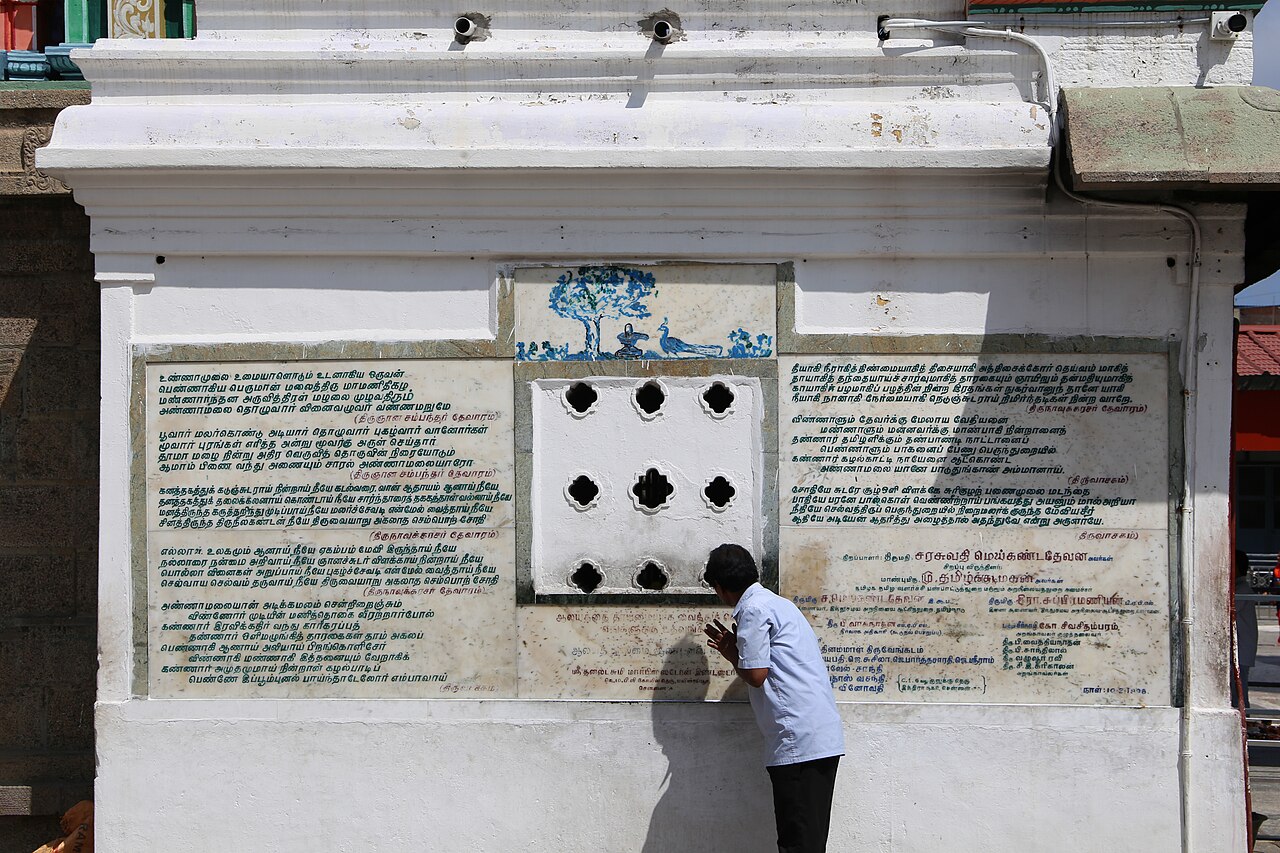
Mylapore itself is named for Her act of worship. Maa Uma, tradition holds, Took the form of a peahen, mayil in Tamil, and Worshipped Lord Shiva beneath the punnai tree, and the town by the sea became Mylai, the town of the peacock.
A Paadal Petra Sthalam of the Tamil Shaiva canon: the boy-saint Thirugnana Sambandar sang the Poompavai pathigam here, ten verses that tradition says raised a girl from her ashes by naming, one by one, the festivals of Lord Kapaleeswarar.
This is the city Temple of Chennai. On Arupathimoovar day all sixty-three Nayanmar saints come out in bronze behind the Lord, and the city pours into the four Mada streets in one of the great processions of the Tamil year.
The peahen, the skull, and the girl of the ashes
Two legends share this ground. In the first, Maa Uma's attention strayed for a moment while Lord Shiva taught the holy syllables, and She Came To earth as a peahen to atone. By the shore of Mylai She Worshipped a lingam beneath a punnai tree until the Lord Received Her back, and the town has carried the memory of Her peacock form in its name ever since. In the second, Lord Shiva plucked away one of Brahma's five heads to humble his pride, and Brahma installed a lingam here in penance. So the Lord of this place Is Kapaleeswarar, the Bearer of the kapala, the skull.
The most beloved telling belongs to the Thevaram age. Sivanesa Chettiar of Mylapore lost his daughter Poompavai to a snakebite, and kept her bones and ashes in an urn, trusting she would live again. When the young saint Thirugnana Sambandar came to Mylai, the urn was set before him. He sang ten verses beginning Mattitta Punnai, each one naming a festival of Lord Kapaleeswarar and asking whether it was right for Poompavai to have gone without seeing it. The legend says she rose from the urn alive, and Mylapore still re-enacts her rising by the Temple tank each spring.
The Temple those hymns describe stood by the sea, near where Santhome Basilica now rises, and stones naming Kapaleeswara and Poompavai have been found around the cathedral. That shore shrine was lost in the sixteenth century, under Portuguese rule on this coast, and the present Temple rose about a kilometre inland in the Vijayanagara manner; inscriptions associated with it reach back to the twelfth century. The great eastern gopuram that now stands for all of Chennai was completed in 1906.
What you'll actually see
1
The eastern gopuram and the Mada streets
The 1906 tower climbs about 37 metres, some 120 feet of stucco gods, saints and guardian figures repainted in living colour. The four Mada streets ring the Temple walls as the processional circuit, and on festival days the whole neighbourhood becomes the Temple's outer courtyard.
2
The punnai tree and the peahen shrine
In the courtyard the sthala vriksham, the Temple's sacred punnai tree, shades a small shrine where Maa Uma in Her peahen form stands worshipping a lingam. It is the quietest spot in a busy Temple, and the reason the city around you is called Mylapore.
3
Maa Karpagambal's shrine and the great tank
The Divine Mother here Is Maa Karpagambal, The Goddess Of the wish-yielding tree, and Mylapore's devotion flows especially To Her. West of the Temple spreads the Kapali Theertham, the vast tank of about 190 by 143 metres that fills each winter for the lamp-lit float festival.
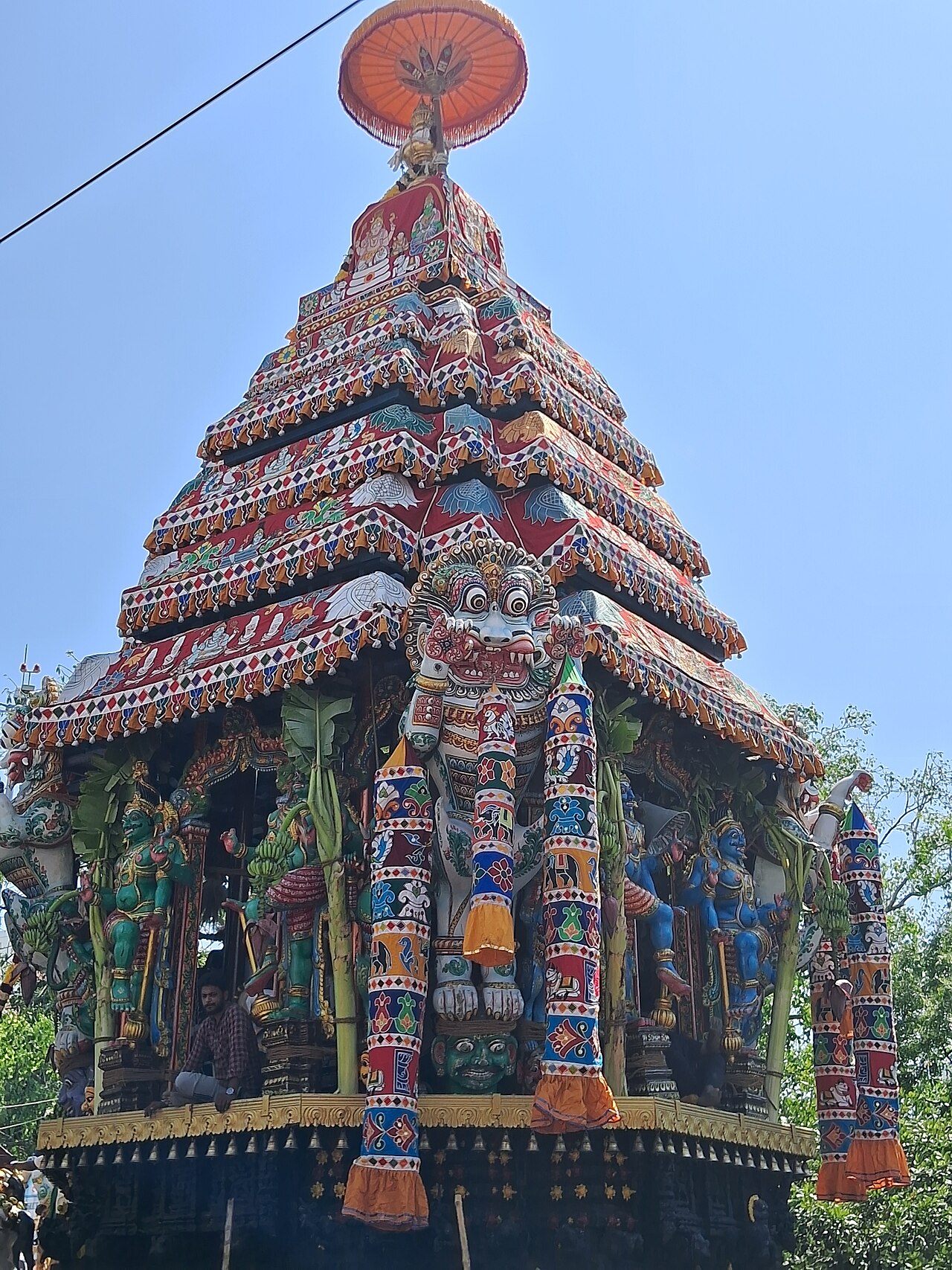
The courtyard shrine of Maa Uma as a peahen worshipping the lingam beneath the punnai treeThe great wooden chariot of Lord Kapaleeswarar drawn through the Mada streets during the Panguni festival
The peahen of the legend under the punnai tree, and the chariot on the Mada streets · photos CC BY 3.0 Sailko and CC BY 4.0 VasuVR, Wikimedia Commons
THE DAY THE SIXTY-THREE COME OUT
Panguni Peruvizha · around 22 March 2027
Each spring the Temple keeps ten days of festival in the Tamil month of Panguni, set by the Panguni Uthiram full moon, which falls on Monday 22 March 2027. The deities come out daily on different mounts, the great wooden chariot rolls on Therottam day, and on the eighth day comes the Arupathimoovar: bronze images of all sixty-three Nayanmar saints, the canonised devotees of Lord Shiva, process through the Mada streets behind Lord Kapaleeswarar and Maa Karpagambal while the city presses in on every side. In 2026 the festival ran 23 March to 1 April, with the Arupathimoovar on 30 March; the Temple announces each year's day-by-day schedule closer to the time. During the same festival, Poompavai's rising by Sambandar's hymn is re-enacted beside the Temple tank.
Arupathimoovar day is among the most crowded days in Mylapore's year; come early in the afternoon, travel light, and expect the Mada streets to be shoulder to shoulder.
Plan your visit
By air
Chennai International Airport is about 16 km away; allow 45 minutes to an hour through city traffic.
By rail
Thirumayilai MRTS station is about a kilometre away, a short walk through the bazaar; Chennai Central is about 8 km.
In the city
The Temple sits in the heart of Mylapore, ringed by the four Mada streets; city buses and autos reach it from every quarter.
Timings
5:30 am to 12:30 pm and 4:00 to 9:30 pm daily; open through the night on Maha Shivaratri.
Entry
Free. Tickets for abhishekams and archanas are sold at the Temple counter; most abhishekams are around ₹900.
Best time
Early morning for the kala poojas and cool streets; evening, when the gopuram is lit and the tank catches the light.
Dress
Modest dress, shoulders and knees covered; footwear is left at the stands outside the gate.
The Temple's own portal notes that Ptolemy, writing nearly two thousand years ago, knew this town as Malliarba: Mylapore is older than almost everything else in Chennai.
The daily rhythm keeps the old six-kala order, from the Go Pooja at 5:30 am to the Arthajama Pooja at 9:00 pm, so there is worship to witness at almost any hour the doors are open.
For three evenings in the Tamil month of Thai, around Thai Poosam, the deities circle the Kapali Theertham on a lamp-lit float; in 2026 the Theppam ran 1 to 3 February.
Navaratri each autumn is kept For Maa Karpagambal, with a great kolu of display dolls and nightly music in the Temple's kalyana mandapam.
Questions pilgrims ask
Is this the ancient Temple the Thevaram saints sang?
The hymns describe a shrine by the seashore, and that older Temple stood near where Santhome Basilica now stands; it was lost in the sixteenth century. The present Temple is a Vijayanagara-era rebuild about a kilometre inland. The worship, the hymns and the festivals continued unbroken, which is why it is still counted and venerated among the Paadal Petra Sthalams.
Who Is Maa Karpagambal?
The Divine Mother of this Temple, Enshrined beside Lord Kapaleeswarar. Her name means The Goddess Of the wish-yielding karpaga tree, She Who Grants what Her devotees ask, and much of Mylapore's daily devotion flows To Her shrine. Tradition remembers Her as Maa Uma, Who Worshipped the Lord here as a peahen.
When should I come for the Arupathimoovar?
It falls on the eighth day of the Panguni Peruvizha, the ten-day spring festival anchored on Panguni Uthiram, which is 22 March in 2027. The Temple publishes the exact processional schedule near the time; in 2026 the Arupathimoovar was on 30 March.
Is there an entry fee, and how long does darshan take?
Entry is free for everyone. On ordinary days you can move through the sanctums unhurried within the open hours, 5:30 am to 12:30 pm and 4:00 to 9:30 pm; on festival days, and especially during Panguni, expect long, slow-moving crowds.
The Sthan in photographs
Darshan from afar
From the temple's own channels. Nothing loads until you press play.
Dharamshalas and guest houses near this Sthan, shared by devotees. Adisthan takes no bookings and no money; contact each stay directly.
No stays are listed here yet. Know one that serves pilgrims well?
Are you a priest, trustee or staff member of Arulmigu Kapaleeswarar Temple, Mylapore? Claim this page to keep darshan hours, pooja times and the Panguni schedule exact for the devotees who plan their year around the Mada streets.