Darshan from 4 am (5 am winter) Darshan free for all Prasad and milk shared with the kabas Navratra fair · 11 to 20 Oct 2026 Marble & silver doors · early 1900s
You leave your shoes at the gate and step onto cool marble in the half-dark before dawn. Bells sound the Mangla Aarti; the smell of milk and ghee drifts across the courtyard; and everywhere, soft as moving shadow, the kabas flow: down the pillars, along the walls, gathering at wide bowls of milk. Nothing here is shooed away. In the house of Maa Karni, the small lives at your feet are not vermin. They are family, Her own Charan kin come home between births.
Maa Karni, the Charan mystic Revered as Maa Hinglaj and Maa Durga Come again, laid the foundation stones of two desert kingdoms: Mehrangarh at Jodhpur in 1459 and the citadel of Bikaner in 1485. Both royal houses worship Her as Kuldevi to this day.
Some 20,000 kabas live within the Temple, held by tradition to be Maa Karni's own Charan kin, the Depavats, moving between births. To harm one, even by accident, is answered by Temple rule with a kaba wrought in silver or gold.
Since partition closed the road to Maa Hinglaj's shrine in the west, Deshnoke has stood as the foremost pilgrimage of the Charani sagatis, the Divine Mothers born among the Charans of the Thar.
The Mother who told death to stand down
Tradition holds that in 1387, in the Charan village of Suwap in Marwar, a daughter was born to Mehaji of the Kiniya clan and named Ridhi Bai. Her people came to call Her Karni Mata, the doer of deeds, and Revered Her even in Her lifetime as Maa Hinglaj and Maa Durga Come again. She lived as an ascetic among the herders of the desert; in 1419 She founded the town of Deshnoke; and the Rathore princes sought Her blessing before all else, Rao Jodha for the foundation of Mehrangarh in 1459, Rao Bika for the citadel of Bikaner in 1485.
The Temple's heart is a story about death refused. Her stepson Lakshman drowned in the Kapil Sarovar at Kolayat. Tradition tells that Maa Karni carried the boy to the room where Her murti now stands, closed the doors, and went To Yamraj himself to demand him back. Asked how the wheel of rebirth could turn if She refused it, She answered that Her family would no longer come to death's court at all: wherever She lived, they would live. From that day Her Charan kin are held to be reborn as kabas within Her Temple, and each kaba, dying, is born again as a Charan. The circle never leaves Her house.
In 1538, at the age of 151 by the tradition's count, Maa Karni's earthly form passed into light at Dhineru talai, and Her murti, carved in Jaisalmer stone, was enshrined at Deshnoke that same year. The shrine that began as a single domed sanctum grew century by century, until Maharaja Ganga Singh of Bikaner completed it in white marble and solid silver in the early 1900s.
What you'll actually see
1
The marble facade and silver doors
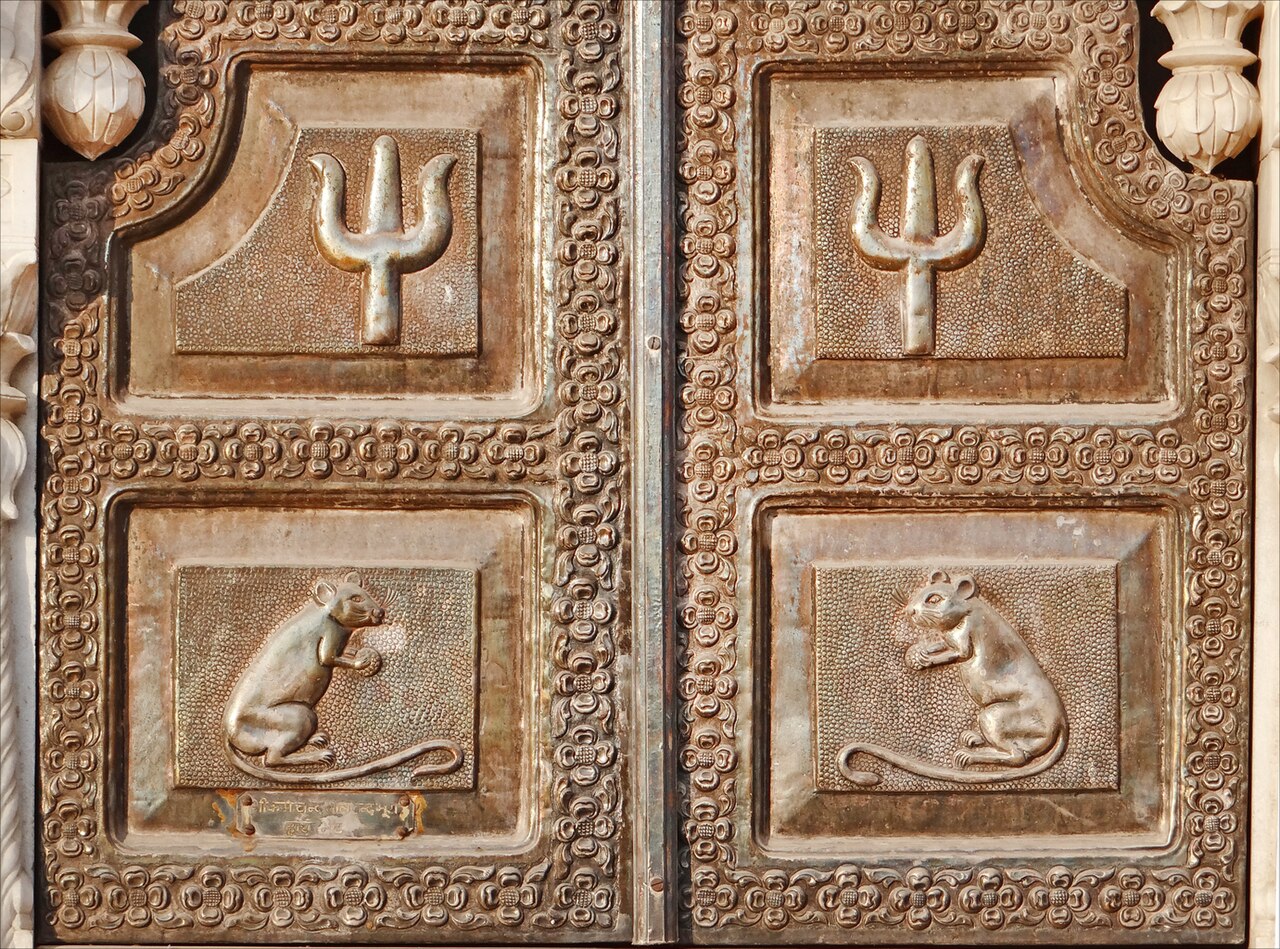
The approach is pure Bikaneri craft: a carved white marble front raised by Maharaja Ganga Singh in the Rajput manner, closed by doors of solid silver. Inside, further silver panels tell the legends of Maa Karni scene by scene, polished bright by generations of hands.
2
Her darbar and the baridari
In the inner sanctum stands the murti of Maa Karni, enshrined in 1538. Only one person may enter the innermost chamber: the baridari, a head priest chosen in rotation from the Depavat lineage, who lives day and night within the Temple for his month of service and does not cross its boundary.
3
The milk bowls
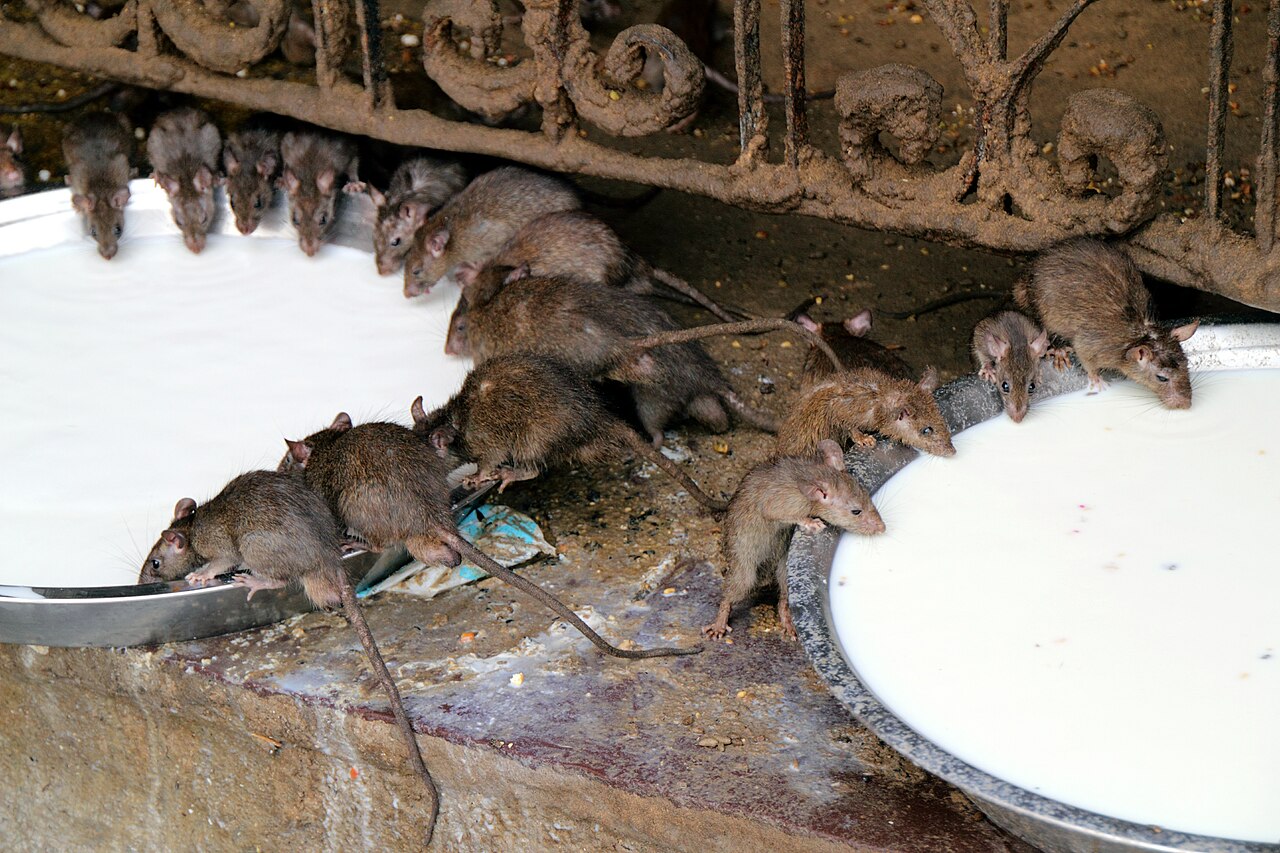
Wide metal bowls of milk sit in the courtyard and side rooms, ringed at all hours by drinking kabas. Devotees crouch to offer laddus, grain and coconut; the kabas eat from open palms and from the same thalis as the Temple workers, utterly unafraid.
Worked silver door panels at Maa Karni Mata Temple, Deshnoke, depicting the legends of the GoddessKabas gather at a wide bowl of milk in the courtyard of Maa Karni Mata Temple, Deshnoke
The silver doors of Maa Karni's darbar, and kabas at a milk bowl · photos CC BY 2.0 (dalbera) and CC BY-SA 2.0 (Fulvio Spada), Wikimedia Commons
The festival found nowhere else
Karni Mata Fair · Navratra, 11 to 20 October 2026
Twice each year, in the Navratras of Chaitra and Ashvin, Deshnoke becomes the destination of the desert. The fair runs from Shukla Ekam to Dashmi, and thousands make the pilgrimage on foot across the sands to Maa Karni's doors. Around the town they walk the Oran Parikrama, a 42 km circuit of the sacred grove Maa Karni Herself declared inviolate, where no tree may be cut and no living being harmed; in the Navratras it draws tens of thousands. The autumn fair of 2026 begins with Ghatasthapana on 11 October; the next spring fair begins 7 April 2027.
Trains and buses from Bikaner fill with padyatris through Navratra; a pilgrim seeking quiet darshan should come on an ordinary weekday morning instead.
Plan your visit
By rail
Deshnoke station (DSO) is about 1 km from the Temple, on the Bikaner-Jodhpur line; regular trains cover the 32 km from Bikaner Junction.
By air
Bikaner's Nal Airport is about 31 km away; Jodhpur airport, about 250 km, has more connections.
By road
Deshnoke sits about 30 km south of Bikaner; taxis and buses run through the day.
Timings
Opens with Mangla Aarti about 4 am in summer and 5 am in winter; evening aarti near sunset; closing runs between 9 and 10 pm by season, so allow margin.
Best time
Just after Mangla Aarti, when the kabas gather for milk and the marble is still cool; October to March for the gentlest weather.
Dress & feet
Shoes come off at the gate and the whole visit is barefoot; dress modestly, shoulders and knees covered.
Walk with a slow shuffle, feet close to the marble: harming a kaba even by accident is answered, by Temple rule, with a kaba wrought in silver or gold.
Food a kaba has touched is not spoiled here; prasad the kabas have shared is held a high honour, and many devotees seek it.
Offerings are made two ways: the dwar bhent goes to the priests and Temple workers, the kalash bhent to the Temple's own upkeep.
Deshnoke is the town Maa Karni founded in 1419, named Deshnak, the nose of the land, for it was to be as vital to Marwar as a nose to an honourable face.
Questions pilgrims ask
Are the kabas just rats?
Not to anyone here. The kabas are held to be Maa Karni's own Charan kin, the Depavats, living near Her between human births. They are fed prasad, milk and grain, protected from predators, and mourned when they die. The Temple has stood among them for centuries, and the Devasthan Department notes that no outbreak of disease has ever been recorded here, which devotees hold as Her grace.
What is a white kaba?
Among the thousands of dark kabas live a rare few white ones, believed to be manifestations of Maa Karni Herself and Her four nephews. Sighting one is a special blessing, and pilgrims wait quietly with offerings of prasad hoping to draw one forth.
Who is Maa Karni?
A Charan mystic born as Ridhi Bai at Suwap in 1387, Revered in bardic and local tradition as an incarnation of Maa Hinglaj and Maa Durga. She founded Deshnoke, laid the foundations of the forts of Jodhpur and Bikaner, and remains the Kuldevi of both royal families. Tradition holds She Lived 151 years before Her mahaprayan in 1538.
Is there a fee or a booking?
No. Darshan is free and there are no tickets. You simply leave your shoes at the gate and walk in; on Navratra fair days expect long, slow-moving crowds.
How should I behave among the kabas?
Move slowly, shuffle rather than stride, and let them come to you; devotees consider it auspicious when a kaba runs across the feet. Offer prasad or milk gently, and never chase, lift or corner one.
Dharamshalas and guest houses near this Sthan, shared by devotees. Adisthan takes no bookings and no money; contact each stay directly.
No stays are listed here yet. Know one that serves pilgrims well?
Are you with Shri Karani Mandir Nij Pranyas, Deshnoke? Claim this page to keep aarti times, fair guidance and darshan updates true for the pilgrims of Maa Karni.