Kashi does not fear death: Baba Whispers the crossing into every dying ear.
Be the first to check in
Coming up: Dev Deepawali · 24 NovEntry tended 24 May 2026
Open 2:30 am to 11 pm Five aartis · Mangala 3 am Darshan free · Sugam ₹300 Maha Shivaratri · 6 Mar 2027 Ganga Dwar corridor · 2021
Surrender your phone, your shoes, your hurry. The lane narrows until two shoulders fill it, and the cry moves ahead of you, Har Har Mahadev, rising and falling like breath. Underfoot the stone is wet with Ganga water and milk. Then the lane opens and gold burns against the sky: the spire of Baba Vishwanath. Pilgrims say Kashi is not built on earth at all. The city rests on the point of Lord Shiva's trident.
One of the Twelve Jyotirlingas, the shrines where Lord Shiva is worshipped as a column of light. Here he is Vishweshwara, Ruler of the Universe, and the Kashi Khanda of the Skanda Purana devotes an entire book to his city.
Kashi is Avimukta, the city Lord Shiva never forsakes. Tradition holds that whoever dies here receives the taraka mantra from Baba himself, and that a bath in the Ganga followed by darshan of Vishwanath is a step on the path to moksha.
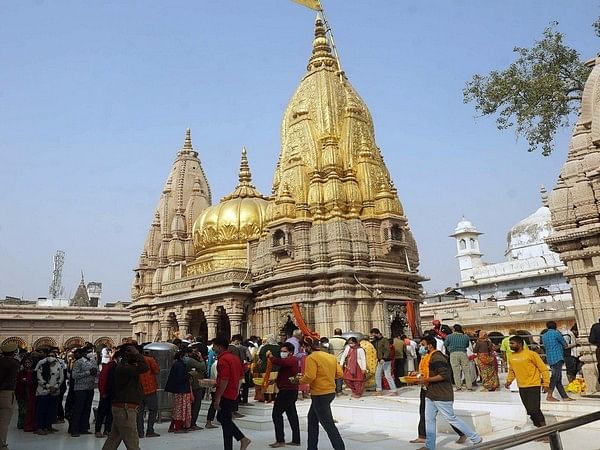
The shrine has been razed and raised for eight centuries and never abandoned. The present Temple was built by Rani Ahilyabai Holkar in 1780, and Maharaja Ranjit Singh gilded its domes in 1835.
The light without beginning or end
The Purana tells it this way. Brahma and Vishnu once argued over who was greater, and while they argued a column of light split the world between them, without top and without bottom. One flew up for ages and found no summit; one dug down for ages and found no root. The light was Lord Shiva, and the places where that light stands in the earth are the jyotirlingas. Kashi holds one of the Twelve, and the tradition of this city goes further: Kashi itself is luminous, the first ground, older than the flood and outside the world's dying.
The buildings, unlike the light, could be broken. The Temple was demolished after the Ghurid conquest in 1194, rebuilt, and torn down again under Sikandar Lodi around 1490. It rose once more in 1585 with the support of Raja Todar Mal. In 1669 the Mughal emperor Aurangzeb ordered its demolition, and the Gyanvapi Mosque was raised where it stood. Tradition holds that the priests dropped the linga into the adjacent well to save it. The mosque still stands beside the Temple today; its site is contested in cases before Indian courts, and this page records both histories without taking a side.
For a century worship continued in courtyards and corners, until Rani Ahilyabai Holkar of Indore built the present Temple beside the mosque in 1780. Maharaja Ranjit Singh of Punjab plated its domes with gold in 1835, giving Varanasi its Golden Temple. In December 2021 the Kashi Vishwanath Corridor opened, clearing a pilgrim's path from the sanctum down to the Ganga at Lalita Ghat, so that for the first time in centuries the Lord of Kashi and the river face each other in the open.
What you'll actually see
1
The gold above the sanctum
Two domes and a spire sheathed in gold, the gift of Maharaja Ranjit Singh in 1835, with the gold-plated spire rising about 15.5 metres over the sanctum. In 2022 the inner walls of the sanctum were clad in gold as well, from a devotee's donation of some 60 kilograms.
2
The Jyotirlinga itself
A dark stone linga about 60 centimetres tall and 90 centimetres around, set low in the small square sanctum. Darshan lasts seconds in the moving line: a glimpse, a poured offering of Ganga water or milk, a prayer said walking. The brevity is part of it; the whole city is the Temple.
3
The corridor and its recovered shrines
The 2021 corridor descends in wide stone courts from the Temple to Ganga Dwar at Lalita Ghat. More than 40 old shrines, swallowed over centuries by houses that grew around them, emerged during its construction and now stand restored in the open precinct.
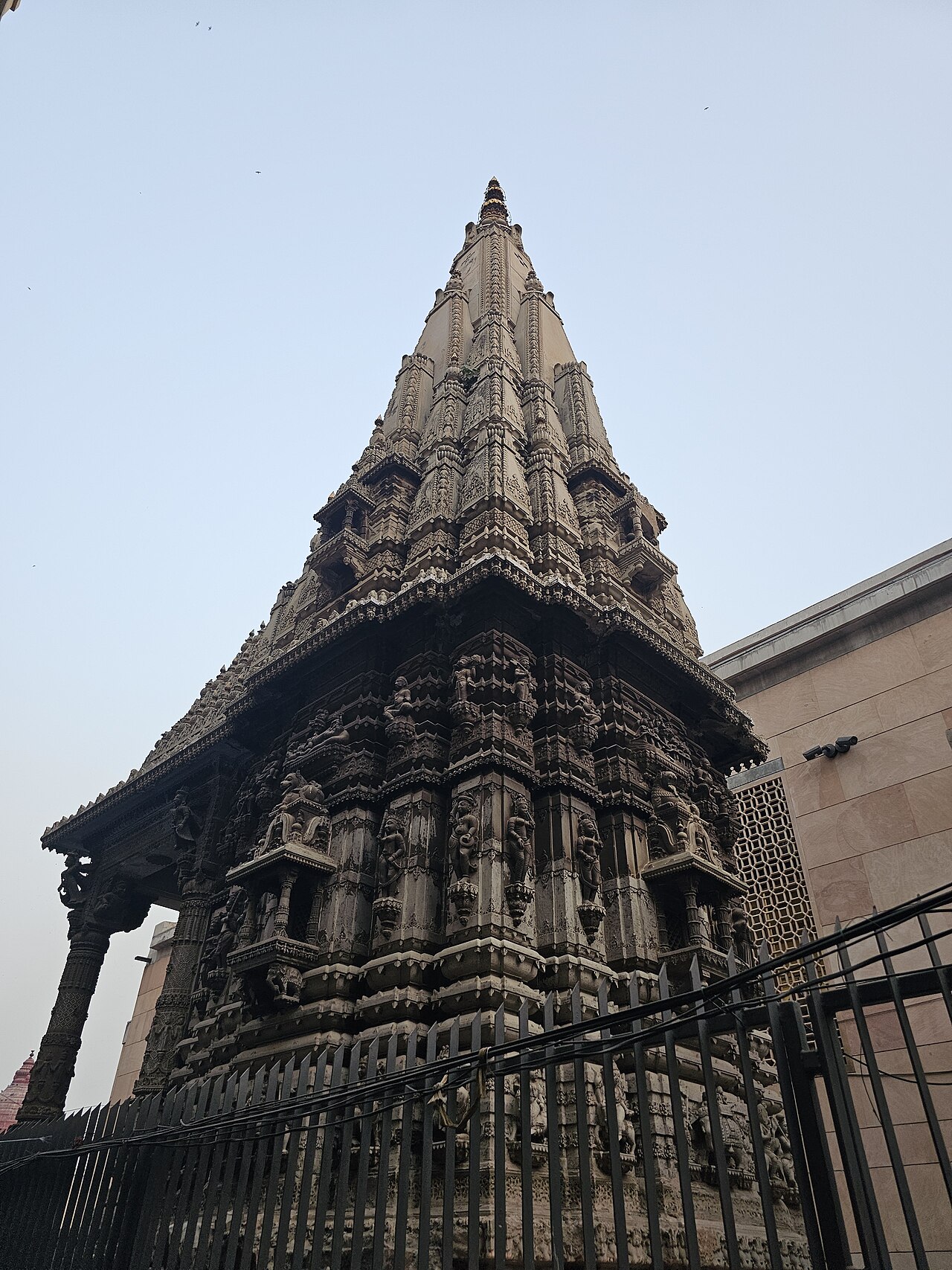
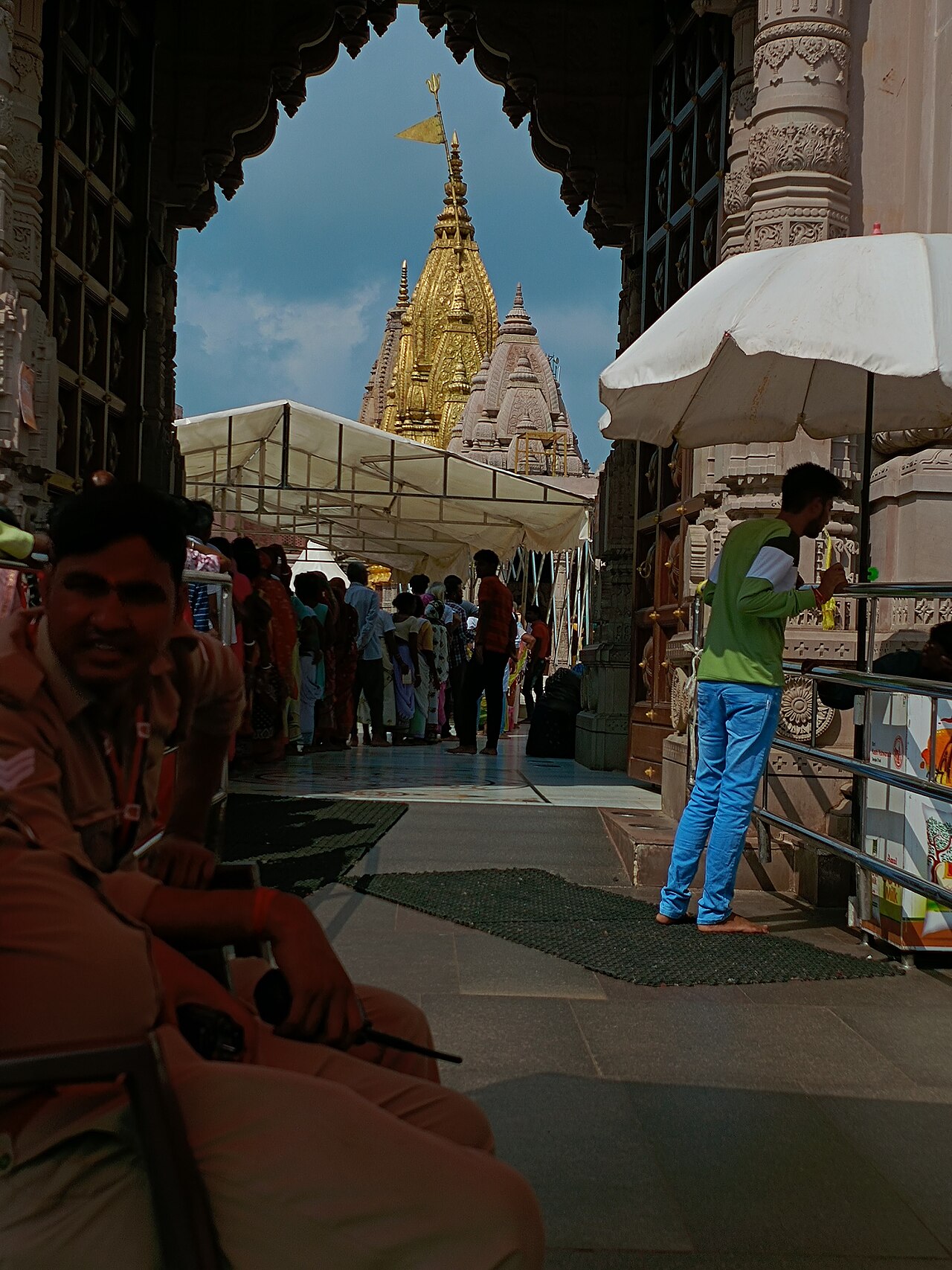
Carved stone shikhara rising within the Shri Kashi Vishwanath Temple complex, VaranasiPilgrims in the darshan line beneath the gold shikhara of Baba Vishwanath
Inside the precinct of Baba Vishwanath · photos by Gannu03 (CC BY-SA 4.0) and Thenerdatul (CC BY 4.0), Wikimedia Commons
The festival found nowhere else
Rangbhari Ekadashi, when Holi begins at Baba's door
On the eleventh day of the bright half of Phalguna, Kashi keeps the gauna of its Lord: Baba Vishwanath, newly wed, Brings Maa Parvati home to his city. Images of the divine couple are carried in procession, and the year's first gulal and abir fill the air at the Temple, days before the rest of India plays Holi. The next Rangbhari Ekadashi falls on 18 March 2027.
The lanes are packed solid that morning; come very early, or watch the colours from a rooftop along Vishwanath Gali.
Plan your visit
By air
Lal Bahadur Shastri International Airport, Babatpur, about 25 km; roughly 45 to 55 minutes by taxi.
By rail
Varanasi Junction (Cantt) about 4 to 5 km away; Banaras and Kashi stations also serve the city.
On foot
Vehicles stop at Godowlia crossing; from there it is a 5 to 8 minute walk through the lanes, or enter from the river side through Ganga Dwar at Lalita Ghat.
Timings
Open about 2:30 am to 11 pm daily. General darshan is free, pausing for the midday Bhog aarti around 11:15 am to 12:20 pm.
Tickets
Sugam Darshan ₹300 with an escorted side entry; Mangala aarti ₹500. Book only at shrikashivishwanath.org; no agent is authorised.
Best time
Early weekday mornings after 4 am are calmest. Mondays, the month of Shravan, and festival days bring the heaviest crowds of the year.
Dress
Modest dress with shoulders and legs covered; you will pass airport-style security at every gate.
The queue
A moving line that can stretch to hours on Mondays and festivals; the Sugam ticket bypasses most of it. Same-day Sugam booking is possible at the Temple helpdesk.
Phones, cameras, smartwatches, earphones, bags and large belts are not allowed inside; lockers stand near the gates, so carry only some cash and a government ID.
Vishwanath means Ruler of the Universe; the Temple is also called the Golden Temple of Varanasi for the gilded domes given by Maharaja Ranjit Singh.
During Shravan (29 July to 29 August 2026) the Temple expects extreme crowds, and online ticket bookings are suspended for the period per the trust's notice.
The Gyanvapi Mosque adjoins the Temple precinct behind a heavily guarded boundary; follow police directions calmly and treat both congregations with respect.
Questions pilgrims ask
Is this the original ancient Temple?
The worship is ancient; the walls are not. Temples on this site were demolished repeatedly between 1194 and 1669, and the present structure was built by Rani Ahilyabai Holkar in 1780. For devotees the jyotirlinga, not the building, is the Temple.
Can I take my phone inside?
No. Phones, cameras, smartwatches and bags are all barred at security. Leave them at your lodging if you can, or use the lockers near the gates, and carry only cash and an ID card.
Do I need a ticket for darshan?
No. General darshan is free through the public queue. Sugam Darshan (₹300) gives an escorted shorter route, and the five daily aartis are separately ticketed, with Mangala aarti at ₹500. Children under 12 need no ticket for ticketed services.
What is the mosque beside the Temple?
The Gyanvapi Mosque, raised in 1669 after the Temple ordered demolished by Aurangzeb. Hindu tradition holds the original linga was hidden in the well between them. The site's status is before Indian courts; prayer continues in both places, and pilgrims are expected to respect both.
What will I actually see in the sanctum?
A small dark stone linga in a low sanctum, seen for a few seconds as the line moves. Devotees pour Ganga water or milk and offer bel leaves and flowers. The blessing of Kashi is not a long look; it is having stood there.
Dharamshalas and guest houses near this Sthan, shared by devotees. Adisthan takes no bookings and no money; contact each stay directly.
No stays are listed here yet. Know one that serves pilgrims well?
Are you a priest, trustee, or officer of the Shri Kashi Vishwanath Temple Trust? Claim this page to keep timings, aarti bookings, and festival notices true for the pilgrims who rely on them.