Mangla Aarti 4:45 am · Shayan till 10:30 pm Darshan free for all Nishan padyatra · 17 km from Ringas Lakkhi Mela · Ekadashi 18 Mar 2027 White Makrana marble · rebuilt 1720
The chant reaches you streets before the marble does: Haare ka sahara, Baba Shyam hamara, rising over drumbeats from a river of red and saffron flags. Pilgrims who have walked through the night from Ringas dance the last stretch, nishans held high. Past the carved gateways, in a white marble hall lettered Jai Shri Shyam, the queue turns a corner and goes quiet. There is no full murti waiting at the end of it. What is worshipped here is a head: the shish of Barbarika.
In the sanctum rests the shish, the head of the warrior Barbarika, tradition holds: given to Sri Krishna on the eve of the Kurukshetra war as the greatest act of charity ever asked of any man.
By Sri Krishna's boon he is worshipped by Krishna's own name, Shyam, and he is Haare ka Sahara, the refuge of the defeated: whoever comes to him having lost everything comes under his protection.
This is one of India's fastest-growing pilgrimages. Every Shukla Ekadashi the town overflows, and each Phalguna the Lakkhi Mela, the mela of lakhs, arrives flag by flag on foot from Ringas.
The head that watched the war
The Mahabharata's telling begins with a boy too strong for the war he was born into. Barbarika, son of Ghatotkacha and grandson of the Pandava Bhima, carried three infallible arrows: enough, the epic tradition says, to end the war at Kurukshetra by himself. He had given his mother a vow that he would always fight for the weaker side. Sri Krishna, coming to him on the road in the guise of a Brahmin, saw the trap in that vow: whichever side began to lose would gain Barbarika, and the war would never end. So the Brahmin asked the young warrior for a gift, and named the unthinkable: his head.
Barbarika did not refuse. He asked only to watch the battle, and so his severed head was set upon a hill above Kurukshetra, where it saw the whole eighteen days. Moved by the greatest daan of the age, Sri Krishna granted him a boon: in Kaliyuga, Barbarika would be worshipped by Krishna's own name, Shyam, and those defeated by life would find refuge in him. Haare ka sahara: the support of the defeated.
Ages later, tradition holds, the shish surfaced at Khatu, in the pond now called Shyam Kund. Guided by a dream, the local ruler Roop Singh Chauhan and his wife Narmada Kanwar raised a Temple over it in 1027 CE. In 1720 Diwan Abhai Singh, at the behest of the king of Jodhpur, renovated the shrine, and the Temple that stands today, in white Makrana marble carved in the Rajasthani manner, grew from that rebuilding.
What you'll actually see
1
The gateway arches
The pilgrim roads into Khatu pass beneath grand carved gateways of pale sandstone, their panels set with painted scenes and their lintels lettered Jai Shri Shyam and Shri Shyam Sharanam. Padyatris touch the ground here; many walk the last stretch barefoot behind their flag.
2
Baba Shyam's darbar
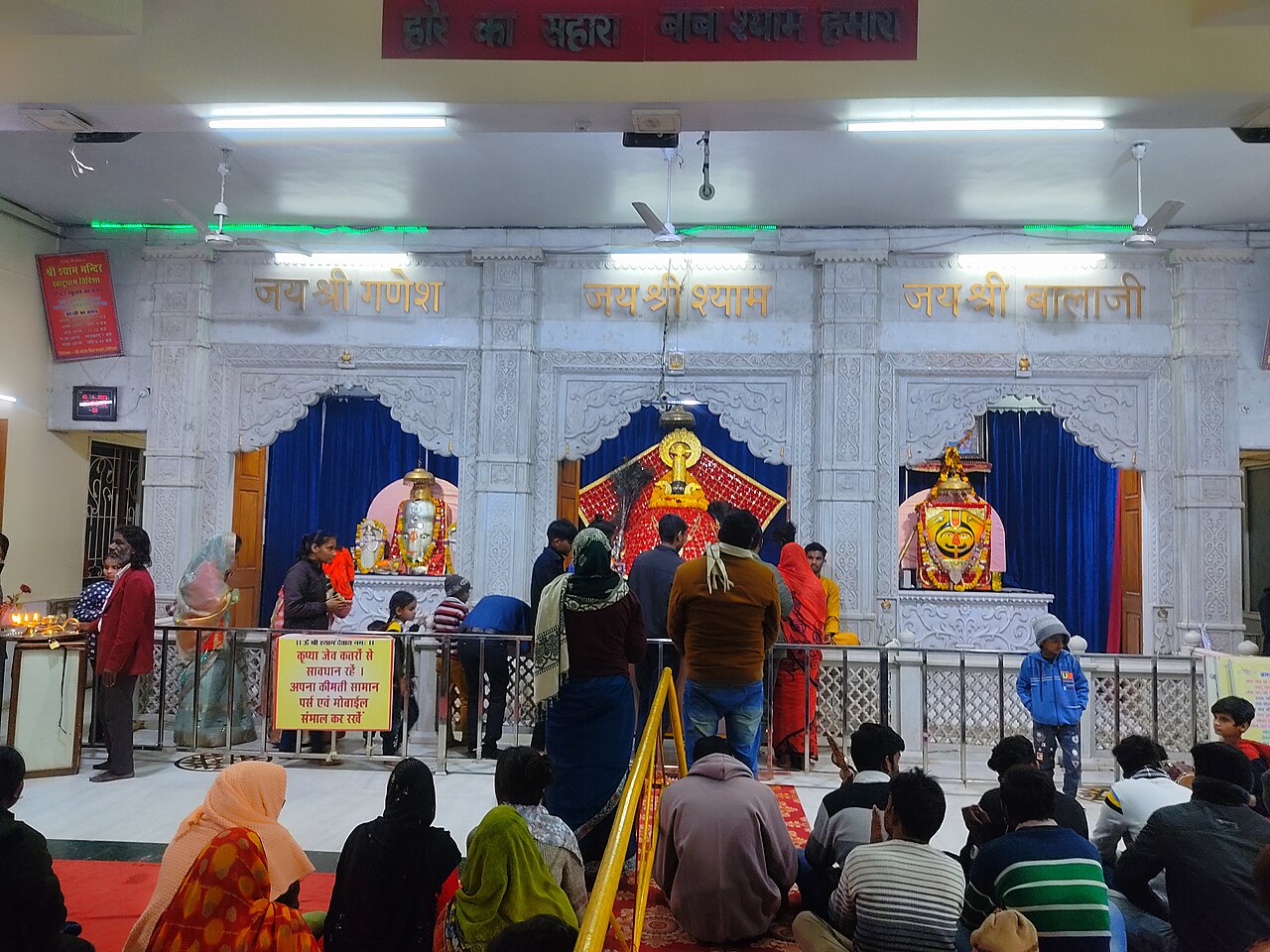
The darshan hall is a screen of white marble jharokha arches beneath the words Haare ka sahara, Baba Shyam hamara. At its centre the shish of Baba Shyam sits in shringar, dressed in flowers and gold, with shrines of Shri Ganesh and Shri Balaji Hanuman to either side.
3
Shyam Kund
A short walk from the darbar lies the stepped pond where tradition holds the shish emerged from the earth. Devotees bathe in its water and hold it purifying. Nearby is Shyam Bagichi, the garden whose flowers dress Baba each day, where the devotee Aloo Singh lies in samadhi.
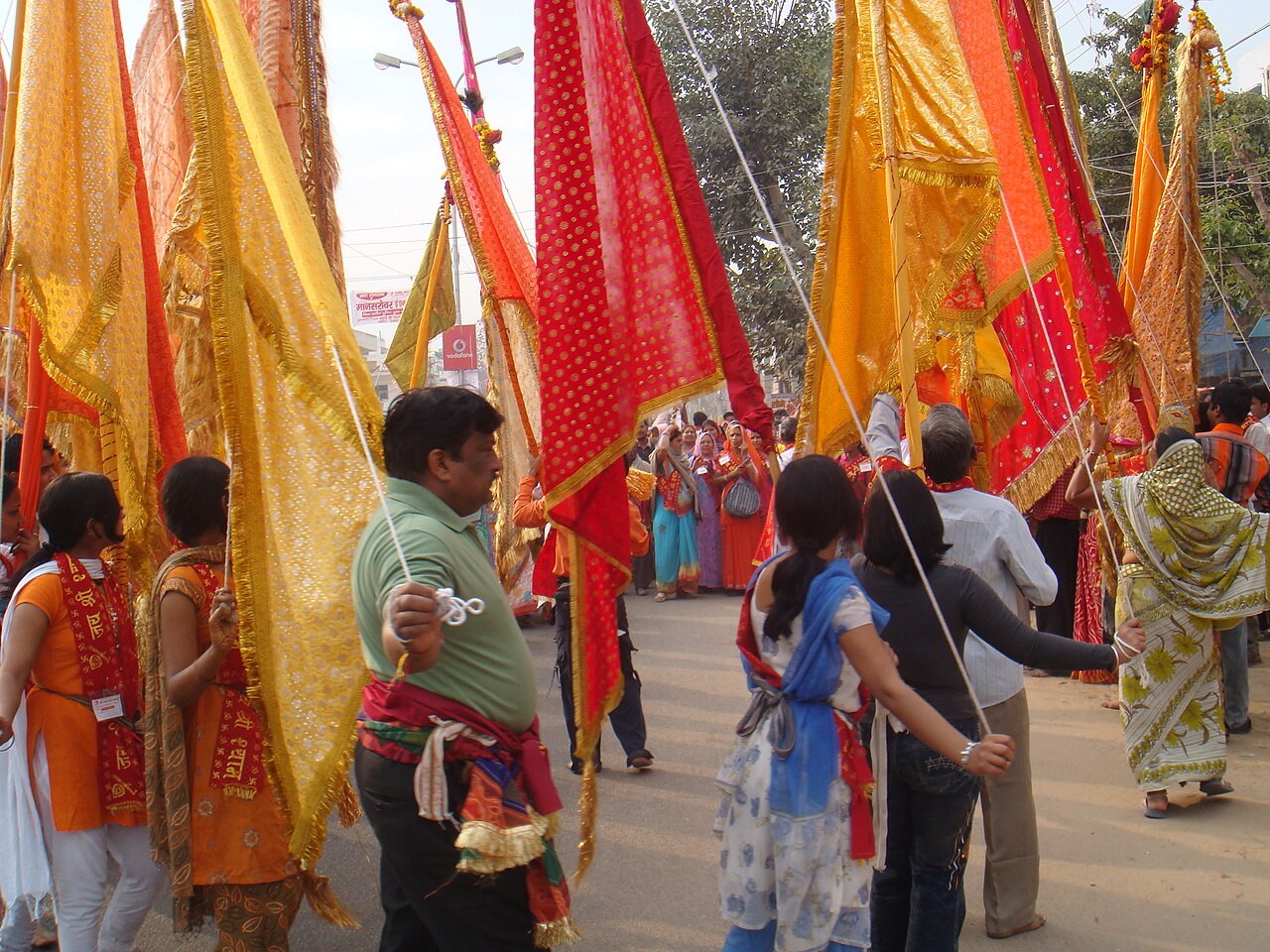
The white marble darshan hall of Shri Khatu Shyam Ji Temple, with the shish of Baba Shyam in shringar between the Ganesh and Balaji shrinesDevotees raise saffron and red nishan flags as a padyatra for Khatu Shyam Ji sets out from Jaipur
Inside Baba Shyam's darbar, and nishan flags rising for the Khatu padyatra · photos CC0 and CC BY-SA 3.0, Wikimedia Commons
THE FESTIVAL FOUND NOWHERE ELSE
Phalguna Lakkhi Mela · culminating on Ekadashi, 18 March 2027
Each spring, in the bright half of Phalguna, Khatu becomes the destination of one of north India's great walking pilgrimages: the Lakkhi Mela, the mela of lakhs. Its heart is Phalguna Shukla Ekadashi, held in tradition as the day the shish was revealed; in 2027 it falls on 18 March. For about a week beforehand the Ringas road becomes a river of nishans walked the 17 km to the darbar, and before any of them the white flag of Surajgarh, marked with a blue horse and carried 152 km on foot, is raised atop the Temple as it has been for over 300 years. The 2026 mela ran 21 to 28 February and was expected to draw more than 60 lakh pilgrims, and days after Ekadashi the town plays Holi with its Baba.
Enter only by the committee's marked routes and expect darshan to take hours; the same grace on a plain weekday morning takes minutes.
Plan your visit
By rail
Ringas Junction (RGS) about 16 km; taxis, buses and shared jeeps run to Khatu through the day.
By air
Jaipur airport about 90 km, roughly two hours by road.
By road
Jaipur 80 km, with regular buses from Sindhi Camp bus stand; Delhi about 266 km.
Timings
Five aartis daily: Mangla 4:45 am, Shringar 7 am, Bhog 12:15 pm, Sandhya 6 pm, Shayan 9 pm, with darshan running between them through the day.
Fee
Darshan is free for all; the committee sells no tickets.
Best time
A plain weekday morning outside Ekadashi for a quiet darshan; a Shukla Ekadashi night for the full tide of faith.
Dress
Modest dress, shoulders and knees covered; this is a working darbar, not a monument.
The padyatra
The classic nishan yatra is walked 17 km from Ringas, flag in hand; the nishan is offered at the darbar in completion of a vow.
His jaikara is everywhere in Khatu: Haare ka sahara, Baba Shyam hamara. Baba is also loved as Sheesh ke Dani, the giver of the head, and Teen Baan Dhari, bearer of the three arrows.
Shukla Ekadashi each month is Baba's own day; lakhs arrive, darshan runs deep into the night, and the town fills like a small mela.
After a crowd tragedy at the Ekadashi darshan of August 2022, in which three pilgrims died, the approach was rebuilt: one-way corridors, smart parking and marked e-rickshaw routes now carry the crowds, so follow the committee's signage.
The committee streams the morning shringar aarti live on its own YouTube channel, Shri Shyam Darshan, so the darbar is never out of reach.
Questions pilgrims ask
Is Khatu Shyam Ji the same as Sri Krishna?
He is Barbarika, grandson of Bhima, who gave his head to Sri Krishna before the Kurukshetra war. Krishna's boon was that in Kaliyuga Barbarika would be worshipped by Krishna's own name, Shyam. So devotees call him Baba Shyam and Shyam Baba, and what is enshrined is his shish, his head, not a full murti.
Why is he called Haare ka Sahara?
Barbarika had vowed always to fight for the losing side, and Sri Krishna turned that vow into a blessing: in Kaliyuga he is the refuge of the defeated. Devotees come to Khatu precisely when everything else has failed.
Is darshan free, and do I need a booking?
Yes, darshan is free, and the Temple committee sells no darshan tickets. On ordinary days you simply join the queue; on Ekadashi and mela days expect long waits and follow the committee's routed corridors.
When are the biggest crowds?
Every Shukla Ekadashi draws lakhs for the monthly darshan, and the Phalguna Lakkhi Mela, culminating on Ekadashi, 18 March 2027, is among the largest gatherings in Rajasthan. For quiet, come on a plain weekday morning.
What is a nishan, and can I offer one?
A nishan is a triangular flag, usually saffron, red or orange, carried on foot as the sign of a vow and offered at the darbar. Any devotee may bring one; the honoured way is the 17 km padyatra from Ringas.
The Sthan in photographs
Darshan from afar
From the temple's own channels. Nothing loads until you press play.
Dharamshalas and guest houses near this Sthan, shared by devotees. Adisthan takes no bookings and no money; contact each stay directly.
No stays are listed here yet. Know one that serves pilgrims well?
Are you with the Shri Shyam Mandir Committee, Khatu Shyamji? Claim this page to keep aarti times, mela guidance and darshan updates true for the lakhs who set out for Baba Shyam.