Held as the birthplace of Lord Krishna Garbha Griha darshan 5 am to 9:30 pm Janmashtami · 4 Sep 2026 Present complex built 1953 to 1982 Free entry · phones not allowed Katra Keshavdev, beside the Shahi Idgah
Past security barricades and cloakroom counters, where every phone and camera is surrendered before the gate, a narrow lane opens into Katra Keshavdev, and the pink sandstone towers of Keshavdev Temple rise over stalls selling laddoos and marigold garlands. Inside, the crowd narrows toward a stair that leads down, not up, past a small silver-doored shrine to Maa Yogmaya, into a plain underground chamber. Tradition holds that a locked prison cell once stood on this ground, and that at midnight, within these very walls, Lord Krishna Was Born to end a tyrant's reign.
Devotees hold the underground chamber here, reached by a narrow descending stair, to be the actual cell where the king Kansa held Vasudeva and Maa Devaki captive, and where tradition says Lord Krishna Was Born at midnight before Vasudeva carried the newborn across a flooding Yamuna to safety in Gokul.
The Temple on this ground has been destroyed and rebuilt across roughly two thousand years, most recently in 1670 when the Mughal emperor Aurangzeb demolished the Keshavdeva Temple that stood here; each rebuilding has been read by devotees as an act of devotion insisting the ground itself outlasts whatever is built upon it.
One birthplace, three sanctuaries: the soaring Keshavdev Temple, the intimate underground Garbha Griha, and the frescoed hall of Bhagavata Bhavan share a single walled complex, so a single visit carries a pilgrim through Krishna's story from His birth to His life as king.
The night the chains fell away
Tradition tells that Kansa, the tyrant king of Mathura, had imprisoned his own sister Maa Devaki and her husband Vasudeva after a prophecy warned that her eighth child would end his reign. One by one he killed the children born to them, until, on a monsoon midnight, Lord Krishna Was Born in that cell. The legend says the guards fell asleep, the chains binding Vasudeva Fell away, and the prison doors stood open. Under cover of storm and darkness, Vasudeva carried the infant across a flooding Yamuna to Gokul and exchanged Him for the newborn daughter of Maa Yashoda, who revealed herself to Kansa as the goddess Yogmaya, escaping his grasp and leaving the prophecy, and the child, intact.
Vaishnava tradition credits Krishna's own great-grandson Vajranabha with raising the first shrine on this spot, and archaeological finds, pottery, terracotta, and the remains of an old Buddhist and Jain quarter, attest to religious life here from at least the sixth century BCE. A Temple certainly stood by the Gupta era, when Chandragupta II is said to have rebuilt it around 400 CE, and inscriptions record further royal patronage into the twelfth century. Mahmud of Ghazni plundered Mathura's Temples in 1017, and centuries later, in 1618, Raja Vir Singh Deo of Orchha raised a grand red sandstone Temple that European travellers described as one of India's finest, until Aurangzeb demolished it in 1670 and built the Shahi Idgah mosque on part of the site.
Mathura passed to British rule in 1804, and the land was bought at auction by a Banaras banker whose heirs held it undivided for over a century. The statesman Madan Mohan Malaviya purchased it in 1944 with funds from the industrialist Jugal Kishore Birla, and the trust they formed, the Shri Krishna Janmasthan Seva Sansthan, built the present complex between 1953 and 1982 with further support from the Dalmia family. The Temple's eastern wall meets the rear wall of the Shahi Idgah mosque to this day, and the boundary between the two has been before India's courts since 2020. Pilgrims come here for darshan, not for that dispute, and the Temple's daily worship has continued without pause through it.
What you'll actually see
1
Keshavdev Temple
The first sight from the market lane: a pink stone Temple in Nagara style, built in 1958, its shikhara rising above the surrounding rooftops. Inside, the sanctum holds the black stone image of Keshava Dev, one of Lord Krishna's own names, richly dressed and garlanded.
2
The Garbha Griha, down the narrow stair
A separate entrance leads down to a plain, marble-floored underground chamber that pilgrims hold to be Kansa's actual prison cell. There is no image here, only the room itself; nearby stands a small shrine to the eight-armed Maa Yogmaya, who tradition says shielded the infant Krishna that night.
3
Bhagavata Bhavan
A wide assembly hall completed in 1982, its ceilings and pillars covered in frescoes of Krishna's life and the text of the Bhagavad Gita engraved on copper plates along the circumambulation passage. Its central shrine holds Radha and Krishna together, flanked by Balarama, Subhadra and Jagannatha on one side and Rama, Lakshmana and Sita on the other.
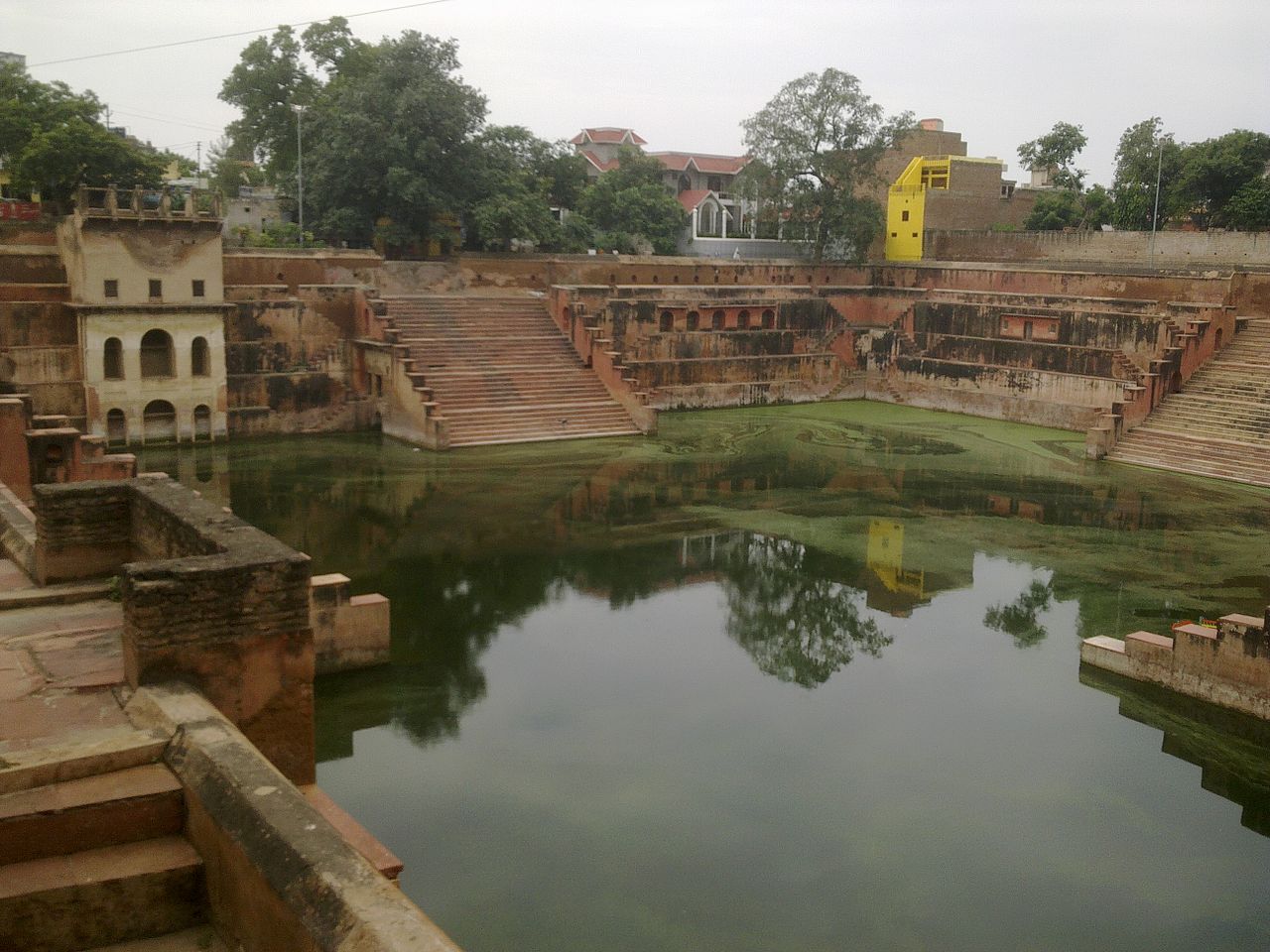
Pilgrims walking through the market lane of Katra Keshavdev toward the pink shikhara of Keshavdev TempleThe deep stepped tank of Potra Kund near the Temple, traditionally linked to the infant Krishna's first bath
The market approach to Keshavdev Temple, and the stepped tank of Potra Kund · photos by Poco a poco (Diego Delso), CC BY-SA 4.0, and Nikhil.sharma123, CC BY-SA 3.0, Wikimedia Commons
THE NIGHT CELEBRATED WHERE IT HAPPENED
Janmashtami: midnight at the birthplace itself, 4 into 5 September 2026
Once a year the whole complex turns toward a single moment: the instant, calculated anew each year against the Ashtami tithi and Rohini nakshatra, that tradition holds as Krishna's exact hour of birth. In 2026 that night falls from 4 into 5 September, with the Temple's own nishita puja spanning roughly 11:56 pm to 12:41 am. The Garbha Griha and Keshavdev Temple stay open through the night, the deities receive a full abhishek and a new form of shringar at the birth moment itself, and tens of thousands of devotees fill Katra Keshavdev and the lanes beyond it, many having queued since the previous morning.
Arrive well before dusk if you want to be near the sanctum at midnight; expect airport-style security queues on top of the crowd, and dress for a long wait on your feet.
Plan your visit
By air
Agra's Kheria Airport is the nearest, roughly 55 to 60 km away; Delhi's Indira Gandhi International Airport is about 145 km, both reached by road.
By rail
Mathura Junction is the main station, about 4 km from the Temple and well connected to Delhi and Agra; autos and e-rickshaws cover the last stretch.
Getting there
The complex sits in the Katra Keshavdev neighbourhood near Deeg Gate; the final approach is on foot through a market lane closed to vehicles.
Timings
The Garbha Griha keeps roughly 5 am to 9:30 pm daily. Keshavdev Temple and Bhagavata Bhavan keep a split schedule, close to 5 am to noon and 4 to 9:30 pm in summer, shifting toward 5:30 am to noon and 3 to 8:30 pm in winter.
Entry fee
Free; there is no ticket for darshan.
Security
Among the strictest of any Temple in Braj, since the complex adjoins the Shahi Idgah mosque. Phones, cameras and bags are not permitted past the checkpoint and must be left at a cloakroom counter outside for a small per-item charge.
Dress
Modest Indian dress is expected: long trousers or a dhoti with a shirt or kurta for men, a saree or salwar kameez for women, shoulders and knees covered. Shorts and sleeveless tops are turned away.
Best time
Mangala Aarti at 6:30 am, when the Temple has just opened and the Garbha Griha is at its quietest; October to March brings the gentlest weather.
Janmasthan simply means birthplace; Katra, the name of the surrounding neighbourhood, means market or enclave, a reminder that the site was bought back from an ordinary land auction in the 1940s.
A small railway halt a short way from Mathura Junction is named Sri Krishna Janam Sthan after the Temple itself, though most pilgrims still arrive via the main Mathura Junction station.
Photography is not permitted anywhere inside the complex; even the images on this page were taken from the public street outside, since cameras do not pass the gate.
The Temple's eastern wall meets the rear wall of the Shahi Idgah mosque, and the exact boundary between the two has been under litigation in Indian courts since 2020, with the Supreme Court directing mediation talks in 2026. The Temple's own daily worship continues regardless, and this page follows the site's practice of describing the dispute factually without taking a side.
Questions pilgrims ask
Is this really the exact spot where Krishna was born?
It is the spot devotees across the Vaishnava tradition have held as Krishna's birthplace for as long as records survive, with a shrine here attested from around the first millennium BCE and rebuilt repeatedly ever since. Whether the present underground chamber is the literal prison cell of the Bhagavata Purana's telling is a matter of faith, carried forward through centuries of destruction and rebuilding rather than settled by archaeology.
Can I take photos or bring my phone inside?
No. Mobile phones, cameras and bags are barred past the security checkpoint and must be deposited at a cloakroom counter outside, for a small fee. This is among the strictest such rules of any Temple in Braj, and it is enforced without exception.
What is the Temple's relationship to the Shahi Idgah mosque next door?
The two structures share a boundary wall, a legacy of Aurangzeb's demolition of the earlier Keshavdeva Temple in 1670 and the mosque built on part of its site soon after. The precise line between them has been the subject of litigation in Indian courts since 2020, including Supreme Court-directed mediation in 2026. Adisthan records this as a live legal matter without taking a position; pilgrims visit for darshan at the birthplace, not to adjudicate the dispute.
What will I actually see at the birthplace shrine?
A narrow stair leads down from the main complex to a plain, marble-floored underground room with no image inside it, only the space itself, alongside a small nearby shrine to the eight-armed Maa Yogmaya. The devotional weight of the Garbha Griha lies in what tradition says happened here, not in anything ornate to look at.
When is the best time to visit if I am not coming for Janmashtami?
Come for the 6:30 am Mangala Aarti on an ordinary day and the Garbha Griha is calm enough for unhurried darshan. Tuesdays, Saturdays and the days around Radhashtami, Govardhan Puja and Holi draw larger crowds than a typical weekday, though nothing approaches the scale of Janmashtami itself.
Dharamshalas and guest houses near this Sthan, shared by devotees. Adisthan takes no bookings and no money; contact each stay directly.
No stays are listed here yet. Know one that serves pilgrims well?
Do you serve the Shri Krishna Janmasthan Seva Sansthan, the trust that keeps this birthplace shrine? Claim this page to keep its timings, security guidance and festival dates exact for every pilgrim who comes to Katra Keshavdev.