Open about 5 am to 9 pm Free entry Mahashivaratri Jagara · 6 Mar 2027 11th-c. Kalinga deul · 55 m Bel leaves and tulasi together
Climb the old viewing platform beside the compound wall and the Temple city opens before you: a bronze-green lake, lanes of flower sellers, and a forest of carved spires with one tower over them all, rising 55 metres like a ribbed mountain. Bells drift across Bindusagar with the smell of marigold and lamp ghee. And at the heart of it lies a stone honoured with bel leaf and tulasi together, for the Lord of this tower is not Lord Shiva alone. He is Harihara, half Hari, half Hara, in one body of rock.
The great shrine where the svayambhu linga is worshipped as Harihara, Lord Shiva and Lord Vishnu together in one self-arisen stone, offered bel leaves and tulasi alike and invoked as Tribhubaneswara, Lord of the Three Worlds. The city of Bhubaneswar carries His name.
Kalinga Temple architecture at its full height: a 55 metre deul with four halls in a single axial line, standing among some 150 subsidiary shrines inside a walled compound of about 520 by 465 feet.
The crown of Ekamra Kshetra, the ancient mango-tree sanctuary praised in the Ekamra Purana, beside Bindusagar, the tank whose spring, tradition holds, was sanctified by the waters of every holy river.
The grove the Lord preferred to Kashi
The old telling, kept in the Ekamra Purana, begins with a secret. Lord Shiva confided to Maa Parvati that there was a retreat He cherished even above Kashi: a grove in the south where He dwelt beneath a single mango tree, the ekamra. Maa Parvati came down to see it for Herself, walking the grove as a simple cowherd woman. Two demons, Kritti and Vasa, saw Her and wanted Her, and She pressed them into the earth beneath Her feet. When She thirsted, Lord Shiva struck His trident into the ground and summoned a spring, and the waters of every holy river came to sanctify it. That gathering of drops became Bindusagar, and the grove became Ekamra Kshetra, the Temple city.
Worship at this spot reaches back to at least the sixth or seventh century, but the Temple as it stands was raised in the last decade of the eleventh century under the Somavamsi kings; tradition names Jajati Keshari as its builder, and historians add that his successors carried the work forward. Later, under the Ganga dynasty that raised the Jagannath Temple at Puri, Vaishnava guardians Jaya and Prachanda took their places at the doors, and the worship settled into the form that makes Lingaraja singular: the Lord served as Harihara, with the bel leaf dear to Lord Shiva and the tulasi dear to Lord Vishnu laid on the same stone.
The worship has never stopped. Each day the servitors keep a long round of rites, from Mangala Alati before dawn to the Mahasnana, when the linga is bathed with water and panchamrita, down to the last lamp at night. The city grew outward from this courtyard, and its very name, Bhubaneswar, is His title worn smooth by centuries of speech.
What you'll actually see
1
The great deul
The sanctum tower rises 55 metres in deeply carved, ribbed courses of weathered stone, curving inward to the great ribbed disc of the amalaka at its crown. It has commanded the skyline of Old Town for nine hundred years, and on Mahashivaratri night a lamp burns at its very top.
2
Four halls in one line
You pass through the Temple the way the centuries built it: the bhoga-mandapa where offerings are readied, the natamandira raised for music and dance, the broad-roofed jagamohana, and then the dark garbhagriha under the tower itself, each hall stepping higher toward the Lord.
3
The courtyard of 150 shrines
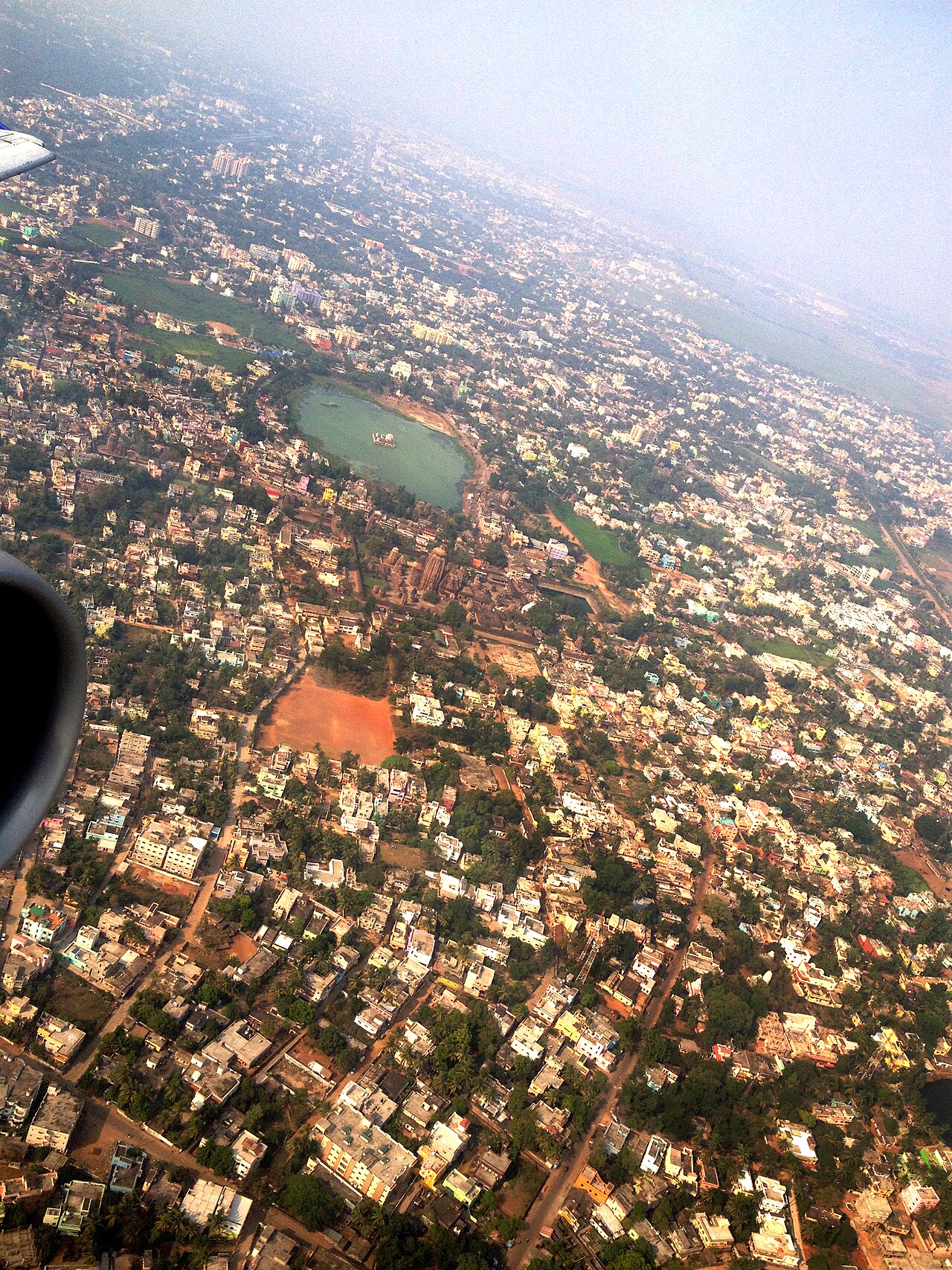
Inside the laterite compound wall stands a whole city of miniature Temples, around 150 of them, including the shrine of Maa Parvati, itself a large Temple. North of the wall lies Bindusagar, 450 metres of still water with the little Jagati shrine at its centre.
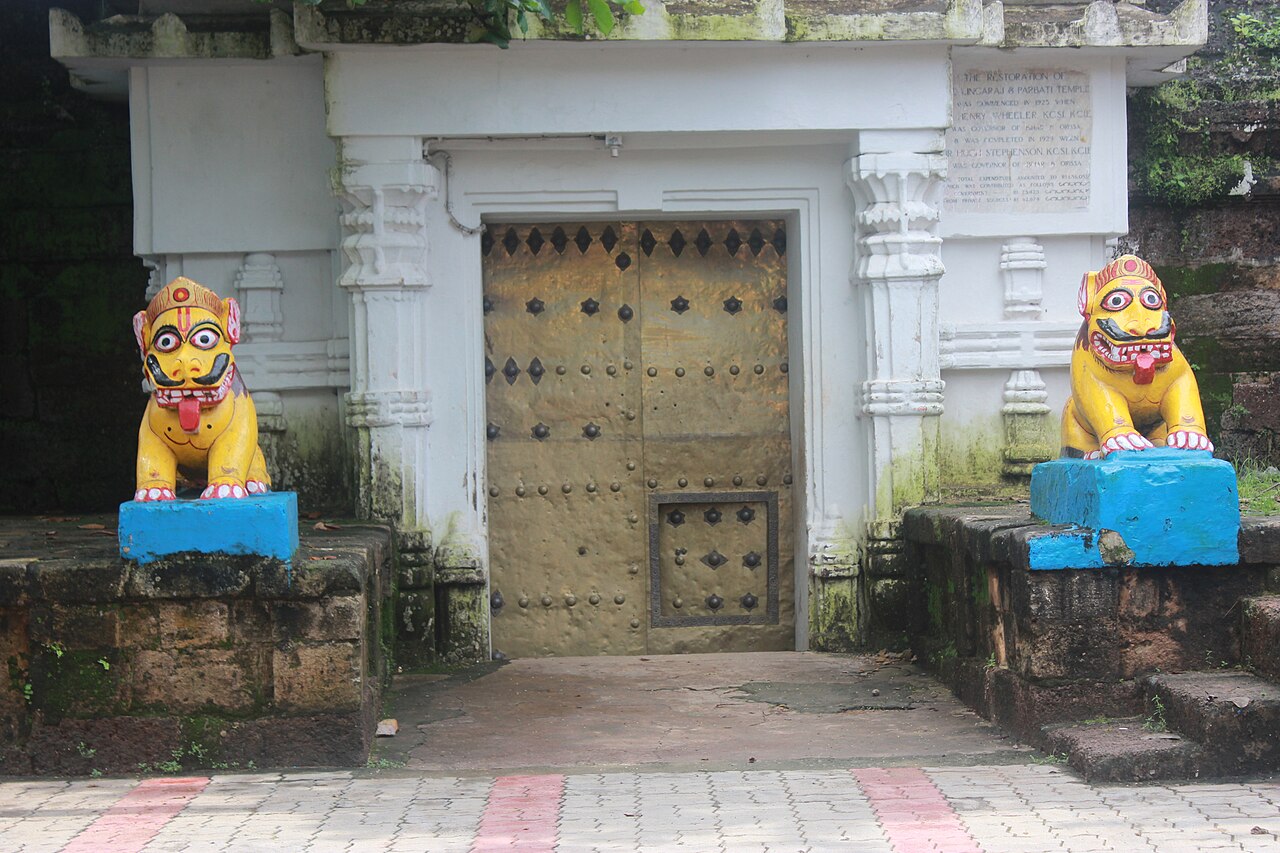
The Lingaraja Temple towers seen across the waters of Bindusagar, BhubaneswarStone guardian lions at the Lingaraja Temple, Bhubaneswar
The temple above Bindusagar, and the guardian lions of the gateway · photos CC BY-SA 3.0 Subhashish Panigrahi and CC BY-SA 4.0 Chandan Pattnaik, Wikimedia Commons
THE CHARIOT THAT NEVER TURNS
Ashokashtami Rukuna Rath Yatra · 14 April 2027
On Chaitra Shukla Ashtami, the movable form of Lord Lingaraja, Shri Chandrashekhara, comes out of the Temple with Rukmini and Basudev and mounts a four-wheeled chariot about 35 feet high. Tradition holds that Lord Brahma Himself takes the reins. Devotees pull the rath through the Old Town lanes to Rameshwar Deula, where the Lord rests for four days. And then the wonder: the chariot does not turn around. For the return, the Swarnadri Bije, the deities' faces are reversed and the same chariot is drawn backward along the same road, home to the Temple. The yatra has been kept for around a thousand years.
The pull fills Rath Road and the lanes around the Temple; come early on 14 April 2027 for the outward journey, or return on the fifth day for the homecoming.
Plan your visit
By air
Biju Patnaik International Airport (BBI), about 3 to 4 km; 10 to 15 minutes by taxi or auto.
By rail
Bhubaneswar railway station, about 5 km; 12 to 20 minutes by auto or taxi.
Timings
Open daily, about 5:00 am to 9:00 pm; the sanctum pauses at points in the day for the ritual round.
Best time
Early morning: Mangala Alati is offered around 5:00 am, and the open darshan gathering, the Sahana Mela, runs from about 7:30 am to noon.
Entry
Free. Entry to the compound is restricted to Hindus; visitors of other faiths may view the whole complex from the raised platform beside the compound wall.
Dress and devices
Dress modestly. Cameras, phones and other electronic devices are not allowed inside the Temple premises.
The queue
Easy on ordinary mornings; on Mahashivaratri the Temple draws crowds in the hundreds of thousands, so expect long waits and road closures.
Bhubaneswar takes its name from the Lord: Tribhubaneswara, Lord of the Three Worlds, worn smooth over the centuries into the name of the city itself.
The viewing platform beside the compound wall was first erected for Lord Curzon, the Viceroy, and it remains the one place from which the whole forest of shrines can be taken in at a glance.
Each May, for about three weeks from Akshaya Tritiya, the Chandan Yatra takes the festival deities out onto Bindusagar in a decorated boat for sandalwood rites on the water.
A short walk along the tank stands the Ananta Vasudeva Temple of Lord Vishnu; the two shrines together hold the city's old meeting of Shaiva and Vaishnava worship.
Questions pilgrims ask
Is Lingaraja a Temple of Lord Shiva or of Lord Vishnu?
Both, and that is the heart of the place. The svayambhu linga is worshipped as Harihara, Lord Shiva and Lord Vishnu in one, so the offerings bring together the bel leaves dear to Lord Shiva and the tulasi dear to Lord Vishnu, and Vaishnava guardians stand at the doors. The Lord is invoked as Tribhubaneswara, Lord of the Three Worlds.
Can visitors of other faiths enter?
No. Entry to the Temple compound is restricted to Hindus. A raised viewing platform beside the compound wall lets other visitors see the main towers and much of the courtyard, and there is no charge.
What does darshan of the linga look like?
There is no towering image. The Lord is a broad, low circle of natural, unshaped rock, about eight feet across and rising only inches above its platform, bathed daily with water, milk and panchamrita in the Mahasnana. Darshan is of the living stone itself.
When is the Temple at its most alive?
On Mahashivaratri, 6 March 2027. Devotees fast through the day and keep the Jagara, the night vigil, and only break their fast when the Mahadipa, the great lamp, is carried up the outside of the 55 metre tower and set alight at its crown, usually between 10:00 and 10:30 pm. The Temple draws crowds in the hundreds of thousands.
How much time should I allow?
Darshan itself can be done in an hour on a quiet morning, but give the place half a day: the walk through the four halls, the courtyard of 150 shrines, the shrine of Maa Parvati, and a slow circuit of Bindusagar reward unhurried time.
Dharamshalas and guest houses near this Sthan, shared by devotees. Adisthan takes no bookings and no money; contact each stay directly.
No stays are listed here yet. Know one that serves pilgrims well?
Are you a priest, sevak or trustee of Shri Lingaraja Temple? Claim this page to keep darshan hours, ritual timings and yatra schedules exact for the pilgrims of the Lord of the Three Worlds.