Nine doors open to one silence, and every prayer on earth is at home in it.
Be the first to check in
Coming up: Birth of the Báb · 10 NovEntry tended 10 Jul 2026
Kalkaji, South Delhi Tue to Sun · 8:30 am to 6 pm Prayer services 10, 12, 3 & 5 27 marble petals · nine sides Entry free · all faiths welcome
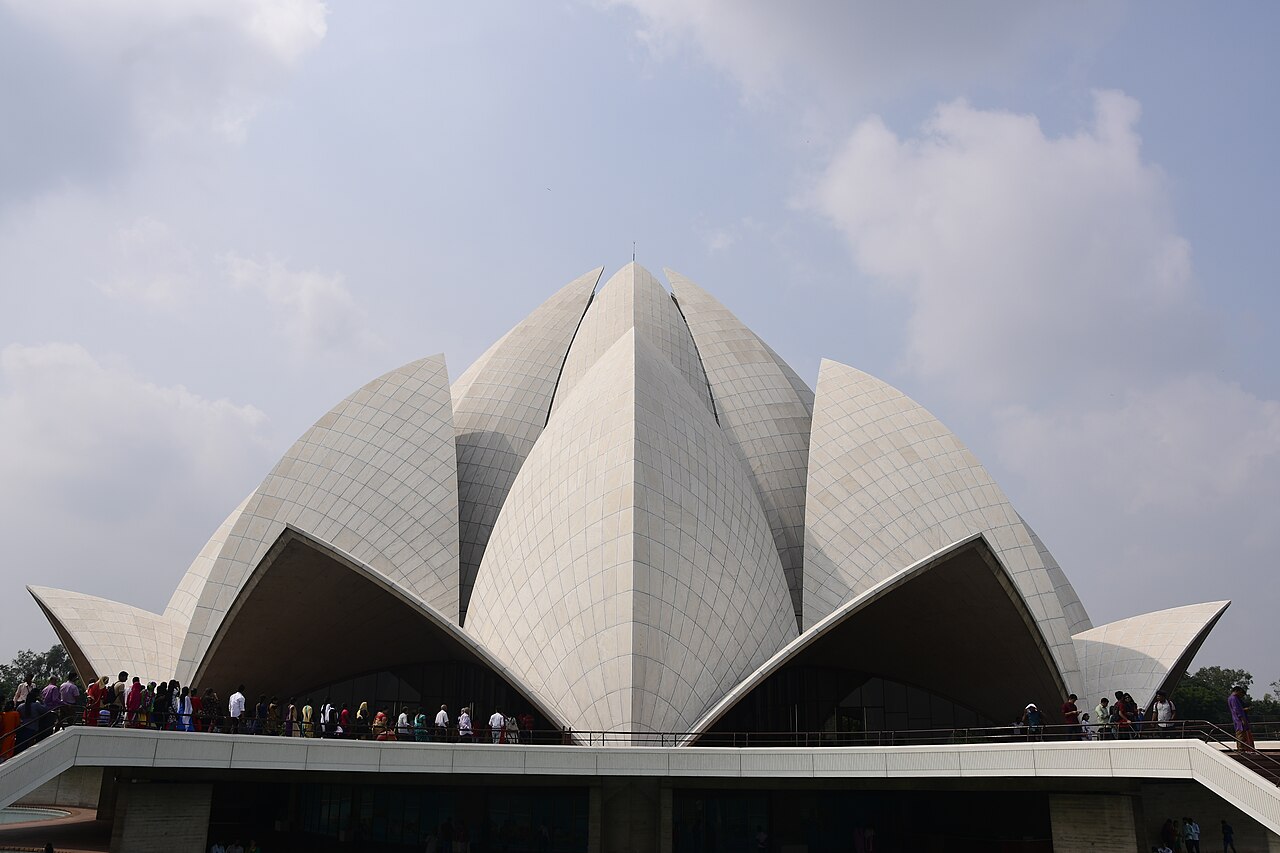
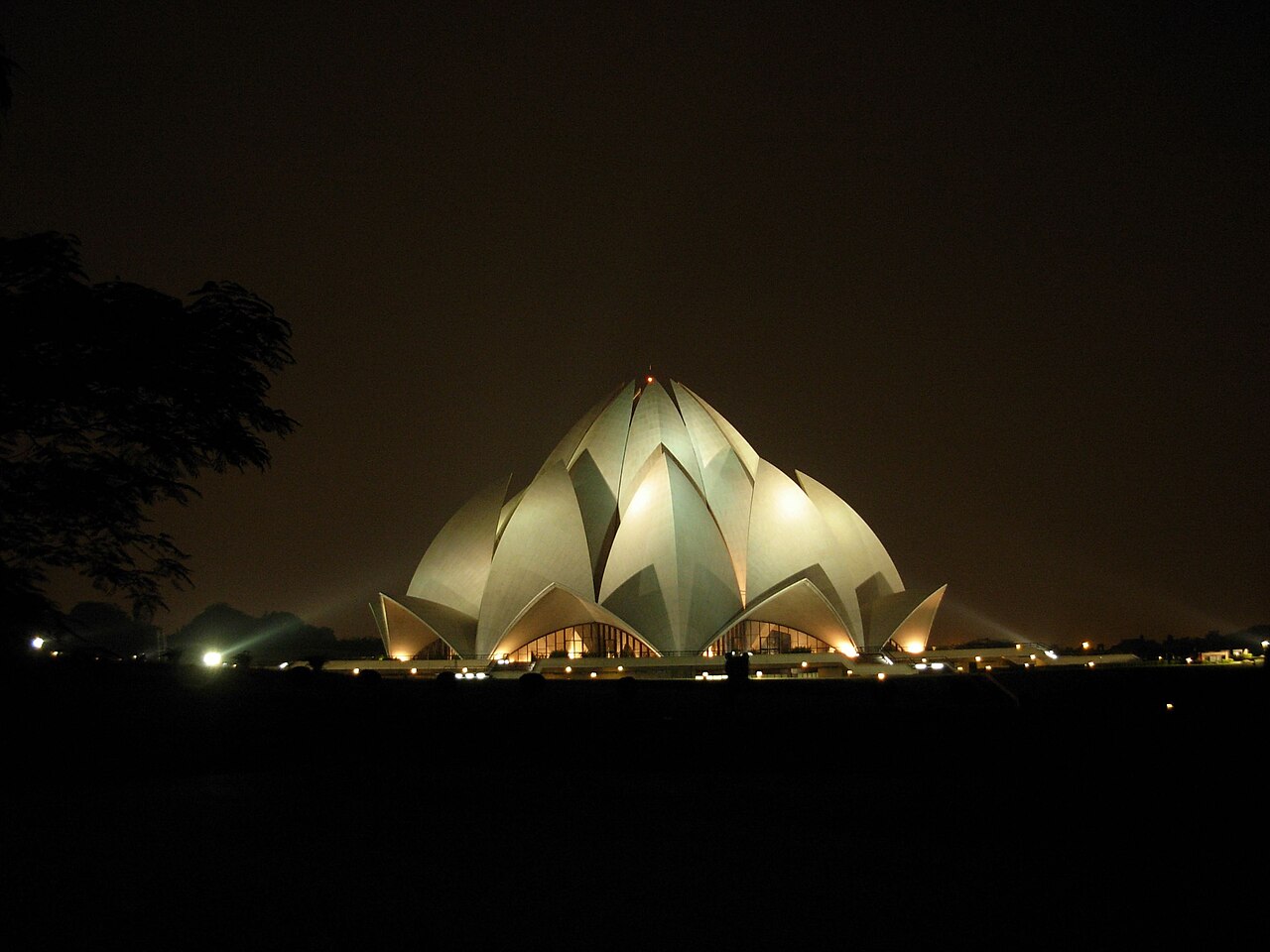
You walk up through gardens toward nine pools of still water, and above them the petals rise: 27 shells of white Greek marble opening out of the green like a lotus coming into bloom. At the shoe room the city's noise falls away. Inside the hall there is only light and the hush of hundreds of people being quiet together. There is no idol here, no altar, no pulpit, and no sermon will ever be preached. Every prayer of every faith is welcome in this silence.
This is a Mashriqu'l-Adhkár, a 'dawning-place of the mention of God': a Bahá'í House of Worship open on equal terms to people of every religion, race, and nation, with no clergy, no ritual, and no sermons, after the teaching of Bahá'u'lláh that humankind is one.
27 free-standing petals of white marble from Mount Penteli in Greece, the same stone as the Parthenon, stand in clusters of three to form nine sides, with nine doors and nine pools: nine, the Bahá'í number of unity and completeness.
It is among the most visited buildings on earth. More than 100 million people had entered by 2014, and a 2001 CNN report called it the most visited building in the world.
How a lotus rose over Delhi
The story begins not with an architect but with a gift. In 1953 the land at Bahapur was purchased for a future House of Worship, and the whole of the purchase was carried by one believer: Ardishír Rustampúr of Hyderabad in Sindh, who gave his entire life savings so that the Indian subcontinent would one day have its Temple. For a quarter of a century the ground simply waited.
When the Iranian architect Fariborz Sahba was asked to design it, he travelled through India studying its sacred architecture, and returned again and again to one form: the lotus, the flower that rises unstained out of muddy water, beloved across the faiths of India as a sign of purity. He resolved that the House of Worship would be a lotus of marble, half open, floating on nine pools. Construction began in 1980, with Flint and Neill of London engineering the shells and the ECC group of Larsen and Toubro building them.
On 24 December 1986 the Temple was dedicated to public worship. Since that day its nine doors have stayed open to everyone without fee, and the prayer hall has heard the scriptures of every religion read under one dome, which is exactly what its builders intended.
What you'll actually see
1
The 27 petals
The lotus is built of three ranks of nine: nine entrance leaves opening outward over the doors, nine outer leaves leaning in above them, and nine inner leaves that close around the prayer hall like a bud about to open. Some 10,000 square metres of marble were quarried on Mount Penteli in Greece and cut to shape in Italy before being fixed over the concrete shells.
2
The nine pools and the gardens
The Temple stands in 26.5 acres of gardens, and the nine ponds around its base do quiet double work: they make the building float like a lotus on water, and they help cool the prayer hall the way a leaf cools a pond. The gardens are kept entirely on recycled water, and solar panels have cut the Temple's electricity costs by about 45 percent.
3
The prayer hall
The central hall seats 1,300 people beneath a dome that rises about 34 metres. What you will not see is the point: no image, no statue, no altar, no pulpit. What you will hear, at service times, is the unaccompanied human voice reading and singing the Holy Scriptures of the world's religions.
Visitors filing along the parapet beneath the white marble petals of the Lotus TempleThe Bahá'í House of Worship lit from within at night, its petals glowing against the dark
The lotus in white marble · photos by Shagil Kannur (CC BY-SA 4.0) and JarrahTree (CC BY 2.5 AU), Wikimedia Commons
A service with no sermon
Four times a day, every scripture, one voice
Short prayer services are held at 10 am, 12 noon, 3 pm and 5 pm, each lasting 10 to 15 minutes. They consist only of prayers and readings from the Holy Scriptures of different religions, offered in the unaccompanied human voice; no instruments are played, and no one preaches. To keep the reverence of the service, the exit door of the prayer hall stays closed until the readings end. Between services, anyone may simply enter and sit in silence for as long as they wish.
Arrive a few minutes before the hour; on Sundays and public holidays the hall may pause entry when it is full or during heavy rain.
Plan your visit
By metro
Kalkaji Mandir station (Violet and Magenta lines) is a 5 minute walk; Okhla NSIC on the Magenta line is also about 5 minutes.
By air
The Magenta line runs directly from Terminal 1 of Indira Gandhi International Airport to Kalkaji Mandir, no interchange needed.
Address
Lotus Temple Road, Bahapur, Kalkaji, New Delhi 110019. DDA parking is opposite the main gate.
Timings
Tuesday to Sunday, 8:30 am to 6:00 pm. Closed every Monday.
Prayer services
10 am, 12 noon, 3 pm and 5 pm daily, 10 to 15 minutes each.
Entry
Free for everyone, of any religion or none. There is no ticket.
Dress & shoes
Modest dress is fitting; shoes are deposited free at the shoe room before you enter the prayer hall.
The queue
The line moves steadily on weekdays; Sundays and public holidays are the busiest, and the hall may briefly close when overcrowded.
Photography is welcome in the gardens and outside, but not inside the prayer hall or the Information Centre; professional photographers need prior permission.
The Information Centre beside the Temple tells the story of the Bahá'í Faith and its work through photo panels, texts and films; groups of ten or more must book at least three days ahead, and group visits do not run on weekends or public holidays.
Wheelchairs are available at the main gate on a first come, first served basis.
The lotus runs green: the gardens are watered entirely with recycled water, and rooftop solar has cut the Temple's electricity costs by about 45 percent.
Questions pilgrims ask
Is the Lotus Temple only for Bahá'ís?
No. Every Bahá'í House of Worship is open to people of all religions, races and nations on equal terms; that openness is the point of the building. You may pray or meditate in your own words and your own tradition. No one will preach to you, and no one will ask you to convert.
Is there an idol, altar or picture inside?
No. Bahá'í Houses of Worship keep no idols, statues, pictures, altars or pulpits. The prayer hall is a single open space seating 1,300 beneath the dome of petals, kept for silence and for the reading of scripture.
Is there singing or music?
Only the human voice. During prayer services the Holy Scriptures of different religions are read and may be sung unaccompanied; musical instruments are not played inside the hall.
What does Mashriqu'l-Adhkár mean?
It is the Bahá'í name for a House of Worship, and means 'dawning-place of the mention of God'. The New Delhi Temple is one of the Bahá'í Houses of Worship that circle the globe, raised for the Indian subcontinent.
When is the best time to come?
A weekday morning soon after the 8:30 am opening is quietest, and the marble is beautiful in low light near closing. It is closed on Mondays, and Sundays and public holidays draw the largest crowds.
Dharamshalas and guest houses near this Sthan, shared by devotees. Adisthan takes no bookings and no money; contact each stay directly.
No stays are listed here yet. Know one that serves pilgrims well?
Do you serve at the Bahá'í House of Worship, or with the National Spiritual Assembly of the Bahá'ís of India? Claim this page to keep its hours, services, and welcome exactly right.