Foot of Gayatri Hill 11 km from Ajmer Navratri · Chaitra & Sharadiya Shiva as Sarvanand Bhairava 5 to 7 km from Brahma Temple
You leave the lakeside lanes of Pushkar behind, and the road runs out toward a lone hill in the open Rajasthan country. For centuries this hill kept its Shrine hidden; the way was simply too remote to walk. Now the road is open, and at the foot of Gayatri Mountain you stand where the Wrists Of Maa Sati are believed to have Fallen.
Here Fell the Wrists Of Maa Sati, the Manibandh that gives this Peetha its name, binding the Shrine To the path where outward action and inner practice meet.
Worship here Is Offered To Maa Gayatri, together with Shiva in his form as Sarvanand Bhairava, the guardian of this Peetha.
The old telling says the Shrine lay unknown on remote Puruhuta Hill until the prayers of devotees drew Maa down from the mountain, and the hidden Peetha came to light.
The story the hill kept
When Maa Sati, The Consort Of Shiva, gave up Her body in the fire of the yagna Her father Daksha held to insult Her lord, grief seized Shiva. He carried Her across the universe and began the Tandava that threatened to end all things. To save creation, Vishnu released his Sudarshan Chakra, and the Body Of The Goddess was divided; wherever a piece fell, a Shakti Peetha arose.
At this place near Pushkar, tradition holds, Her Wrists touched the earth, and so the site is called Manibandh. The Shrine is also named Manivedika Shaktipeeth and Rajarajeshwari Puruhuta Manivedic Shaktipeeth, and local devotees know it as the Chamunda Mata Mandir. Here The Divine Mother Is Worshipped as Maa Gayatri, with Shiva beside Her as Sarvanand Bhairava.
What you'll actually see
1
A Shrine of many names
Manibandh, Manivedika, Rajarajeshwari Puruhuta Manivedic: the Peetha carries several names in the old accounts, while the people of the region simply call it the Chamunda Mata Mandir. Every name points to the same seat among the Fifty-One.
2
The hill that hid Her
The Shrine sits at the base of Gayatri Mountain, also called Puruhuta Hill, about 11 km northwest of Ajmer. Its remoteness kept it little known for centuries, until modern roads opened the way and pilgrims began to arrive in growing numbers.
3
A Peetha of sacred action
Because Her Wrists Rest here, this Peetha is linked to themes of action joined with spirituality: the hand that works and the heart that prays as one. Worship centres on Maa Gayatri and on Shiva as Sarvanand Bhairava.
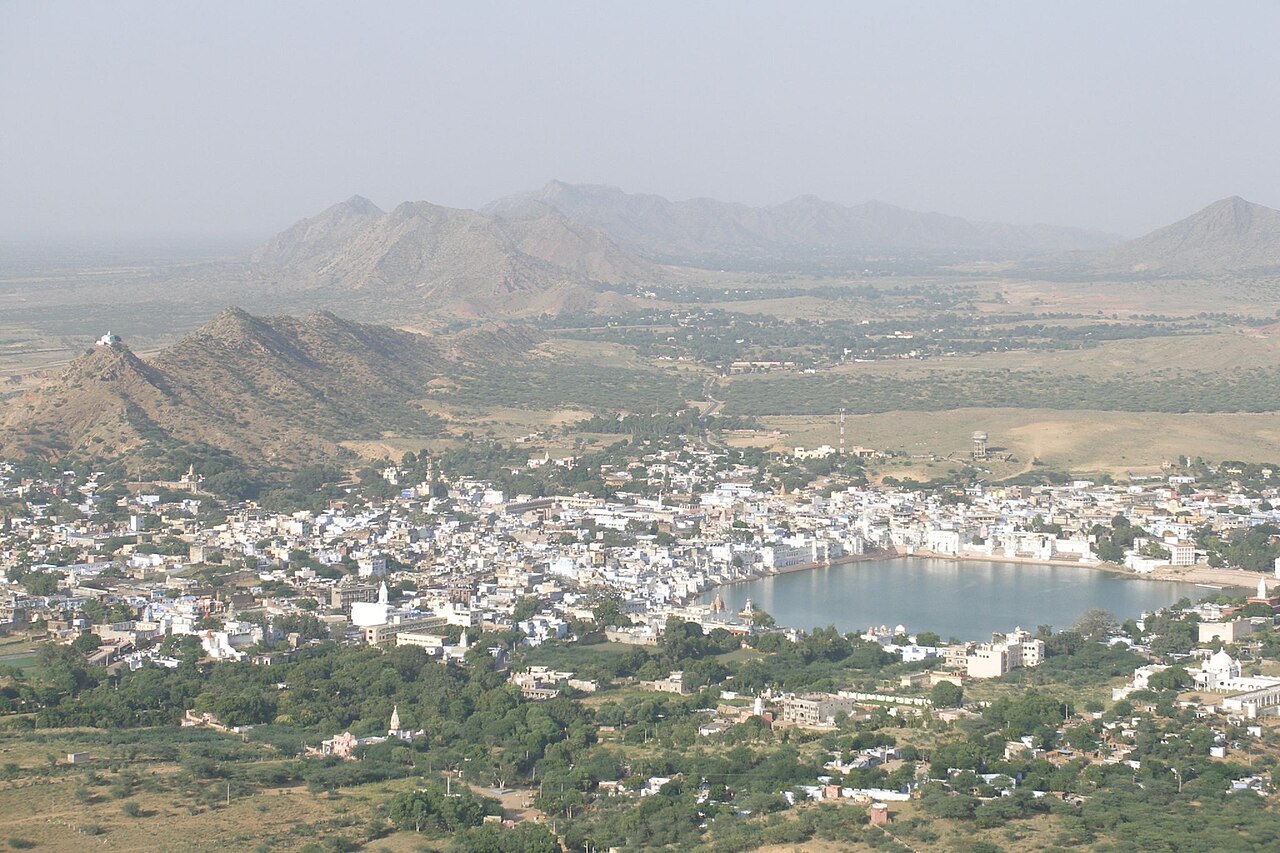
Pushkar town and the open Rajasthan country around it, seen from a hilltop
The Gayatri Shakti Peeth on the Ajmer road, and Pushkar from above · photos CC BY-SA / CC BY, Wikimedia Commons
When the desert fills with pilgrims
Navratri, and the Pushkar Mela beside it
Twice a year the Shrine gathers its largest crowds: Chaitra Navratri in March to April and Sharadiya Navratri in September to October, with special prayers, offerings, and the whole community joining in. Durga Puja too draws pilgrims from across the region. And each year in the month of Kartik, October to November, the famous Pushkar Mela unfolds on the banks of Pushkar Lake nearby, with camel races, cultural exhibitions, and spiritual gatherings that bring visitors from across India and beyond.
Come during Navratri for the fullest worship, but expect company. For a quiet Darshan With Maa, choose the plain weeks outside festival and Mela season.
Plan your visit
By air
Jaipur International Airport, about 150 km from Pushkar.
By rail
Pushkar station is the nearest railhead, connecting to major cities.
By road
About 11 km northwest of Ajmer and 5 to 7 km from the Brahma Temple in Pushkar; public and private transport runs from both towns.
Timings
Darshan hours are not published in our sources; confirm with the Temple office before you travel.
Best time
Navratri, Chaitra or Sharadiya, for festival worship; quieter months for unhurried Darshan.
Entry
No entry fee is documented; confirm locally at the Shrine.
The name Manibandh means wrist: the very part Of Maa Sati that Fell upon this ground.
The Temple maintains an official website at manibandh.com for pilgrims seeking current information.
The approach roads are recent. For most of its history the Shrine was hard to reach, and the steady flow of pilgrims has grown only since the early twenty-first century, tended by local priests and devotees.
Questions pilgrims ask
Which part Of Maa Sati Fell here?
Her Wrists, the Manibandh, from which the Peetha takes its name. It Is counted among the Fifty-One Shakti Peethas born of Her Body.
Who Is Worshipped at this Shrine?
Maa Gayatri Is The Presiding Goddess here, worshipped together with Shiva in his form as Sarvanand Bhairava. Locally the Temple is known as the Chamunda Mata Mandir.
How do I reach the Temple?
By road from Ajmer, about 11 km, or from Pushkar, 5 to 7 km from the Brahma Temple. Pushkar station is the nearest railhead, and Jaipur International Airport is roughly 150 km away.
Dharamshalas and guest houses near this Sthan, shared by devotees. Adisthan takes no bookings and no money; contact each stay directly.
No stays are listed here yet. Know one that serves pilgrims well?
Are you a priest, trustee, or sevak of Maa Gayatri Temple at Manibandh? Claim this page to add true timings, festival updates, and a way for pilgrims To actually reach you.