Beside the Rudra Sagar · Ujjain, Madhya Pradesh, India
Time and death kneel here: Baba Mahakal Keeps Ujjain as its one true King.
Be the first to check in
Coming up: Mahashivratri and Shiv Navratri · 6 MarEntry tended 28 Jun 2026
Bhasma Aarti daily · 4 am Dakshinamukhi · faces south Nag Panchami · 17 Aug 2026 Darshan free · Sheeghra ₹250 Mahakal Lok · 900 m corridor
You come in the dark. Long before four in the morning the courtyard is full, drums rolling, one cry moving through the crowd: Jai Shri Mahakal. Down a narrow stair, below street level, lamplight falls on the sanctum where the Jyotirlinga waits. The priests bathe the Lingam, then clothe it in sacred ash as the conch sounds and the flame is swung. Of the Twelve Jyotirlingas, this One alone faces south, the direction of death itself.
The only dakshinamukhi, south-facing, Jyotirlinga among the Twelve, a distinction the tantric shivnetra tradition reserves for Mahakaleshwar alone. The Lingam is held to be swayambhu, self-manifested, drawing its power from within rather than from ritual installation.
The Bhasma Aarti at four each morning, when the Jyotirlinga is bathed and then adorned with sacred ash. The Temple committee states this is the only Shivalinga in the world where the ash rite is performed every day.
This ground is also a seat Of The Goddess. The Upper Lip Of Maa Sati Fell at Ujjain, where She Is Worshipped as Maa Mahakali, and the shrine is counted among the Eighteen Maha Shakti Peethas.
The king who stayed
The Puranas tell of Avantika, the old name of Ujjain, ruled by Chandrasena, a king devoted to Lord Shiva. A farmer's boy named Shrikhar heard the king's chanting and longed to join him, but the guards drove him beyond the city walls. When rival kings marched on Ujjain with the demon Dushan, made invisible by Brahma's boon, the boy prayed by the Kshipra river, and the priest Vridhi prayed with him. Lord Shiva Appeared in His Mahakala form, a pillar of light and fury, and destroyed the invaders. At the plea of Shrikhar and Vridhi He stayed, in a Lingam formed of its own accord, promising that those who worship Him here need not fear death.
The city has kept that promise close ever since. Kalidasa, in the Meghaduta, sends his cloud-messenger to reach Ujjain at dusk, in time for the evening ritual of music and dance at this Temple. In 1234 to 35 the complex was destroyed in the raid of Iltutmish, and the record holds that the Lingam was cast into the Kotiteerth Kunda beside the shrine.
Worship returned, as it always does here. In the eighteenth century, under Maratha rule, the Diwan Ramchandra Baba Sukthankar raised the Temple that stands today, and the Bhasma Aarti kept its unbroken dawn. The people of Ujjain still worship Baba Mahakal as the city's king and protector, and the Temple still rules the rhythm of the town.
What you'll actually see
1
Mahakal Lok, the 900 metre approach
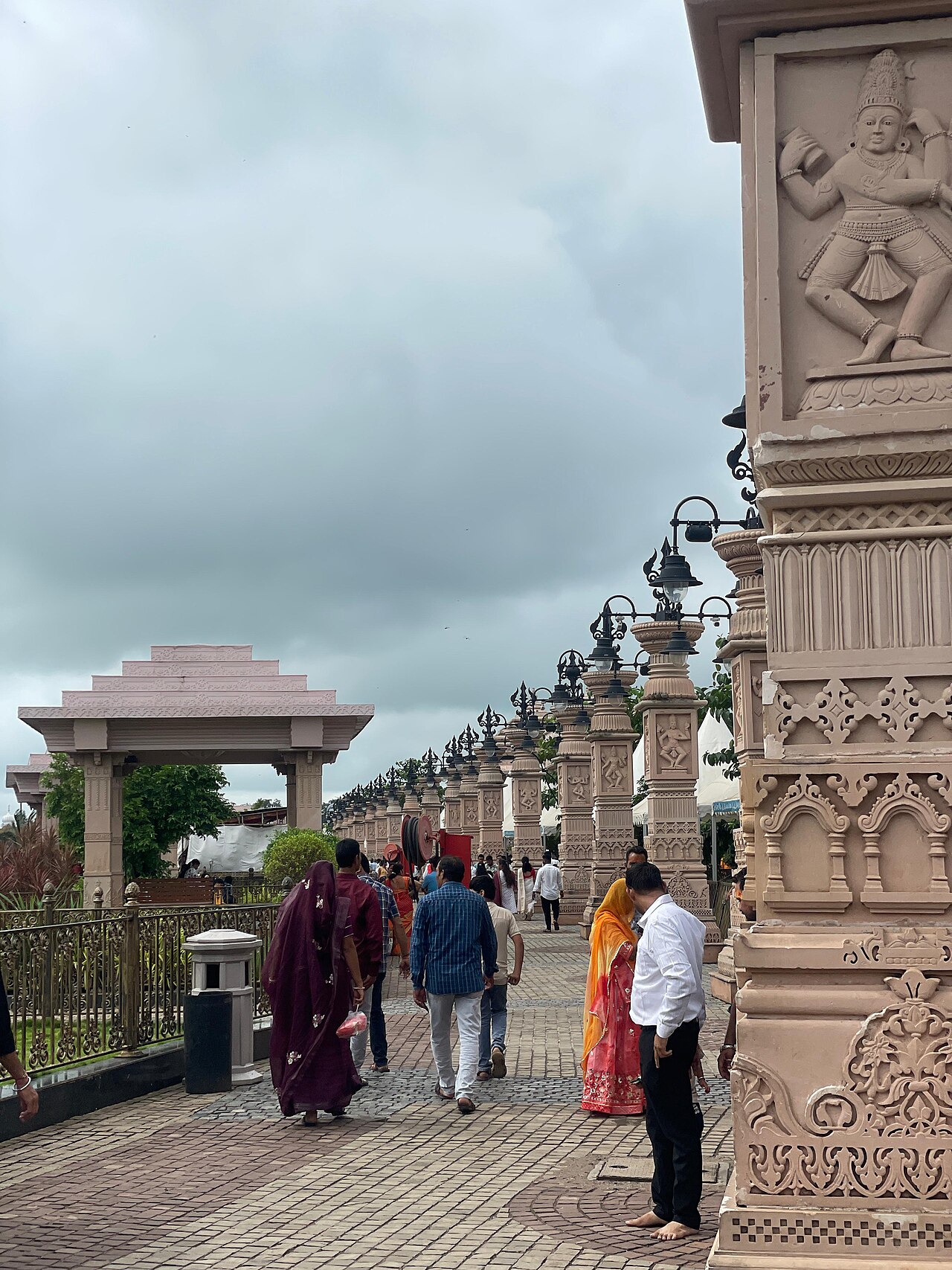
Most pilgrims now arrive through Mahakal Lok, a 900 metre corridor opened in 2022 along the Rudra Sagar lake, lined with 108 carved sandstone pillars crowned with the trishul and the mudras of Lord Shiva, and with murals and sculptures telling the Shaiva stories as you walk.
2
A shrine of five levels, one below the earth
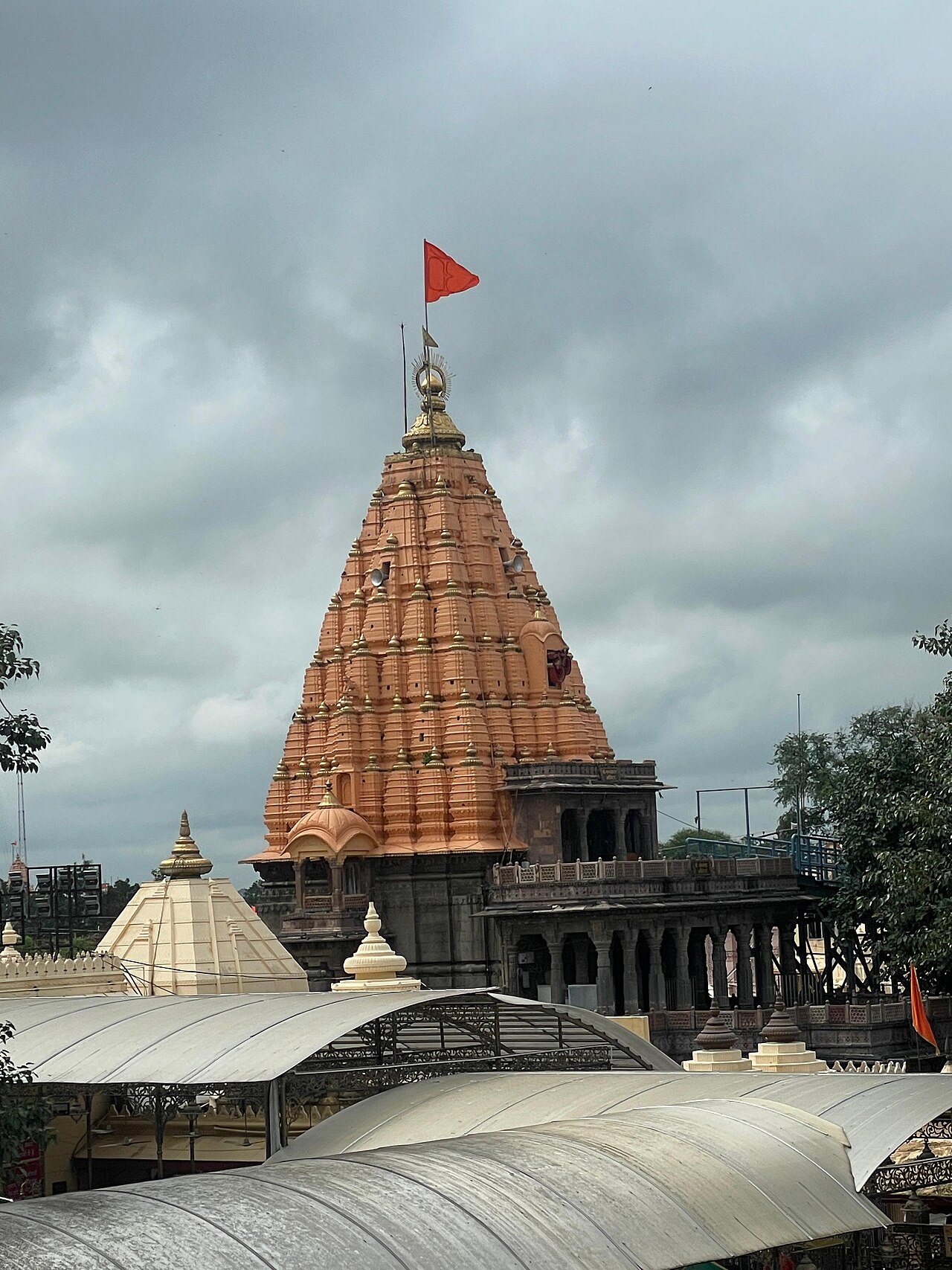
The Mahakal sanctum lies underground, reached down a lamplit stair. Directly above it sits the shrine of Omkareshwar Mahadev, and on the top level Nagchandreshwar, whose doors open one day a year. Over it all the spire rises from a spacious courtyard ringed by massive walls.
3
The Kotiteerth Kunda
The stepped tank beside the shrine is where, by the account cited from the Archaeological Survey, the Jyotirlinga was cast during the raid of 1234 to 35. Festival worship still begins at its water: through Shiv Navratri, abhishek and pujan are performed at the Kund each day.
Pilgrims walking the Mahakal Lok corridor past its carved sandstone pillars in UjjainThe shikhara of Shri Mahakaleshwar Temple with its saffron flag against a monsoon sky
Mahakal Lok and the shikhara · photos by Imakanksha, CC BY-SA 4.0, Wikimedia Commons
THE RITE FOUND NOWHERE ELSE
Bhasma Aarti, the aarti of ash
Every day between 4:00 and 6:00 in the morning, before first light, the Jyotirlinga is bathed and then adorned with bhasma, sacred ash, while drums and conch fill the underground sanctum. The ash is prepared from cow dung cakes by prescribed rite and offered through the Mahant of the Shri Panchayati Akhada Mahanirvani, and the committee states this is the only Shivalinga in the world where the ash rite is performed daily. Seats must be booked in advance on the official website only: regular booking opens at 8 am on the 1st of the previous month, and a tatkal window opens at 8 am one day before. Men attend in a dhoti, women in a saree; mobiles, cameras and leather are prohibited. Once a year, on Mahashivratri, the Bhasma Aarti moves to the afternoon, after the Sehra Darshan.
Gates open around 2:30 am and seating is first come, so arrive by 3 am carrying the photo ID you booked with; foreign nationals need their passport.
Plan your visit
By air
Devi Ahilyabai Holkar Airport, Indore, about 55 km; taxis take 1.5 to 2 hours.
By rail
Ujjain Junction is about 2 km from the Temple; a 20 to 25 minute walk or a short auto ride.
Timings
The Temple day runs from the 4 am Bhasma Aarti to the Shayan Aarti ending 11 pm; morning and evening aartis shift about half an hour with the season.
The queue
General darshan is free and can take hours on peak days; the Sheeghra Darshan ticket, ₹250 per person, uses a faster line. Book only on the official portal.
Dress
Modest dress for ordinary darshan. For the Bhasma Aarti and sanctum rituals, men wear a dhoti and women a saree; leather items stay outside.
Best time
A weekday morning outside Shravan is quietest. Shravan Mondays, Nag Panchami and Mahashivratri bring lakhs of pilgrims and a transformed, intense city.
On foot
Enter through the Mahakal Lok corridor along the Rudra Sagar, a 900 metre walk past 108 carved pillars to the Temple precinct.
Simhastha
Ujjain hosts the Simhastha Kumbh Mela every twelve years; the next runs 27 March to 27 May 2028 on the Shipra.
Mahakal means the Great Time: tradition holds that time and death themselves obey Lord Shiva here, and that those who worship Him in this form are freed from the fear of untimely death.
For centuries the people of Ujjain have worshipped Baba Mahakal as the city's king and protector, and the Temple still sets the rhythm of the town's life.
Mobiles and cameras are prohibited during the Bhasma Aarti, so travel light and leave valuables at your lodging.
A shrine Of Maa Avantika Devi stands within the Mahakal precinct itself, and the Harsiddhi Temple, a Shakti Peetha, is a short walk away: Ujjain holds seats Of The Goddess beside the seat of the Lord of time.
Questions pilgrims ask
Is the ash of the Bhasma Aarti really from the cremation ground?
The old telling says the first bhasma was cremation ash, the sign that Lord Shiva wears what the world fears. Today the Temple states plainly that the ash is prepared from cow dung cakes by prescribed ritual and offered through the Mahant of the Shri Panchayati Akhada Mahanirvani.
How do I attend the Bhasma Aarti?
Book on the official website, shrimahakaleshwar.mp.gov.in, the only authorised channel. Regular booking opens at 8 am on the 1st of the previous month and tatkal at 8 am the day before. Bring the photo ID you booked with, arrive by 3 am, and dress in dhoti for men or saree for women.
What does dakshinamukhi mean, and why does it matter?
It means south-facing. South is the direction of Yama, the lord of death, and among the Twelve Jyotirlingas only Mahakaleshwar faces it. Tradition reads this as the sign of Mahakal's mastery over death and time.
Can I see Nagchandreshwar on an ordinary day?
No. The Nagchandreshwar shrine on the Temple's top level opens for darshan one day a year, on Nag Panchami, from morning to evening. The next opening is Monday 17 August 2026.
When is the next Kumbh in Ujjain?
The Simhastha Kumbh Mela comes to Ujjain every twelve years. The next is 27 March to 27 May 2028, with the principal Amrit Snan days on 9 April, 23 April and 8 May 2028.
The Sthan in photographs
Darshan from afar
From the temple's own channels. Nothing loads until you press play.
Dharamshalas and guest houses near this Sthan, shared by devotees. Adisthan takes no bookings and no money; contact each stay directly.
No stays are listed here yet. Know one that serves pilgrims well?
Are you a pujari, official, or sevak of Shri Mahakaleshwar Temple? Claim this page to keep timings, bookings, and festival dates true for the devotees who come to Baba Mahakal.