
Mahishasuramardini Mandapa
Mahishasuramardini Cave Temple · Yampuri
About
Carved directly into the granite face of a coastal hill near a lighthouse at Mamallapuram, the port town on the Coromandel Coast of Tamil Nadu also called Mahabalipuram, this mandapa belongs to the late seventh-century flowering of Pallava rock-cut artistry. Its three east-facing chambers are modest in scale: roughly thirty-two feet long, fifteen feet wide, and twelve and a half feet in height, yet each interior wall carries sculpture of rare intensity. The facade is articulated by four carved pillars and two pilasters rendered in the Pallava idiom, with lion-based columns fronting the central mukhamandapa entrance porch. Along the cornice run ten horseshoe-arch kudus, decorative windows left intentionally unfinished, alongside five semi-completed gable-roofed miniature shrines.
The dedicatory focus of the cave is Goddess Mahishasuramardini, regarded as a form of Maa Durga, whose battle triumph over the buffalo-demon Mahishasura fills the northern interior wall. There she rides a fierce lion, wielding eight weapons, sword, bow, arrows, bell, noose, conch, and dagger, leading an escort of female warriors and dwarf ganas as she drives the armoured Mahishasura and his retinue into retreat. The carving is considered among the finest achievements of Pallava figurative art. A second panel on the southern wall shows Maha Vishnu in Anantasayana posture, reclining upon the thousand-headed serpent Adisesha, accompanied by the personified forms of his weapons; this composition illustrates the Puranic legend of Vishnu's recovery of the Vedas from the demons Madhu and Kaitabha. The back wall of the central chamber bears a Somaskanda panel: Shiva and Maa Parvati enthroned in royal dress, each wearing a kirita-mukuta crown, with their son Skanda between them and the attendant Nandi at their feet, watched by a trio of grateful gods, Brahma, Vishnu, and Surya, standing reverently behind.
The shrine is part of the Group of Monuments at Mahabalipuram, inscribed as a UNESCO World Heritage Site in 1984, and remains an active site of pilgrimage and scholarly study on the Coromandel Coast, roughly fifty-eight kilometres south of Chennai.
History
The cave was cut into the granite hillside during the reign of the Pallava king Narasimhavarman I, called Mamalla, who ruled from about 630 to 668 CE and gave the town its name. Its three chambers carry the mature Pallava idiom: pillars rising from crouching lions, a facade of unfinished kudu windows, and walls carved with a fluency later Pallava work would echo but rarely surpass. The monument now forms part of the Group of Monuments at Mahabalipuram, inscribed as a UNESCO World Heritage Site in 1984.
Significance
The northern wall's battle relief, Maa Durga astride her lion with eight weapons raised against the retreating Mahishasura, is drawn from the Devi Mahatmya and stands among the finest renderings of that legend in stone. Facing it on the southern wall, Lord Vishnu lies in Anantasayana upon the serpent Adisesha, while the sanctum's rear wall holds a Somaskanda panel of Lord Shiva and Maa Parvati enthroned with Skanda between them, so that Shakta, Vaishnava, and Shaiva devotion all meet within one small cave.
Architecture
Pallava rock-cut mandapa architecture
Visiting
Hours
Hours not listed.
Contact
No contact details listed yet.
Engage with Mahishasuramardini Mandapa
Through the four pathways
Seva सेवा — Service
Offer your time and skills here. The following opportunities are open at Mahishasuramardini Mandapa:
No Seva offerings listed yet.
Sādhana साधना — Practice
Learn the worship and practice associated with Mahishasuramardini Mandapa:
No Sādhana offerings listed yet.
Sandhāna सन्धान — Wisdom
Unite with the wisdom of this tradition:
No Sandhāna offerings listed yet.
Sādhya साध्य — Giving
Support this sacred place according to your means:
No Sādhya offerings listed yet.
All giving flows directly to Mahishasuramardini Mandapa. Adisthan does not take a commission.
Gallery
Related sacred places
 Hinduism
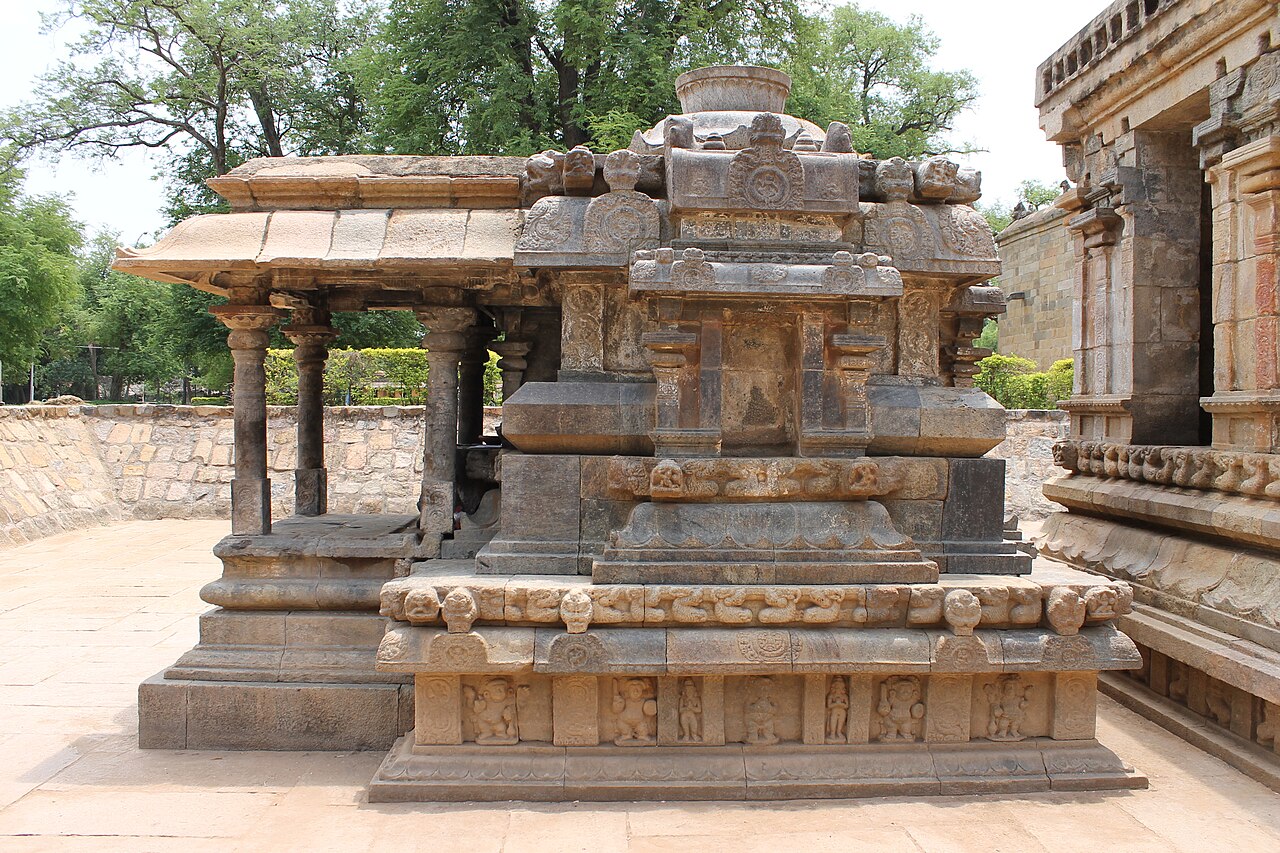
Airavatesvara Temple, Darasuram
Darasuram (Kumbakonam) · India · temple
The third of the Great Living Chola Temples, raised by Rajaraja Chola II around 1166 CE at Darasuram near Kumbakonam: a chariot-form shrine of Lord Shiva as Airavatesvara, famed for its carved stone wheels, its singing steps, and worship that has continued for over eight centuries.
Aisanyesvara Siva Temple
Bhubaneswar · India · temple
A living thirteenth-century Shiva shrine in the Old Town of Bhubaneswar, standing close to the western wall of the great Lingaraj Temple, where a Shivalinga set within a circular yonipitha still receives daily worship in the Kalinga architectural tradition.
 Hinduism
Akhadachandi Temple
Bhubaneswar · India · temple
A tenth-century Kalinga-style shrine on the southwestern bank of Bhubaneswar's sacred Bindusagar tank, Akhadachandi Temple honours Maa Mahishasuramardini, the Goddess in her form as slayer of the buffalo demon, within the dense cluster of ancient shrines that fills the city's Old Town.
 Hinduism
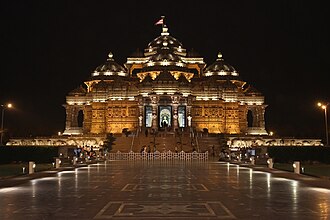
Akshardham
New Delhi · India · temple
A vast contemporary Hindu mandir campus on the Yamuna's west bank in East Delhi, raised without structural steel by 11,000 artisans and volunteers, and recognised by Guinness World Records in 2007 as the world's largest comprehensive Hindu Temple.
 Hinduism
Amarnath Temple
· India · temple
A high Himalayan cave shrine in Jammu and Kashmir where a naturally forming ice lingam is venerated as Lord Śiva, drawing one of India's great seasonal pilgrimages.
 Hinduism
Ambalappuzha Sri Krishna Temple
Ambalappuzha · India · temple
A Vaishnava shrine on the Kerala backwaters consecrated to Sri Krishna in his Parthasarathy form, counted among the seven great Temples of the former kingdom of Travancore and famed across South India for its Ambalapuzha Paal Payasam offering.