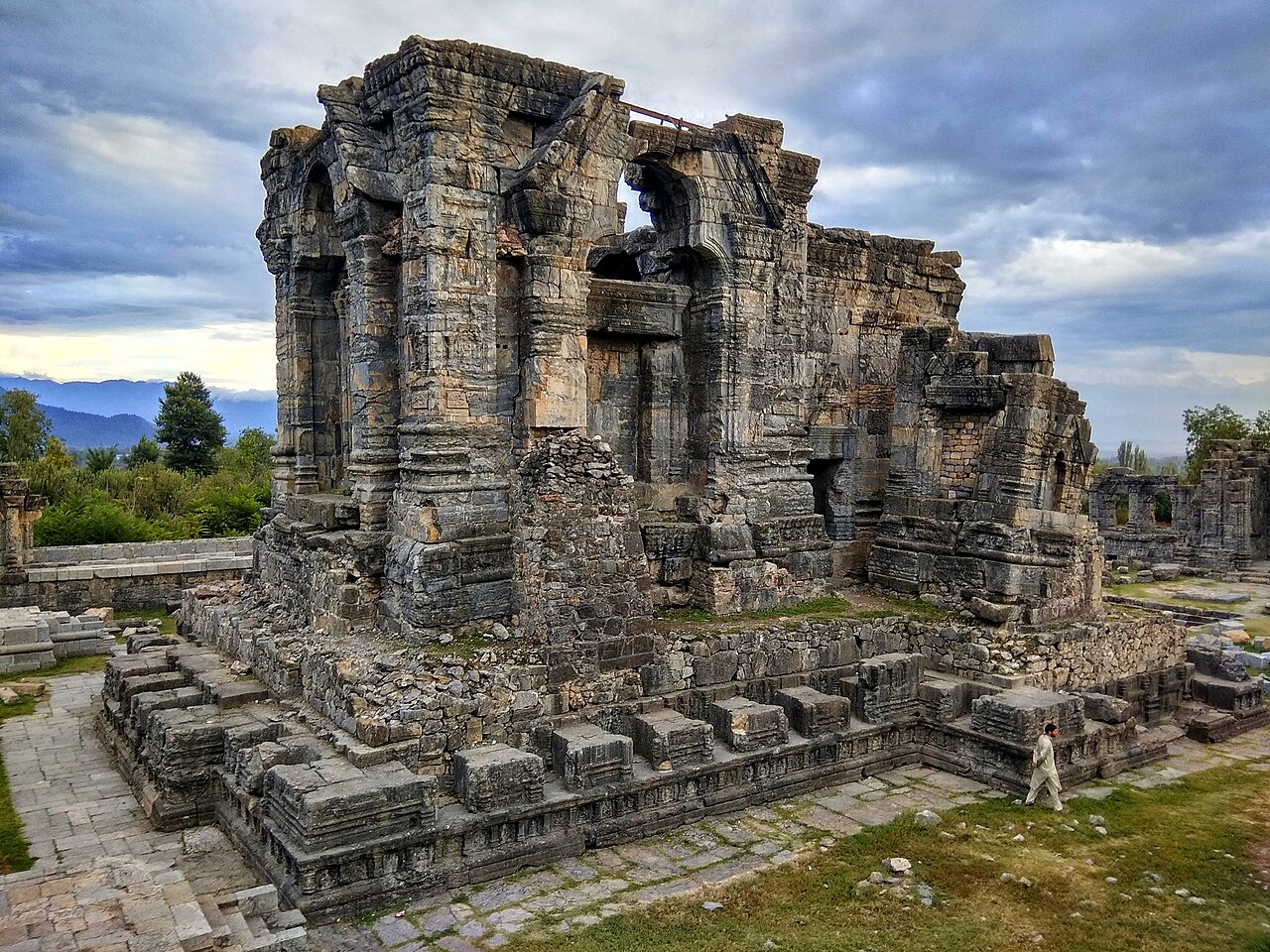
Martand Sun Temple
Martanda Sun Temple · Surya Temple, Mattan · Martand Temple
About
Perched on a high plateau above the town of Mattan in the Anantnag district, the Martand Sun Temple stands as one of the most sublime remnants of ancient Kashmiri devotion. Raised in the eighth century CE to honour Sūrya, the solar deity whose Sanskrit epithet Mārtaṇḍa gives the Temple its name, the complex once embodied a convergence of the valley's highest artistic and spiritual ambitions. Even in ruin, its stone speaks of the reverence with which light itself was once worshipped here.
The architectural arrangement is extraordinary in its scale and coherence. A colonnaded peristyle courtyard, the largest of its kind recorded in Kashmir, extends some 220 feet in length and 142 feet in breadth, enclosing a central shrine and ringing it with 84 smaller sanctuaries. The main shrine is believed to have risen to a pyramidal summit, characteristic of the region's Temple tradition, and its antechamber is adorned with carved figures of Viṣṇu, and of the river goddesses Gaṅgā and Yamunā, alongside representations of Sūrya himself. The western entrance, as wide as the Temple proper, announces the sacred interior with an elaborateness that mirrors the grandeur within.
What makes Martand architecturally singular is the synthesis it achieved: scholars have identified strands of Gandhāran, Gupta, Chinese, and possibly Syrian-Byzantine influence woven into a distinctly Kashmiri idiom. The result is a building that seemed to gather the world's forms and consecrate them to the sun. The plateau on which it stands amplifies this universality, to stand among these columns is to feel the valley open below, as if the place were built to receive the sky as much as the earth.
History
The chronicler Kalhana credits the Karkota king Lalitaditya Muktapida, whose reign the Temple's own on-site plaque dates to 724 to 761 CE, with commissioning the Temple. The Kashmiri chronicler Jonaraja, writing in the fifteenth century, attributed the Temple's destruction to Sultan Sikandar Shah Miri, who reigned from 1389 to 1413, though modern scholars including Chitralekha Zutshi and Richard Salomon caution that Jonaraja wrote under Sikandar's own son and that later chroniclers shaped the past to fit their own purposes. Repeated earthquakes further eroded the ruin in the centuries that followed. The Archaeological Survey of India protects the site as a monument of national importance, and in March 2024 the Jammu and Kashmir government began work toward its restoration.
Significance
Martand's colonnaded courtyard, the largest peristyle recorded in Kashmir, once ringed a central shrine with eighty four smaller sanctuaries, its carvings drawing on Gandharan, Gupta, Chinese and possibly Syrian-Byzantine forms in a single Kashmiri idiom. Even in ruin, the Temple remains one of the valley's holiest sites for Kashmiri Pandits, and its plateau still commands the sweeping view across the Kashmir Valley that its eighth-century builders chose it for.
Architecture
Kashmiri Temple architecture blending Gandharan, Gupta, Chinese and possibly Syrian-Byzantine forms; a colonnaded peristyle courtyard around a pyramidal-roofed central shrine
Visiting
Daily worship
| Site open to visitors (ASI-protected ruin, no active worship) | 06:00 to 19:00 |
Hours
Hours not listed.
Contact
No contact details listed yet.
Engage with Martand Sun Temple
Through the four pathways
Seva सेवा — Service
Offer your time and skills here. The following opportunities are open at Martand Sun Temple:
No Seva offerings listed yet.
Sādhana साधना — Practice
Learn the worship and practice associated with Martand Sun Temple:
No Sādhana offerings listed yet.
Sandhāna सन्धान — Wisdom
Unite with the wisdom of this tradition:
No Sandhāna offerings listed yet.
Sādhya साध्य — Giving
Support this sacred place according to your means:
No Sādhya offerings listed yet.
All giving flows directly to Martand Sun Temple. Adisthan does not take a commission.
Gallery
Related sacred places
 Hinduism
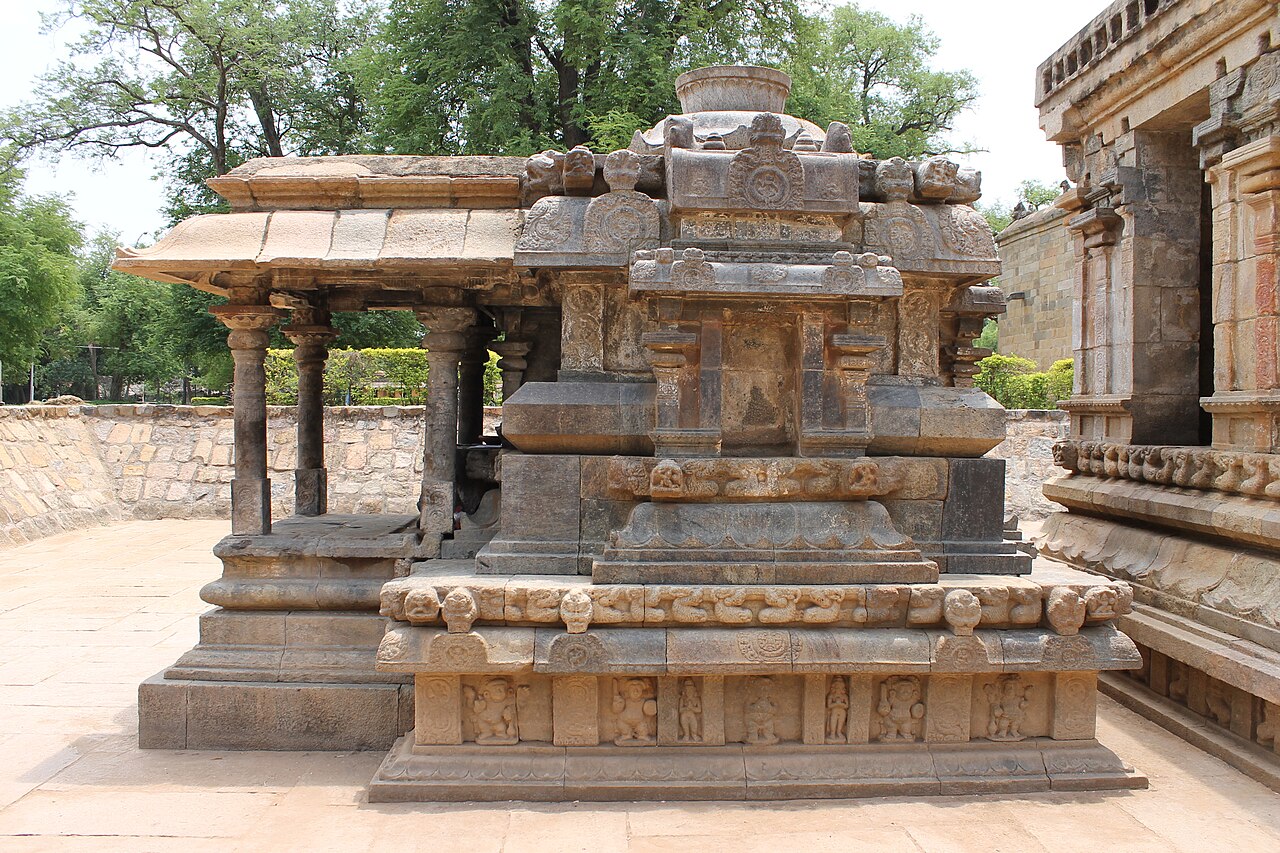
Airavatesvara Temple, Darasuram
Darasuram (Kumbakonam) · India · temple
The third of the Great Living Chola Temples, raised by Rajaraja Chola II around 1166 CE at Darasuram near Kumbakonam: a chariot-form shrine of Lord Shiva as Airavatesvara, famed for its carved stone wheels, its singing steps, and worship that has continued for over eight centuries.
Aisanyesvara Siva Temple
Bhubaneswar · India · temple
A living thirteenth-century Shiva shrine in the Old Town of Bhubaneswar, standing close to the western wall of the great Lingaraj Temple, where a Shivalinga set within a circular yonipitha still receives daily worship in the Kalinga architectural tradition.
 Hinduism
Akhadachandi Temple
Bhubaneswar · India · temple
A tenth-century Kalinga-style shrine on the southwestern bank of Bhubaneswar's sacred Bindusagar tank, Akhadachandi Temple honours Maa Mahishasuramardini, the Goddess in her form as slayer of the buffalo demon, within the dense cluster of ancient shrines that fills the city's Old Town.
 Hinduism
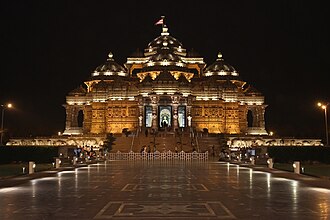
Akshardham
New Delhi · India · temple
A vast contemporary Hindu mandir campus on the Yamuna's west bank in East Delhi, raised without structural steel by 11,000 artisans and volunteers, and recognised by Guinness World Records in 2007 as the world's largest comprehensive Hindu Temple.
 Hinduism
Amarnath Temple
· India · temple
A high Himalayan cave shrine in Jammu and Kashmir where a naturally forming ice lingam is venerated as Lord Śiva, drawing one of India's great seasonal pilgrimages.
 Hinduism
Ambalappuzha Sri Krishna Temple
Ambalappuzha · India · temple
A Vaishnava shrine on the Kerala backwaters consecrated to Sri Krishna in his Parthasarathy form, counted among the seven great Temples of the former kingdom of Travancore and famed across South India for its Ambalapuzha Paal Payasam offering.