Open 5 am to 12:30 pm · 4 to 10 pm Darshan Of Maa Meenakshi first Chithirai wedding · Apr 2027 14 gopurams · tallest 51.9 m Free · special entry ₹50
You give up your sandals and your phone at the gate, and the Temple takes you in barefoot, unarmed of screens. Painted corridors open one into the next, cool stone underfoot, camphor and wet jasmine in the air, and above the rooftops fourteen gopurams climb in tiers of painted gods. Pilgrims here do not go first to the great god's shrine. In Madurai you go first To The Goddess. This Is Maa Meenakshi's house, and Her Husband Lives in it.
One of the very few great Temples of the Shaiva world where The Goddess Rules as the primary deity: pilgrims take darshan Of Maa Meenakshi before Lord Sundareswarar, Her Husband, and the Temple carries Her name, not his.
Fourteen gopurams crown the 14 acre complex. The southern tower alone rises 51.9 metres and carries more than 1,500 painted stucco figures, gods, demons, sages and beasts, a scripture told in colour above the streets.
Every night at the Palliyarai pooja the Temple's living heartbeat sounds: the foot images of Lord Sundareswarar Are Carried in a palanquin To The bedchamber Of Maa Meenakshi, so The Divine Couple Rest together until morning.
The girl Who Walked out of the fire
King Malayadhwaja Pandya and his queen Kanchanamalai fed the sacrificial fire, praying for an heir. Out of the flames, the Tiruvilaiyadal Puranam says, Came a girl of three years, Radiant, and Bearing Three Breasts. To the troubled king a divine voice gave one instruction: raise Her as a son, and the third breast will vanish the day She Beholds Her Husband. The child Was Crowned ruler of Madurai, and She Conquered in every direction, until on Mount Kailasha She Stood Before Lord Shiva and the Third Breast Vanished. She Knew then who She Was: Maa Meenakshi, The Fish-Eyed One, Maa Parvati Come to rule among Her people.
Lord Shiva Followed Her south. In Madurai He Took the form of Lord Sundareswarar, the beautiful lord, and Wed Her before all the worlds, with Lord Vishnu, Her brother, giving the bride away. The city has never let that wedding end: every year in the month of Chithirai, Madurai marries its Queen again.
The shrine She Rules is old beyond its stones. The Temple was wrecked in the raids of Malik Kafur in 1311, and for a time worship guttered among ruins. The kings of Vijayanagara raised it again in the fourteenth century, and the Nayak rulers of Madurai, above all Tirumala Nayaka in the seventeenth, built the walled city of corridors, tanks and towers that pilgrims walk today.
What you'll actually see
1
The fourteen gopurams
You meet the Temple before you reach it: fourteen tower gateways rising straight out of the market streets, the southern tallest at 51.9 metres. Every tier is crowded with painted stucco figures, more than 1,500 on the south tower alone, so that the whole mythology of the tradition stands overhead in colour.
2
Potramarai Kulam, the tank of the Golden Lotus
Inside, the noise falls away at a rectangular tank of stepped stone, about 165 feet by 120, with a gold-gilded lotus at its centre. A pillared, painted corridor rings the water, and pilgrims sit on the steps to rest and collect themselves before darshan.
3
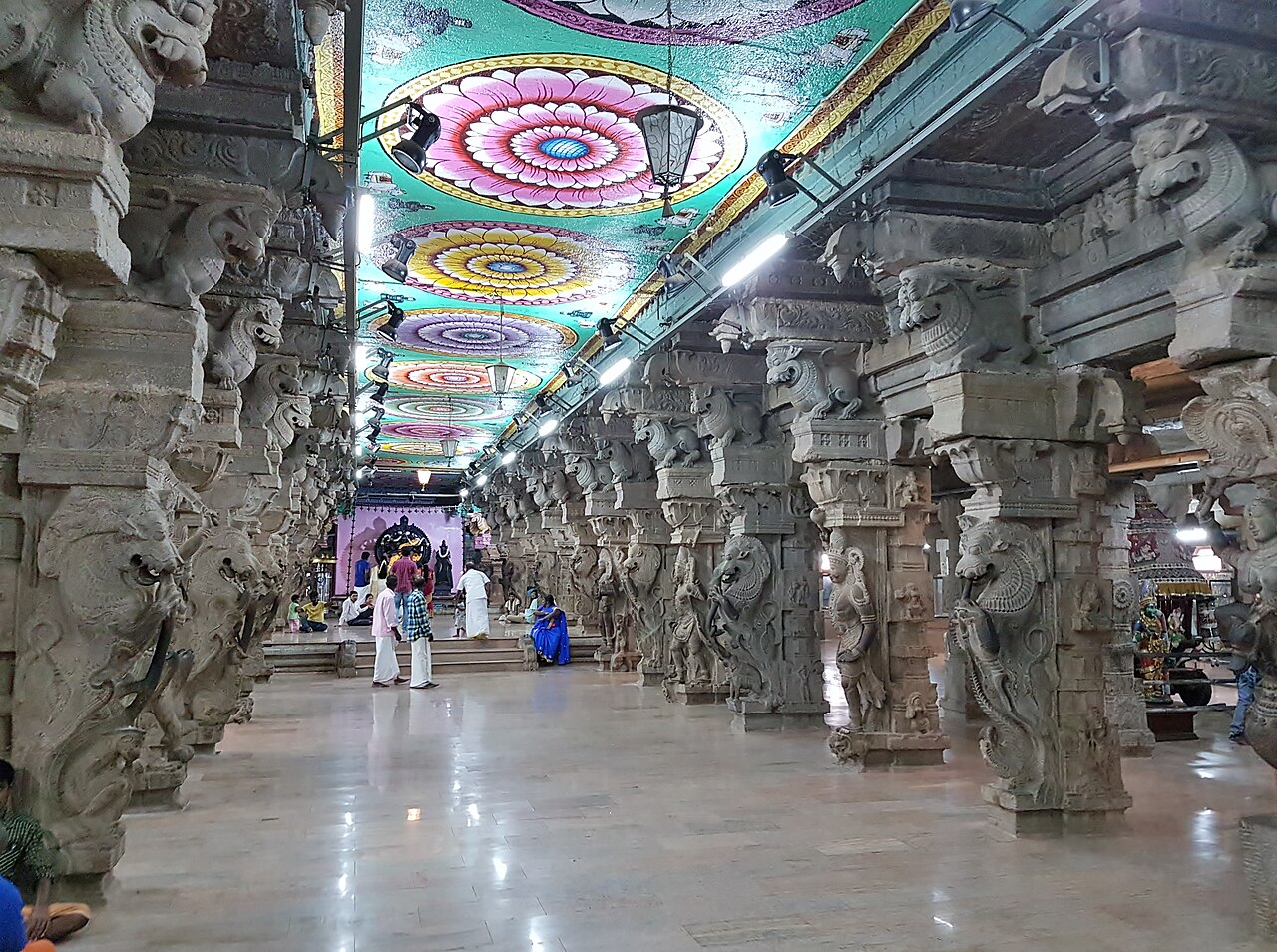
The Hall of Thousand Pillars
The Ayiram Kaal Mandapam holds 985 carved pillars, each one a sculpture: riders, dancers, yalis, gods emerging from stone. Just outside stand the famous musical pillars, slender shafts of rock that ring with a clear note when struck.
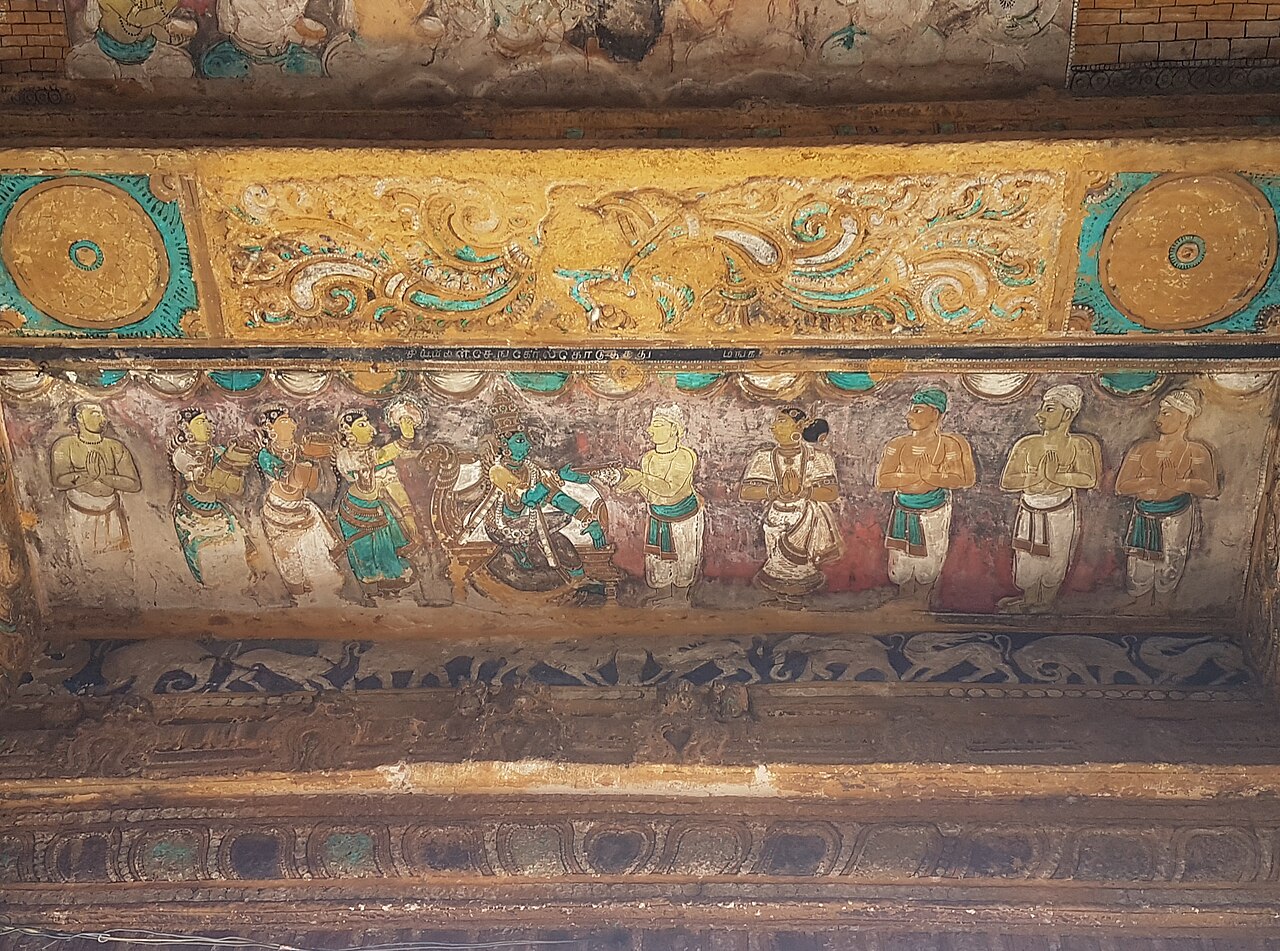
Painted ceiling medallion in a corridor of the Meenakshi Amman Temple, MaduraiCarved pillars of the Thousand Pillar Hall in the Meenakshi Amman Temple, Madurai
Inside the painted corridors of the temple · photos CC BY 2.0 Richard Mortel, Wikimedia Commons
The wedding a whole city keeps
Chithirai and the Meenakshi Tirukalyanam
For about fifteen days in the Tamil month of Chithirai, April into May, Madurai re-celebrates the marriage Of Maa Meenakshi To Lord Sundareswarar. The Meenakshi Tirukalyanam, the wedding rite itself, draws enormous crowds, and the days around it bring the Ther Thiruvizha, when the great Temple chariots are hauled through the outer streets, and the Theppa Thiruvizha float festival. In 2027 the Tirukalyanam falls on Sunday 18 April; the Temple publishes the day-by-day festival schedule nearer the month.
Rooms in Madurai fill well ahead of the wedding days; book early and expect darshan queues to lengthen through the festival.
Plan your visit
By air
Madurai Airport (IXM) is about 12 km from the Temple, roughly half an hour by taxi.
By rail
Madurai Junction is about 2 km away: minutes by auto, or a walk through the old town.
Timings
Open 5:00 am to 12:30 pm and 4:00 to 10:00 pm daily; hours can shift on festival days.
Best time
The first quiet hours after the 5 am opening, or 9:30 pm for the Palliyarai procession that closes the night.
Dress
Cover shoulders and knees; traditional wear is welcomed and shorts are turned away at the gate.
At the gate
Phones, cameras and footwear are not allowed inside; deposit counters stand at the entrances.
Entry
Darshan is free for all; special entry costs ₹50 for one shrine or ₹100 for both and shortens the queue.
The name Maa Meenakshi joins meen, fish, with akshi, eye: The Fish-Eyed One, whose unblinking gaze never leaves Her city.
The Temple runs six poojas every day, from the Thiruvananthal at 5:30 am to the Palliyarai at 9:30 pm, each with sacred bath, decoration, food offering and lamps.
Non-Hindu visitors are welcome through the corridors, halls, gopurams and tank, but entry into the two sanctums Of Maa Meenakshi and Lord Sundareswarar is reserved for Hindus.
The Hall of Thousand Pillars actually counts 985 carved pillars; the name rounds up and nobody has ever minded.
Questions pilgrims ask
Is this a Temple of Lord Shiva or of The Goddess?
Both Live here, but Maa Meenakshi Is the primary deity: the Temple bears Her name, and pilgrims traditionally take Her darshan before Lord Sundareswarar's.
Can non-Hindus go inside?
Yes, into the complex: the corridors, the Thousand Pillar Hall, the gopurams and the Golden Lotus tank are open to everyone. The two inner sanctums are open to Hindus only.
Can I take my phone or camera in?
No. Phones, cameras and other electronics are banned inside the Temple, and footwear too; deposit counters at the entrances hold them while you visit.
What is the Palliyarai pooja?
The Temple's last act each night, 9:30 to 10 pm: the foot images of Lord Sundareswarar Are Carried in a palanquin from his shrine To The bedchamber Of Maa Meenakshi, so The Divine Couple Rest together until the Temple wakes them at dawn.
When should I plan for the Chithirai festival?
The festival fills the Tamil month of Chithirai, mid-April to mid-May. In 2027 the Meenakshi Tirukalyanam wedding day falls on Sunday 18 April; confirm the Temple's published schedule before booking, since dates follow the Tamil calendar and are announced closer to the festival.
Dharamshalas and guest houses near this Sthan, shared by devotees. Adisthan takes no bookings and no money; contact each stay directly.
No stays are listed here yet. Know one that serves pilgrims well?
Are you a priest, trustee or staff member of the Arulmigu Meenakshi Sundareswarar Temple? Claim this page to keep timings, pooja schedules and festival dates true for the pilgrims who rely on them.