A king begged his heirs never to destroy what he had raised for Lord Shiva; a war did, almost, but enough still stands to keep the asking true.
Be the first to check in
Coming up: Vietnam Cultural Heritage Day · 23 NovEntry tended 24 May 2026
Open 6 am to 5 pm daily Cham brick kalans · 4th to 13th c. Lord Shiva as Bhadreshvara 150,000 VND foreign · 100,000 domestic Cham dance · four shows daily Vietnam Heritage Day · 23 Nov 2026
The road narrows to a dirt track and the jungle closes in, cicadas louder than any voice, before the first brick tower breaks through the canopy, red and green and leaning, half held by the roots that also threaten to pull it down. There is no incense here, no bell, no queue of pilgrims waiting their turn. Only heat, birdsong, and more than seventy brick shrines a Hindu kingdom raised across nine centuries to Lord Shiva under a name of his own, Bhadreshvara. Mỹ Sơn does not perform devotion anymore. It keeps the evidence of it.
The foremost Shaiva sanctuary Champa ever built: more than seventy brick towers and shrines raised across nine centuries by a long line of Cham kings, in religious use for longer than almost any other Hindu site in Southeast Asia.
Built entirely of fired brick, carved directly into the finished wall rather than pre-cut, by a bonding technique no scientist has fully explained; no mortar has ever been identified in the joints.
A cosmology built into the land itself: the ring of mountains read as Lord Shiva, the valley as Maa Parvati, and the stream threading between them carrying the name of the sacred Ganga.
A king's plea, a war, and what returned
An inscription names King Bhadravarman, who reigned from about 380 to 413 CE, as the one who first raised a hall here to hold a linga of Lord Shiva, whom he named Bhadreshvara, joining his own royal name to ishvara, Lord. Bhadravarman asked his successors, in words still legible on the stone, to protect rather than destroy what he had given. For a while they listened. That first wooden shrine burned in a fire in 535 to 536 CE, and King Sambhuvarman rebuilt it in brick, reinstalling the god as Sambhu-Bhadreshvara, the creator of the world and the destroyer of sin.
Building never really stopped. Prakasadharma extended the sanctuary in the seventh century, Harivarman II and Harivarman IV added and renovated in the tenth and eleventh, and the last Cham inscription found on site, set under King Jaya Indravarman V, is dated 1243. As Champa's power ebbed and Vietnamese rule moved south along the coast, the valley slipped out of use and out of memory, until the French surveyor Camille Paris rediscovered it in 1898. Henri Parmentier's team spent 1903 and 1904 cataloguing 71 monuments across ten Temple groups he lettered A through K, skipping I and J, the same letters still used on every map of the site today.
The valley's twentieth century was harder. Mỹ Sơn sat inside a wartime base area, and for a week in August 1969 American B-52s carpet-bombed the site; more than fifty of its surviving structures were destroyed or badly damaged, among them the great tower A1, once the tallest and most accomplished building at Mỹ Sơn, left as little more than a mound of broken brick. From 1981 a Polish-Vietnamese team led by the architect Kazimierz Kwiatkowski cleared the valley of vegetation and unexploded ordnance and began stabilising what remained, piecing towers back together from their own scattered brick rather than rebuilding them new. Italian- and Japanese-funded conservation followed in the early 2000s, UNESCO inscribed the whole valley as a World Heritage Site in 1999, and India's Archaeological Survey completed its own restoration of the A, H and K groups in December 2022. What stands today is a fraction of what Bhadravarman's line built. It is also, after a war that nearly finished what time and the jungle had started, still standing.
What you'll actually see
1
Groups B, C and D, the first cluster you meet
Just past the entrance stands Mỹ Sơn's densest surviving cluster, anchored by the kalan B1, the one main shrine at the site built of stone rather than brick. Around it, smaller towers and repository halls carry false doors, colonnettes, and the guardian carvings, lions, elephants, dancers, that once ringed every sanctuary in the valley.
2
The crater where tower A1 stood
Climb the low rise at the centre of the valley and you reach Group A, once the site's grandest, crowned by the A1 tower, twin-doored and reportedly some 24 to 28 metres tall, ringed by six smaller shrines. The 1969 bombing left it a field of broken brick and a crater still visible in the earth, the clearest single mark the war left on Mỹ Sơn.
3
Groups H and K, restored brick by brick
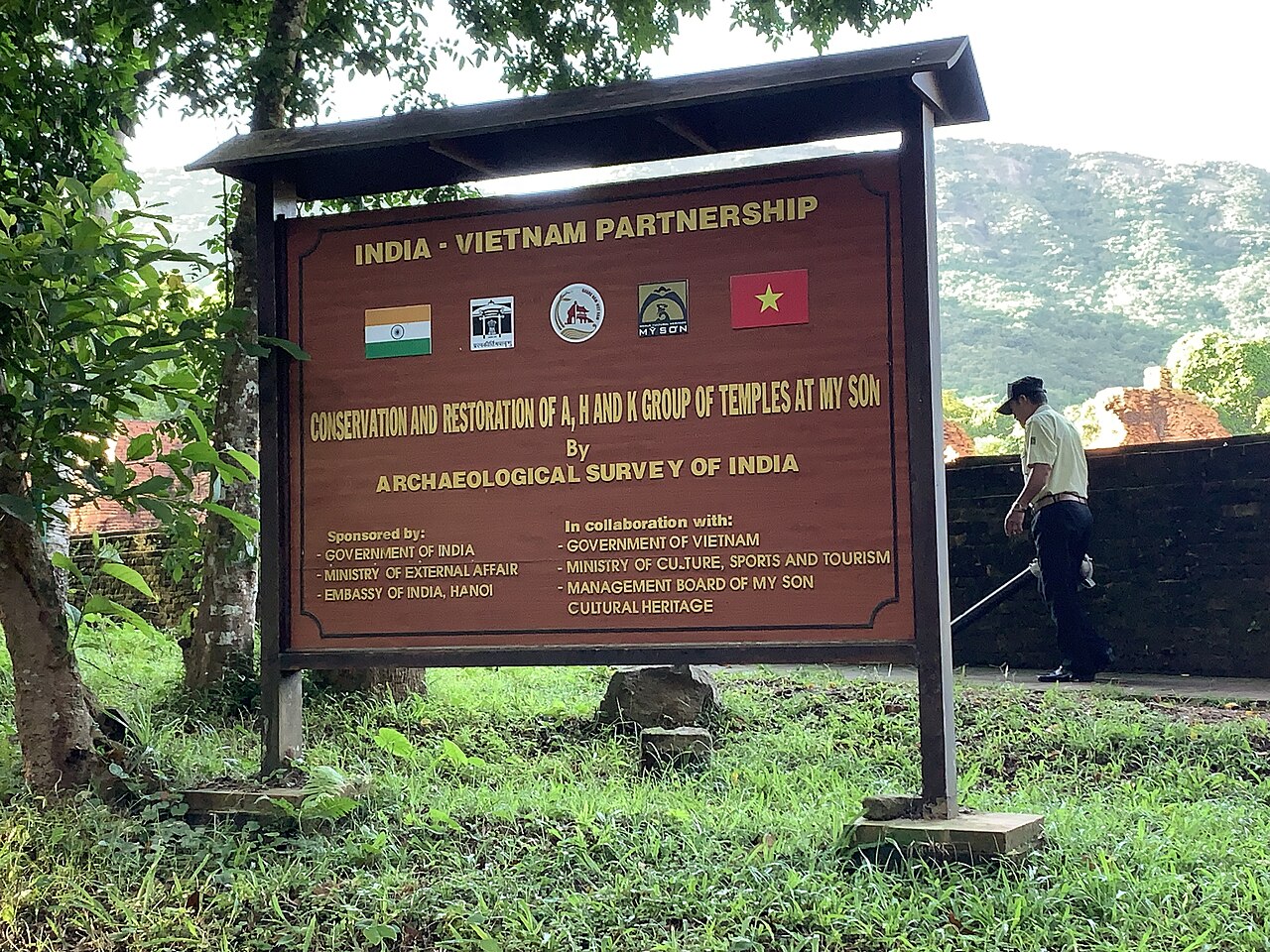
In the newer part of the visit stand the towers the Archaeological Survey of India rebuilt between 2017 and 2022, working alongside Vietnamese conservators to re-lay original brick and reset the carved sandstone pedestals, lingas, and yonis found scattered on the ground. A signboard beside them, in Vietnamese, English, and Hindi, records the partnership plainly.
A carved mukhalinga, a linga bearing the face of Lord Shiva, from Mỹ Sơn and now held in the site's own museumA signboard at Mỹ Sơn recording the India-Vietnam Partnership restoration of the A, H and K Temple groups
A mukhalinga in the site museum, and the India-Vietnam restoration signboard for Groups A, H and K · photos CC0 Gary Todd and CC BY 4.0 Chainwit., Wikimedia Commons
WHAT RETURNS TO THE RUINS EACH DAY
The Cham heritage dance, performed live among the towers
This is not worship. Mỹ Sơn keeps no priests and holds no daily rite. But several times each day, Cham and local performers bring the Apsara, the Offering, the Fan, and the Water Jar dances back to the foot of the towers, danced to the Paranung drum and the Saranai trumpet, reviving a court repertoire the Champa kings themselves once kept. Shows run at the Performance House at 9:45 am, 10:30 am, 11:15 am, and 3:30 pm, and at the foot of Tower G at 9 am and 2:45 pm.
The performances are included in the entrance ticket, no extra charge; the 9 am Tower G show draws the smallest crowd and the best light for photographs.
Plan your visit
By air
Da Nang International Airport (DAD) is the nearest gateway, about 68 to 70 km away, roughly 1.5 to 2 hours by road.
By road
About 40 km southwest of Hoi An via provincial roads DT610 or DT609; most visitors come by organised tour or taxi from Hoi An or Da Nang.
Timings
Daily, 6 am to 5 pm.
Entry
150,000 VND for foreign visitors, 100,000 VND for Vietnamese nationals, including the on-site museum and the electric shuttle.
Getting to the towers
A free electric car covers the 2 km between the entrance gate and the Temple groups; the paths beyond are dirt and gravel, uneven in places, not wheelchair friendly.
Best time
Early morning, before the tour-bus window of roughly 10 am to 4 pm, or the last hour before closing.
Cham dance
Several shows daily: Performance House at 9:45 am, 10:30 am, 11:15 am, and 3:30 pm; foot of Tower G at 9 am and 2:45 pm; included in the entrance ticket.
The ten Temple groups still carry the letters the French archaeologist Henri Parmentier gave them in 1904, A through K, skipping I and J, so a marker reading E1 or B5 is dating from that first survey, not a modern sign.
Unexploded ordnance was still being cleared from the valley into the 1980s; keep to the marked paths rather than the shortcuts through the undergrowth.
Vietnam's 2025 province merger folded Quảng Nam into an expanded Da Nang, so Mỹ Sơn now sits administratively in Da Nang city and Thu Bồn commune, even though most maps and tour listings still say Quảng Nam.
The Cham community's own living festival, Katê, is kept today at the still-active towers of Ninh Thuận and Khánh Hòa provinces, not here; Mỹ Sơn's brick sanctuaries no longer receive that yearly worship.
Questions pilgrims ask
Is Mỹ Sơn still an active place of Hindu worship?
No. Mỹ Sơn is an archaeological park under Vietnamese state and UNESCO care, with no resident priests and no daily puja. Cham heritage dance is performed live at the site several times a day, but the towers themselves have not held regular worship for centuries. The Cham community's own living Hindu practice continues today at Temple towers such as Po Klong Garai and Po Nagar, further south.
What happened to Mỹ Sơn during the Vietnam War?
The valley lay inside a wartime base area, and in August 1969 a week of American B-52 bombing destroyed or badly damaged more than fifty of its surviving structures, including tower A1, once the site's tallest and most accomplished building. Restoration began in 1981, when a Polish-Vietnamese team first cleared the valley of vegetation and unexploded ordnance, and continues today with Vietnamese, Italian, and Indian conservation partners.
How much of the original site still stands?
Roughly twenty structures remain out of more than seventy recorded in the twentieth century; the rest were lost to time, reclaiming jungle, and the 1969 bombing. What survives is still enough to read the site's scale, and in Groups A, H, and K, to see what a completed restoration looks like.
What is a mukhalinga?
A linga, the aniconic form in which Lord Shiva is worshipped, carved with a human face turned toward the god himself. Mỹ Sơn's own examples, along with the yonis found among the towers, are now kept partly in the site's small museum and partly in place among the ruins.
Can I see the Katê festival at Mỹ Sơn?
Not at the ruins themselves. Katê is the Cham people's major yearly festival, held in early autumn at the living Cham towers of Ninh Thuận and Khánh Hòa provinces, several hours south. Mỹ Sơn's own towers stopped receiving that worship long ago.
Dharamshalas and guest houses near this Sthan, shared by devotees. Adisthan takes no bookings and no money; contact each stay directly.
No stays are listed here yet. Know one that serves pilgrims well?
Are you with Vietnam's Mỹ Sơn Cultural Heritage Management Board, or one of the conservation teams from Vietnam, Italy, or India keeping these towers standing? Claim this page to keep its hours, fees, and restoration story accurate for every visitor.