Darshan 6 am to 12, 5 to 10 pm Free · Special darshan up to ₹100 Arudra Darshan · 24 Dec 2026 Four Chola gopurams · 40 acres Six pujas daily, Dikshitar rite
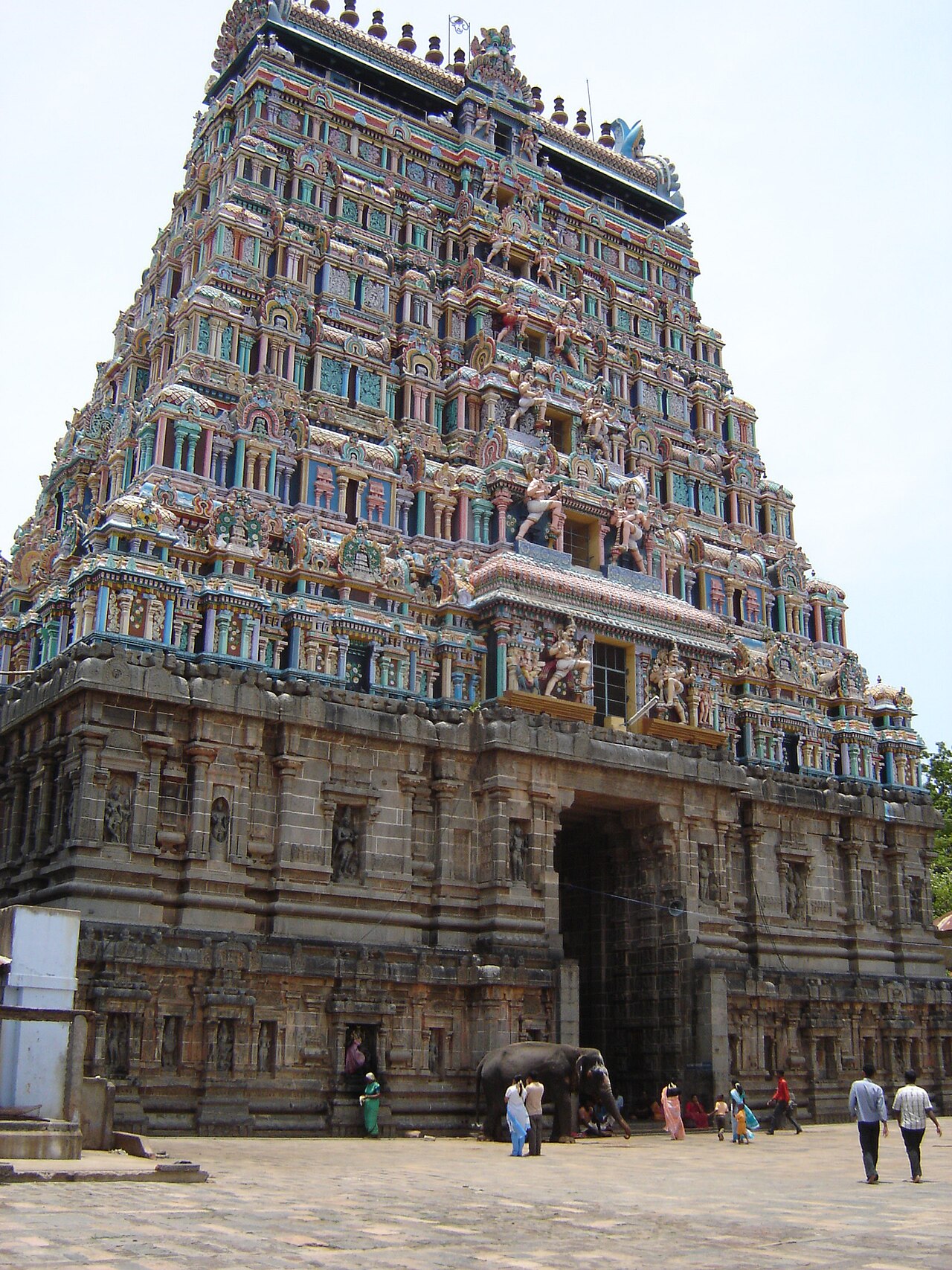
The four Car Streets circle the walls like a slow procession, and above each one a seven-storeyed gopuram lifts its painted crowds of gods a hundred and forty feet into the Tamil sky. Inside, courtyards of dark stone open one into another until a low roof of gold appears above the innermost hall. Camphor drifts. Bells announce one of the six daily pujas. In the sanctum ahead the Lord is not a lingam but a dancer caught mid-step, and beside Him hangs a curtain, and behind the curtain, nothing at all.
One of the five Pancha Bhoota Sthalams, the elemental shrines of the south: at Chidambaram Lord Shiva is worshipped as akasha, space itself, the subtlest of the five elements, held here not in a stone lingam but in the open air of the sanctum.
The Chidambara Rahasyam, the secret of Chidambaram: behind a curtain in the Chit Sabha hangs a garland of golden vilva leaves over empty space. When the Dikshitars draw the curtain aside at arati, devotees take darshan of the formless.
This is the home of the Ananda Tandava, Lord Nataraja's dance of bliss, and the east gopuram carries all 108 karanas of the Natya Shastra, each dance posture carved in its own niche. Bharatanatyam still reads its grammar from these walls.
The dance the sages asked to see
The old telling begins in the Thillai forest, a grove of mangrove trees by the Coleroon river. Two sages lived there in penance: Patanjali, the serpent-bodied master of yoga, and Vyaghrapada, given the feet of a tiger so he could climb for flowers before the bees woke. Both prayed for one thing, to see Lord Shiva dance. The Lord granted it here, in the little hall the tradition calls the Chit Sabha, the hall of consciousness, and the dance He danced was the Ananda Tandava, the cosmic dance of bliss that creates, sustains and dissolves the worlds in a single poised step.
Another telling remembers a contest. Maa Kali, who ruled the Thillai grove, matched the Lord step for step until He raised one leg straight to the sky in the Urdhva Tandava, a pose Her modesty declined. Yielding the grove, She moved to the northern edge of the town, where She Is Worshipped still as Maa Thillai Kali. The devotee who honours both shrines honours the whole story.
The Thevaram saints Appar and Sambandar sang this Temple in the seventh century, and for the Chola emperors Lord Nataraja became the family deity itself. Parantaka I roofed the sanctum in gold in the tenth century; the four great gopurams rose between about 1150 and 1300. Through it all, one hereditary community, the Podu Dikshitars, has kept the worship unbroken, a right the Supreme Court of India affirmed in January 2014 when it restored the Temple's administration to them.
What you'll actually see
1
The gopurams and the karana galleries
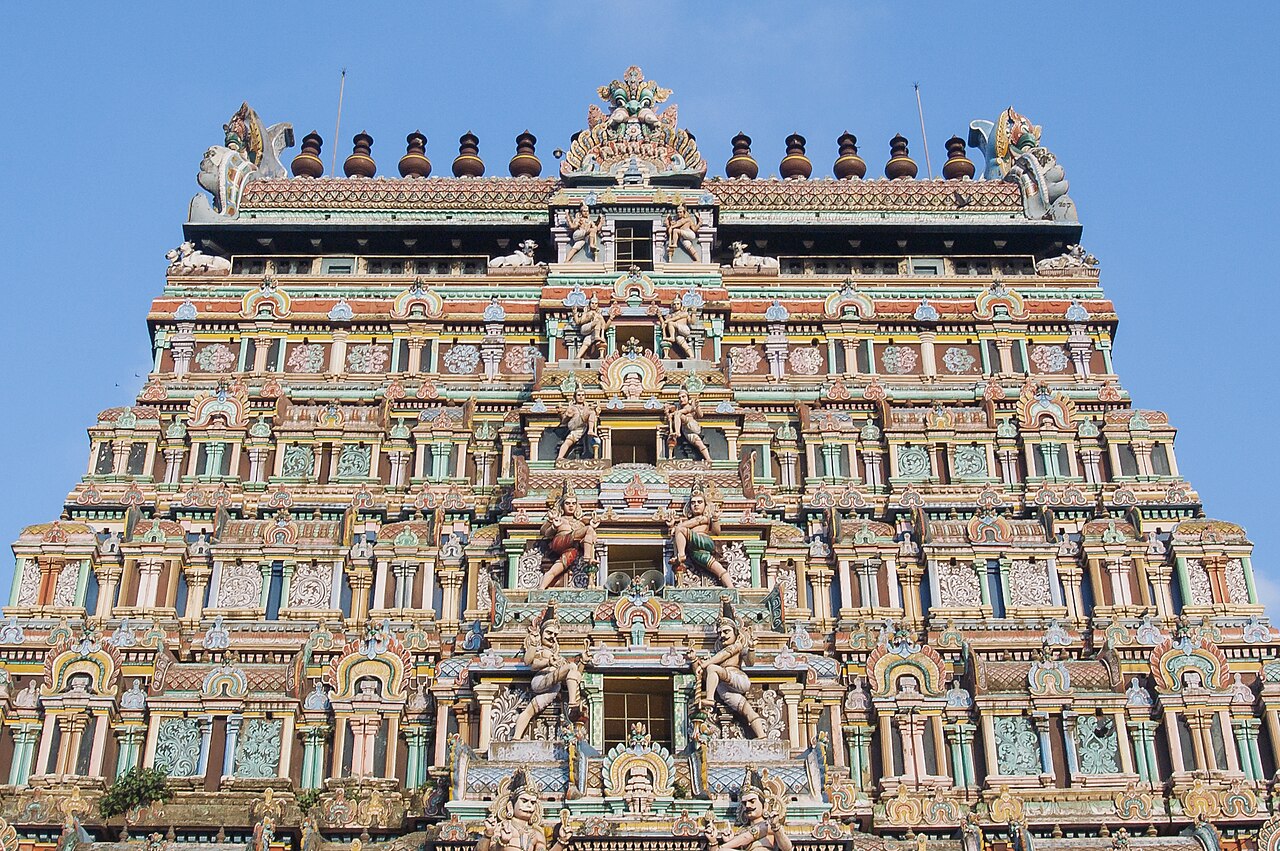
Each of the four gateway towers rises about 140 feet in seven storeys of painted stucco, raised between roughly 1150 and 1300. Walk the east gateway slowly: in the passage, 108 small reliefs, each about 22 centimetres in its own niche, spell out every karana of classical Indian dance.
2
The Chit Sabha and Kanaka Sabha
At the heart of the courtyards stand two joined wooden halls under roofs of gilded tiles, the innermost sanctum of the Temple. In the Chit Sabha Lord Nataraja dances in bronze beside the curtained space of the Rahasyam; in front of it, in the Kanaka Sabha, the Dikshitars perform the six daily pujas, bathing the spatika crystal lingam and the ruby Nataraja.
3
The Sivaganga tank and the Govindaraja shrine
In the third courtyard the Sivaganga tank drops away in stone steps, the gopurams doubling in its green water. Close to the sanctum stands the shrine of Lord Govindaraja Perumal, a reclining Vishnu sung by the Alvars as one of the 108 Divya Desams: two of Hinduism's great traditions worshipped under one roof.
Tiers of painted stucco deities on a gopuram of the Nataraja Temple, ChidambaramThe east gopuram of the Nataraja Temple with the Temple elephant and pilgrims at its gate
The painted tiers of a gopuram, and the east tower over the courtyard · photos CC BY-SA 4.0 Matthew T Rader and CC BY-SA 3.0 BishkekRocks, Wikimedia Commons
THE NIGHT THE COSMIC DANCE IS BATHED
Arudra Darshan · 24 December 2026
On the full-moon Thiruvathirai star of the Tamil month of Margazhi, the tradition keeps the birthday of Lord Nataraja's dance. Days of processions through the four Car Streets lead to the great morning: in the pre-dawn dark the Dikshitars perform the maha abhishekam, bathing the Lord of the dance in milk, curd, honey and sandal before vast crowds, and the Ananda Tandava is honoured at the very place tradition says it was first revealed. The next Arudra Darshan falls on Thursday, 24 December 2026.
The abhishekam draws the year's largest crowds; arrive the previous evening, expect the Car Streets full by night, and keep the day unhurried.
Plan your visit
By air
Puducherry Airport is about 65 km away; Tiruchirappalli International Airport, about 168 km, has wider connections; Chennai is about 232 km by road.
By rail
Chidambaram station (CDM) is about 2 km from the Temple, an auto ride of a few minutes, with trains on the Chennai to Thanjavur line.
Timings
6:00 am to 12:00 noon and 5:00 to 10:00 pm daily; six pujas from morning Kalasandhi to the 9 pm Ardhajama.
Best time
Early morning for quiet darshan, or 7:00 to 8:00 pm when the Rahasya curtain is drawn aside at the evening puja.
Entry
Free at all times; a special-darshan ticket, ₹50 to ₹100, shortens the line on busy days. All bookings are made in person at the Temple.
Dress
Modest, traditional dress; shoes are left at the gates and phones put away inside.
The queue
Ordinary days are unhurried, roughly 15 to 45 minutes; Arudra Darshan and festival evenings draw very large crowds.
Chidambaram is read as chit ambaram, the sky of consciousness; Tamil Shaivas simply call this shrine Koyil, The Temple, the way Srirangam is Koyil for Vaishnavas.
The worship here is threefold: the form of Lord Nataraja in bronze, the subtle form of the spatika crystal lingam bathed at every puja, and the formless space of the Rahasyam.
Photography is not permitted inside the inner Temple; the gopurams, courtyards and Sivaganga tank are photographed from the outer enclosures.
Maa Thillai Kali's own Temple stands at the northern edge of the town, and tradition invites the pilgrim To complete the darshan there.
Questions pilgrims ask
Is there a lingam in the sanctum?
Not as the main image. Chidambaram is the rare great Shiva Temple whose principal worship is the Lord's form, the bronze Nataraja in the Ananda Tandava, alongside the crystal lingam bathed daily and the open space behind the curtain. Form, subtle form and formless are all honoured here.
What exactly is the Chidambara Rahasyam?
Beside Lord Nataraja in the Chit Sabha hangs a curtain, and behind it there is no image at all, only a garland of golden vilva leaves over empty space. Tradition holds this as the truth the Temple exists to teach: the Lord as akasha, formless consciousness. The curtain is drawn aside during arati, most famously at the 7 pm puja.
Who are the Dikshitars?
A hereditary community of priests, the Podu Dikshitars or Thillai Muvayiravar, the Three Thousand of Thillai, who have served this Temple since before recorded memory as both priests and trustees. In January 2014 the Supreme Court of India upheld their right to administer the Temple, setting aside a government takeover.
Why is there a Vishnu shrine inside a Shiva Temple?
The shrine of Lord Govindaraja Perumal, a reclining form of Lord Vishnu, shares the innermost courtyard and is itself one of the 108 Divya Desams praised by the Alvar saints. Pilgrims of both traditions take darshan within the same walls, and the Temple presents both with equal honour.
When should I plan a visit?
December to March is the gentlest season. The Margazhi festival ending in Arudra Darshan, 24 December 2026, is the grandest sight of the year; the Natyanjali festival brings five nights of classical dance before Lord Nataraja, closing on Maha Shivaratri, 6 March 2027; Aani Thirumanjanam follows in high summer, next on 9 July 2027.
Dharamshalas and guest houses near this Sthan, shared by devotees. Adisthan takes no bookings and no money; contact each stay directly.
No stays are listed here yet. Know one that serves pilgrims well?
Are you a Dikshitar or officer of the Thillai Nataraja Temple? Claim this page to keep puja times, abhishekam days and festival schedules exact for the devotees who travel to see the Lord dance.